
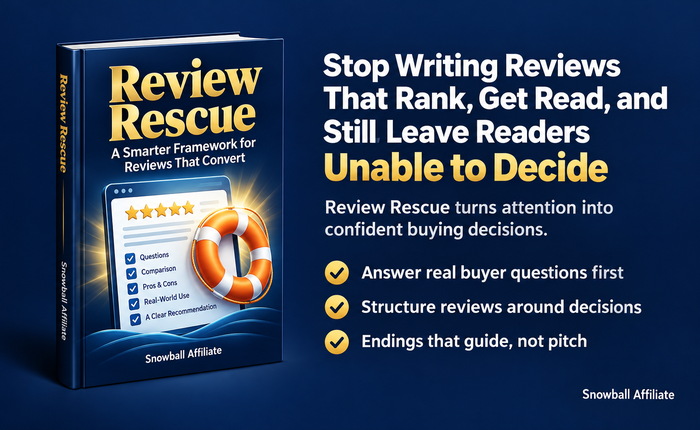
Review Rescue

Instructor
Nathan Conner
Reviews
Course Overview
Stop Writing Reviews That Rank, Get Read, and Still Leave Readers Unable to Decide
Your review ranks. Visitors show up, they scroll, and the time-on-page looks fine. Then they open three new tabs and search “[product] problems,” “[product] vs [competitor],” and “[product] Reddit,” or they leave a comment asking the one question your review should have answered: will it work for my situation? That’s the quiet failure behind a lot of affiliate content. The page is found and read, but it never helps anyone decide. Because the dashboard looks healthy, the problem is easy to miss and expensive to keep, since the page keeps earning attention it can’t turn into confident choices. Review Rescue is for the writer who has read their own review and thought, this is accurate, thorough, and somehow not very useful.
The reason it keeps happening isn’t a lack of effort or keywords. Most reviews are built from the product outward, starting with the spec sheet, the feature list, and the sales page, so they end up as a rewritten product page with a verdict box on top. Add the habit of copying whatever shape already ranks, and you get reviews that answer “What is it? What does it have? Should I buy it?” while the reader’s real doubts go untouched. Review Rescue shows you why readers can know every spec and still not know whether a product is right for them. It also gives you the working tools to close that decision gap: the Question Ledger, the evidence audit, criterion blocks, fit statements, and a swap test that shows in two minutes whether your review is describing a category or helping someone choose.
Inside, you’ll learn to replace generic feature summaries with the buyer questions, doubts, tradeoffs, and use cases people actually need resolved before purchasing. Features become proof for real answers, and “pros and cons” lists give way to honest tradeoffs and conditional answers. You’ll structure reviews around decision criteria that show exactly who the product fits, who should avoid it, and what alternatives deserve consideration, so readers can sort themselves instead of piecing together a verdict on their own. And you’ll build recommendation and call-to-action sections that make the reader’s next step obvious without turning the review into a sales pitch, with conditional verdicts, a next-step map for different reader states, and link text that would still hold up if you earned nothing from the click.
Review Rescue is a focused, practical guide to doing all of it in the right order. It includes a step-by-step sequence, a walk-through of one weak review rebuilt from start to finish, guidance on rescuing a review that already gets traffic without wrecking what works, and a pre-publish checklist you can reuse on every review after it. You won’t be left with theory about what good reviews look like. You’ll have a repeatable standard you can apply to the next review you publish or the one you’d be a little embarrassed to hand a skeptical buyer today. If you’re ready to turn reviews that get attention into reviews that help readers decide, get Review Rescue and start with the review that needs it most.