

First, Which Authorpreneur Academy Is This?
This review covers Dave Chesson’s Authorpreneur Academy from Kindlepreneur. It is not the different, same-named book-marketing product sold by Ashley Mansour. If you searched the name and landed on both, that’s the confusion I want to clear up before anything else. Everything below is about Chesson’s course.
Everything below is based on the official course page and the published curriculum — what the course covers, how it’s structured, and where that structure does and doesn’t line up with a nonfiction-only goal.
The question I’m answering is narrow. If you’re a first-time nonfiction author and you’ve found a broad, self-paced publishing course, does it fit what you’re trying to do? You can see the official page for yourself at academy.kindlepreneur.com . I have no affiliate relationship with Kindlepreneur, and nothing here is sponsored.
Table of Contents
Authorpreneur Academy at a Glance
Here are the verified basics from the sales page:
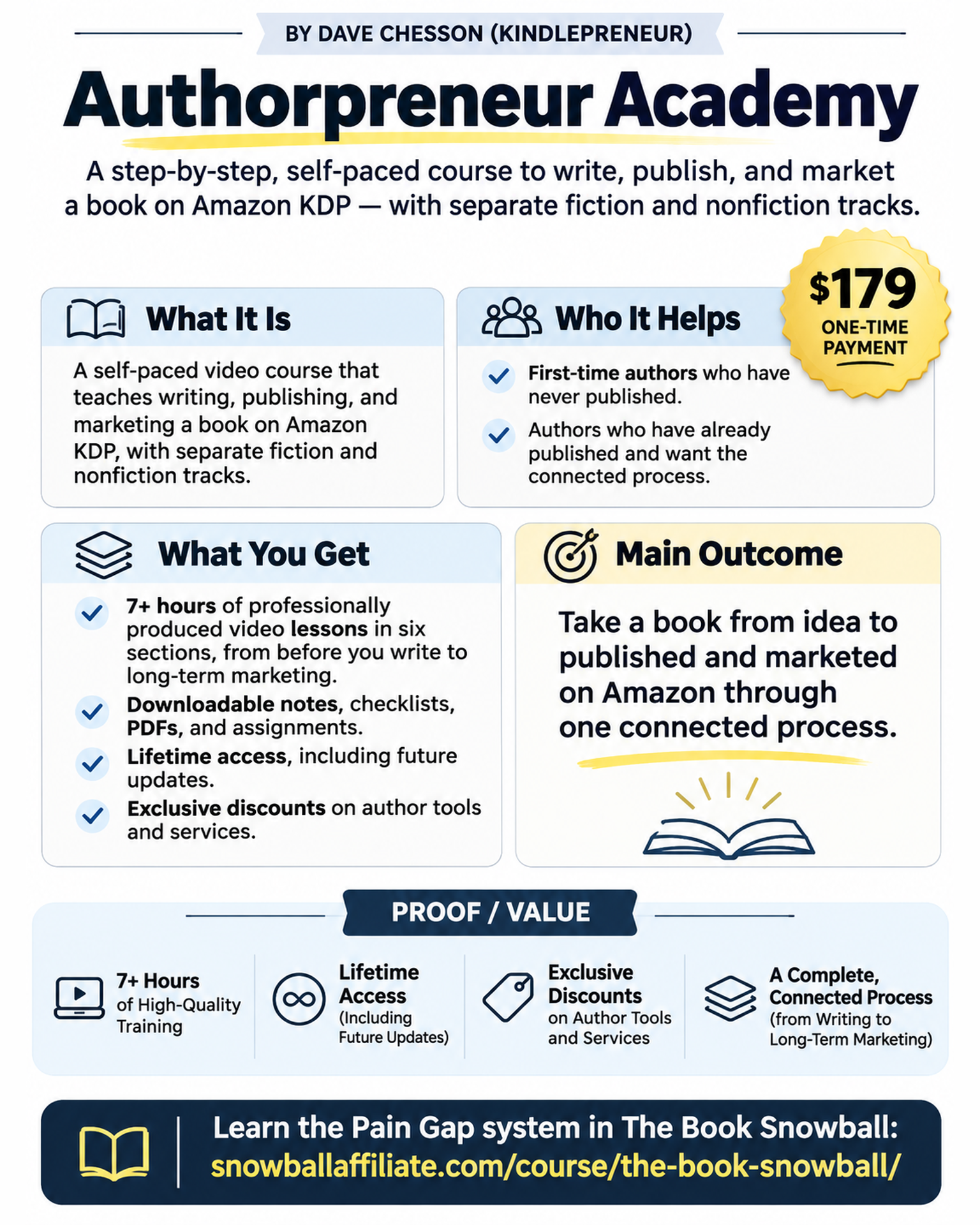
- Price: $179, one-time payment
- Format: Video course with 7+ hours of professionally produced lessons, all taught on screen by Dave Chesson
- Included materials: Downloadable notes, checklists, PDFs, and assignments
- Structure: Six sections, including separate fiction and nonfiction tracks
- Access: Lifetime access, including future updates and new lessons
- Extras: Exclusive discounts on author tools and services Chesson recommends
- Intended audience (per the vendor): First-time authors and already-published authors, writing fiction or nonfiction
One small discrepancy: the product description says 7+ hours of video, while the vendor’s own FAQ says “over 10 hours.” I’m going with 7+ throughout this review. If the longer figure is right, you’d simply be getting more than I’ve assumed.
What the Course Actually Covers
The six sections, including the separate fiction track
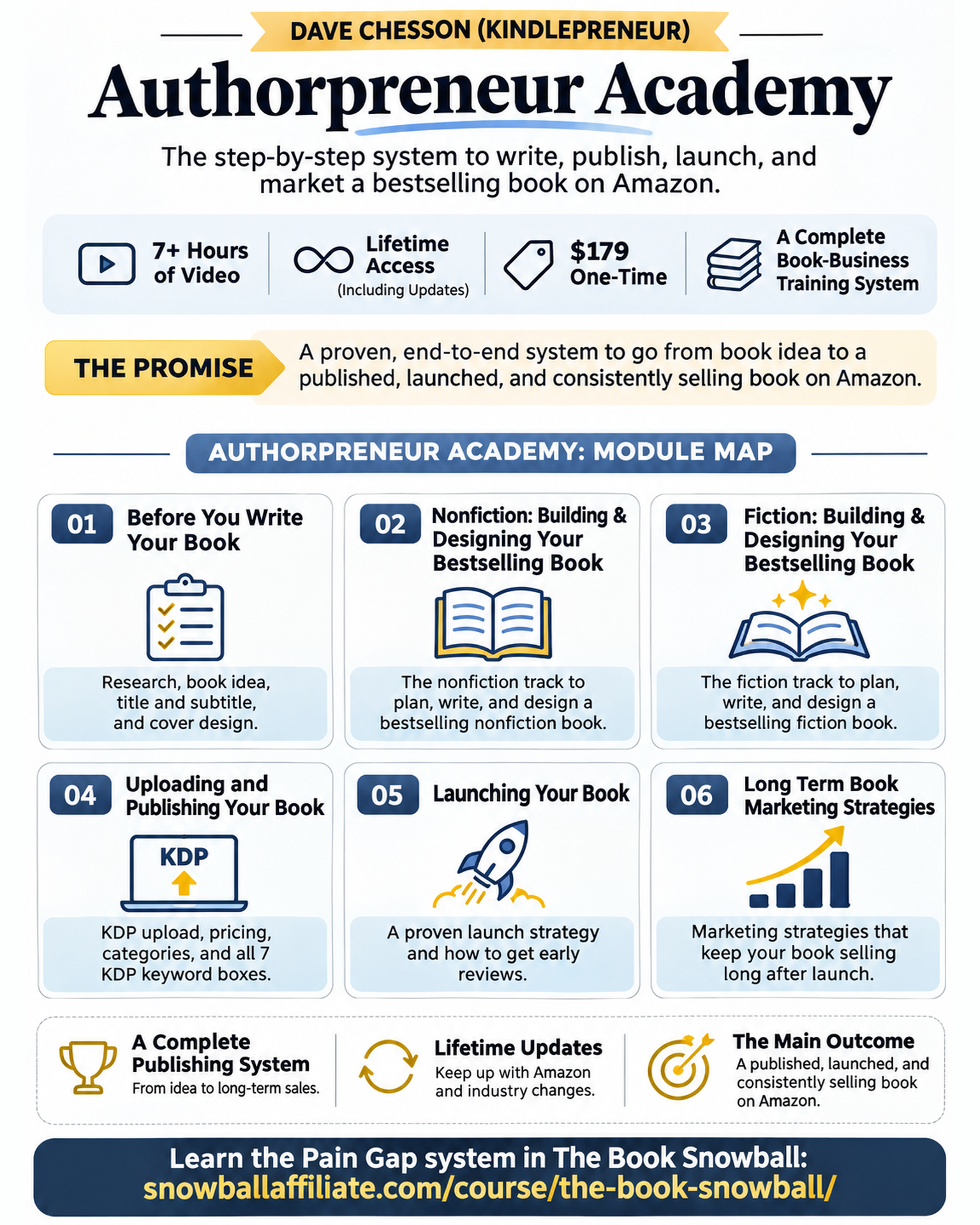
The course is organized into six sections:
- Before You Write Your Book. This is the groundwork section. I can’t see inside it, so I’m judging only from the title. It sits before the writing and design sections, which suggests it covers planning rather than production.
- Nonfiction: Building & Designing Your Bestselling Book. This is the track written for you if you’re a nonfiction author.
- Fiction: Building & Designing Your Bestselling Book. This is the parallel track for novelists. The course runs two separate tracks rather than blending the two, which is good for clarity.
- Uploading and Publishing Your Book. This is the mechanical heart of the course, and I break it down in the next subsection.
- Launching Your Book. This covers the launch itself, after publishing.
- Long Term Book Marketing Strategies. This covers what comes after launch.
The structure follows a book’s life in order: before you write, write and design, publish, launch, then market over the long term. For a beginner who doesn’t know what comes next, that’s a sensible layout. You can follow the sequence instead of piecing together advice from scattered videos.
The detail that matters most for you is that the fiction track is its own section. As a nonfiction author, you’d presumably skip section 3 entirely. The sales page doesn’t break down how many of the 7+ hours belong to each track, so I can’t tell you what share of the video is aimed at you. I’ll come back to that in the shortfalls section.
The KDP publishing section in detail (keywords, categories, Amazon page)
Section 4 is the most concretely described part of the course, and it’s the part that applies to both fiction and nonfiction authors. According to the sales page, it covers:
- Amazon Exclusive vs. Wide. This is the decision about whether to sell only on Amazon or distribute more broadly.
- Book pricing. How to think about setting a price.
- Constructing the Amazon page. Building the product page readers will see.
- Categories. Choosing where your book is placed.
- All 7 KDP keyword boxes. Filling in every keyword slot KDP offers.
- Uploading to KDP. The actual upload process.
If you’ve never published a book on Kindle Direct Publishing, this is the list of tasks that tends to feel opaque the first time. Keywords, categories, and the Amazon page are the pieces that affect whether a reader can find your book and decide to buy it. A first-timer would likely value having them walked through on screen.
One caveat is stated on the sales page itself. A few planned items in this section, editorial reviews and Author Central, are still marked “Coming Soon.” So the section isn’t fully complete as advertised. That isn’t unusual for a course with lifetime updates, and the sales page says future lessons are included. But if you’re buying specifically for Author Central help, you should know it isn’t there yet.
Who Authorpreneur Academy Fits Best
Based on the sales page and structure, I think the course fits these readers best:
A first-time author who needs the whole map. If you don’t yet know the difference between writing a book and publishing one, a course that runs from pre-writing through long-term marketing gives you the sequence. The vendor says it’s for first-time authors, and the six-section layout bears that out.
An author who wants the KDP mechanics shown, not described. Video lessons with a presenter on screen, plus checklists and assignments, suit people who learn better by watching and then doing than by reading a long guide.
Someone who might write in both worlds. If you’re a nonfiction author who might someday try fiction, or the reverse, you’d have access to both tracks at one price. This isn’t the situation I’d assume for most readers of this site, but it’s a real scenario where the broad structure is a plus.
An author who already has a topic and wants help with the publishing side. The course is built around producing and releasing a book. If the idea is settled and the question is “how do I get this onto Amazon properly,” the structure points straight at that.
The vendor also says the course is for already-published authors. I can’t judge how much an experienced author would gain from it, since I can’t see the lesson depth.
Where It Falls Short for a Nonfiction-Only Author
This is the part of the review I care most about, because your question is whether a broad course fits a narrow goal. Here are the friction points I see.
Part of what you pay for isn’t aimed at you. One of the six sections is explicitly fiction. The sales page doesn’t say how many of the 7+ hours that section takes up. I’d treat it as a section you won’t use, not necessarily a large one. But you’re paying one price for a course built to serve two audiences.
The course is a publishing course, not a list-building system. This is the biggest gap for many nonfiction authors. Section by section, the course is about writing, designing, publishing, launching, and marketing a book. It isn’t a system for turning readers into email subscribers, and it isn’t designed around that goal. If your plan is to use a book as the front end of a business, a newsletter, or a service, you’d need to find that part elsewhere. This isn’t a flaw in the course so much as a boundary of what it is.
Nothing on the sales page covers topic selection from reader problems. The first section is called “Before You Write Your Book,” which sounds like planning. But I can’t confirm from the sales page how it handles choosing what to write about, so I won’t claim either way. If choosing a topic is your biggest uncertainty, ask yourself whether you want to buy before you can see what that section teaches.
There are “Coming Soon” items. Editorial reviews and Author Central are marked as planned, not delivered. Lifetime updates should eventually fill that in, but “should eventually” isn’t a date.
The hours figure is inconsistent. 7+ in the description versus “over 10” in the FAQ. It’s minor, but when a vendor’s own pages disagree on a basic number, I’d rather note it than skip over it.
The sales page advertises no community or coaching. I’m not saying that’s a weakness for everyone, since plenty of people prefer self-paced video. But if you want feedback on your manuscript or a place to ask questions, the page doesn’t offer either one. Also, the sales page doesn’t state a refund or guarantee policy. I’m not saying there isn’t one, only that I couldn’t find it on the page. If that matters to your decision, confirm it with the vendor before you pay.
How the lessons teach is the open question. A course page shows structure, not depth or teaching style. That’s true of any course, and it’s the one thing a curriculum listing can’t settle for you.
What It Costs and What You Get
The price is $179, one time. There’s no subscription listed. For that you get:
- 7+ hours of professionally produced video, taught by Dave Chesson
- Downloadable notes, checklists, PDFs, and assignments
- Lifetime access, including future updates and new lessons
- Exclusive discounts on author tools and services Chesson recommends
If you take the 7-hour figure at face value, that works out to roughly $25 to $26 per hour of video. It would be less if the “over 10 hours” claim holds. I’m offering that only as a rough way to compare it against other courses. Hours of video say nothing about quality.
Whether $179 is a fair price depends on what you’d otherwise spend. If you’d be paying for hours of trial and error on KDP setup, categories, and keywords, a structured walkthrough has value. If you only need one or two of those pieces, it may be more course than you need. The sales page doesn’t advertise coaching or a community, so the price is for the video library and its materials.
The Alternative I Built: The Book Snowball
A fair contrast starts with what each product is. Authorpreneur Academy is a broad publishing course, split across fiction and nonfiction tracks. It is a publishing course, not a list-building system.
The Book Snowball is nonfiction-only. It has 9 modules built on two ideas:
- The Pain Gap method. Choosing a book topic by starting from reader problems people actually want solved.
- The List Bridge. Turning book readers into email subscribers.
The price is $47, a founding price.
These aren’t like-for-like products, and I’m not claiming one replaces the other. One is a broad publishing walkthrough for two kinds of authors. The other is narrow, built for nonfiction authors who want a book to lead to an email list. Which one fits depends on which problem you’re actually trying to solve.
Final Verdict — Who Should Buy It, Who Should Pass
Here’s where I come out, given what I could verify.
Buy Authorpreneur Academy if:
- You’re a first-time author and want the whole publishing sequence laid out in order, from pre-writing through long-term marketing.
- The KDP mechanics (Exclusive vs. Wide, pricing, the Amazon page, categories, all 7 keyword boxes, and the upload) are what you’re stuck on, and you’d rather watch them done than read about them.
- You’re comfortable with self-paced video and don’t need a community or coaching.
- You might write both fiction and nonfiction, so the separate tracks would both be useful.
Pass, or at least think twice, if:
- Your main goal is building an email list from your book. This is a publishing course, not a list-building system, so you’d need to look elsewhere for that.
- You want a nonfiction-only course and don’t want to pay for a fiction track you’ll skip.
- You need a refund policy, feedback, or community before you spend money. The sales page doesn’t state a refund policy or advertise coaching or a community.
- You specifically need Author Central or editorial review lessons today, since those are still marked “Coming Soon.”
I can’t promise any course will get a book published or sold, and this one doesn’t make that promise on the pages I reviewed. What I can say is that it’s a clearly structured, fairly priced option for the publishing side of a book, with a fiction track you won’t use. If that’s the problem you have, it’s a reasonable fit. If your problem is choosing the right topic or building a list from your readers, it was built for a different job.
Before you buy anything, read the official course page yourself and check the details I flagged against it, since vendors update their pages.