Deciding between high ticket vs low ticket affiliate marketing is the most critical strategic choice you will make when starting your journey toward a profitable and sustainable online business.
For many beginners, the initial excitement of launching an affiliate venture quickly turns into frustration. You might be spending hours creating content or managing social media, only to see commissions that amount to mere pocket change. This gap between your effort and your earnings is where most people quit, simply because they haven’t aligned their strategy with their financial goals. Understanding the mechanics of these two distinct models is the key to ensuring your time translates into meaningful revenue.
At its core, the choice determines how you will allocate your most precious resource: your time. While one path relies on the sheer volume of transactions, the other focuses on the depth of value provided per sale. Both have a place in the digital economy, but for a newcomer, choosing the wrong one can lead to burnout before you ever gain real momentum.
Understanding the Low Ticket Affiliate Marketing Model
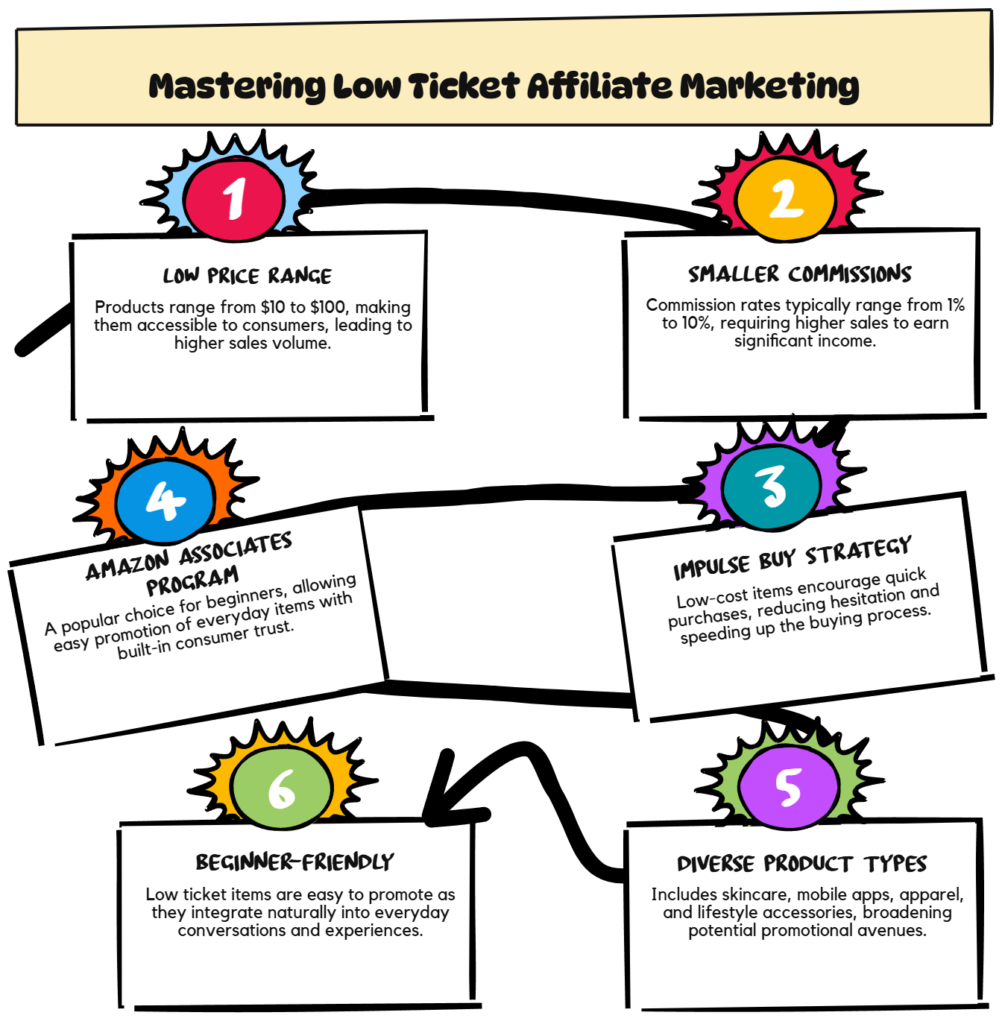
To navigate the choice between high ticket vs low ticket affiliate marketing, you must first understand the mechanics of the volume-based model. Low ticket affiliate marketing involves promoting products that typically retail for anywhere from $10 to $100. Because the price point is low, the commissions are usually smaller—often ranging from 1% to 10% for physical goods, or slightly higher for digital downloads.
The primary driver of this model is the “impulse buy.” When a product is inexpensive, the consumer requires very little convincing to make a purchase. There is less friction in the sales process because the financial risk to the buyer is minimal.
Common Examples of Low Ticket Products
The most recognizable example of this model is the Amazon Associates program. When you recommend a book, a kitchen gadget, or a pair of headphones, you are engaging in low ticket marketing. Other examples include:
Budget-friendly skincare products.
Basic mobile apps or low-cost software subscriptions.
Physical apparel and lifestyle accessories.
Why Accessibility Makes This a Popular Starting Point
Most beginners gravitate toward low ticket offers because they are easy to talk about. You are likely already using these products in your daily life, making the “pitch” feel natural and conversational. Furthermore, established brands like Amazon or Walmart carry immense consumer trust. You don’t have to “sell” the platform; you only have to point the way to the product. This low barrier to entry allows newcomers to practice the basics of link placement and content creation without the pressure of high-stakes sales psychology.
The Reality of the Volume Game
While the accessibility of low-cost products is appealing, it introduces a significant mathematical challenge. To generate a full-time income, you must master the art of driving massive amounts of traffic. If you earn a $5 commission per sale, reaching a goal of $5,000 per month requires 1,000 sales. Even with a healthy 2% conversion rate, you would need 50,000 targeted visitors to your content every single month.
This volume-heavy approach is a defining characteristic of the “low ticket” side of the high ticket vs low ticket affiliate marketing spectrum.
The Trade-off Between Sales Ease and Income Scale
The “win” comes more frequently in this model. Seeing daily notifications of small commissions can provide a powerful psychological boost for a beginner. However, the effort required to maintain that volume is relentless. You are often at the mercy of platform algorithms; if a search engine update or a social media shift reduces your traffic, your income can drop significantly overnight because your margins are so thin.
For those who excel at creating viral content or have a knack for SEO in high-demand niches, this model can be lucrative. But for most, the low-margin nature of these sales means you are working harder for every dollar earned compared to higher-value alternatives. It essentially turns your business into a numbers game where you are constantly chasing new eyeballs to sustain your revenue.
Defining High Ticket Affiliate Marketing
To understand the other side of the high ticket vs low ticket affiliate marketing equation, you must look beyond physical goods and impulse buys. High ticket affiliate marketing focuses on promoting premium products or services that offer substantial value and, consequently, carry a higher price tag.
In this model, the goal isn’t to rack up hundreds of small transactions. Instead, you focus on a few high-value conversions that can significantly impact your bottom line. While a low ticket sale might net you enough for a cup of coffee, a single high ticket commission can often cover a month’s rent or more.
What Qualifies as “High Ticket”?
Generally, a high ticket offer is any product that pays a commission of $500 or more per sale. In many cases, these commissions can reach into the thousands. These products are usually digital or service-based because these industries allow for higher profit margins.
Examples include:
Enterprise Software (SaaS): High-end tools for CRM, automation, or specialized data analysis.
Comprehensive Online Programs: In-depth certification courses or business-building workshops.
Masterminds and Coaching: High-level consulting or group mentorship programs.
Luxury Travel or Financial Services: High-end boutique experiences or specialized investment platforms.
The Shift from Quantity to Quality in Lead Generation
When you move into high ticket territory, your marketing strategy undergoes a fundamental shift. You are no longer chasing massive traffic numbers; you are chasing the right people.
Because the buyer is making a larger financial commitment, they require more information, trust, and education before they click “buy.” This requires you to become a source of genuine authority. You aren’t just a “linker”; you are a bridge between a complex problem and a premium solution. This model rewards those who can communicate value clearly and build a relationship with their audience, rather than those who simply have the most followers.
What is high ticket affiliate marketing? High ticket affiliate marketing is a business model where affiliates promote premium products or services that result in large commissions, typically $500 to $1,000+ per sale. Unlike low ticket models that require high volume, high ticket marketing focuses on targeted traffic and high-value conversions.
The Precision Game: Advantages of High Ticket Offers
When evaluating high ticket vs low ticket affiliate marketing, the most significant advantage of the premium model is the math of efficiency. High ticket marketing allows you to decouple your income from massive traffic spikes. Instead of needing to reach the “masses,” you only need to reach a small, specific group of people who are actively seeking a solution to a high-stakes problem.
This shift from a volume-based approach to a precision-based approach changes the way you work on a daily basis. You stop worrying about “going viral” and start focusing on the quality of the information you provide.
Lower Traffic Requirements for Higher Revenue
For a beginner, the biggest hurdle is often generating traffic. It takes time to build an audience of tens of thousands. However, it is much more feasible to find 10 or 20 highly interested individuals.
If your goal is to earn $3,000 a month, the high ticket model provides a much clearer path:
Low Ticket: 600 sales at a $5 commission.
High Ticket: 3 sales at a $1,000 commission.
The latter requires significantly less infrastructure and fewer visitors. This makes high ticket marketing particularly attractive for those who prefer to focus on deep, helpful content rather than managing the complexities of high-volume ad campaigns or massive social media accounts.
Building Deeper Relationships with a Smaller Audience
High ticket offers usually solve “bleeding neck” problems—urgent needs that the customer is willing to invest in to resolve. Because the price point is higher, the buyer’s journey is longer. This gives you the opportunity to build real authority.
Instead of being a nameless person behind a “Buy Now” button, you become a trusted advisor. You provide the clarity, comparisons, and insights that help the buyer feel confident in their investment. This relationship-heavy approach creates a more stable business; satisfied customers who bought a high-value solution through your recommendation are far more likely to return to you for future advice. It transforms affiliate marketing from a series of one-off transactions into a professional brand.
High Ticket vs Low Ticket Affiliate Marketing: Key Differences Compared
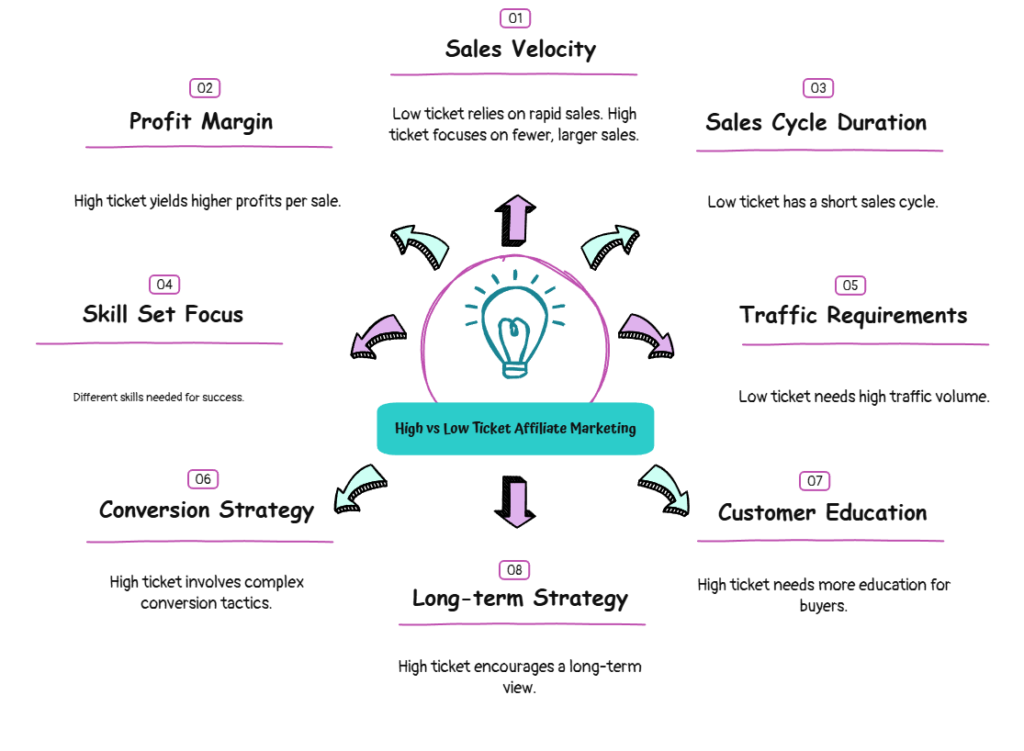
To choose the right path, you must look at how high ticket vs low ticket affiliate marketing models perform across different business metrics. While the ultimate goal of both is to generate commissions, the day-to-day operations and the skills required to succeed in each are vastly different.
Understanding these differences helps you set realistic expectations for your first six months in the industry.
Sales Velocity vs. Profit Margin
The most immediate difference is how often you see a “win.” Low ticket marketing relies on high sales velocity—making many sales quickly. Because the price is low, people buy on impulse, leading to frequent notifications of small commissions.
In contrast, high ticket marketing has a much lower sales velocity but significantly higher profit margins. You might go days or even weeks without a sale, but when one occurs, the financial impact is equivalent to hundreds of low ticket transactions. This requires a different level of patience and financial planning.
The Complexity of the Sales Cycle
The “sales cycle” is the time it takes for a person to go from discovering a product to buying it.
Low Ticket: The cycle is often minutes. A user sees a recommendation for a $20 kitchen tool, clicks the link, and buys it immediately. Your job is simply to provide the link at the right moment.
High Ticket: The cycle can last weeks or even months. A buyer considering a $2,000 software suite will read reviews, watch tutorials, and perhaps even speak with a representative. Your role here is more involved; you must provide ongoing value and education to keep them moving through the funnel.
Skill Set Requirements
Low ticket marketing rewards those who are excellent at “top-of-funnel” activities: SEO, social media reach, and eye-catching visuals. You need to be a master of attention.
High ticket marketing rewards those who excel at “middle-of-funnel” activities: copywriting, email marketing, and building trust. You need to be a master of intention and persuasion.
What is the main difference between high ticket and low ticket affiliate marketing? The main difference lies in the balance between traffic volume and commission value. Low ticket affiliate marketing requires high traffic to generate significant income through small commissions on inexpensive items. High ticket affiliate marketing requires less traffic but higher conversion skills to earn large commissions on premium products.
Which Model Should a Beginner Choose?
Choosing between high ticket vs low ticket affiliate marketing often feels like a choice between “easy” and “profitable.” However, the right path depends entirely on your current resources, your temperament, and how quickly you need to see a return on your time investment. There is no universal “best” option, but there is a best option for your specific situation.
For most beginners, the decision comes down to a trade-off between the frequency of success and the scale of the reward.
When to Start with Low Ticket Offers
If you are completely new to the digital space and have never built a website or run a social media campaign, starting with low ticket offers can serve as a valuable “training ground.”
You should consider this path if:
You need immediate proof of concept: Seeing those first few dollars—even if they are small—can provide the motivation needed to keep going.
You have a knack for content volume: If you enjoy creating a lot of content, such as product reviews, gift guides, or “best of” lists, the low ticket model fits your workflow.
You want to leverage established trust: Promoting well-known brands allows you to piggyback on their existing reputation, making the initial sale much easier to close.
When to Start with High Ticket Offers
If you already possess a specific skill set or deep knowledge in a particular niche—such as finance, technology, or business growth—skipping the low ticket phase may be the smarter move.
The high ticket model is likely for you if:
You have limited time for content creation: If you can only dedicate a few hours a week to your business, it is more efficient to spend that time creating one high-value piece of content that could lead to a $1,000 commission than 50 pieces of content for $5 commissions.
You prefer a “consultative” approach: If you enjoy teaching, solving complex problems, and diving deep into how a product works, you will find high ticket marketing much more rewarding.
You want to reach your income goals faster: It is often easier to find 5 people to buy a premium solution than it is to find 500 people to buy a budget one.
The Decision Matrix
To help clarify your direction, ask yourself: Am I better at getting a lot of people to pay attention, or am I better at getting a few people to take action?
If you are a master of attention, low ticket volume will work in your favor. If you are a master of intention and clarity, high ticket precision will likely yield better results. Regardless of which path you choose, the goal is to build a foundation of trust with your audience. Without that trust, neither model will be sustainable in the long run.
Common Misconceptions About High Ticket Sales
One of the primary reasons beginners shy away from the premium model in the high ticket vs low ticket affiliate marketing debate is the intimidation factor. There is a persistent belief that selling expensive products requires a level of “salesmanship” that most newcomers don’t feel they possess. However, this fear is usually based on a misunderstanding of how high-value transactions actually work online.
Breaking down these misconceptions is essential to seeing the high ticket model for what it really is: a structured process of providing clarity.
“It’s 10x Harder to Sell a $1,000 Product”
The most common myth is that the difficulty of a sale scales linearly with the price. In reality, the effort required to sell a $1,000 solution is not ten times greater than the effort to sell a $100 product. While you do need to provide more information and build more trust, the process remains the same. The buyer of a high ticket item is simply more deliberate. Once you understand their specific pain points and how the product solves them, the price becomes a secondary factor to the value provided.
“I Need to Be an Expert to Promote High Ticket”
Many beginners believe they need a decade of experience or a massive personal brand to be successful with high-end offers. This isn’t true. You don’t need to be the world’s leading authority; you only need to be one step ahead of the person you are helping. By positioning yourself as a “curator of information” or a “transparent reviewer,” you provide value by doing the research and testing that the buyer doesn’t have time to do. Your value lies in your ability to simplify their decision-making process.
“High Ticket Requires a Large Team or Budget”
Because the commissions are large, people assume the operation must be complex. In truth, high ticket affiliate marketing often requires less infrastructure than low ticket models. You don’t need to manage a massive catalog of products, deal with hundreds of different affiliate links, or maintain a high-frequency posting schedule to stay relevant in an algorithm. A single, well-written guide or a helpful video can generate high ticket commissions for months or even years with very little maintenance.
The Hybrid Approach: Integrating Both Models for Long-Term Stability
While the debate of high ticket vs low ticket affiliate marketing often presents these models as mutually exclusive, the most resilient affiliate businesses use a hybrid approach. Relying solely on one model creates specific vulnerabilities: a low ticket business is fragile against traffic fluctuations, while a high ticket business can suffer from inconsistent cash flow during long sales cycles.
By strategically integrating both, you create a “full-funnel” ecosystem that captures immediate revenue while positioning yourself for significant backend commissions.
The Ascension Ladder Strategy
In a hybrid model, low ticket products act as an “entry point” to your brand. When a user purchases a $20 book or a $40 software trial through your recommendation, they are doing more than just generating a small commission; they are self-identifying as a buyer.
Once a user has successfully solved a small problem using your advice, their trust in your recommendations increases. This makes them significantly more likely to consider a high ticket solution later. You can visualize this as a ladder:
Step 1 (Low Ticket): An accessible, low-risk product that solves an immediate, specific problem.
Step 2 (Mid-Tier): A more comprehensive tool or resource that helps them implement the solution.
Step 3 (High Ticket): A premium program, coaching, or enterprise-level software that provides a complete transformation or scales their results.
Diversifying Your Income Streams
Using both models provides a balanced financial structure. The low ticket offers provide “bread and butter” income—consistent, predictable daily sales that cover your operational costs, such as hosting, email software, or advertising spend.
The high ticket offers provide the “growth capital.” These larger commissions allow you to reinvest in your business, hire help, or significantly increase your marketing reach. This diversification protects you from the “feast or famine” cycle often associated with high ticket marketing alone.
Practical Implementation of a Hybrid Model
To implement this without confusing your audience, focus on logical progression. Your content should address different stages of the buyer’s journey.
Top-of-Funnel Content: Create “How-to” guides or “Best Tools for Beginners” lists that feature low ticket, high-utility products. This attracts a wide audience and builds initial trust.
Bottom-of-Funnel Content: Create deep-dive case studies, webinars, or comprehensive comparisons of premium solutions. Target these toward the segment of your audience that has already seen success with the basic tools and is ready to level up.
By treating low ticket offers as the foundation and high ticket offers as the ceiling, you build a business that is both accessible to the masses and highly profitable at the top end.
How to Vet a High Ticket Affiliate Program
Once you decide to incorporate premium offers into your strategy, the selection process becomes your most critical task. In high ticket vs low ticket affiliate marketing, the stakes for a poor recommendation are significantly higher. If you recommend a $15 book that underdelivers, you lose a small amount of trust. If you recommend a $2,000 software suite that fails to work, you lose a client for life.
Vetting a program requires looking past the commission percentage and evaluating the infrastructure behind the offer.
1. Evaluate the Tracking and Cookie Duration
Because the sales cycle for a high ticket item is longer—often spanning several weeks—the “cookie duration” is vital. A 24-hour cookie (common in low ticket retail) is virtually useless for high ticket offers. Look for programs that offer:
Long-form cookies: 60, 90, or even 365 days.
Lead-tracking attribution: Programs that “lock” a lead to your affiliate ID the moment they sign up for a webinar or download a whitepaper, regardless of when they eventually buy.
2. Analyze the Vendor’s Sales Funnel
In high ticket marketing, your job is to generate the lead, but the vendor’s job is to close the sale. Before signing up, go through their funnel yourself.
Is the landing page professional?
Is the email follow-up sequence persuasive without being aggressive?
Do they offer live demos or webinars? A high ticket product with a poor sales process is a waste of your traffic. You want to partner with companies that have a proven “middle-of-funnel” system that converts the leads you send.
3. Assess Product Reputation and Refund Rates
High commissions are irrelevant if the refund rate is 30%. High ticket buyers are often more demanding; they expect a level of support and quality that matches the price.
Research third-party reviews: Look for genuine feedback on platforms like G2, Capterra, or Trustpilot.
Test the support: Send a technical question to the vendor’s support team. If they take three days to respond to a pre-sales question, they will likely fail your referred customers.
4. Transparency in Commission Structure
A quality high ticket program should be transparent about how you get paid. Look for:
Tiered commissions: Some programs increase your percentage as you hit certain sales milestones.
Recurring potential: Some high ticket SaaS products pay a high upfront fee followed by a monthly recurring commission. This is the “gold standard” of affiliate marketing.
Clarity on “clawbacks”: Understand the policy regarding refunds. Most programs will withhold commission for 30–60 days to ensure the sale is final, which is a standard industry practice you should account for in your cash flow.
Key Vetting Question: “If I weren’t an affiliate, would I still recommend this product to a friend or colleague?” If the answer is no, the commission size is irrelevant; the offer will eventually damage your brand authority.
Content Strategies: Tailoring Your Message to the Price Point
Success in the high ticket vs low ticket affiliate marketing landscape requires more than just picking a product; it requires a content strategy that aligns with the buyer’s psychological state. A person buying a $15 gadget is looking for convenience and quick validation. A person investing $5,000 in a business mastermind or enterprise software is looking for risk mitigation and a return on investment (ROI).
To convert traffic into commissions, your content must match the weight of the decision the consumer is making.
Low Ticket Strategy: The “High-Volume Utility” Framework
For low ticket offers, the goal is to capture high-intent search traffic and provide a quick path to purchase. Because the financial risk to the buyer is low, the content does not need to be exhaustive. It needs to be useful and accessible.
“Best Of” Lists: These are the backbone of low ticket affiliate marketing. Articles like “Top 10 Budget Microphones for Podcasting” or “5 Must-Have Kitchen Gadgets for 2024” work because they aggregate options for a buyer who is already in the “shopping” mindset.
Comparison Tables: Use structured data and clear visuals to show specs, pros, and cons. The buyer wants to see that they are getting the best value for their money quickly.
Speed to Information: In this model, brevity is an asset. Don’t bury the recommendation under 2,000 words of backstory. Give the answer early and back it up with concise data.
High Ticket Strategy: The “Authority-Led Education” Framework
High ticket content requires a shift from “recommending” to “consulting.” You are no longer just a source of links; you are a source of clarity. Your content must answer the unasked questions and address the deep-seated objections that prevent a high-value sale.
Deep-Dive Comparisons: Move beyond basic specs. Instead of comparing features, compare outcomes. For example, “Platform A vs. Platform B: Which Scales Better for a 7-Figure Agency?” This targets a specific, high-value demographic.
Case Studies and Proof of Concept: High ticket buyers need evidence. Content that shows exactly how a product solved a complex problem—complete with data, timelines, and specific results—is the most effective way to drive conversions.
Video Walkthroughs and “Behind the Scenes”: Transparency reduces perceived risk. Showing the inside of a premium course or the dashboard of an expensive software suite helps the buyer “own” the product in their mind before they click the buy button.
Aligning Search Intent with Price
Understanding the “search intent” is where many affiliates fail.
Low Ticket Intent: Usually “Transactional.” The user knows what they want; they just need to know which one is best.
High Ticket Intent: Often “Informational” or “Commercial Investigation.” The user has a problem but isn’t sure which category of solution is right for them. They need education before they are ready for a recommendation.
By tailoring your content depth to the price point, you ensure that you aren’t over-explaining a simple purchase or under-serving a complex one.
Traffic Acquisition: Matching Channels to Your Margin
The final piece of the high ticket vs low ticket affiliate marketing puzzle is understanding how to drive traffic. Your choice of product dictates your traffic strategy because the “unit economics”—the cost and effort required to acquire a single customer—must align with the eventual payout.
If your commission is $5, you cannot afford to spend $10 on advertising to get a click. Conversely, if your commission is $1,000, you have the financial “breathing room” to invest in more expensive, high-precision traffic sources.
High-Volume Channels for Low Ticket Growth
Low ticket offers thrive on volume. Because the conversion rate is typically higher (due to the low barrier to entry), your goal is to get your recommendation in front of as many eyes as possible.
Long-Tail SEO: Focus on specific, high-intent keywords like “best waterproof running shoes under $100” or “affordable home office chairs.” These keywords have lower competition and attract users ready to make a quick purchase.
Social Commerce and Short-Form Video: Platforms like TikTok, Instagram Reels, and Pinterest are ideal for low ticket items. These platforms favor visual appeal and impulse buys. A 30-second demonstration of a clever gadget can drive thousands of clicks in a short window.
Niche Review Sites: Building a site dedicated to a specific category (e.g., camping gear or skincare) allows you to capture traffic across a wide range of low ticket products, creating a cumulative income stream.
High-Precision Channels for High Ticket Conversion
High ticket offers require a shift from “reach” to “resonance.” You aren’t looking for a million casual browsers; you are looking for a few hundred qualified prospects.
Search Intent SEO: Instead of broad terms, target “solution-aware” keywords. Examples include “[Software Name] enterprise pricing,” “[High-end Course] vs. [Competitor],” or “how to automate [Complex Business Process].”
Paid Search (PPC): Because high ticket commissions are substantial, you can often justify the cost of Google Ads. This allows you to “buy” your way to the top of search results for the most profitable keywords in your niche.
Email Marketing and Nurture Sequences: This is the most critical channel for high ticket sales. A high-value purchase rarely happens on the first visit. By capturing an email address through a lead magnet (like a whitepaper or checklist), you can use an automated sequence to provide value, address objections, and build the necessary trust over time.
The Mathematics of Traffic
To determine which channel is right for your chosen model, calculate your Maximum Cost Per Acquisition (CPA).
Low Ticket Example: If you earn $10 per sale and your conversion rate is 2%, you need 50 clicks to make one sale. To break even, those clicks must cost you no more than $0.20 each. This usually necessitates “free” organic traffic or very low-cost social traffic.
High Ticket Example: If you earn $1,000 per sale and your conversion rate is 0.5% (1 in 200), you can afford to pay up to $5.00 per click and still break even. This allows you to compete in premium advertising auctions where the lead quality is much higher.
Understanding these numbers prevents the common mistake of spending high-ticket effort on low-ticket rewards, or trying to scale a high-ticket offer using low-intent traffic sources.
Conclusion: Building a Sustainable Affiliate Ecosystem
The debate between high ticket vs low ticket affiliate marketing often frames the choice as a fork in the road. In reality, the most sophisticated digital businesses treat these models as two sides of the same coin.
Low ticket offers provide the volume, data, and “entry-level” trust required to build a broad audience. High ticket offers provide the margins and capital necessary to scale operations, invest in high-quality content, and achieve significant financial milestones. Choosing one over the other is rarely the optimal move; instead, the goal should be to align your product selection with your current resources, your audience’s needs, and your long-term business objectives.
Final Strategic Takeaways
Focus on Trust Over Commission: Whether you are selling a $10 ebook or a $10,000 corporate retreat, your primary asset is your reputation. A single high-ticket “cash grab” recommendation that fails to deliver value can dismantle years of authority-building.
Master the Unit Economics: Success in affiliate marketing is a mathematical exercise. Ensure your traffic acquisition costs (whether measured in time or advertising spend) are lower than your average lead value.
Build an Ascension Path: Don’t leave your audience hanging. If they buy a low-cost tool through your link, be ready with the next logical step in their journey—whether that’s a mid-tier solution or a premium partnership.
Next Steps for Implementation
Audit Your Current Portfolio: Identify if you are over-indexed in one model. If you have high traffic but low revenue, look for high-ticket “backend” offers. If you have high-ticket offers but no sales, look for low-ticket “lead-ins” to build trust.
Analyze Your Audience Intent: Review your top-performing content. Are people coming to you for quick fixes (low ticket) or for fundamental business/life transformations (high ticket)?
Vet One Premium Partner: If you are currently 100% low-ticket, select one high-ticket product that solves a major pain point for your audience. Apply the vetting criteria discussed—check the sales funnel, the cookie duration, and the product’s reputation.
Update Your Content Strategy: Create one “authority-led” piece of content (a case study or deep-dive comparison) that targets the bottom of the funnel for that premium offer.
Affiliate marketing is not about finding a “loophole” or a shortcut. It is about becoming a trusted filter in an era of information overload. By strategically balancing high and low ticket offers, you create a resilient business that provides value at every price point while securing your own financial growth.
Nathan Conner is the founder of Snowball Affiliate, where he teaches niche affiliate bloggers how to grow from invisible to influential using pain-point-driven content and layered monetization strategies. With a background in finance and leadership—and a passion for AI and automation—Nathan helps aspiring marketers build profitable content ecosystems one snowball at a time. When he’s not crafting frameworks or testing funnels, he’s a devoted husband and dad, sneaking in story time or volleyball practice with his kids.
Most beginners overlook the fact that high ticket affiliate marketing is a performance-based model where you promote expensive products or services to earn larger payouts per successful referral. You...
Paradoxically, many site owners focus only on content and product promotion, yet without strong backlink acquisition, even the best affiliate pages can struggle to gain visibility. You need to...