

You published a blog post last week. Then you recorded a video on a different topic. Then you sent your list an email about something else, and posted on LinkedIn because someone said you should.
Now look at all of it together. Different angles, different calls to action, nothing pointing at anything else. Hours of work, and none of it builds on the rest.
If you searched for a content repurposing strategy, this is probably the real problem under your question. You don’t need more content. You need the content you make to work as one system.
That matters most if you’re building around a full-time job. You have a few focused hours a week, not a few focused days. Every hour spent on a one-off post that goes nowhere is an hour you don’t get back.
This guide covers what a working repurposing strategy looks like, why the usual approaches fall flat, and the order to build things in. By the end, you’ll know how to take one strong idea and turn it into a connected set of assets (a long-form video, platform articles, an email, short-form clips) without becoming a tech expert.
Why Is Content Repurposing So Hard to Get Right?
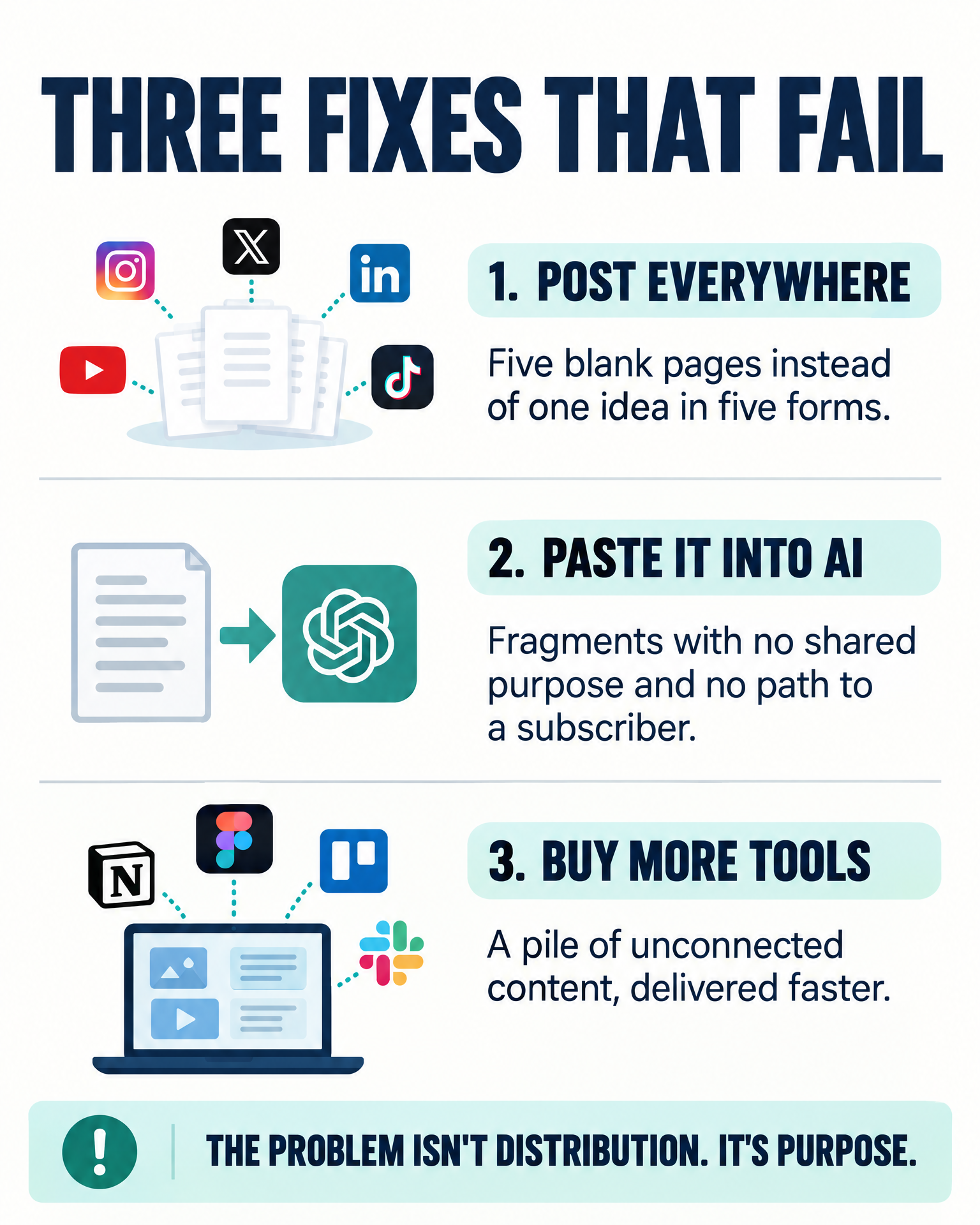
Most people try one of three fixes, and each has a flaw.
The “post everywhere” schedule. You commit to a blog post, a video, and a daily social post. But each piece starts from a blank page, so you’re creating five things instead of one thing in five forms.
Pasting a blog post into AI and asking for a tweet thread. You get fragments. They sound like the article, but they have no shared purpose and no path to a subscriber. Repurposing without structure just copies the weak parts of the original into more places.
Buying more tools. Schedulers, editors, and automation platforms speed up delivery. They don’t fix what’s being delivered. A pile of unconnected content moves faster, but it’s still a pile.
The common thread is that all three start with distribution. They ask “where do I post this?” before answering “what is this content for?” That question is why most repurposing efforts feel like busywork. The posts exist, but nothing ties them to a lead magnet, an email, or an offer.
What Is a Pillar-Based Content System?
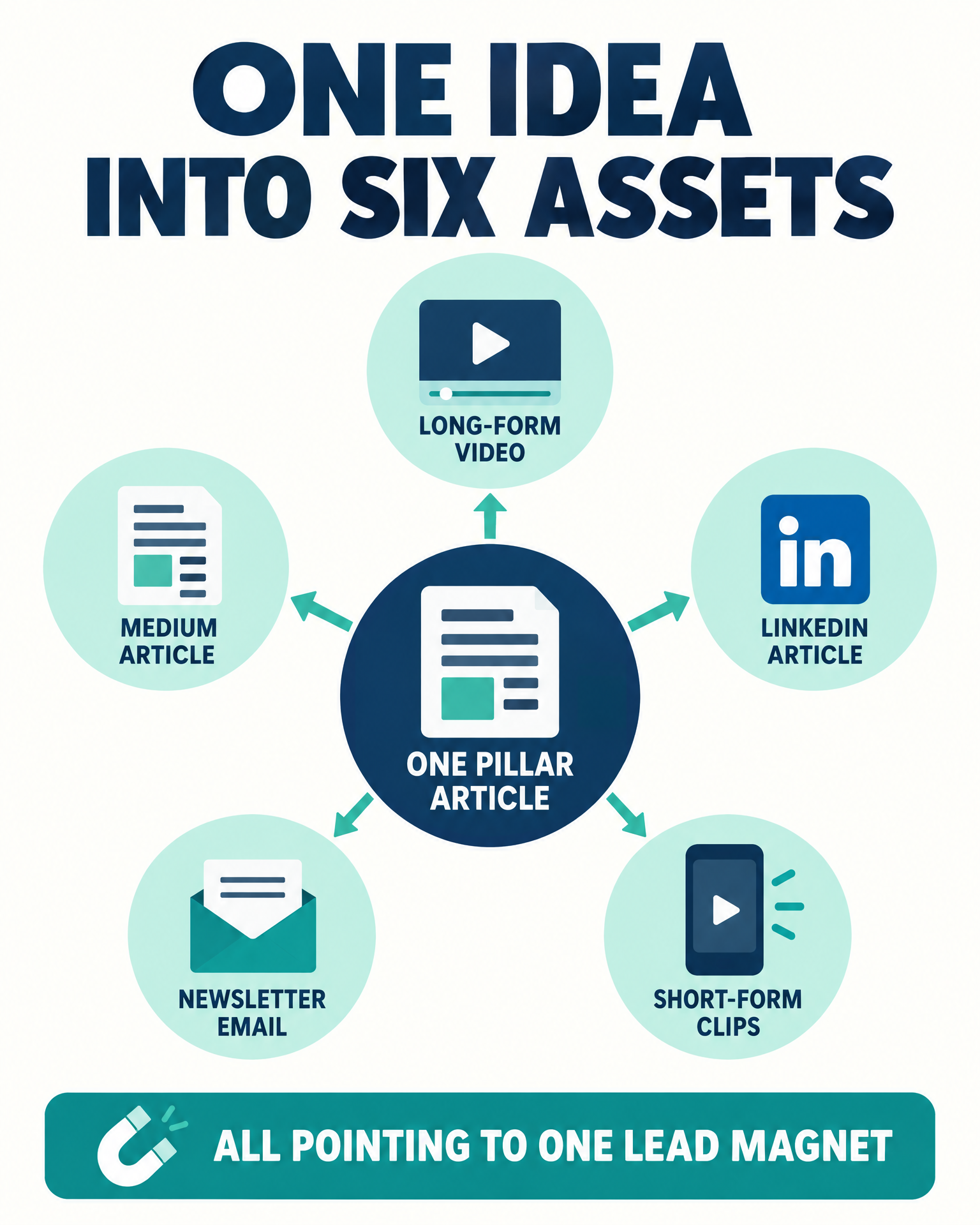
A pillar-based content system starts with one in-depth article on a single idea, then builds every other asset from it. That way each piece reinforces the same message and points to the same next step.
The pillar article is the source, not an afterthought. The video, the newsletter email, and the platform articles are all derived from it, so you do the hard thinking once.
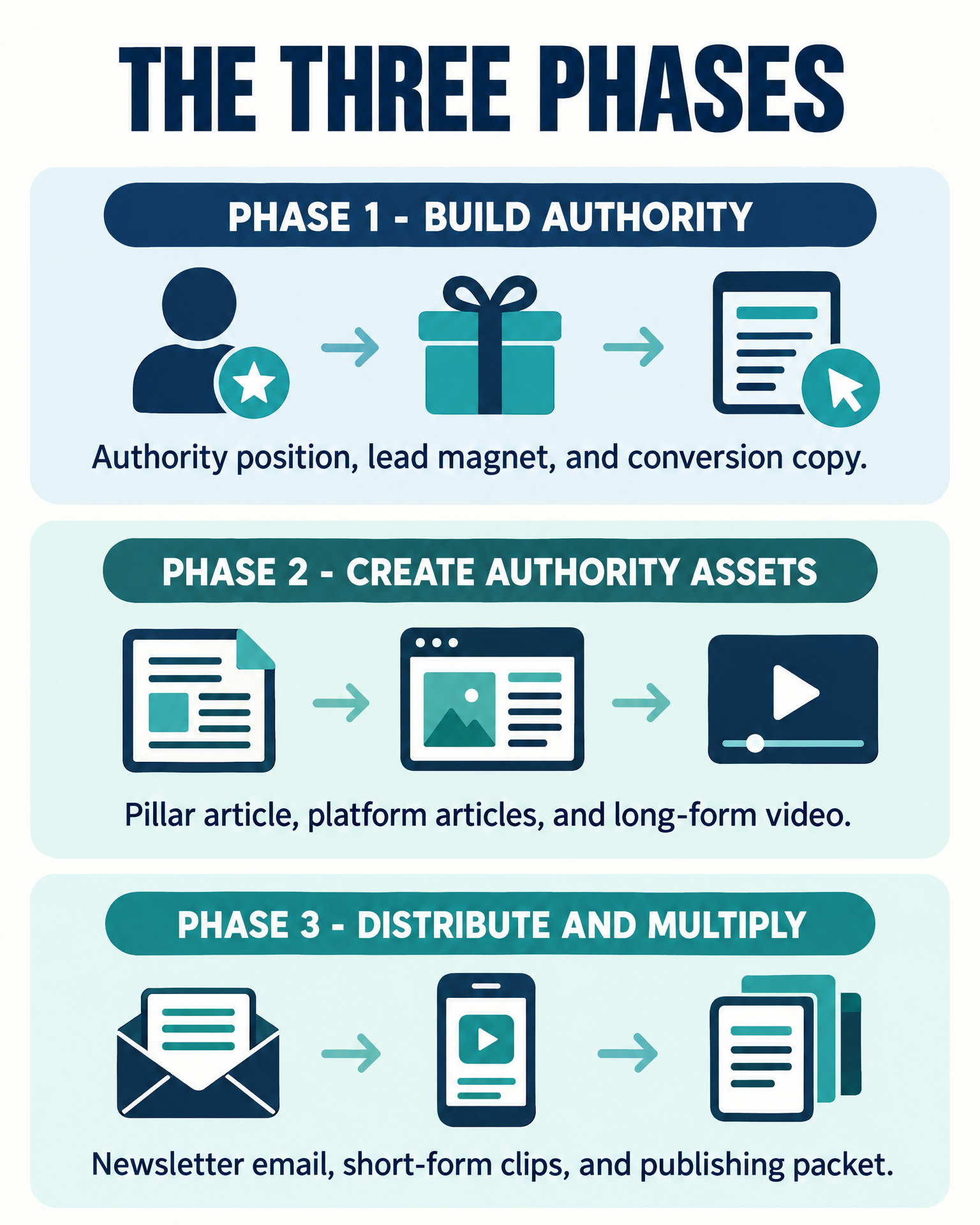
The order of operations is what makes it work. The strongest version has three phases:
Build authority. Decide what you’re credible about, design a lead magnet, and write the conversion copy for the places readers will meet it: a welcome popup, an exit-intent popup, an in-article block, and a landing page.
Create authority assets. Build the pillar article section by section, then adapt it into articles for outside platforms like Medium and LinkedIn and into a long-form video lesson.
Distribute and multiply. Turn the same idea into a newsletter email, a short-form video package, and a public authority publishing packet.
Notice that the lead magnet and conversion copy come before the content. That’s the reverse of how most people work, and it’s the reason the finished assets connect.
How to Build Your Repurposing System, Step by Step
You can do this on your own with a free afternoon and an AI chat account. Here’s the practical path:
Step 1: Pick one idea your audience already searches for. Choose a problem you can speak about credibly, ideally one tied to what you recommend as an affiliate.
Step 2: Write down your authority position. Who do you help, with what, and why should they trust you? Every later asset pulls from this, so it keeps your voice consistent.
Step 3: Design the lead magnet and its placements. Decide what readers get in exchange for their email, then draft the short copy for each placement. Doing this first means every asset can point somewhere.
Step 4: Build the pillar article in sections. Work section by section instead of facing a blank page. Each section should be strong enough to stand alone, because later it will.
Step 5: Multiply, in order. Adapt the pillar into a long-form video, then platform articles, then a newsletter email, then short clips. Each format borrows from the one before it.
If you’d rather not design all of this from scratch, Content Avalanche is the course I built around exactly this sequence. It walks through each step in nine short modules, with prompt sets for your AI chat account, deliverable templates, and review checklists. It’s a shortcut, not the only route. If you like designing systems from scratch, the steps above will get you moving.
What Results Can You Realistically Expect?
I’ll keep this grounded, because inflated promises are what make content-marketing advice hard to trust.
My track record: between 2021 and 2024, my content generated $600,000 in attributed affiliate sales. That’s sales attributed to my links, not personal income. I built it alongside a full-time job, and the same approach underlies Content Avalanche.
What the course is built to deliver: by the end of the nine modules you’ll have produced a complete, connected set of deliverables:
- An authority master packet and a lead magnet design
- Conversion copy for four placements
- A pillar article, borrowed-authority articles, and a long-form lesson
- A newsletter email, a short-form video package, and a public authority publishing packet
Before and after: before, you have scattered posts that each took a full effort. After, you have one idea expressed across several formats, all pointing to the same lead magnet. The video content totals 2 hours 27 minutes, and you set the pace with a few focused hours a week.
What it won’t do: it can’t guarantee traffic or sales. Those depend on your niche, your consistency, and the quality of your idea. What it does give you is a repeatable structure, so your effort compounds instead of scattering.
Ready to See the Full System?
The single most important point: repurposing works when the pillar comes first and everything else is derived from it. Start from distribution and you get noise. Start from one strong idea with a clear next step and you get a system.
If you want to see how the nine modules fit together, including the Christmas Tree Method for building the pillar article, the full outline is at Content Avalanche. It’s $147 (regular price $500), and you only need a blog or website, an AI chat account such as ChatGPT, and a few focused hours a week. Take a look at the module breakdown and ask yourself one question: which of those deliverables would save you the most time right now?
Frequently Asked Questions
Do I need an existing audience to use a content repurposing strategy?
No. The strategy works best when you build the authority position and lead magnet first, which gives even a brand-new blog a clear purpose for every piece. It’s designed for people with a small audience or none at all.
Do I need expensive tools or technical skills?
No. You need a blog or website and an AI chat account such as ChatGPT. The course uses prompt sets and templates, so you don’t need to be a tech expert or buy extra software.
How much time does it take?
The video lessons total 2 hours 27 minutes across nine modules. Building the deliverables takes longer, but most students work through it in a few focused hours a week alongside other commitments.