

There’s a version of this industry most people never get shown.
You won’t find it in your Awin dashboard. It’s not sitting quietly in the “browse offers” tab of ShareASale, waiting for you to stumble across it. And no, it doesn’t show up when you search “highest paying affiliate programs” for the fourth time this month, scrolling past the same twelve recycled lists everyone else has already bookmarked. This layer of the industry lives somewhere else entirely — in direct messages, in advertiser inboxes, in Slack channels with maybe three hundred members who all seem to know each other. It’s built on relationships, not applications. On timing, not forms.
If you’ve ever applied to a program and gotten that flat, forgettable rejection — “your site doesn’t currently meet our requirements” — you’ve already brushed up against the wall. On one side sits the world most affiliates live in: public offers, fixed commissions, approval queues that feel more like gatekeeping than vetting. On the other side sits something quieter. Negotiated deals. Terms nobody else in your position is getting. Access that was never listed anywhere for you to find.
This is about getting to that other side. Not by tricking anyone, not by gaming a system — but by understanding it well enough that the door opens because you deserve to be standing in front of it.
What Private Affiliate Offers Actually Are (And Why They Stay Hidden)
Here’s the plain version: a private affiliate offer is any partnership you can’t just find. You can’t search for it, browse it, or hit “apply” on a standard form somewhere. Someone — an advertiser, a program manager, a person with actual decision-making power — has to hand you the access directly, usually after deciding you’re worth the risk.
Most affiliates never think past this because most affiliates only ever see the surface. They assume the entire market lives inside CJ Affiliate, or Impact, or Rakuten. And to be fair, those platforms feel comprehensive when you’re new — endless categories, thousands of programs, more offers than you could ever apply to. But that’s the trick of it. What looks like the whole ocean is really just the part visible from shore.
Public, Private, In-House — They’re Not the Same Game
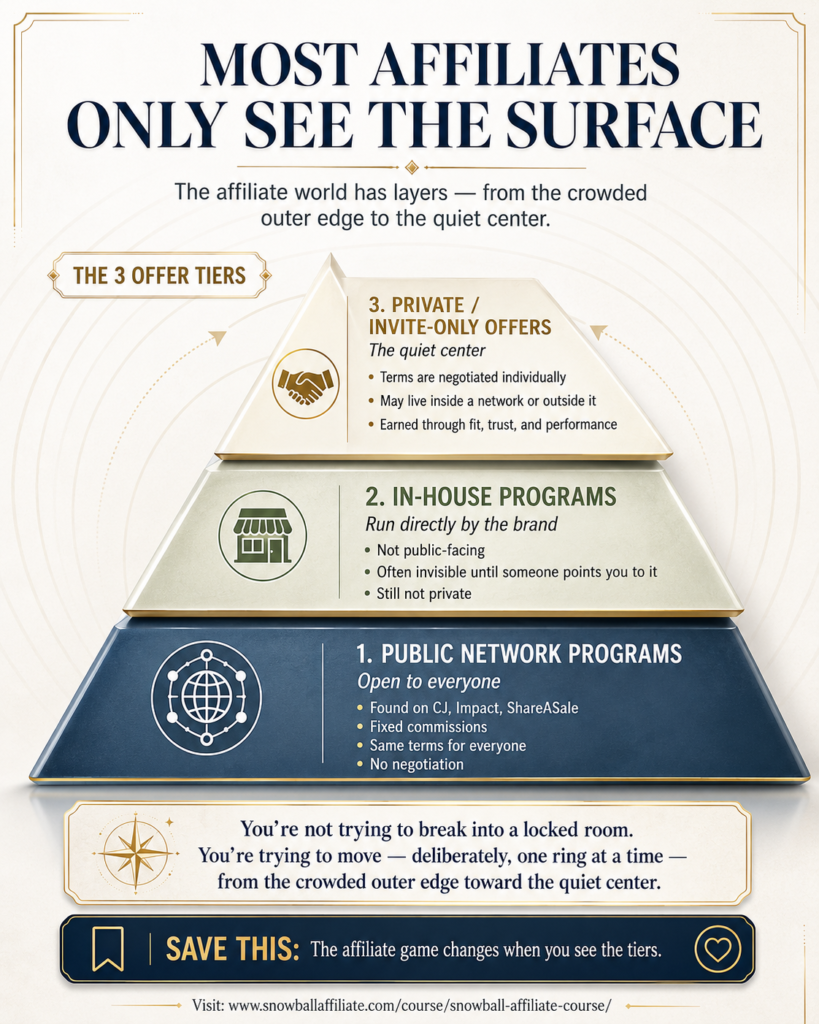
Picture three rings, each one further from the surface than the last.
The outer ring is what almost everyone starts in: public network programs. Listed openly on Impact, CJ, ShareASale, Awin — anywhere you can create an account and start applying the same day. Commission rates are fixed. Terms are the same for you as they are for the affiliate who signed up an hour before you did. There’s no negotiation here, not yet.
One ring in, things get quieter: in-house programs. These are run directly by the brand, often through something like PartnerStack or a dashboard they built themselves, and they don’t live inside the major networks at all. You won’t stumble onto these by browsing — you have to already know they exist, which usually means someone told you, or you went looking.
And then there’s the center — the part most people never reach: private, invite-only offers. Sometimes these hide inside a network as a restricted listing only certain approved partners can see. Sometimes they exist completely outside any network, just a direct handshake between you and someone at the company. Terms here aren’t fixed. They’re negotiated, person by person, based on what you bring to the table.
Generic gets ignored. Specific gets a meeting. That’s really the whole rule.
When “No Approval Needed” Should Make You Nervous
Not every offer that skips approval is a hidden gem. Some skip it precisely because they’d never survive being looked at closely.
Reading the Warning Signs Before They Read You
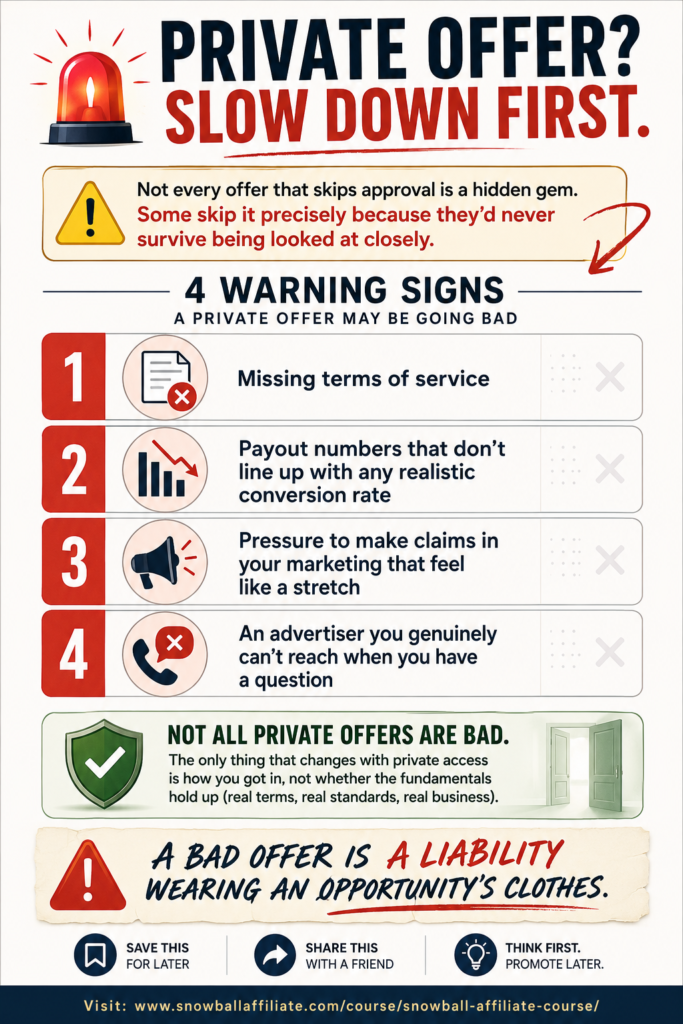
Be careful with anything that markets itself around the absence of scrutiny — that’s rarely a good sign on its own. Watch for missing terms of service, payout numbers that don’t line up with any realistic conversion rate, pressure to make claims in your marketing that feel like a stretch, or an advertiser you genuinely can’t reach when you have a question.
A legitimate private offer still has real terms behind it, still has standards, still has an actual business you could pick up the phone and call if something went wrong. The only thing that changes with private access is how you got in — not whether the fundamentals hold up. An offer that skips approval because there’s nothing there to approve isn’t an opportunity. It’s a liability wearing an opportunity’s clothes, and it can cost you more than the offer was ever worth — your other accounts, your traffic sources, your name in a small industry where reputations travel fast.
What People Actually Wonder About This
Can someone just starting out actually get into private offers, or is this only for people with a track record?
Beginners get in more often than you’d think — just not usually through direct negotiation with an advertiser. The fastest door tends to be joining as a sub-affiliate under someone established, because that access is inherited through the relationship rather than earned through your own history. After that, showing up consistently in niche communities and being genuinely responsive to affiliate managers on the networks you already use tends to open things up faster than most people expect.
Is the money actually better with private deals, or is that mostly a myth?
Usually, yes — private offers tend to carry higher commissions, longer cookie windows, or bonus structures built just for you, because someone negotiated those terms individually instead of setting one flat rate for everyone. That said, payout isn’t the whole story. Some private deals trade a lower base rate for something else — less competition, more support, exclusivity that actually matters in your niche — so it’s worth reading the full terms rather than just chasing the commission percentage.
Products, Tools & Resources Worth Knowing
A few things that tend to come up once you’re actually operating in this space:
- Affiliate networks worth having accounts on regardless — Impact, CJ Affiliate, Awin, and PartnerStack all still matter, even once you’re chasing private deals. They’re often where a relationship starts before it moves somewhere more private.
- Outreach and CRM tools — something as simple as a well-organized spreadsheet or a lightweight CRM like HubSpot’s free tier can make a real difference once you’re managing more than a handful of advertiser relationships at once. Losing track of who you emailed and when is an easy way to look unprofessional.
Understanding this shifts the whole question. You’re not trying to break into a locked room. You’re trying to move — deliberately, one ring at a time — from the crowded outer edge toward the quiet center.
Why Advertisers Keep the Good Stuff Behind a Curtain
It’s tempting to read gatekeeping as arrogance, or as some kind of insider club protecting its turf. It’s rarely that. From where advertisers sit, restricting access solves problems that would otherwise sink the campaign.
Budgets, for one. A lot of high-payout offers run on capped spend, and throwing that open to every affiliate on a network is a fast way to blow through the budget in days with nothing to show for quality. Brand risk matters too — a company running something reputation-sensitive wants to know who’s representing them, what traffic they’re pulling in, what the messaging actually says before it goes live. Fraud is another quiet driver; open, low-barrier offers tend to attract exactly the kind of traffic nobody wants, and manual vetting is one of the few real filters against it. And then there’s leverage — when terms stay private, an advertiser can pay a proven performer more than a brand-new affiliate, something a flat public rate simply can’t do.
None of this is a conspiracy aimed at keeping you out. It’s risk management, plain and simple. And once you see it from their side of the table, the path forward stops looking like a hack and starts looking like something much more obvious: become the kind of partner that risk management doesn’t need to worry about.
The Real Ways In (No Shortcuts, Just Different Doors)
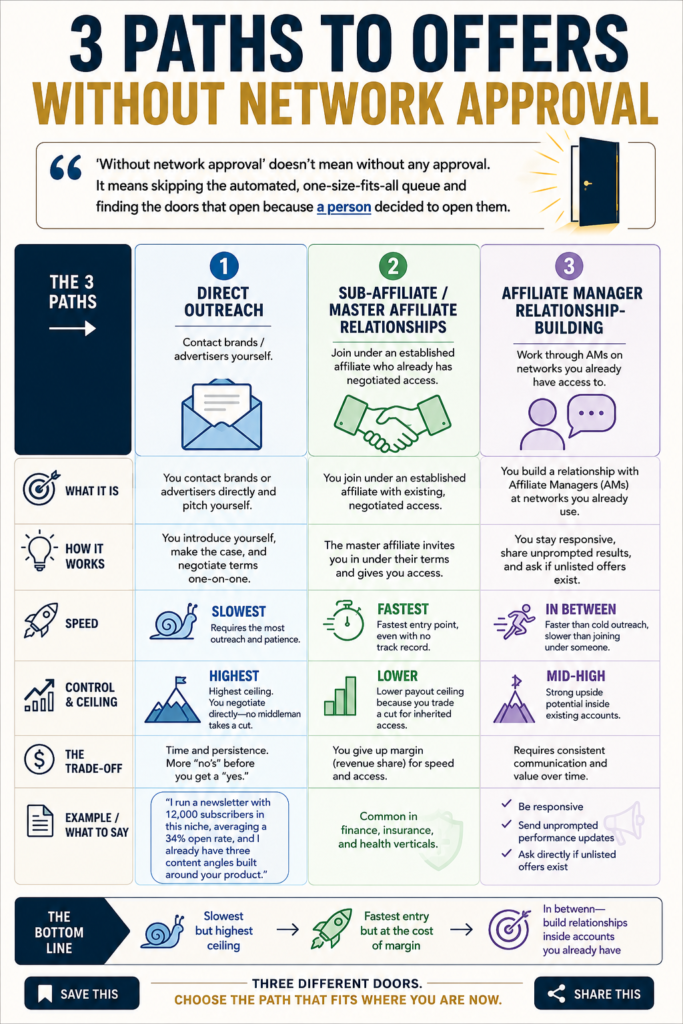
“Without network approval” doesn’t mean without any approval. It means skipping the automated, one-size-fits-all queue and finding the doors that open because a person decided to open them.
Just Ask — Direct Outreach to Advertisers and In-House Programs
This one gets overlooked constantly, probably because it feels too simple to work. But contacting the brand yourself — before or instead of applying through a network — is still the most direct route there is.
A lot of companies run affiliate programs that never touch a network at all, or they have a public listing and a better, unlisted arrangement reserved for people who reach out personally. Start by finding brands in your niche, checking their site footer for an “Affiliates” or “Partners” link, and tracking down whoever runs their partnerships — LinkedIn is usually enough, look for titles like Affiliate Manager, Partnerships Lead, Growth Marketing Manager.
What separates a pitch that gets read from one that gets deleted is specificity. “I’d love to promote your product” says nothing. But something like — I run a newsletter with 12,000 subscribers in this niche, averaging a 34% open rate, and I already have three content angles built around your product — that gets a reply, because it proves you did the work before you asked for anything.
Borrowed Access — Sub-Affiliate and Master Affiliate Relationships
Sometimes the fastest way into a private offer isn’t going direct at all. It’s finding someone who already has the access and asking to work under them.
Master affiliates — sometimes called super affiliates, or people running informal sub-networks of their own — often negotiate exclusive terms with advertisers, then quietly distribute a slice of that access to a small group of trusted sub-affiliates. This is common in verticals like finance, insurance, health — spaces where one high performer locks in a private deal and builds a small team underneath themselves.
Join as a sub-affiliate and you inherit access you probably couldn’t get approved for alone, in exchange for a cut of your revenue or a lower payout than going direct would offer. That trade-off is real, and it’s worth being honest with yourself about it. But if you’re starting with no track record, this is often the shortest bridge between “nobody knows who you are” and “someone’s willing to vouch for you.”
The Person Behind the Platform — Building Real Relationships With Affiliate Managers
Even inside the networks you already have access to, private offers usually get unlocked through a person, not a system. Affiliate managers frequently hold discretionary access — unlisted offers, higher commission tiers, early looks at new campaigns — and they hand these out selectively, to whoever they trust.
A few things that consistently move the needle here. Answer every message an AM sends you, even the ones that feel like nothing — responsiveness is one of the quiet signals they track. Send updates nobody asked for; something like this creative angle is converting well, here’s what I’m seeing tells them you’re paying attention in a way most affiliates never bother to. Ask, plainly — do you have anything unlisted, or any higher-tier arrangement for consistent performers? — because the door doesn’t open if you never knock. And keep your record clean, because an AM often has to advocate for you internally, and that’s a lot easier to do for someone with nothing messy in their history.
Where This Access Actually Lives
Nobody puts these opportunities on a billboard. They surface in the right rooms, at the right moment, in front of the right people.
The Rooms Where People Already Trust Each Other
Private, invite-only communities are where a surprising share of unlisted offers first get shared. Affiliate-focused Slack groups, Discord servers built around a specific vertical — SaaS, finance, e-commerce — paid mastermind communities where the barrier to entry itself does some of the vetting for you. These spaces often carry access to in-house programs, early offers, direct advertiser contacts, none of which ever touch a public listing.
They also function as informal reputation systems. Show up consistently, contribute something real, and eventually someone refers you into a private deal personally — which carries far more weight than any cold application ever could.
Conferences: Where the Whole Room Already Wants to Talk to You
Affiliate marketing conferences — Affiliate Summit, Lions Den, PI Live, the usual names — remain one of the highest-yield environments for this kind of thing. Advertisers and affiliate managers show up specifically hunting for partners. The entire context of the room is pre-qualified for exactly the conversation you’re trying to have.
One good conversation at a booth can produce more than months of cold emails ever would. It’s also where a lot of sub-affiliate relationships start in the first place — established players scouting the room for new talent worth bringing in.
What to Actually Say When You Reach Out Cold
Structure matters more than politeness here. A message that gets a response usually does four things, and does them in under 150 words: says who you are, proves you looked into their brand specifically, states something concrete you bring to the table, and asks one low-friction question.
Something like this tends to work:
Subject: Partnership opportunity — [your niche] audience, [specific number]
Hi [Name], I run [brief description] reaching [specific number] in [specific niche]. I’ve been following [Brand]’s recent [launch/campaign/product] and think there’s a real fit with my audience because [specific reason].
I’d love to talk about a direct partnership outside your standard network listing — do you have 15 minutes this week?
- Media kit builders — tools like Canva
 or a simple one-page PDF can go a long way toward making your pitch feel finished rather than improvised. Advertisers respond to polish, even in a five-minute glance.
 - Communities worth finding — niche-specific Discord servers and Slack groups (search by your vertical plus “affiliate” or “partners”) are often where the earliest access gets shared, long before it’s public knowledge anywhere else.
- Conferences to keep on your radar — Affiliate Summit, Lions Den, and PI Live are the names that come up again and again for a reason. If budget allows even one trip a year, it tends to pay for itself in relationships alone.