

Before You Assume This Is the Fix
If your site has stalled — traffic that plateaued, content that isn’t leading anywhere, a general feeling that you’ve done a lot of work for not much to show — it’s natural to start looking at every well-known course as a potential rescue. Project 24 comes up in that search a lot, and for good reason. It’s a legitimate, well-regarded program. But “well-regarded” and “right for your specific stall” aren’t the same thing, and this review is here to help you tell them apart.
Project 24, built by Income School, is a broader content-business training program. It’s built to help you grow a content site — often through a mix of display ads, affiliate income, and other revenue streams — into something that functions as a genuine long-term asset. That’s a wider lens than a system focused narrowly on sequencing one affiliate offer through a buyer’s journey.
For a stalled niche blogger, whether that wider lens actually helps depends entirely on why your site stalled in the first place. If the issue is scope — a niche that quietly grew too broad, content with no real unifying direction — Project 24’s broader framework can genuinely help. If the issue is something narrower, like a disconnected reader journey that never quite reaches a specific offer, that’s a different kind of problem, and not the one Project 24 was primarily built to solve.
Table of Contents
What Project 24 Actually Is
Project 24 is a structured training program organized around one central idea: build a content-based website as a real, long-term business asset. The “24” refers to the general goal underneath it — replacing a full-time income within roughly two years of consistent, sustained effort. Its scope is deliberately wide. Content, SEO, site growth, and monetization — which can mean display advertising, several affiliate programs, or a mix of both — are all part of the same framework.
That breadth is really the whole point of Project 24, and it’s worth sitting with for a second. It isn’t narrowly built around sequencing a single affiliate offer through a buyer’s mind. It’s built around growing a content site the way you’d grow any business, with affiliate income sitting as one possible stream among several, not the entire architecture.
Who This Was Actually Built For
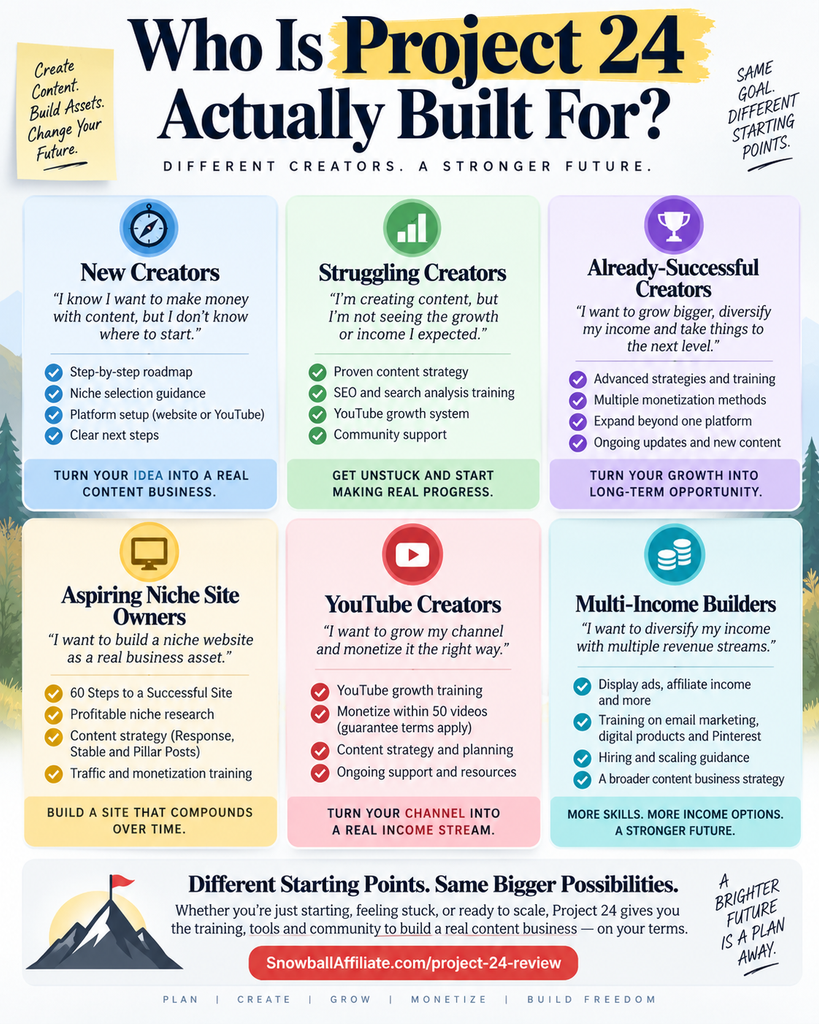
Project 24 tends to genuinely fit readers who:
- Want a content site that functions as a broader business, not exclusively a machine built around one affiliate funnel.
- Are comfortable with a longer runway and a general growth philosophy, rather than a tight, offer-first sequence.
- Want room to diversify later — display ads, multiple affiliate programs, whatever else comes along — instead of architecting the entire site around a single offer from day one.
- Actually want a broad content and SEO education alongside the monetization training, not just the monetization piece alone.
That’s a genuinely different reader than the one whose core frustration sounds like, “I don’t know what to publish next, in what order, to move a specific reader toward a specific offer.” That reader’s problem is narrower and more specific than what Project 24 was primarily built to answer.
“Stalled” Means Different Things — Figure Out Which One First
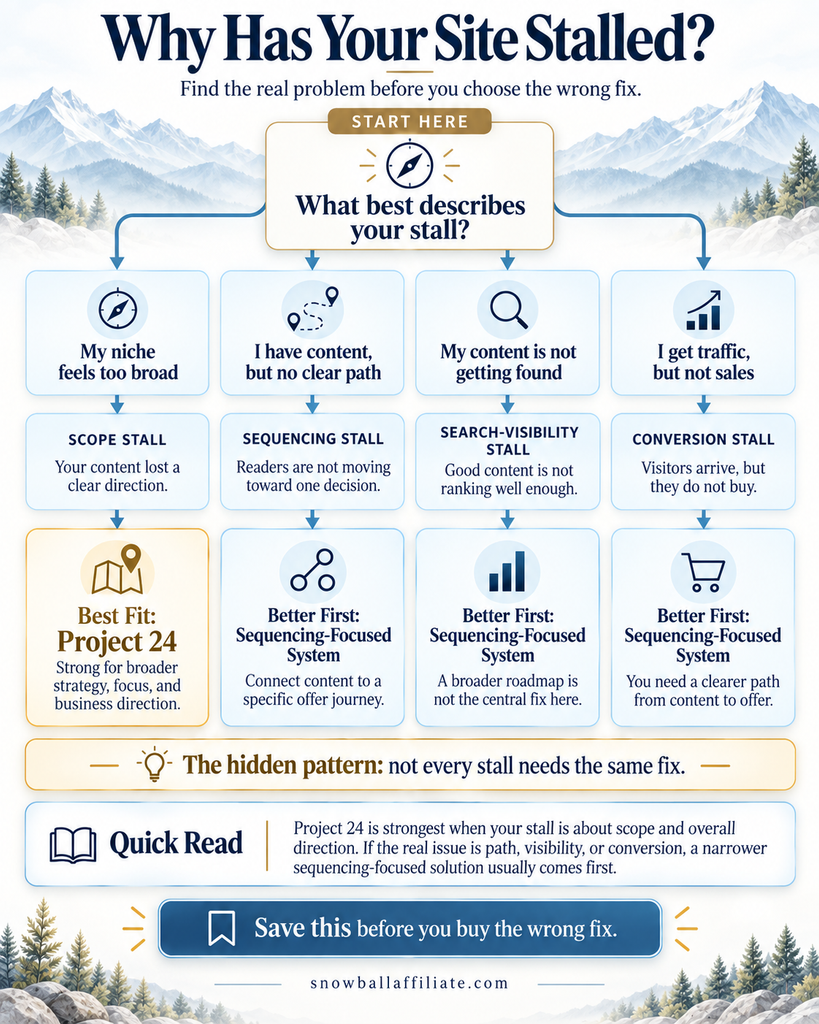
Here’s something worth being honest about before buying anything: “my site has stalled” can mean several genuinely different things, and the right fix depends entirely on which one is actually happening to you.
- A scope stall — the niche quietly grew too broad, and the content lost any real, unifying direction. (There’s a full diagnostic on this exact problem linked below.)
- A sequencing stall — content exists, plenty of it even, but there’s no connected path carrying a reader from symptom, to understanding, to an actual decision.
- A search-visibility stall — decent content that just isn’t ranking well enough to bring in meaningful traffic.
- A conversion stall — traffic is showing up, and it simply isn’t turning into affiliate revenue.
Project 24 is best positioned to help with the first of these — scope and general business direction — as part of its wider content-business philosophy. The other three tend to respond better to an offer-first sequencing framework specifically, which is where a narrower, more focused system usually has the real edge.
Where Project 24 Genuinely Earns Its Reputation
To give this its fair due: Project 24’s broader take on content strategy and site growth can genuinely help someone whose site drifted into an unfocused, overly broad niche with no real sense of itself as a business. Its emphasis on building something long-term, rather than chasing whatever tactic is trending this month, is a legitimate and useful antidote to the exact kind of scattered, directionless publishing that stalls out so many sites in the first place.
If your honest issue is “I built this without ever really thinking of it as a business,” Project 24’s broader framework speaks directly to that gap. That’s a genuine strength, not a footnote.
Where It Isn’t the Central Fix
Where Project 24 pulls back a bit is the specific mechanism most relevant to an affiliate-conversion stall — actually connecting existing content into a deliberate reader journey aimed at a specific offer. Because its scope spans multiple monetization paths and a broad content-business philosophy, it doesn’t narrow in on offer-to-pain-to-content sequencing the way a system built specifically for that job does.
If your site has traffic but no sales, or content that just doesn’t seem to be leading anywhere in particular, that narrower sequencing fix might be the more urgent thing you need — even if a broader content-business education would still be useful somewhere down the line.
The Real Difference Between a Business Roadmap and a Sequencing System
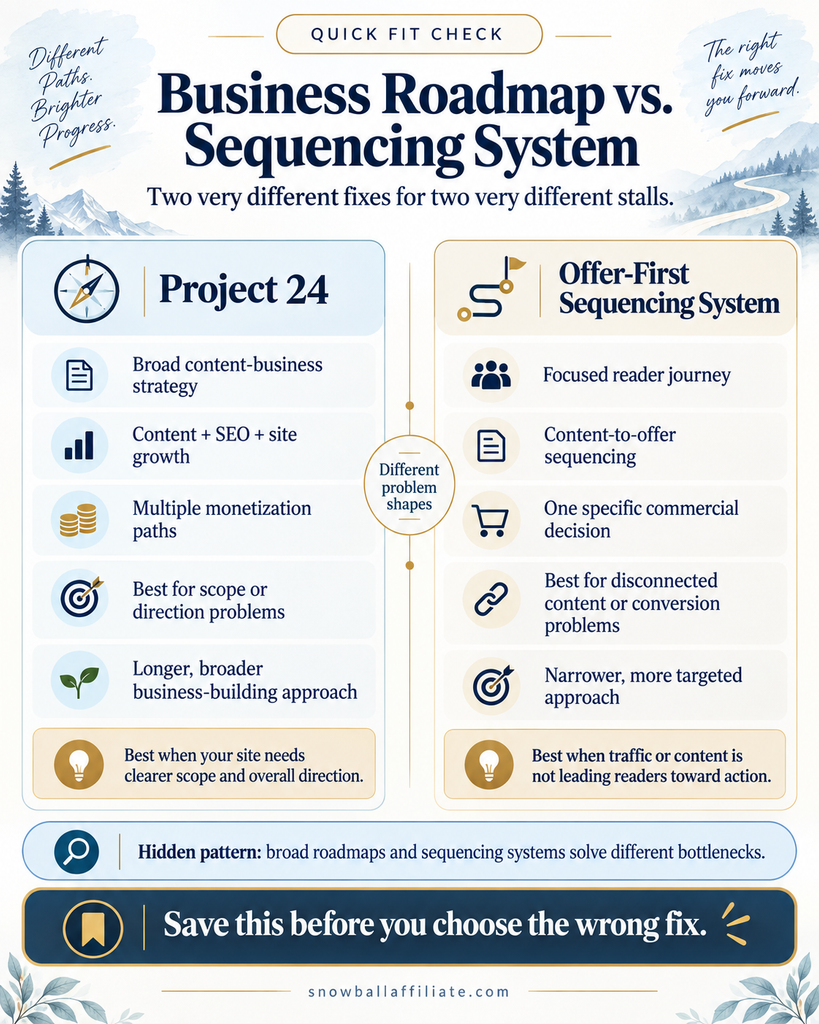
Here’s the cleanest way to put it: Project 24 teaches you to build a content business broadly. An offer-first sequencing system teaches you to connect the content you already have into a deliberate path toward one specific commercial decision.
Neither one is better in some absolute sense — they’re just built for different-shaped problems. If you genuinely need both — some general content-business skills, and a fix for a reader journey that’s currently going nowhere — it’s worth evaluating both approaches directly against your actual stall before picking one.
→ Continue to: [Snowball Affiliate vs Project 24: Which System Fits a Niche Blogger Better?] (internal link: BG02)
Who Should Choose This
- Anyone building a content site as a genuine, broader business — not solely an affiliate-conversion engine.
- Anyone who wants flexibility across several monetization types, rather than betting everything on one primary offer.
- Anyone whose stall is honestly about scope and direction, not specifically about sequencing content toward a purchase decision.
- Anyone comfortable playing a longer game with a broader growth philosophy.
Who Should Look Elsewhere First
- Anyone whose stall sounds like “I have traffic, and it just isn’t converting.”
- Anyone whose stall sounds like “I genuinely don’t know what to publish next, or why.”
- Anyone who wants a tightly focused, offer-first sequencing system rather than a wider content-business education.
What People Ask Before Buying
Is this only about display ads, or does it actually cover affiliate marketing too?
Both, actually, alongside other content-monetization approaches — it’s part of the broader content-business philosophy rather than a program built exclusively around affiliate offers.
Could I use this alongside a sequencing-focused system like Snowball Affiliate?
In principle, sure — one handles broader content-business strategy, the other handles reader-journey sequencing toward a specific offer. Most people do better identifying which gap is more urgent first, rather than trying to run both frameworks side by side from day one.
Does this work for a true beginner, or do I need an existing stalled site first?
It’s built to work for both, though a total beginner who wants a narrow, step-by-step offer-to-content sequence might find the broader scope here a little less immediately actionable than they were hoping for.
Will this fix a disconnected reader journey specifically?
Not as its central focus, no. Its real strength is broader content-business strategy and general site growth. A disconnected reader journey aimed at a specific offer is more directly the job of a sequencing-focused system.
Products, Tools & Resources Mentioned in This Review
Project 24 (Income School) — the broader content-business training program covered in this review.
Snowball Affiliate — the offer-first sequencing system this site primarily recommends when the stall is specifically about content-to-conversion sequencing.
Our direct comparison guide — for anyone trying to decide between these two approaches head-to-head: Snowball Affiliate vs Project 24: Which System Fits a Niche Blogger Better?
Our niche-focus diagnostic — for anyone still unsure whether their stall is actually a scope problem underneath everything else: Is Your Affiliate Niche Too Broad? Signs Your Site Has Lost Focus.