

Your book is published. It’s live, it’s available, and the people you wrote it for aren’t responding. Most authors in that spot reach for the same explanation: not enough promotion, or readers can’t find the book. Sometimes that’s true.
But there’s another possibility that gets less attention. The book may be reaching people, and what it promises may not match what your intended reader is looking for. That’s a positioning problem, and more promotion won’t solve it.
This article is a self-diagnosis, not a verdict. I can’t tell you why your book isn’t landing, and nobody can from the outside. What I can give you is three signs to check and a way to compare what you meant with what you’re actually saying. By the end you should have a hypothesis you can test.
Free download: The Book Visibility Triage Toolkit. Check whether your promise matches the readers you want to reach. Pick your publishing stage, then use the Reader Positioning Audit to record your intended reader, the actual book problem, the promised result, the mismatch you see, and how strong your evidence is. A description alignment checklist and a discovery research log round it out. A triage matrix then keeps what you know apart from what you only suspect, and a plan names your next three actions.
Table of Contents
Before You Blame Promotion, Check the Fit
When a book underperforms, promotion is the easiest thing to blame, because it’s the most visible thing to change. You can post more, run an ad, or ask for more reviews. Each of those feels like progress, and none of them requires you to question the book itself.
The trouble is that promotion amplifies whatever message is already there. If the message fits the reader, more exposure helps. If it doesn’t, more exposure just puts the same mismatch in front of more people. I’ve watched authors work harder and harder on visibility while the real gap sat untouched in the book’s central promise.
So before you spend more effort on reach, ask a narrower question: if my intended reader saw this book, would they recognize it as being for them?
Here’s how to use the rest of this article:
- Read each sign and answer honestly, not hopefully.
- Treat each “yes” as a clue, not a conclusion.
- Write down what you notice. You’ll use it in the comparison exercise later.
- Expect that you may find more than one issue, or none. A clean result is useful too, because it points you back toward visibility or other causes.
Nothing here guarantees that a fit problem is your problem. It’s a way to check before you commit more time and money to the wrong fix.
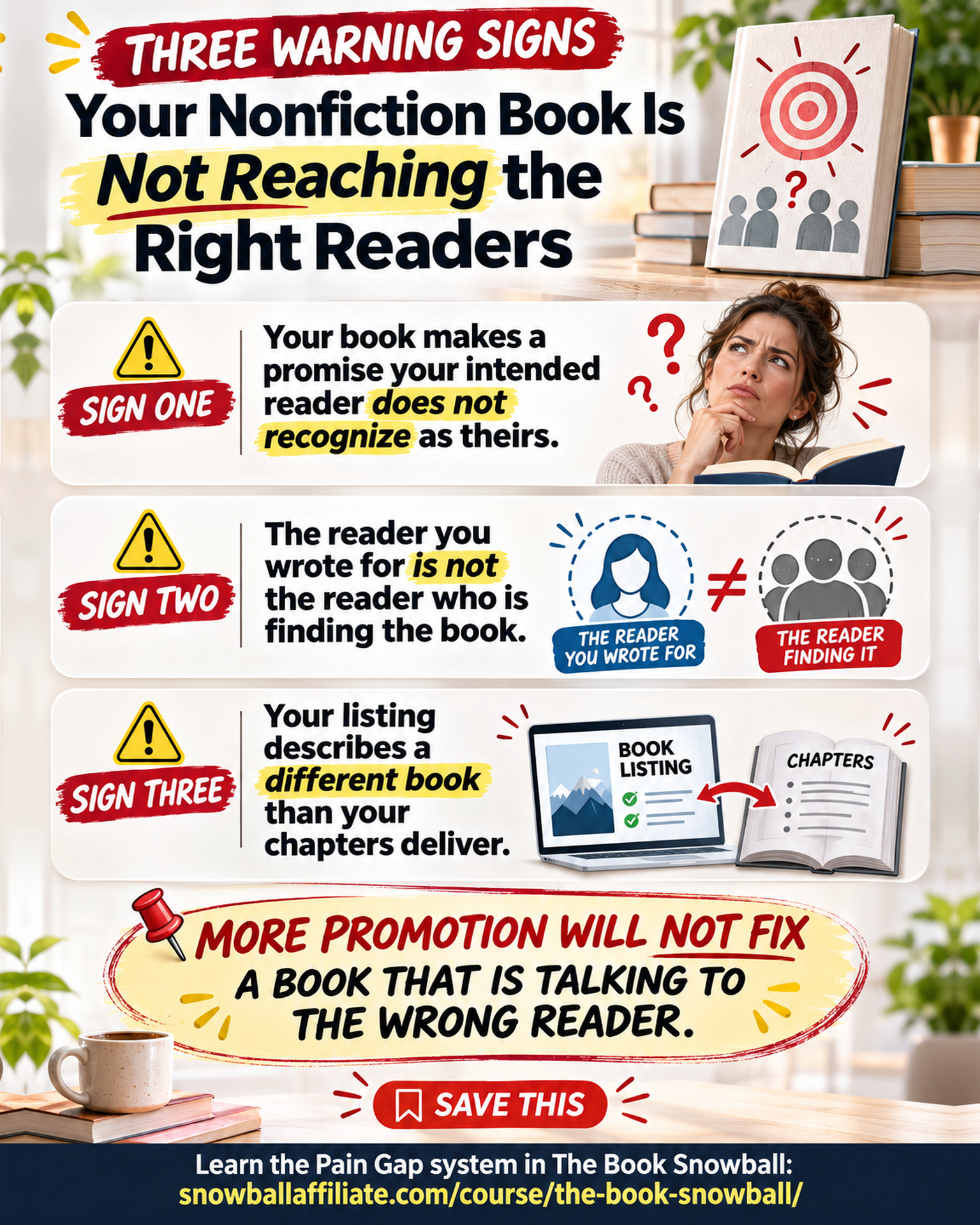
Sign One — The Book Promises a Result Its Intended Reader Doesn’t Recognize
A nonfiction book is a promise. It says: if you read this, something changes for you. The reader has to see that change as one they want, in words they’d use themselves.
This sign shows up when the promise makes sense to you but not to the person you wrote it for. Some common ways that happens:
- The promise is in your vocabulary, not theirs. You call it “frictionless operational alignment.” Your reader calls it “my team keeps dropping the ball.”
- The promise is too broad. “Live a better life” or “master your money” could describe thousands of books. A reader can’t tell whether this one addresses their specific situation.
- The promise answers a question they aren’t asking. You solved a problem you find fascinating, but your reader doesn’t experience it as a problem yet.
- The promise is real but buried. The result is in chapter four, and the cover and subtitle talk about something else.
To check this one, take your subtitle and your one-sentence description of the book. Show them to two or three people who match your intended reader, without explaining anything. Ask: “What would this book do for you?” If their answer is far from yours, or if they shrug, that’s worth paying attention to.
One caution: friends and family usually aren’t the right test group. They’re being kind, and they know you. Look for someone who actually has the problem your book addresses.
If this sign rings true, the book may not be failing to reach readers so much as failing to say something they recognize.
Sign Two — The Reader You Wrote For Isn’t the Reader Finding It
This sign is about who is actually showing up, as opposed to who you pictured.
Many authors write for a specific person in their head: a first-time manager, a mid-career professional changing fields, a parent of a newly diagnosed child. Then the book goes out and the people who respond turn out to be someone else. Maybe they’re students, or experts who already know the material, or people curious about the topic but with no real problem to solve.
None of that is automatically bad. Sometimes an unexpected audience is a gift. But if your intended reader isn’t among the people responding, ask why.
Some things to look at, using only what you can really observe:
- Who writes to you or reviews the book? Read what they say about why they picked it up. Are they describing the problem you meant to solve?
- Who shares it, and with whom? Notice whether it travels through the circles you expected.
- Who asks questions after reading? Their questions often reveal the gap between what they expected and what you delivered.
- Who doesn’t respond at all? The silence from your intended reader is data too, though you’ll need to be careful not to over-read it.
One possible cause here deserves its own mention: no owned audience. If the only way people encounter your book is by stumbling on it, you have no direct line to the readers you meant to reach, and no way to learn from them before or after launch. That’s a structural gap, and it can look like a positioning failure when it isn’t one. Whether an author needs an email list before a first book is its own question, and I cover it separately here: Do Nonfiction Authors Need an Email List Before Their First Book?
The point for now is to keep the two causes apart. “My intended reader isn’t finding the book” and “my intended reader doesn’t want what the book says it offers” can feel identical from where you sit. They aren’t, and the fixes differ.
Sign Three — The Listing Describes a Different Book Than the Chapters Deliver
This one is a quick pointer, not a full audit.
Sometimes the page that sells the book and the pages inside the book are describing two different things. The listing might lean on one angle while the chapters spend their energy on another. A reader who clicks because of the first and opens the second can feel misled, even when nobody meant any harm.
The simple check: read your listing description, then skim your table of contents. Do they tell the same story? If a stranger read only one and then the other, would they believe it was the same book?
If you notice a gap, note it and move on for now. A proper look at how to examine a listing, line by line, belongs in a later article. Here the only job is to flag whether a mismatch exists, because it feeds the larger fit question.
How to Compare Your Intended Reader With Your Actual Message
This is the working part. You’ll build two short descriptions and hold them next to each other.
Step 1: Describe your intended reader in concrete terms.
Write a paragraph, not a demographic label. Cover:
- What situation they’re in right now
- What they’ve already tried
- What they’re frustrated by, in their own words
- What they’d say they want, not what you think they need
If you can’t write this without guessing, that’s a finding. It may mean you’ve never spoken in depth to someone like this, and the book rests on assumptions.
Step 2: Describe your actual message.
Now look only at what the book presents to the world: the title, subtitle, cover text, and listing description. Write down, as plainly as you can:
- What result does this message promise?
- Who does it seem to be addressed to?
- What problem does it appear to solve?
Do this as if you were a stranger. Avoid filling in what you meant. Use only what’s on the page.
Step 3: Compare line by line.
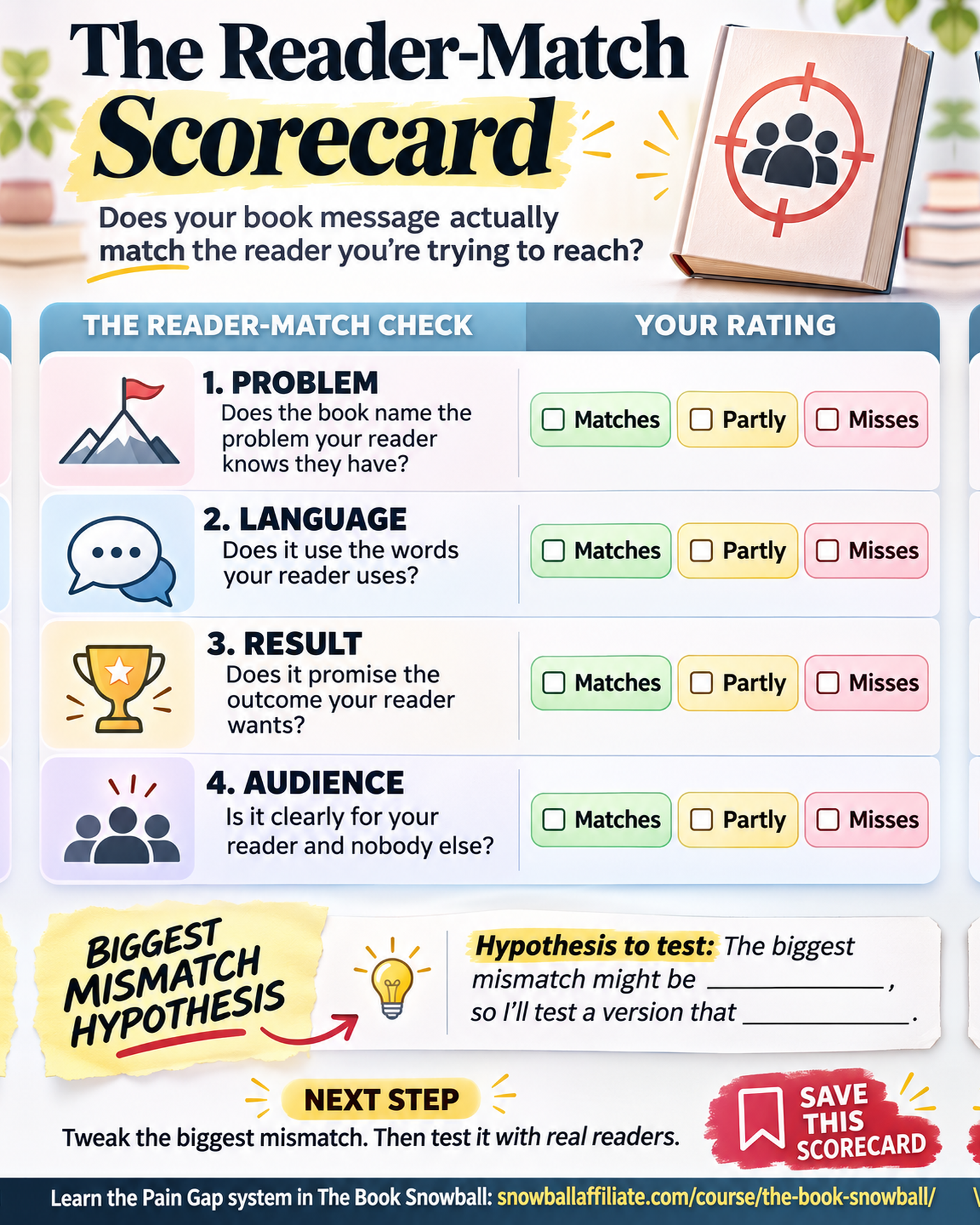
Lay the two side by side and mark where they diverge. Look at four places:
- Problem. Is the problem in your message the one your reader says they have?
- Language. Do the words match the words they use?
- Result. Is the promised outcome one they’d actually want?
- Audience. Does the message seem addressed to them, or to someone adjacent?
Step 4: Write a hypothesis, not a conclusion.
Finish with one sentence in this shape: “I suspect the gap is in ______, and I could test that by ______.”
For example: “I suspect my subtitle describes the method, but my reader searches for the outcome, and I could test that by asking five people in that group what they’d expect from it.” That’s a hypothesis you can act on, and it’s honest about what you don’t yet know.
If the comparison shows no meaningful gap, that’s useful too. It suggests looking at other causes, including reach, timing, and how readers are encountering the book.
What to Fix First — and What to Leave Alone
If your comparison turned up a gap, resist the urge to rewrite everything at once. A few ideas on order:
Start with the smallest change that tests your hypothesis. If you suspect the subtitle is the problem, change the subtitle and see whether the way people describe the book shifts. Small, reversible changes teach you more than a total overhaul, and they’re easier to undo if you were wrong. I can’t promise any particular change will improve how readers respond, so treat each one as a test.
Fix the promise before you fix the packaging. A better cover or a cleaner layout won’t help if the underlying promise is aimed at the wrong problem. Get the message right, then make it look right.
Leave the chapters alone until you’re sure. Rewriting content is the most expensive fix, and it’s tempting to jump there. Only go there if you’ve found that the book itself doesn’t deliver what your intended reader needs. Often the content is sound and the way it’s framed is what needs work.
Hold off on new promotion until you know what you’re promoting. This doesn’t mean stopping everything. It means not pouring new money or energy into amplifying a message you’ve just discovered may be off.
There’s one more possibility to be honest about. Sometimes the comparison shows that the mismatch goes deeper than wording. The problem your book solves may not be one your intended reader strongly feels, or may not be one many people are actively trying to solve. That’s a harder finding, and it points back to how the book’s central problem was chosen in the first place. If that’s where your diagnosis lands, this is worth reading next: How to Find Nonfiction Book Problems People Actually Want Solved
That doesn’t mean the book was a mistake. It means the most useful next move is understanding the problem choice, not tweaking surface details.
Whatever you find, keep your conclusions as modest as your evidence. You’re trying to replace a vague worry (“nobody’s responding”) with a specific, testable idea (“my message may not match what this reader is looking for”). That shift alone makes the next step clearer.