

If you’re writing your first nonfiction book, you’ve probably heard that you need an email list, and that you needed it yesterday. Then you open a blank manuscript, see how far you are from done, and wonder whether a list is a smart head start or a way to avoid the hard part.
I get why this is confusing. The advice usually comes from people who already have a book out, and it rarely separates two stages: before the book exists and after it does. This article covers only the first stage. I’ll tell you who gains from starting a list early, who is better off writing first, and what the real cost is either way.
Free download: The Author Audience Bridge Planner. Before you build an author list, decide what it should actually do for your readers and for you. The planner starts with an audience stage selector that routes you to the right pages first. Then you complete an Ideal Reader Relationship Map, a companion resource builder, and a permission-based subscriber acquisition map. It also includes three reader feedback questions with space for answers and a four-week reader engagement calendar.
Table of Contents
The Short Answer — It Depends on What the List Is For
No, you don’t need an email list before your first book. Plenty of nonfiction authors publish without one, and the book still gets written, edited, and released.
But “need” is the wrong question. A better one is: what would a list do for me right now that I can’t get any other way? If you have a clear answer, a list may be worth starting. If you can’t name one, it’s probably a distraction.
A list isn’t a rite of passage or proof that you’re a serious author. It’s a tool, and a tool is only worth picking up when you have a job for it. Before the book exists, that job is usually one of three things:
- Getting feedback from the people you’re writing for
- Having a few interested readers ready to notice when the book comes out
- Keeping a thread of connection that carries into your second book
If none of those matters to you yet, you can skip the list and nothing breaks.
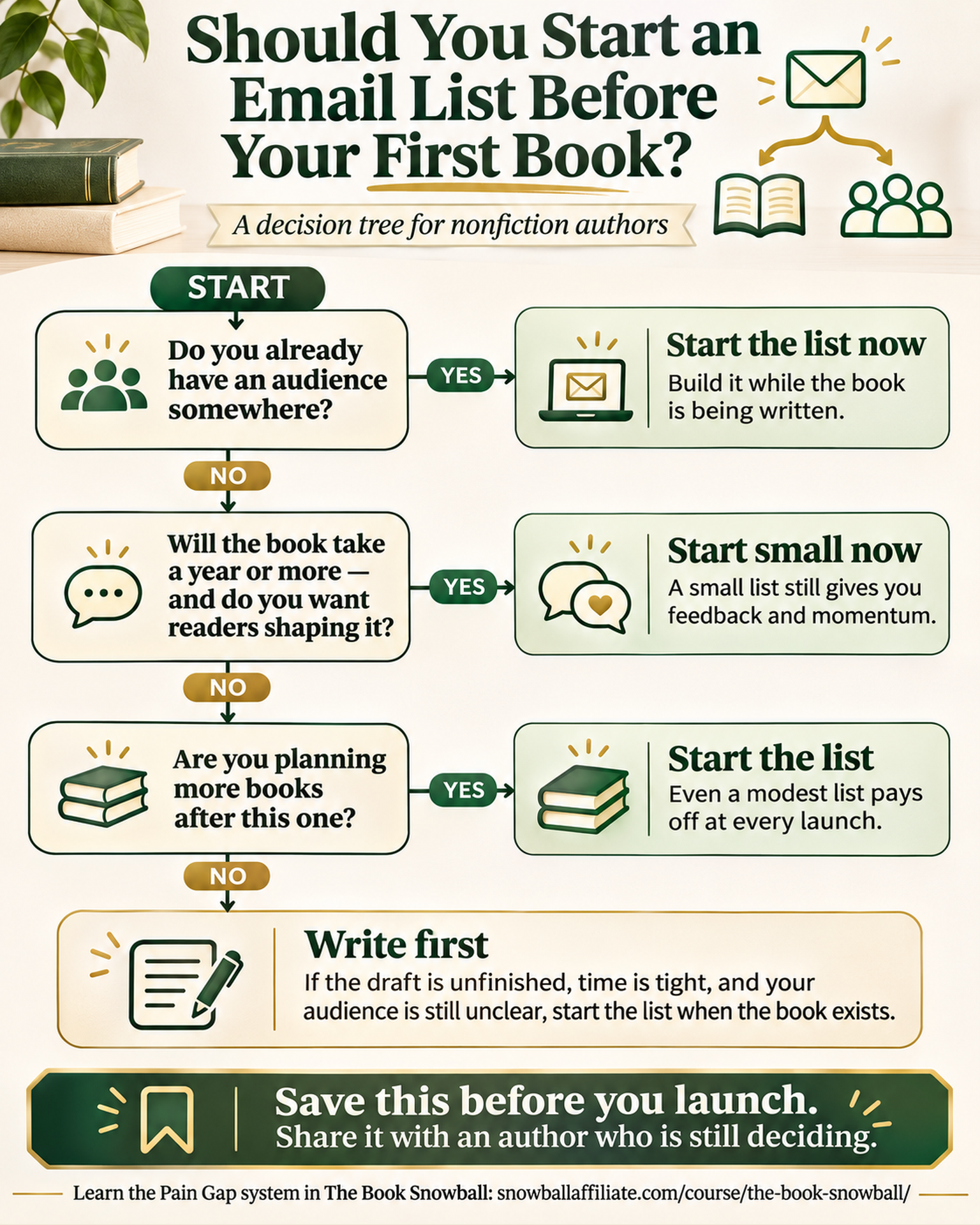
Who Benefits From Starting a List Before Book One
A pre-book list makes the most sense when one of these describes you.
You already have a topic and an audience, and you talk to them regularly. Maybe you teach workshops, run a small practice, coach people, or write about your subject somewhere public. You already have people who care about what you know. A list gives those people one place to hear from you, instead of leaving you scattered across platforms you don’t control.
You’re writing a long book and want readers to shape it. If the manuscript will take a year or more, early readers can be valuable. They can tell you which questions they’re asking, which chapters they’d read first, and where your explanations lose them. A small group that replies to your emails is worth more than a large group that never does.
You plan to write more than one book. If you already know there’s a second or third book in your future, building even a modest list early means you aren’t starting from zero each time. I’d call this a long-term argument, though, and it shouldn’t pull you away from finishing book one.
You enjoy writing to people in short form. Some authors find that writing a short email now and then keeps their thinking sharp and their momentum up. If it feeds your writing, it’s worth doing. If it feels like a chore, that tells you something too.
Notice what’s missing from this list: “because everyone says to.” That reason alone isn’t strong enough to justify the work.
Who Should Write First and Build the List Later
For a lot of first-time authors, my honest advice is to finish the draft first. That’s especially true if one of these fits.
You haven’t finished a full draft yet. Until you have a complete manuscript, the book is the bottleneck. Everything else can wait. A list can’t help a book that doesn’t exist, and a half-finished book can’t be saved by a well-tended list.
You don’t have an established audience or topic focus yet. If you’re still figuring out exactly who the book is for, starting a list too early means you’ll attract people for a book you may end up not writing. Sometimes the writing itself clarifies the audience. Letting the draft show you who it’s for isn’t a failure of planning.
You tend to use side projects to avoid the manuscript. Be honest with yourself here. Setting up a signup page, picking an email service, designing a welcome message, and tweaking a logo can feel productive for weeks. If that’s your pattern, the list is a more comfortable way to not write.
Your time is genuinely tight. If you have a few hours a week to give this project, spend them on pages. Pages are the one thing nobody else can produce for you.
Writing first doesn’t mean you can never have a list. It means the list comes after you have something to put in front of people. Nothing about the book’s success is lost by waiting.
What a Pre-Book List Can Realistically Do (Feedback, Launch Readers, Second-Book Continuity)
I want to be careful here, because this is where a lot of advice gets inflated. A list built before your book exists won’t make the book succeed, and I can’t promise any particular number of subscribers or any particular result. What it can do is more modest and still useful.
Feedback. If you share what you’re working on and ask a real question, such as “Which of these two chapter ideas would help you more?”, some readers will answer. Those answers can improve your outline, your examples, and your word choices. This only works if you actually ask and actually listen. A list you only talk at gives you nothing back.
Readers who might be ready when you launch. People who’ve followed along may be more likely to notice when the book comes out, and a few may be willing to read an early copy and leave an honest review. I’d treat any of that as a possibility, not a plan. Some people will forget you, unsubscribe, or never open a thing. That’s normal.
Continuity into book two. If you do write another book, the people who’ve been hearing from you already know your voice and your subject. That’s a real advantage for a second book. It’s also the least urgent benefit, since you can’t collect it until the first book is done.
None of these outcomes is guaranteed. Think of a pre-book list as a modest way to stay close to your readers, and don’t expect it to market the book for you.
The Tradeoff Nobody Mentions: Time Spent Listing vs. Time Spent Writing
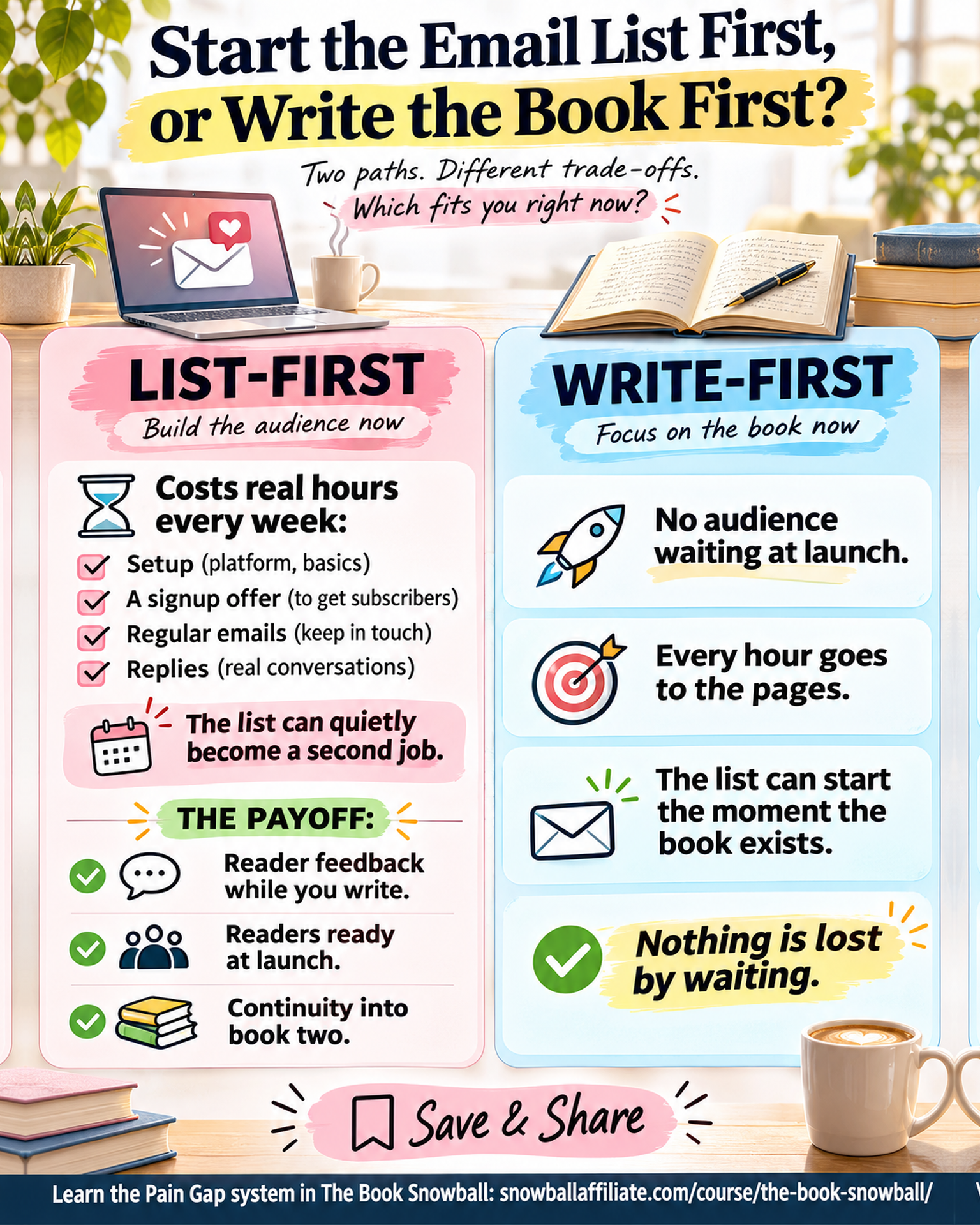
Every hour you spend on a list is an hour you don’t spend on the manuscript. People rarely say that out loud, because “build your list” sounds like free upside. It isn’t free. It’s a trade.
Here’s what the time actually goes to:
- Choosing and setting up an email service
- Creating something people would want to sign up for
- Writing emails on a regular basis, not just once
- Checking replies and answering them
- Keeping the whole thing from drifting
Done lightly, that can be small. Done seriously, it can quietly become a second job. I’ve watched authors slide from “I’ll send an email now and then” into spending more evenings on their newsletter than on their book.
A simple test: set a cap before you begin. Decide how many hours a week the list gets, and hold to it. If you can’t keep it under that cap without the manuscript suffering, that’s your answer for now. Pause the list and finish the draft.
It’s also fine to want a complete picture of the whole path, from draft to published book, before you decide where a list fits. If you’re comparing structured training options for that, see Best Self-Publishing Courses for First-Time Nonfiction Authors. Whatever you choose, pick based on what you need to learn, and don’t let it become another reason to delay the draft.
If You Start Now, Start With One Useful Reason to Join
Say you’ve weighed all this and decided a list makes sense for you. Keep it small and simple.
“Sign up for updates” is a weak reason to join. Almost no one is waiting for general updates from an unpublished author. Offer one specific, useful thing instead. A few examples of the kind of reason that works:
- A short email series that answers the one question your future readers keep asking
- A plain-language checklist, template, or summary related to your book’s topic
- Occasional notes about what you’re learning while writing, aimed at people who care about the same problem
The test is whether it helps someone who never buys your book. If it only works as a pitch, it won’t earn trust. If it’s useful on its own, people will stay.
Then keep the setup light:
- Pick one email tool and one signup page.
- Write one clear promise of what people will get and how often.
- Send something at a pace you can keep up without resenting it.
- Ask a question now and then, and read the answers.
Skip the elaborate funnels, the multiple lead magnets, and the redesigns. You’re not building a business yet. You’re starting a small, honest conversation with the people your book is for.
Once Your Book Exists, the Job Changes
Everything above applies to the stretch before your book is published. Once the book exists, the question stops being “should I start a list?” and becomes “how does my book connect to people who want more from me?”
That’s a different problem with different tools. A published book is something readers can find, and it can lead them somewhere. One note on how: Amazon doesn’t allow links inside a book that go straight to a form collecting customer information. The usual approach is to have the book point readers to a resource page on your own site, with any signup one click further along from there.
I cover that in full in a separate piece, so I won’t repeat it here. If you’ve finished your book, or you’re close, read How to Build an Email List With a Nonfiction Book. It picks up where this article leaves off.
If your book isn’t finished yet, don’t worry about any of that today. Decide whether a list serves a clear purpose for you now. If it does, start small. If it doesn’t, go write. Both are reasonable, and the book is the part that only you can do.