

You went looking for the best affiliate niche for beginners with a full-time job, and you picked it the way everyone said to. You chased the profit lists. Now the site wants feeding every week.
It wants new posts. It wants constant updates. Some topics expire before you finish writing about them.
Your job gives you a few evenings and part of a weekend. The niche doesn’t care. Miss two weeks and the site stalls. Drafts pile up. Your side hustle starts to feel like a second shift you pay for.
This post stops that before it starts. It’s written for the part-time affiliate marketer working around a 9-to-5 schedule. It asks ten questions. Each one tests a niche against the hours you actually have.
Answer them before you commit. At the end, you’ll also see how a free Niche & Offer Fit Scorecard scores a niche against your situation, hours included.
What Gut-Feel Answers Cost You
You can answer these questions in your head. Most people do. It costs more than you think.
Your head is a flattering witness. It says “ten hours a week” when the real number is four. It forgets the week your boss dumped a deadline on you.
A wrong answer here doesn’t show up today. It shows up in month three, as an abandoned site.
So you need a record. You need the same questions asked the same way about every niche. That is what the Scorecard does.
The Niche & Offer Fit Scorecard turns the questions in this post into a score. Every niche on your shortlist gets counted the same way: hours, upkeep, and fit.
You compare niches on evidence instead of enthusiasm. Read the ten questions first. Then you’ll know what the score measures.
Table of Contents
Part One: Your Weekly Time Commitment on a 9-to-5 Schedule
Three questions about the hours you really have, before any niche enters the picture.
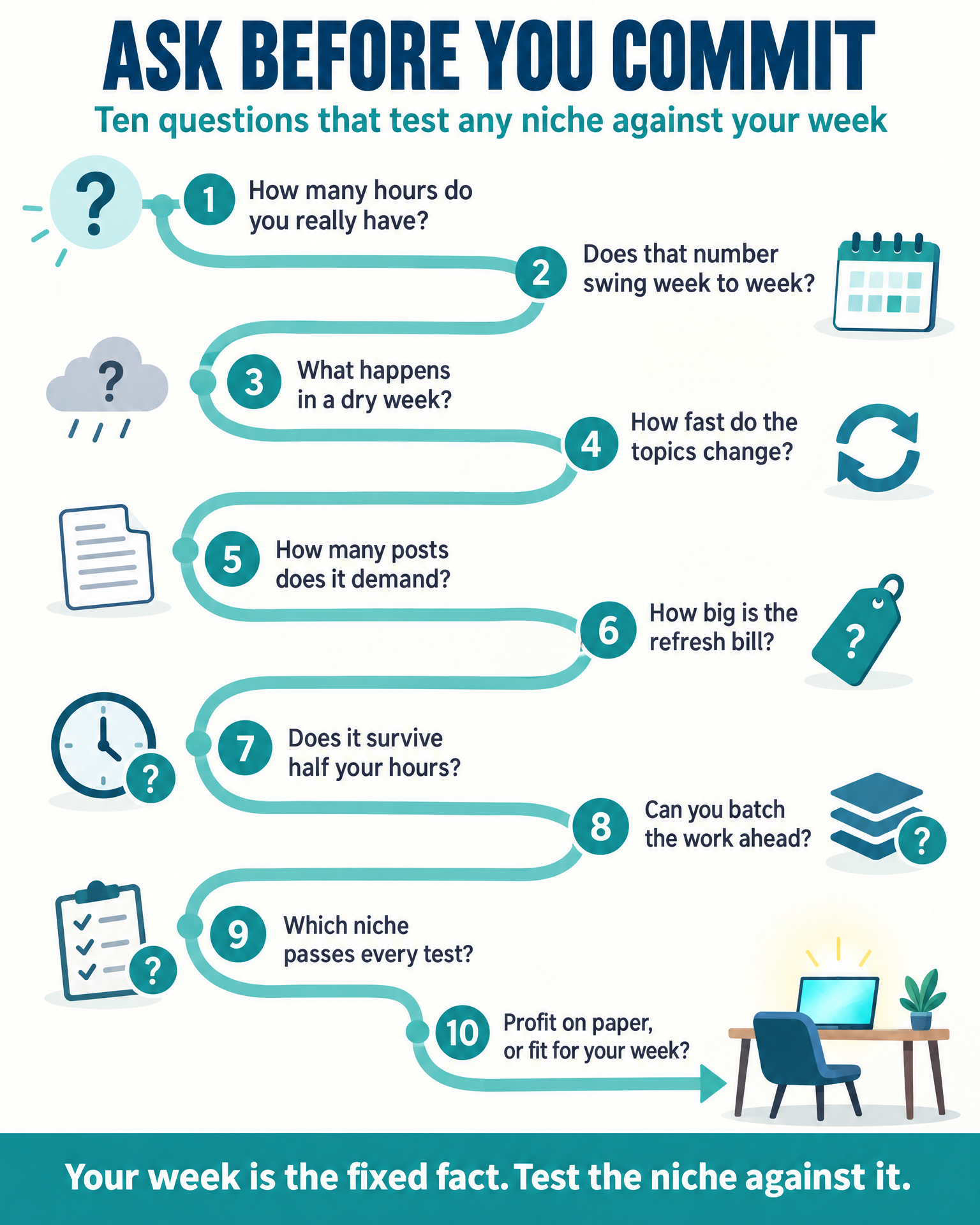
Question 1: What Is Your Real Weekly Time Commitment After the Job, Family, and Sleep?
Start with the week you actually live. Subtract work. Subtract the commute. Subtract sleep, meals, and the people who need you.
What’s left? Write that number down. It is your weekly time budget: the evening and weekend hours you can realistically commit to your site. Full-time employees have limited weekly hours for site building, so the first job is to name yours instead of guessing.
Here’s a made-up example, there only to show the logic, not to hand you data. Four evenings of one hour each, plus two hours on Saturday, is six hours. Don’t count hours you’d “find” by sleeping less. Those hours vanish the first tired week.
Whether your number is five hours a week or fifteen, the rest of the test works the same way. A small number isn’t a verdict. It only tells you how much niche you can afford.
Everything else in this post depends on that number. Keep it in front of you.
Question 2: Is Your Weekly Time Budget the Same Every Week, or Does It Swing?
Think about last month. Did every week match? Probably not.
Don’t guess. Open your calendar and count the free evening and weekend hours in each of the last four weeks. Write the four numbers side by side.
Maybe one week had a work trip. Maybe another had a sick kid. Real schedules swing.
Here’s another made-up example. Six hours one week, one hour the next, three the week after. The average looks fine. But the average hides the bad weeks, and the bad weeks are the ones that break a site.
So which number should you plan around? The best week, or the worst? Plan around the worst week. Life will hand you plenty of those. A plan built on your worst week is a realistic content schedule. A plan built on your best week is a wish.
Question 3: What Happens to a Site That Needs Feeding When You Have No Free Hours?
Be honest. What happens?
A site that needs weekly posts falls behind the first time you miss one. Then you miss another. Then guilt arrives.
Guilt makes you avoid the site. Avoiding the site ends it. That’s how most abandoned sites die.
A dry week shouldn’t be a crisis. So you need a niche that forgives a dry week. What decides that? The topics themselves.
Notice what this question is really about. It isn’t about discipline. Anyone on a 9-to-5 schedule will have dry weeks. The only thing you control is how much the niche punishes them. Some niches shrug off a missed week. Others answer it with stale posts and a growing backlog. That difference is the ongoing content demand, and Part Two shows you how to measure it.
Part Two: Niche Time Fit and the Evergreen vs. Fast-Moving Split
Question 4: How Often Do Your Niche’s Topics Change? Will Last Year’s Post Still Stand?
Pick one niche from your shortlist. Imagine a post you’d write today. Now fast-forward one year.
Is it still true? Or has the topic moved on?
Some topics change slowly. Others change every month. Some swing with the seasons, and some stay put all year. That’s the line between seasonal vs. evergreen topics, and it drives niche time fit.
This is the split between evergreen and fast-moving niches. Fast-moving niches demand constant publishing and revisions. Slow-changing topics let a post keep working while you sleep. Evergreen niches need less frequent content updates, which is what makes a low maintenance niche possible at all.
Ask it plainly. How often would you have to touch a post to keep it right? Once a year? Once a month? The update frequency of your niche’s topics sets the minimum weekly maintenance you’re signing up for.
Which kind can your six hours feed (the made-up number from Question 1)? If you want to see the slow end of this scale, this guide to evergreen niches shows what it looks like.
Question 5: How Many Posts Does the Niche Demand Before It Covers Its Topics?
Now count the topics. Think about what a newcomer to this niche would ask. List those questions.
You can skim search suggestions for a rough count. Any keyword research tool you already use works too. You don’t need precision. You just need a feel for the number of topics to cover.
Here’s the real question. Does the list end? A handful of evergreen pillar posts can cover some niches. Others need an endless stream chasing news.
Try a made-up example. Say a niche needs 30 posts. At one post every two weeks, that takes about 60 weeks.
That’s long, but it ends. You can drop those made-up 30 posts into a content calendar and see the finish line. A news-driven niche never ends. Your ongoing content demand never drops to zero.
This gap matters when you have limited hours. A list that ends gives you a publishing frequency you can sustain. A list that never ends turns your side hustle workload into a job you can’t finish.
Question 6: How Much of Your Limited Time Goes to New Posts, and How Much to Refreshing Old Ones?
Every post you publish creates a future chore. Prices change. Links break. Facts go stale.
Picture a content refresh checklist. Check the facts. Check the links. Check the dates. Check what’s changed.
Each item costs minutes. Across many posts, it costs hours. That’s your true maintenance bill, and new site owners often forget to count it.
Say you have six hours (made-up). If refreshing eats three, only three remain for new posts. Content refresh needs increase ongoing upkeep hours, and those hours come out of the same small budget as your new writing. In a fast-moving niche, that bill grows with every post you publish.
In a slow-changing niche, it stays small. You give older posts a light check now and then, and a simple content refresh schedule is enough. Which niche on your list has the smaller bill?
Part Three: Which Affiliate Niche Fits Around a Full-Time Job
Question 7: Which Niche on Your Shortlist Still Fits If Your Weekly Hours Get Cut in Half?
Take out your niche shortlist. It exists to narrow your options before you make a final choice, so keep it short. If it’s too long, this post on choosing when you have too many ideas helps you trim it.
A list of affiliate niche ideas for people with a busy schedule can only sound good until you run it through this cut. The cut shows which ideas survive your real calendar.
Now cut your hours in half. Six becomes three. Run each niche again.
You may think you’ll just work harder. Maybe you will, for a month. But halving isn’t a wish. It’s a normal Tuesday in a busy season.
Which niches survive? Cross off any that need daily content. A beginner niche that needs daily content can’t live on evenings and weekends. What’s left is a short list of low time commitment affiliate niches. Those are the only ones worth testing further.
Question 8: Can You Batch Content Creation and Still Publish at a Sustainable Pace?
Batch content creation is simple. You block out one longer session. You draft several posts at once. That’s a batch-writing session.
Then you publish them slowly. One a week works fine. Your site looks consistent even when your life isn’t. Batch writing helps part-time marketers publish consistently, because the writing happens when you have the time and the publishing runs on a steady rhythm.
Picture one Saturday morning. You draft three posts. You publish one per week while you’re away on a trip. That’s a realistic content schedule for a part-time affiliate marketer.
But there’s a catch. Will those drafts still be right in three weeks? In a fast-moving niche, they go stale on the shelf. Batching only works when topics move slowly. So Question 4 decides Question 8.
If you can’t batch, your pace falls back to whatever each week allows. That’s the dry-week problem from Question 3 all over again.
Question 9: Which Niche Passes Every Test and Fits Around Your Full-Time Job?
Put your answers together. You’re looking for a niche that does four things.
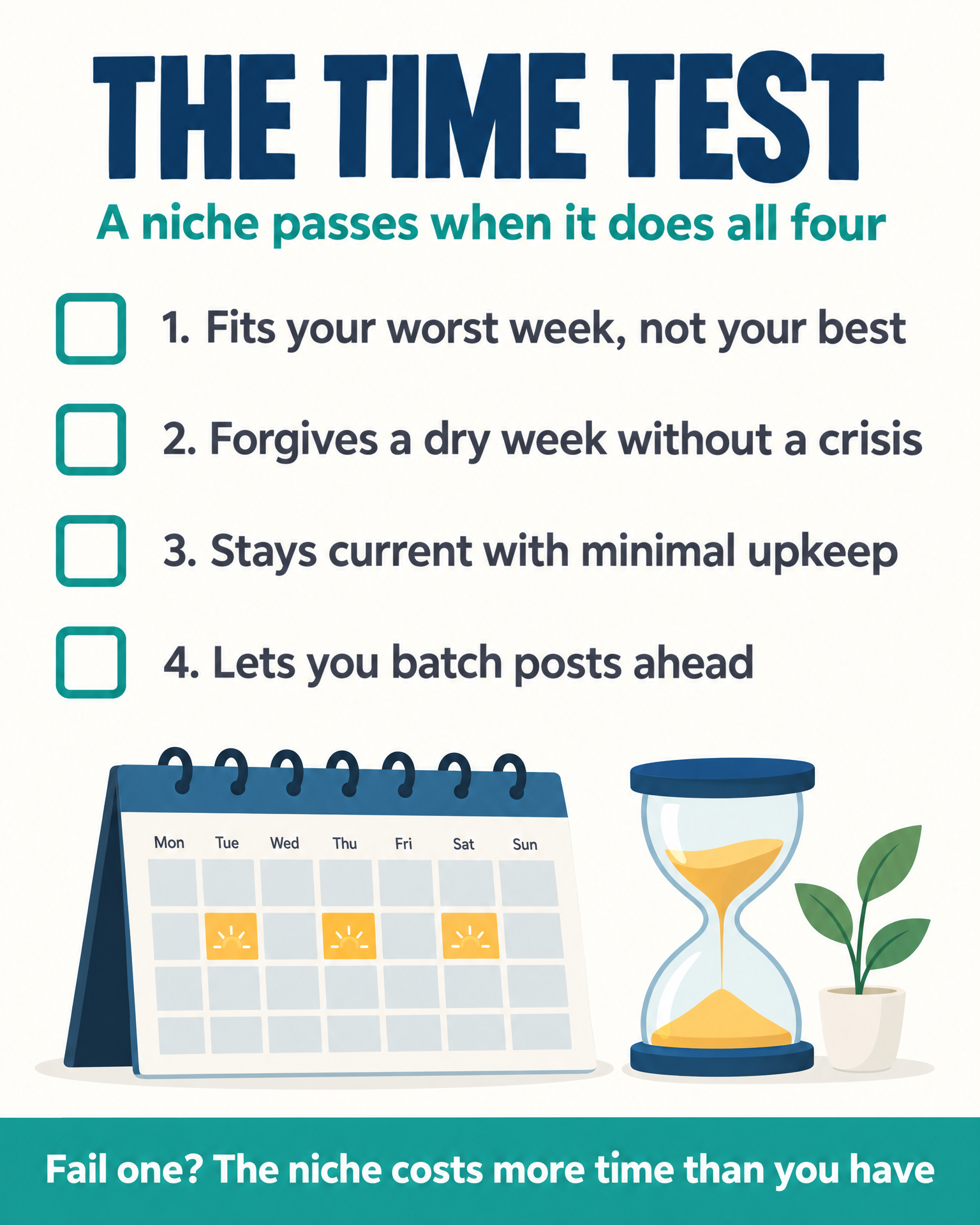
- It fits your weekly time commitment, even in your worst week.
- It survives dry weeks without a crisis.
- It stays current with minimal weekly maintenance.
- It lets you batch ahead.
Build a simple niche comparison spreadsheet. Put your niches in the rows. Put hours needed, publishing frequency, topic count, and refresh load across the top.
Mark each cell pass or fail. Look at the rows. Which niche passes every column?
That row is your answer to how to choose an affiliate niche when you work full time. You aren’t hunting for the easiest affiliate niche to start while working full time. You’re hunting for the one whose workload you can carry week after week.
Maybe none do. That tells you something too. Your shortlist needs new candidates, or your hours need a second look.
One honest limit: this spreadsheet scores time fit only. It doesn’t predict income, and it isn’t meant to.
Part Four: The Choice Between Profit on Paper and Time Fit
Question 10: Is the Best Niche the Most Profitable One on Paper, or the One Your Week Can Actually Carry?
Think about a niche that pays well on paper. Now think about abandoning it in month three. What does it pay then?
Nothing. A profit forecast means nothing if the site dies of neglect.
A well-fitted niche prevents burnout and abandoned sites. That is burnout prevention built into the choice itself, before you write a single post.
Profit still matters. Time fit is the first screen, not the only one. You apply it before the profit math, not instead of it. For the money side, the profit-first niche guide covers it.
So what’s the best affiliate niche for beginners who work 9 to 5?
The best affiliate niche for beginners with a full-time job is the one that passes the time test. It fits your worst-week hours, forgives a dry week, stays current with minimal weekly maintenance, and lets you batch posts ahead. A niche that clears all four keeps you publishing.
You just answered it yourself. Your own ten answers built the test.
Run the Time-Fit Test on Your Niche Shortlist Tonight
No guru’s list can name the best affiliate niche for beginners with a full-time job. Only your week can.
A niche that fits your hours keeps you publishing. A niche that ignores them burns you out. Your week is the one fixed fact, so build around it.
Tonight, take one niche from your shortlist, grab a pen and paper, and run all ten questions on it in order. Write every answer down. Don’t trust your head. Then run the next niche.
Products / Tools / Resources
Everything below is free. The method needs nothing more.
- A pen and paper. Do an honest count of your week. Track your real evening and weekend hours for Questions 1 and 2.
- A simple spreadsheet or doc. Use it for your niche comparison. Rate each niche on weekly hours, publishing pace, topic count, and refresh load.
- **The free Niche & Offer Fit Scorecard.** It scores each niche on your shortlist against your situation, hours included.