

You publish a post. Then another. Each one comes from a random keyword idea.
Meanwhile, your review sits alone. Nothing sends it readers. Nothing tells Google your site owns this topic.
If you built your site from random keyword lists, you know the feeling. Every new post makes it worse. It adds one more island and one more page competing on its own.
The keyword list grows. The site stays a pile instead of a structure.
This post fixes that. It shows how to build a topic cluster for an affiliate blog, step by step, around one money page. It is the construction method that problem calls for.
There’s also a free tool made for exactly this build: the Content Node Planner. More on it in a moment.
What Mapping a Whole Cluster Costs When You Do It on Sticky Notes
Try planning a cluster the usual way. Ideas live on sticky notes. Keywords sit in one doc, and half-finished outlines sit in another.
Nothing shows the whole picture. You hold the cluster in your head, and your head forgets. A post gets written twice. Another never gets linked.
The Content Node Planner is the one-page map of this article’s build. It lists every page in the cluster, its role, its keyword target, and its links. You draw the cluster once instead of carrying it around in your head.
Keep it nearby as you read. Each step below fills in one more part of the page.
Table of Contents
Why a Money Page Needs a Topic Cluster Around It
Let’s begin with something simple. Your money page is the review, comparison post, or buying guide that earns commissions. That is its whole purpose. A product review covers one product. A comparison post sets two or more against each other. A buying guide helps readers choose within a category. Each one is the page you want readers to reach.
Here is the next obvious point. A money page earns nothing until readers reach it. A perfect review that nobody opens pays zero. Better writing doesn’t fix that. Affiliate conversions start with a reader who arrives.
Now think about how readers arrive. They don’t land on your site. They land on one post, from one search.
Picture a reader typing a question into Google. They click one result. That page is their entire first impression of you.
So the post they land on matters a lot. It may not be your review. In fact, it usually isn’t. The distance between the post a reader lands on and the page that pays you is the gap a topic cluster closes.
What Questions Do Readers Ask Before They Buy an Affiliate Product?
Think about how you shop for anything pricey. You don’t jump straight to “best espresso machine.” You ask smaller questions first.
Take a beginner who wants home espresso. Before they read a review, they might wonder:
- What is an espresso machine, exactly?
- How does one actually work?
- What does café coffee cost compared to making it at home?
- What mistakes do beginners make?
- What are the alternatives?
These are example questions, not data. They show the pattern. A reader who isn’t ready to buy asks earlier questions first, and that holds for any product you review.
Each of these questions carries informational intent. The reader wants to learn something, not buy yet. Questions like these get typed into a search box.
Here is the part that’s easy to miss. Someone will write a post answering each question. Search results will fill up with them. You don’t have to take that on faith. Type any one of those questions into Google and look at who answers it.
So the only choice you have is where those answers live. They can live on a competitor’s site. Or they can live on yours.
And on your site, they can point somewhere. A post that answers “what mistakes do beginners make” can point to your review. A post on another site won’t.
How Internal Linking Passes Link Equity and Builds Topical Authority
A link is a path. It’s the simplest thing on the web. A reader finishes one post and sees where to go next.
Suppose each question-post links to your money page. Then every reader who lands on one has a road to the review. Without that link, they read the answer and leave.
Links carry something else too. When one page links to another, it passes a little authority along. SEOs call this link equity. Your supporting posts can pass theirs to the page that earns.
Now look at it from Google’s side. Google can’t read your mind. It reads your links. The words inside each link count too. Descriptive anchor text signals what the linked page is about. A link that names the review tells Google more than a link that says “click here.”
When many posts on one subject point to one page, the pattern says something. It says this site covers the topic in depth. That’s topical authority.
Topical authority improves rankings for the money page. The posts around it give it semantic relevance, so it isn’t a lone page making claims. No structure can promise a ranking. But a page with a cluster behind it has something a lone page lacks: proof, in your own links, that your site covers the subject.
What a Pillar and Cluster Structure Looks Like on an Affiliate Blog
Put those facts side by side. A money page needs readers. Readers arrive through earlier questions. Those questions become posts, and the posts link to the page.
Now ask what shape that makes. One page sits in the center. Every other post has a job: answer one question, then point to the center.
That shape has a name. It’s a topic cluster. It also goes by pillar and cluster structure, or the hub-and-spoke content model. Some people call the finished result a content hub.
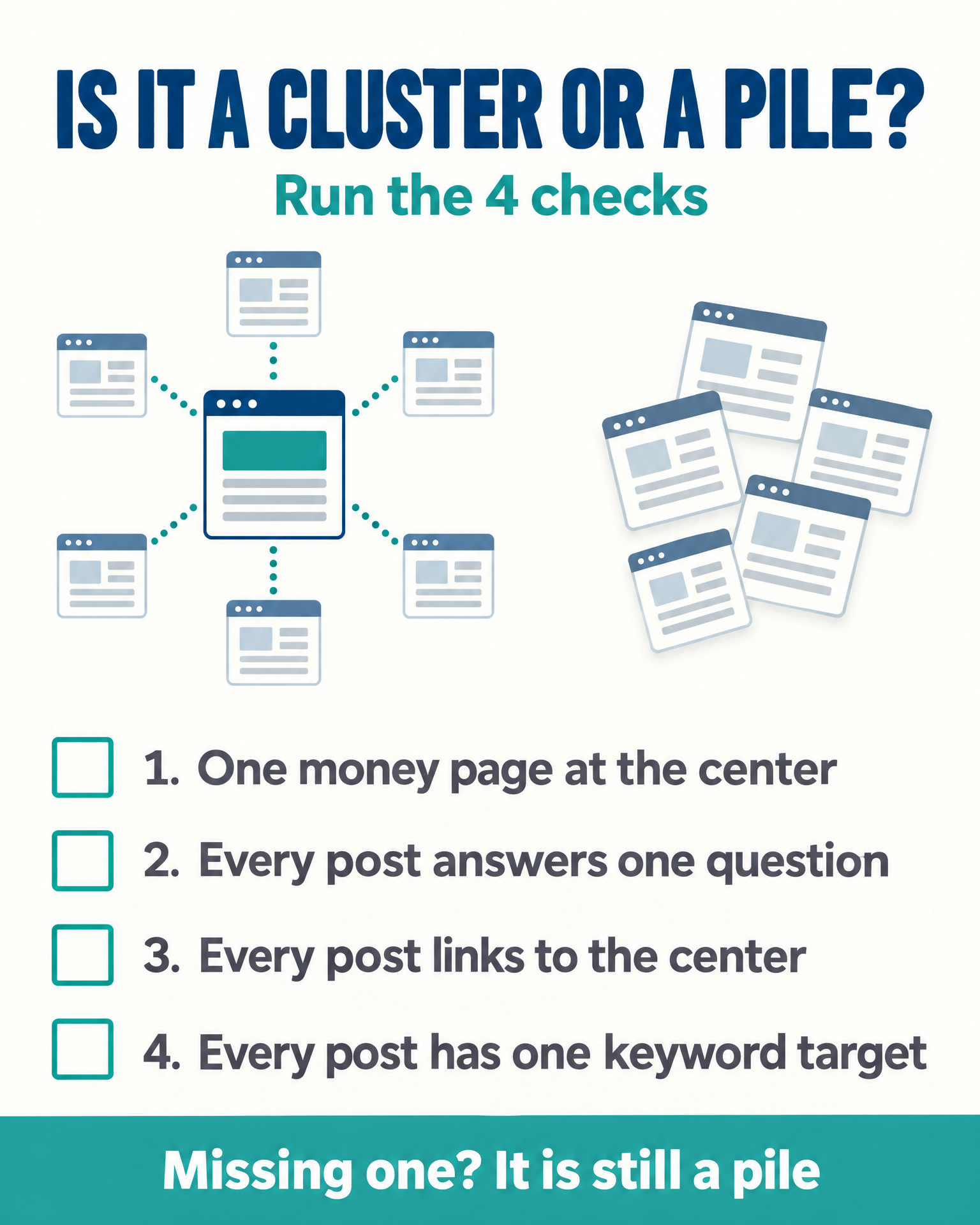
It isn’t a trend. It isn’t a trick. It’s just what a site looks like when every post has a purpose.
One quick note, so you don’t mix it up with something else. A cluster is not the same as a blog category. Categories sort your posts. Clusters wire them together. If you want that difference spelled out, read how to organize blog categories without overlapping topics.
The cluster also fits the bigger picture of beginner, middle, and buyer content. That’s covered in how TOFU, MOFU, and BOFU content fits together. You don’t need it to build this.
So what’s the obvious next move? Build one cluster around one money page. Here’s the short answer first, then each step in full.
How do you build a topic cluster for an affiliate blog?
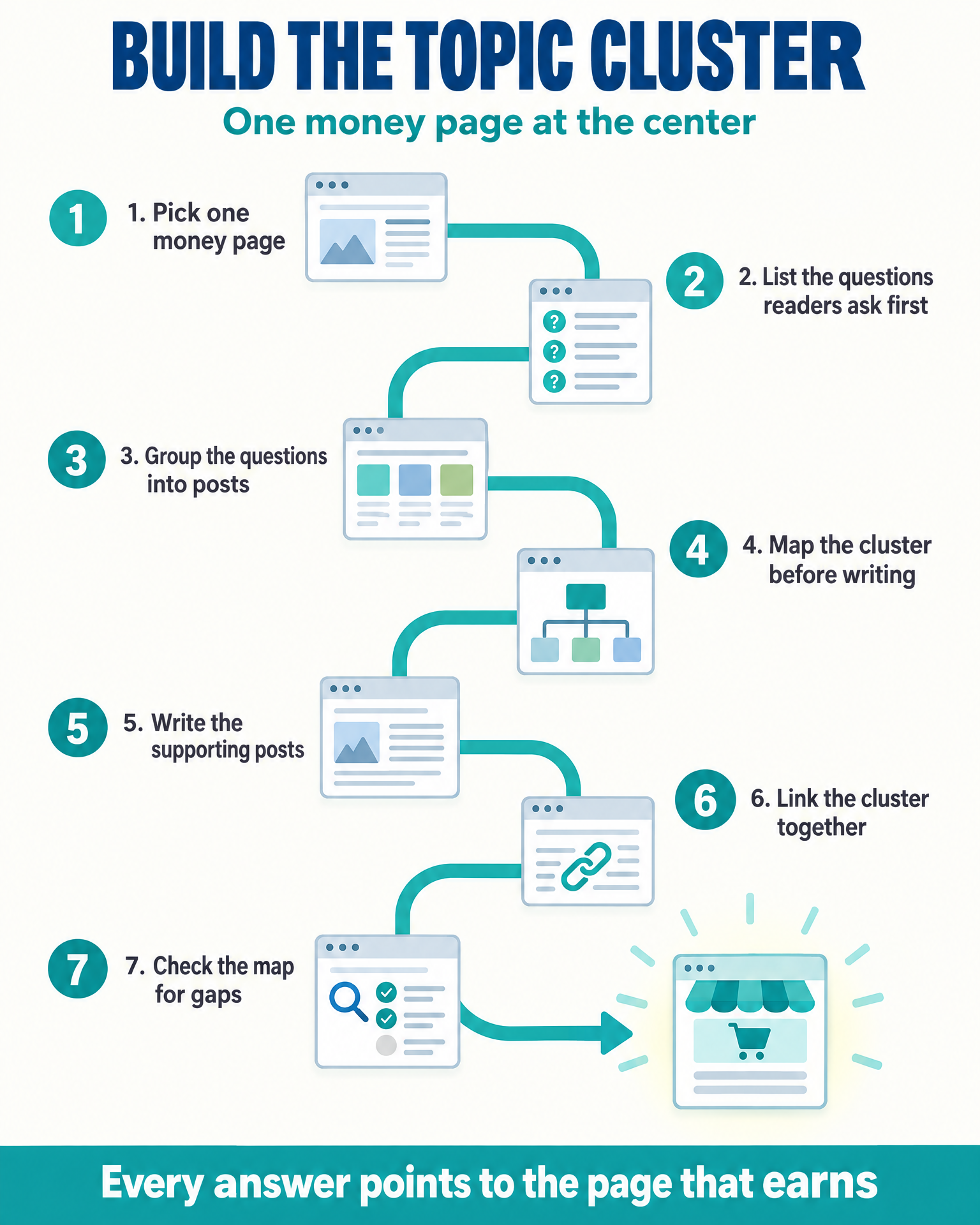
Center the cluster on one money page, then surround it with linked posts that answer the questions readers ask first:
- Pick one money page.
- List the questions readers ask first.
- Group the questions into posts.
- Map the cluster before writing.
- Write the supporting posts.
- Link the cluster together.
- Check the map for gaps.
Steps 1 to 3: Choose the Money Page and Plan the Supporting Posts
The first three steps decide what goes into the cluster. Nothing gets written yet.
Step 1: Pick One Money Page for Your Affiliate Topic Cluster
Choose a product review, comparison post, or buying guide. It can already exist. It can also be the next one you plan to write.
This becomes your pillar page, the center of the cluster. One cluster gets one center. Don’t start with five. Five centers means five maps and no finished cluster. Write the page’s name at the top of your map. Every other page gets measured against it.
Step 2: List the Questions Readers Ask Before They Buy (Keyword Research)
Take a seed keyword for that money page. For our example, that might be “best beginner espresso machine.”
Now list every question a reader must answer before they’re ready for it. Think what, how, cost, mistakes, and alternatives. In the espresso example, the five questions from earlier are the start of your list. Many of these are long-tail keywords. Those are the specific phrases a reader types when they have one specific question.
Collect them in a keyword research spreadsheet. A plain one works fine. One column for the question, one for the search phrase.
Keyword research identifies your cluster topics. That’s its job here. You aren’t trying to cover your whole niche. You’re listing the questions that stand between a reader and this one page.
Step 3: Group Questions Into Posts With SERP Analysis and Search Intent
Now sort the list. This is keyword clustering: grouping related search phrases so each post gets one clear target. Search each question and look at the SERP results page. This is quick SERP analysis.
Search intent decides what you see. Some questions need their own post. Others fit as a section inside a bigger post. If the results show a full page built around that one question, it earns its own post. If several questions share one answer, fold them together.
Most of your questions will have informational intent. These become supporting informational posts. A few sit closer to buying, with commercial investigation intent. Those are your buyer-intent keywords. Search intent determines the type of supporting post, so let the results page guide the format.
Then give every planned post one distinct keyword target. This is the cannibalization guard. Two posts chasing the same phrase compete with each other. Distinct targets prevent that.
Steps 4 and 5: Map the Cluster, Then Write the Supporting Posts
Step 4: Map Your Topic Cluster Before You Write
Don’t write yet. First, lay everything out on one internal link map. This is the content mapping step. It shows in one view which posts link to the money page and to each other.
For each page, write down three things:
- Its keyword target.
- Its job in the cluster.
- Which pages it links to.
The Content Node Planner does exactly this. A spreadsheet works too. Either way, the money page goes in the middle and every post gets a row.
Here’s a good test. If you can’t draw the cluster, you don’t understand it yet. Fix the drawing before you write a word. A cluster you can’t draw is just a list of posts hoping to become one.
Step 5: Write the Supporting Posts Around Your Money Page
Now write. Each supporting post is a spoke. It covers one question completely. Open the map, take one row, and write what that row says.
Stay on that one question. Don’t wander into the review’s territory. If a post tries to answer everything, it ends up answering nothing well. The review has its own job. The supporting post’s job is to answer one question and hand the reader on.
Write them one at a time. Finish a post, then move to the next. That’s how one person with a full-time job gets a cluster done.
Steps 6 and 7: Internally Link Supporting Articles and Check for Gaps
Step 6: Internally Link Supporting Articles to Your Affiliate Review
Links turn separate posts into a cluster. Follow three simple rules.
- Every supporting post links to the money page. Use descriptive anchor text. “Our beginner espresso machine review” tells Google what the page is about. “Click here” tells it nothing.
- The money page links back out to supporting posts. Do this only where a reader needs more depth. A short explainer link works well there.
- Supporting posts link sideways to each other. Do this only when the connection is real. Forced links confuse readers.
Then check your work. Open each supporting post and find the link to the money page. If you can’t spot it fast, a reader won’t either.
Good internal linking is how supporting articles hand authority to the page that earns. For a deeper look, see how to plan internal links that move readers toward buying content.
Step 7: Check the Cluster for Gaps With a Content Gap Analysis
Last, compare your finished map to your questions list. This is content gap analysis. It reveals missing supporting topics.
Look for two problems:
- A question with no post. That’s a hole in the cluster. Add a supporting post.
- A post with no link to the center. That’s a spoke attached to nothing. Add the link, or ask why the post exists.
When both lists come up empty, the cluster is complete. Every question has an answer. Every answer points to the page that earns.
You Already Agreed to Build a Topic Cluster for Your Affiliate Blog
Look back at what you accepted along the way. A money page earns only when readers reach it. Readers arrive through earlier questions. Someone will answer those questions.
You also agreed that links give those readers a path. And you agreed that Google reads those links as a map of what your site knows.
Nothing in that chain was new. You nodded at every step. The cluster is simply where those nods land.
So stop adding to the pile. Pick one money page. Open a spreadsheet or the Planner. Put that page in the center and map its cluster before you write anything else.
Products / Tools / Resources
Everything in this build is free.
- Google Search Console: See which searches already show your pages, and check results against search intent.
- A simple spreadsheet or doc: Collect your questions, keyword targets, and cluster map in one place.
- **Content Node Planner:** The free one-page map for every page in your cluster, its role, its keyword, and its links.