

You picked your topic. You sat down to outline, and what came out was a list: history of the subject, key terms, common mistakes, tools, case studies, resources. Every item is true and every item is something you know. Read top to bottom, though, it’s a pile of facts in a plausible order.
I’ve seen this a lot, and it’s a quiet problem. A list like that feels like progress, so you start drafting. Then around chapter four you can’t say why the book needs to exist, or why chapter five comes before chapter six. Readers feel the same thing. They finish a chapter informed but unchanged, and they stop reading.
The fix is to stop outlining around your topic and outline around one problem your reader has. Here’s the method, step by step.
Free download: The Nonfiction Manuscript Momentum Planner. When you build your outline around your reader’s main problem, every chapter has a job. The planner helps you do that. Its Chapter Blueprint Grid shows, for each chapter, the reader question it answers, its practical takeaway, key teaching points, evidence needs, and how it connects to the next. Then use the drafting cards, repetition audit, promise alignment test, seven-day sprint planner, and quality gate to write and check your draft.
Table of Contents
Why Most Nonfiction Outlines Fail (topics listed, problem ignored)
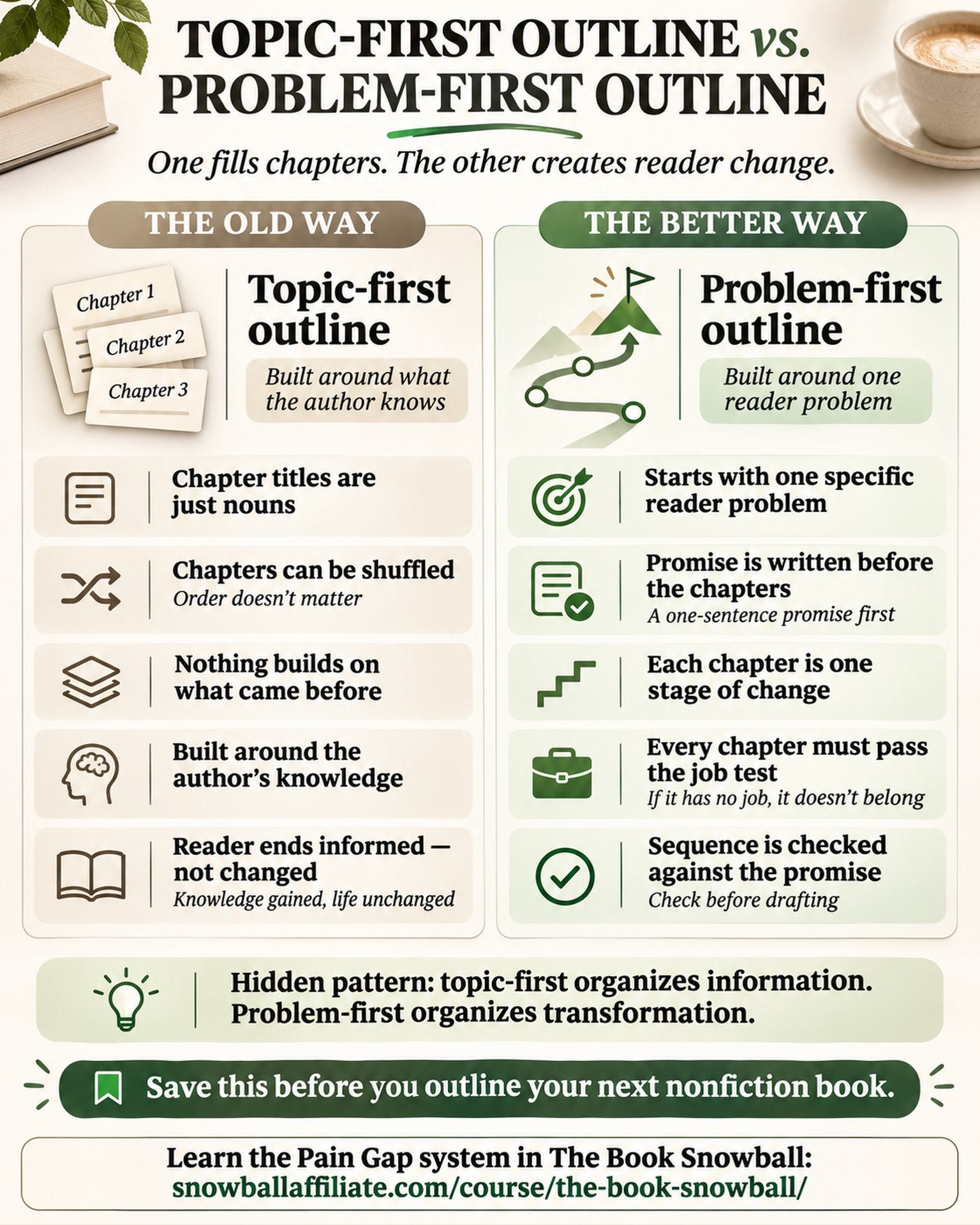
Most first outlines are built by asking, “What do I know about this subject?” That question produces topics. Topics are easy to list, easy to defend, and easy to shuffle around, and that’s the trouble. If you can drag any chapter to any position without anything breaking, the outline has no spine.
A topic-based outline has a few telltale signs:
- Chapter titles are nouns. “Nutrition.” “Marketing.” “Mindset.” Each one names a subject area, not something that happens to the reader.
- The order is arbitrary or merely logical. “Basics first, advanced later” sounds sensible, but it’s the order a textbook would use. It says nothing about the order in which a struggling reader actually needs things.
- No chapter depends on the one before it. You could read them out of sequence and lose nothing.
- You can’t say what the book is for in one sentence. You can say what it covers, but that’s different.
The deeper issue is that a topic outline is organized around the author’s knowledge. A reader doesn’t pick up a nonfiction book to receive your knowledge. They pick it up because something in their life isn’t working, and they hope you can help.
So the question to ask isn’t “What do I know?” It’s “What is this reader stuck on, and what has to happen, in what order, to get them unstuck?”
Step One — State the One Reader Problem and the Promise
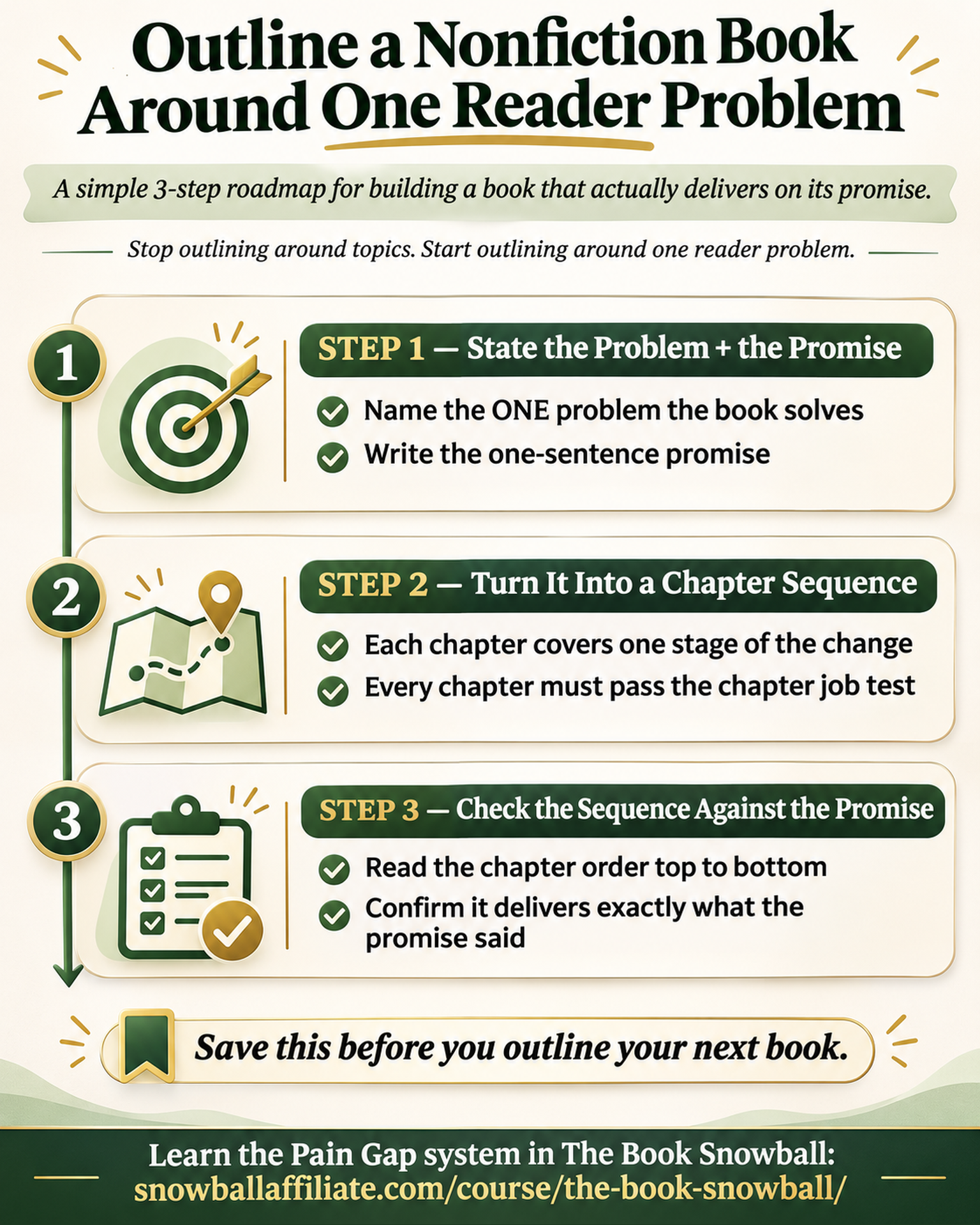
Before you list a single chapter, write two things: the reader and their problem, then the promise your book makes about that problem.
Define the reader and the problem. Be specific about both. “People who want to be healthier” isn’t a reader. “Adults who spend long shifts on their feet and go home with aching feet and legs” is much closer. Notice the problem is something the reader would recognize and describe in their own words, not something you’d find in your table of contents.
If you haven’t settled on a problem yet, or you’re torn between several, stop here and sort that out first. This article assumes you’ve chosen a topic, but a topic and a problem aren’t the same thing. How to Find Nonfiction Book Problems People Actually Want Solved walks through finding one worth building a book around.
Write the promise in one sentence. The promise says what the reader will be able to do, understand, or have by the end of the book that they couldn’t before. A usable template:
By the end of this book, [specific reader] will [specific change] so that [outcome they care about].
A few rules for the promise:
- One sentence. If it needs two, you’re probably covering two problems.
- Concrete, not grand. “Transform your life” is a slogan. “Build a daily routine that eases end-of-shift foot and leg discomfort” is a promise a reader can picture and check.
- Honest. Promise what a reader can reasonably do by following your book, not a guaranteed result. You don’t control their circumstances, and overpromising is the fastest way to lose trust.
- Written before the chapter list. This is the step people skip, and it’s the one the rest of the method depends on. The promise is the yardstick you’ll measure every chapter against.
If you can’t write the sentence yet, that’s useful information. It means the outline isn’t your real problem. The book’s purpose is still fuzzy, and no amount of chapter shuffling will fix that.
Step Two — Turn the Problem Into a Chapter Sequence
Now you have a reader who starts in one place and a promise about where they’ll end up. The chapters are the path between those two points.
Picture the reader on day one: they have the problem, they feel it, and they may not understand why it’s happening or what to do. Picture them at the end: the promise has come true. Your job is to break that journey into stages. Each stage becomes a chapter.
One chapter, one stage of the reader’s change
The rule is simple: each chapter exists to move the reader one stage from the problem toward the promised outcome. Not one subject, one stage.
Stages usually look something like this, though the labels will vary by book:
- Recognize and understand the problem. The reader sees what’s actually going on, often differently than they assumed.
- Clear the obstacles. Common wrong turns, myths, or habits that keep the problem in place.
- Build the core capability. The central skill, system, or practice that addresses the problem.
- Apply it in real conditions. Fitting it into an actual life, with actual constraints.
- Sustain it. Handling setbacks and keeping the change going.
Don’t treat that list as a template to copy. It’s a way to think. The point is that the chapter titles you end up with describe movement (“From guessing to knowing what’s causing it”) rather than subject areas (“Causes”).
A practical way to draft the sequence: write the starting state and the promised ending state at opposite ends of a page. Then ask, “What’s the first thing the reader has to understand or do before anything else can work?” Write that as chapter one. Then ask the same question about what comes next. Work forward until you reach the promise. Each chapter should depend on the one before it, and that dependency is what turns a list into a path.
The chapter job test (what changes for the reader by the end)
For every chapter, finish this sentence:
By the end of this chapter, the reader will ______ (understand, decide, do, stop doing, believe) that they couldn’t before.
That’s the chapter job test. If you can fill in the blank with something specific, the chapter has a job. If the best you can write is “know more about X,” the chapter probably doesn’t have one.
The harder half of the test is the failure case: if nothing changes for the reader by the end of a chapter, the chapter doesn’t earn its place. It might be interesting. It might be material you worked hard to research. But if the reader’s position isn’t different when they finish it, it’s not moving them along the path, and the book is better without it, or with that material folded into a chapter that does have a job.
Write the job in one line under each chapter title in your outline. That one line will save you from drifting while you draft.
Step Three — Check the Sequence Against the Promise
Once you have a full draft sequence, go back to the promise sentence from Step One and run two checks.
Check 1: Does each chapter serve the promise? Read each chapter’s job line and ask, “Does this move the reader toward what I promised?” If a chapter is relevant to your topic but not to the promise, it’s a candidate to cut. Be honest here. Authors get attached to material, and “it’s related” is not the same as “it serves the promise.”
Check 2: Does the sequence, taken as a whole, deliver the promise? Imagine a reader who does everything in your book in order. Would they arrive at the outcome you promised? Look for gaps: a stage the reader would need but you haven’t given them. Missing links are more common than overstuffed ones, and they’re harder to spot because you know the material and your brain fills the gap automatically.
Then check the order:
- Could any chapter be understood without the ones before it? If so, ask whether it belongs earlier, later, or elsewhere.
- Does any chapter assume something the reader hasn’t learned yet? If so, move it later or add what’s missing.
- Is there a long stretch where the reader learns but never does or decides anything? That’s often where readers drop off.
Cut or move whatever fails these checks. A tighter outline that clearly serves one promise beats a longer one that covers more ground.
A Worked Mini-Example
Here’s how the pieces fit together on one sample. This is an illustration of the method, not a real book plan or a real reader.
Sample entry (illustrative)
Reader problem — Adults who work on their feet all day (retail, hospitality, healthcare, trades, and similar jobs) and finish shifts with foot and leg pain that they’ve mostly learned to tolerate.
Promise — By the end of this book, readers who stand for work will have a practical daily routine for caring for their feet and legs, so they can finish shifts more comfortably.
Chapter sequence —
- Why your feet hurt by the end of the shift. Job: the reader understands the main contributors to standing-related discomfort, so they stop treating it as random bad luck.
- What you’re doing now (and what’s not helping). Job: the reader identifies their own habits, shoes, and surfaces, and drops at least one assumption that isn’t serving them.
- Choosing footwear and support for your actual work. Job: the reader can evaluate their shoes and inserts against their job’s demands and make a decision.
- Building a before-, during-, and after-shift routine. Job: the reader has a written routine they can start using.
- Fitting the routine around a real schedule. Job: the reader adapts the routine to double shifts, short breaks, and tired evenings.
- Knowing when it’s more than tiredness. Job: the reader can recognize signs that call for a professional’s attention rather than a routine.
- Keeping it going. Job: the reader has a plan for setbacks and for reviewing what’s working.
Run the checks. Each chapter has a job, and each depends on the last: the reader can’t pick footwear sensibly before they know what’s causing their discomfort, and a routine only makes sense once they know what they’re correcting. Against the promise, there’s a chapter for every part: understanding, choices, the routine, and sustaining it.
Now the cut test. Suppose the author was tempted to add a chapter on the full history of footwear design. It’s interesting, but the reader’s position wouldn’t change by the end of it, and it doesn’t serve the promise. It either goes, or one useful point from it moves into chapter three.
What to Do When a Chapter Doesn’t Fit
Eventually you’ll have a chapter you love that fails the test. Here’s what I’d do, in order:
- Rewrite the job line. Sometimes the chapter is useful and you just haven’t named what it does for the reader. If you can now state a clear change, keep it and sharpen the chapter around that job.
- Move it. The material might be right but in the wrong spot. A chapter that assumes knowledge from later in the book belongs after that knowledge.
- Merge it. If two chapters each do half a job, combine them. Thin chapters often point to a stage you’ve split unnecessarily.
- Shrink it. If only a piece of the chapter serves the promise, pull that piece into a neighboring chapter and drop the rest.
- Cut it, and keep it. If it still doesn’t serve the promise, take it out. Put it in a “later” file. It may become a blog post, a bonus, a second book, or nothing, and you lose nothing by saving it.
And if too many chapters fail, or you can’t write job lines at all, go back to Step One. The usual cause isn’t the chapters. It’s a promise that’s too vague, or a reader and problem that aren’t specific enough to guide decisions.
An outline built this way isn’t finished the moment it’s written. Expect to revise it as you draft and learn what the material needs. The difference is that you’ll be revising against a clear promise rather than rearranging topics and hoping.
If you’ve finished your outline and you’re weighing which full training systems can help you get from outline to published book, this comparison is a good next step: Best Self-Publishing Courses for First-Time Nonfiction Authors.