

What are the warning signs of a bad affiliate offer? Check eight things before you promote: unrealistic income claims, vague or missing affiliate terms, refund and return traps, commissions with no product reason behind them, no performance data from the affiliate manager, attribution fine print that routes your commission elsewhere, payout thresholds and payment terms that lock up your money, and weak product signals under a polished pitch. A flag is a reason to ask questions. It is not proof of a scam.
Most advice about affiliate offers sounds sure of itself. This post won’t. I’ll start with every way my argument can fail.
Running these checks is tiring. You read the terms for one offer, then try to remember what you saw on the last three. Was the cookie window shorter on that one? Did the refund policy bury something? By offer number four, the details blur together. You end up going with a gut feeling. That’s not a system. It’s a guess. You need the comparison out of your head and onto paper. The free Niche & Offer Fit Scorecard does that. It lets you line up your niche and offer ideas side by side, score each one, and see which ones deserve your time and work. No more juggling notes in your mind. Grab your copy below.
Table of Contents
Where This Affiliate Offer Vetting Checklist Falls Short
My argument is simple. Before you promote an affiliate offer, run it through a checklist. That checklist protects your audience and your time.
Here is where that argument breaks down.
1. No checklist catches every bad offer. Some bad offers look clean on paper. The terms are clear. The sales page is calm. The product still disappoints people.
2. Many warning signs also show up in honest programs. A short cookie window can be normal for some product types. So can a high payout threshold. A flag is a reason to ask questions. It is not proof of a scam.
3. The numbers programs show you can mislead you. EPC (earnings per click) and conversion rate are averages across many affiliates. A few big sites can pull those averages up. Your small blog may see something very different.
4. Vetting cannot replace testing. A spotless offer can still flop with your audience. Audience fit matters as much as program quality. No audit tells you how your readers will react.
5. Caution can turn into an excuse. This is the strongest objection to my position. You can audit forever and never promote anything. A person with a full-time job and limited hours can hide behind “I’m still researching.”
A smart reader can hold any of these views. I’m not going to argue you out of them. They are true.
So Why Vet Every Offer Anyway?
The best evidence against me is simple. Plenty of people promote offers without a deep audit and do fine. They test fast and drop what fails. That approach works for some people.
So why bother with a checklist? Because the cost is lopsided.
A pre-promotion audit takes maybe an hour. A bad promotion can cost you far more. You lose reader trust, and that’s hard to win back.
Think of it as an affiliate offer risk assessment, not a verdict. The goal is not to find perfect offers. The goal is to find the known problems before your readers do.
Here’s the deal I’m offering. Treat each sign below as one of the questions to ask before promoting an affiliate product. Write down the answer. Then decide.
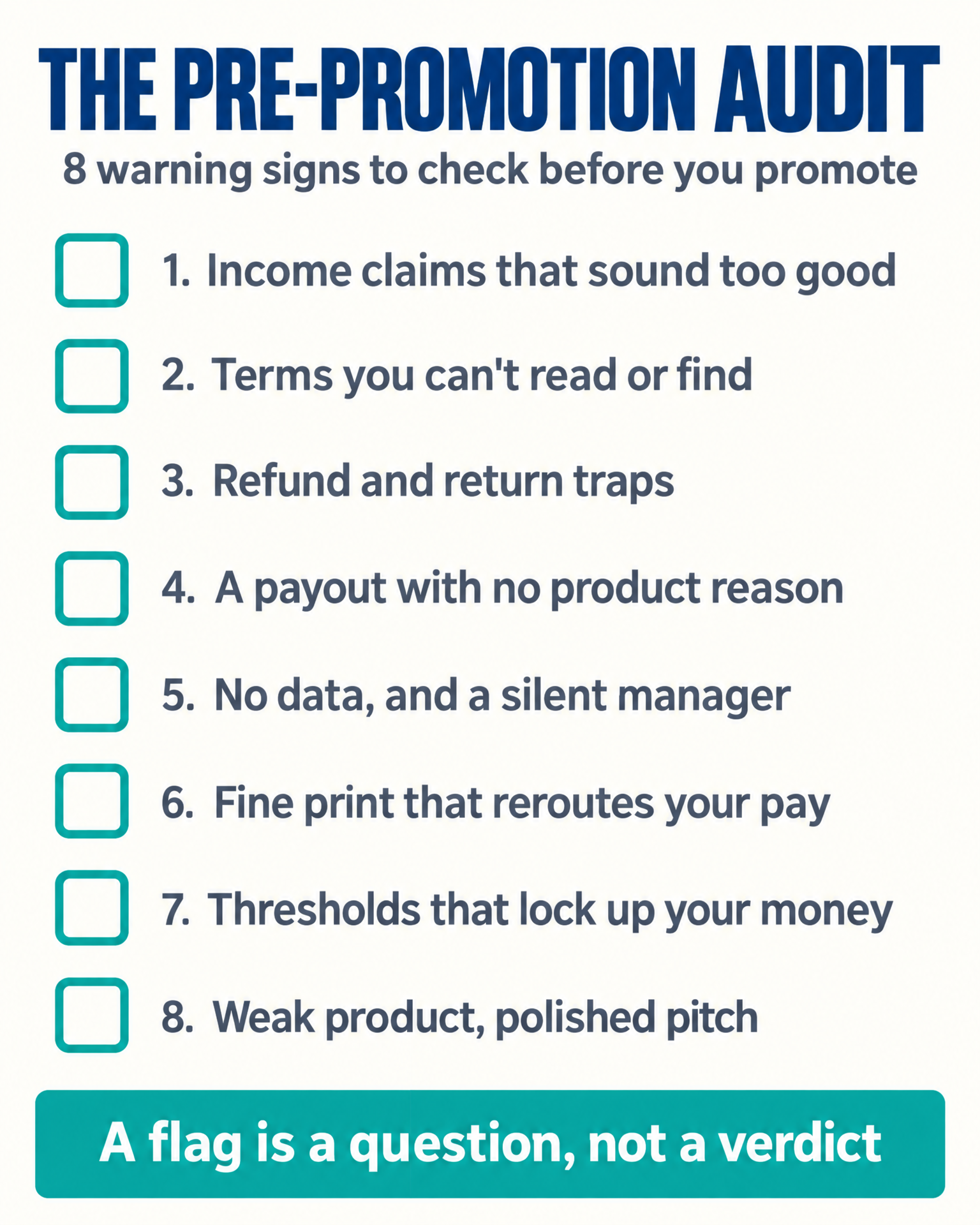
Every check works on any offer. It doesn’t matter which affiliate network hosts it. You need a browser and an email.
Sign 1: Income Claims That Sound Too Good to Be True
“Make $10,000 a month from your couch.” You’ve seen that kind of line. Unrealistic income claims are a classic sign of a bad affiliate offer.
But a bold claim alone doesn’t prove anything. Some pages exaggerate and still sell a decent product. The real question is what stands behind the claim.
How to verify it:
- Find the income disclaimer. Is it hidden in tiny gray text?
- Look for proof. Does the page show how the results were measured?
- Search for independent reviews of the product. Ignore the testimonials on the page itself.
- Ask yourself if the claim fits what the product actually does.
This sales page review matters for a personal reason. Your readers will tie those claims to you. If you repeat them, you own them. Income claims and disclaimers touch your reputation too.
Sign 2: Affiliate Terms You Can’t Read, or Can’t Find
Good programs publish their rules. Vague commission terms create payout risk. You can’t plan around terms you can’t read.
Look for the affiliate terms and conditions. Find these four things:
- The commission structure
- The cookie duration
- The payout threshold
- The payment schedule
Some programs share these only after you apply. That’s fine. Apply, then read.
If the terms never appear anywhere, that silence is the signal. Ask the affiliate manager in writing. A legitimate program answers plainly.
Also check whether commissions are recurring or one-time. A subscription product with recurring commissions can pay very differently from a one-time sale. Short cookie windows also reduce earning potential. They aren’t always a problem. They matter more for products people research for weeks.
Sign 3: Refund and Return Traps
A high price tag can hide a refund problem. High refund rates often point to poor product quality. They can also point to pushy sales tactics.
Read the refund policy before you promote anything. Then walk through the checkout like a buyer.
Watch for these during your review:
- Pressure upsells right after purchase
- Hard-to-find cancel buttons
- Trial offers with confusing billing dates
- A refund policy that contradicts the sales page
Why does this matter to you? Refunds and chargebacks can lead to clawbacks and reversals. You earn a commission, then it vanishes weeks later.
Check the affiliate terms for how reversals work. Find out how long the reversal window lasts. That window affects when your money is truly yours.
Sign 4: A Payout That Makes No Sense for the Product
A huge payout on a cheap product should make you pause. Someone is paying for that commission. Often the buyer pays through hidden costs or upsells.
Run the math. Here’s a made-up example to show the logic, not real data.
Say a product costs $40. The program pays you $38 per sale. That leaves the company $2 to cover everything else. Now add refunds. Those numbers rarely survive real-world refund rates.
Ask a few simple questions:
- What does the product cost?
- Does the payout leave room for the merchant to survive?
- Is the commission tied to a real sale or a sign-up trick?
- Does the product have a clear price anywhere?
A strange payout doesn’t prove a scam. Some high-margin products, like software or courses, pay well for honest reasons. You’re just checking that a reason exists.
Sign 5: A Silent Affiliate Manager and No Performance Data
Programs that want good affiliates share data. Affiliate managers provide performance and payout data when asked. Silence tells you something.
Send a short email. Keep it polite and direct. Ask these questions:
- What is the current EPC for affiliates with a site like mine?
- What is the typical refund rate?
- How long does it take to get paid after a sale?
- Do you have commission payout history you can share?
A legitimate program treats these as normal questions. A slow reply isn’t a red flag by itself. People get busy.
But dodging every question is different. If you get vague answers after two tries, take the hint.
Remember the weakness I admitted earlier. EPC is an average. Ask what kind of sites make up that average. A number from huge sites tells a small blog very little.
Sign 6: Fine Print That Sends Your Commission to Someone Else
Unclear tracking causes lost commissions. This one hides in the fine print. You send the reader, but someone else gets paid.
Look for the rules on tracking and attribution in these three areas:
- Coupon and deal sites. Can they override your link at checkout?
- Brand trademark bidding. Can other affiliates bid on the brand name in paid ads?
- Last-click attribution. Does the final click before purchase take all the credit?
Say you write a thorough review. A reader loves it. Then they search for a coupon code, click a deal site, and buy. Under last-click rules, the deal site may get the commission.
That doesn’t make the program bad. Many programs work this way. You just need to know it before you spend hours on a review.
Sign 7: Payout Thresholds and Payment Terms That Lock Up Your Money
A payout threshold is the minimum you must earn before you get paid. Payment terms like Net-30 or Net-60 add a waiting period. Together, they can lock up your earnings for months.
Here’s a made-up example. Say the threshold is $100. Say your blog earns $15 a month from that offer. You’d wait about seven months to reach the threshold. Then you’d wait another 30 or 60 days for payment.
Check these numbers against your realistic traffic. Be honest with yourself. Use your current numbers, not your dream numbers.
A high threshold can be normal for some categories. That’s the second weakness I admitted earlier. So don’t reject an offer on this alone. Ask whether the timeline works for your situation.
Also look at the payout methods. Can you get paid in a way that works where you live? Do fees eat into small payments?
My $837.75 lesson.
In 2024, I promoted the Vital Reaction affiliate program. I did the work the way you’re supposed to: I created content, I promoted it, and I kept at it. Behind the numbers I’m about to give you sit many hours of that work, the kind of hours you don’t get back. That time was my real investment, and the commissions were how I expected to be paid for it.
Here is what my affiliate dashboard shows. I sent the program 7,034 clicks. Those clicks turned into 22 signups and 19 paying customers. The dashboard credits me with $837.75 in tracked commissions. Those are the program’s own numbers, not my estimates. By its own count, I delivered customers.
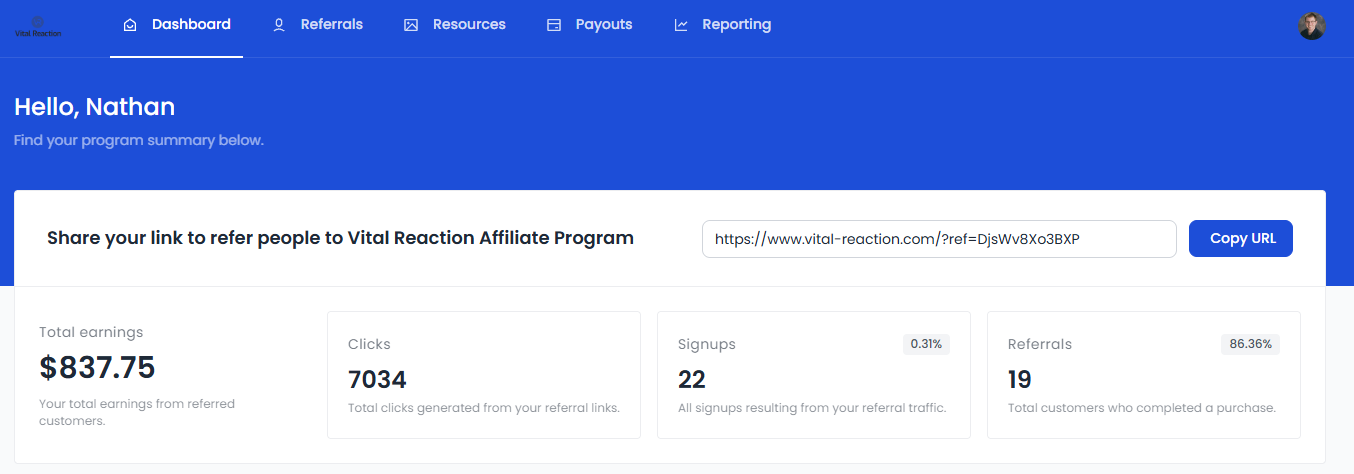
I never received any of that money. I asked for my payout, then asked again, and kept asking. The response was nothing. Not a refusal. Not an explanation, a dispute, or a policy citation. Just silence. I can work with a clear no, because a no tells you where you stand. Being ignored tells you something too. I was never paid, and being ignored like that is its own answer.
That was back in 2024, and the dashboard still shows the balance today, as if the money exists. I look at that number and it reads like money in an account. It isn’t. The work was real. The hours were real. It was never sent.
A tracked balance is not income. Earnings on a dashboard are a promise, not a payment. Before you put real promotion effort into any program, check its payout terms and its payout reputation. The most expensive warning sign is the one you only see after the traffic is sent.
Sign 8: Weak Product Signals Under a Polished Pitch
A slick landing page costs money to build. A good product costs more. Don’t confuse the two.
Check landing page and funnel quality, but go deeper. Look at the reputation and trust signals that real customers leave right now.
Do this in ten minutes:
- Read recent customer reviews, not just old ones
- Check whether the product still gets updates
- Send a support question and see if anyone replies
- Do a quick merchant reputation check
- Look at the company’s history and how long it has existed
Better yet, try the product yourself. Testing the product firsthand reveals hidden flaws. Reviews can’t show you everything.
If you can’t afford to buy it, ask for a free trial or review access. Many merchants say yes. Some say no. Either answer tells you something.
Finish with a brand-safety and compliance review. Does the merchant follow FTC disclosure guidelines in its own marketing? FTC guidelines require clear affiliate disclosure. A merchant that dodges the basics may put you at risk too.
Run the Audit, Then Test Small
Let me return to where I started. A checklist won’t catch everything. Some flags are harmless. Some numbers mislead. And your audience may still say no.
So use this list for what it does well. It catches known problems early. It protects your audience’s trust. It keeps you from tying your name to something you’d regret.
Then avoid the trap I warned about. Don’t audit forever. Set a limit.
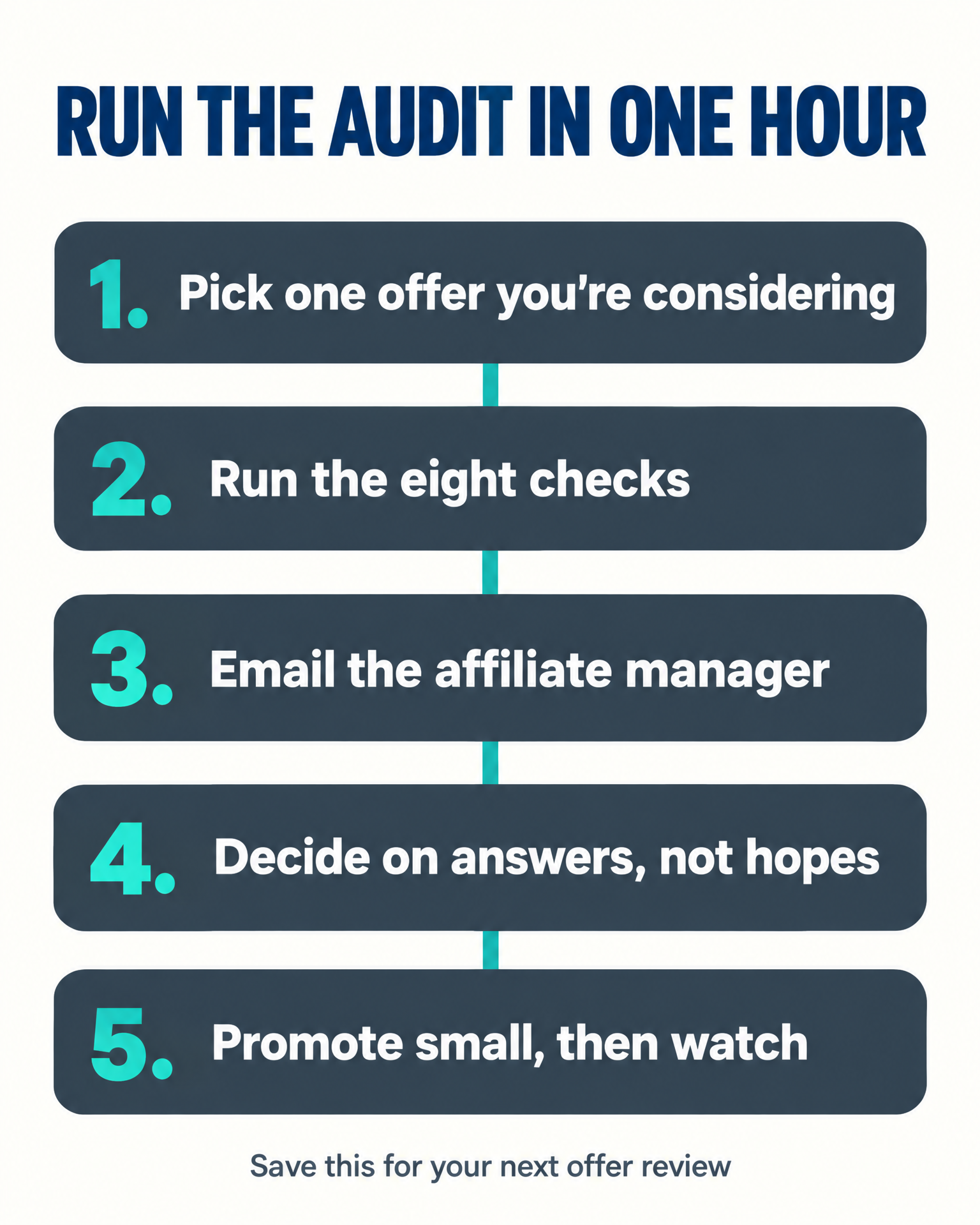
Here’s a simple plan:
- Pick one offer you’re considering right now.
- Spend one hour running these eight checks.
- Email the affiliate manager with your questions.
- Decide using what you learn, not what you hope.
- If it passes, promote it in one post and watch what happens.
Promoting a bad offer damages your reputation as an affiliate. Pre-promotion vetting protects the trust you’ve built with readers. That trust is the only asset you can’t easily replace.
Take the offer you’ve been eyeing and open a blank note. Write the eight signs down the page. Fill in each answer tonight, and send that first email to the affiliate manager before you go to bed.
Products / Tools / Resources
- Niche & Offer Fit Scorecard (free): Compare your ideas side by side and decide what deserves your work — the fill-in scorecard for running this audit on paper instead of in your head. Get the free Niche & Offer Fit Scorecard.
- A blank note or spreadsheet: The audit worksheet from the closing section. Eight warning signs down the page, one column per offer, each answer written down before you decide.
- Should You Choose a Niche or an Affiliate Offer First? (companion guide): The decision that comes before this audit on the same node — which comes first, the niche or the offer. Read the companion guide.