

The Short Version, Before You Sink Twenty Minutes Into This
Here’s the thing nobody tells beginner affiliate bloggers: you’re probably not lazy, and you’re probably not doing it wrong in the way you think you are. You’re just missing the order of operations.
Snowball Affiliate is a training system built for exactly that gap — for the beginner or stalled niche blogger who has a site, has some posts, maybe even has a few affiliate links buried in there somewhere, and still can’t answer the question that actually matters: what do I work on next, and why? Instead of the usual pile-more-content-on-and-hope approach, it hands you a sequence — offer first, buyer pain second, connected content third, a real reader journey fourth, a buying decision fifth, expansion last.
If that question — what next, and why — makes you go quiet for a second, keep reading. If you already have that answer and it’s working, you can probably skip this one. We’ll tell you exactly why, further down.
Table of Contents
1. What Snowball Affiliate Actually Is
Strip away the marketing language and Snowball Affiliate is, at its core, a structured affiliate-blogging education and site-building system. Not a plugin. Not a done-for-you site in a box. Not a traffic trick you run once and forget about.
Its whole premise rests on one sentence, and it’s worth sitting with for a second: blogging success comes from stacking simple advantages in the correct sequence, rather than executing disconnected tactics.
That word — sequence — is doing more work than it looks like. Most people who fail at affiliate blogging didn’t fail from lack of effort. They wrote the posts. They showed up. What they didn’t have was an order — some internal logic telling them which decision needed to happen before which other decision, so that the article they wrote on a random Tuesday afternoon was actually a rung on a ladder, not just another page floating in the void.
Snowball Affiliate exists to be that ladder: turning content and tactics that used to live in isolation into one connected path — niche, then traffic, then, finally, commissions that make sense instead of arriving as a surprise.
2. Who This Was Built For (And Who It Wasn’t)
Picture the reader this was actually designed around: beginner or stalled niche affiliate blogger. Someone who either hasn’t started yet, or has started and can feel — almost physically — the disconnect between the hours they’re putting in and the money that isn’t showing up.
You’ll probably recognize yourself here if any of this feels a little too familiar:
- Your niche has changed three times this year, and you’re not entirely sure the fourth one will stick either.
- You’ve published. Genuinely published. And “nothing seems to be happening” is the phrase that keeps surfacing in your head.
- You can’t tell — honestly can’t tell — whether the market you picked is one that can realistically pay you back.
- You understand traffic in theory. You do not understand how traffic quietly becomes commissions in practice.
- You keep discovering new tactics, and each one resets the clock before the last one had a real chance.
- What you’re actually craving isn’t another tactic. It’s a sequence. First this, then this, then this — and a reason why.
None of that is a character flaw. It’s architecture — or the absence of it. That’s the specific hole this system is built to fill.
3. The Trap Most Beginners Fall Into Without Noticing
Here’s the pattern that quietly wrecks most beginner sites, and it’s so common it barely registers as a pattern anymore:
Niche → Keywords → Random Posts → Rankings → Hopefully Commissions
Read that last word again. Hopefully. That’s the whole problem, hiding in plain sight. Monetization isn’t planned in that sequence — it’s wished for, tacked on at the very end, long after every decision that actually mattered (the niche, the topics, the structure) was already made without a single commercial thought behind it.
Snowball Affiliate flips the order entirely:
Offer → Buyer Pain → Connected Content → Reader Journey → Buying Decision → Expansion
Under this model, you don’t pick topics and cross your fingers. You start with a real offer and a real, specific problem a real buyer has — and every piece of content after that has a job to do, moving that person one step closer to a decision. Traffic stops being the finish line. It becomes one stage in a longer story.
This, more than anything else, is why so many beginner sites stall out at month four or six. They were never structurally pointed at a purchase decision to begin with. You can’t publish your way out of a foundation that was never built toward anything.
4. Inside the System: Nine Modules, One Sequence
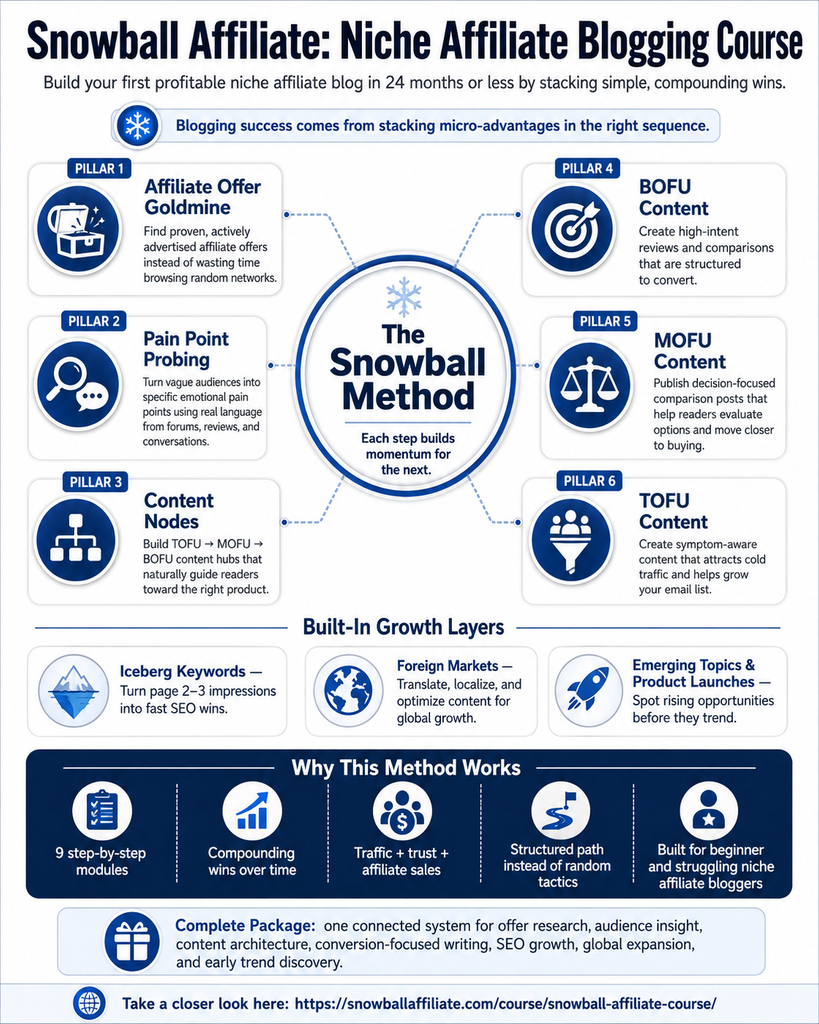
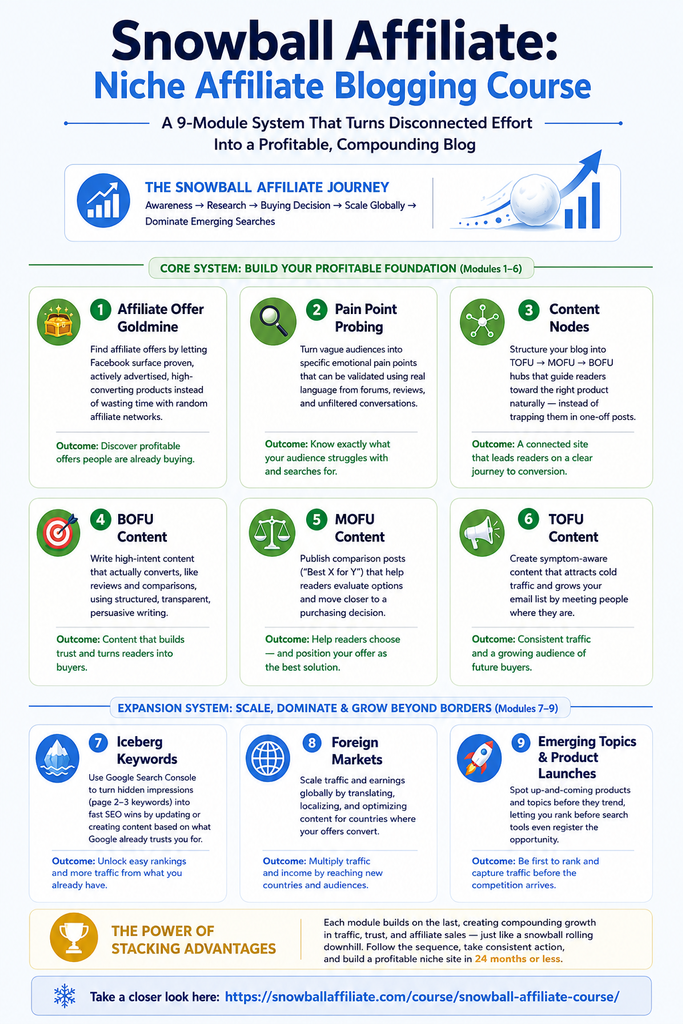
The curriculum breaks into nine modules. Each one is aimed at a specific place where beginner affiliate blogs typically come apart.
Module 1 — Affiliate Offer Goldmine. Rather than scrolling affiliate networks hoping something looks promising, this module reads active advertising signals — what’s genuinely being promoted right now, with real money behind it — to surface offers that have already proven they can pull a buyer’s attention.
Module 2 — Pain Point Probing. Takes a fuzzy idea of “an audience” and sharpens it into specific, emotionally real pain points, pulled from language people actually type into forums and reviews — not guessed at from a keyword tool’s autocomplete.
Module 3 — Content Nodes. The architectural heart of the system. It teaches you to build clusters of TOFU, MOFU, and BOFU content that connect to each other, so a reader always has a next step instead of hitting a dead end and bouncing.
Module 4 — BOFU Content. The high-intent stuff — reviews and comparisons built for someone who’s already warm, already close, already trying to decide. (This article you’re reading right now is exactly that kind of page.)
Module 5 — MOFU Content. Comparison and buying-guide material for the reader who knows they have a problem and is starting to weigh their actual options.
Module 6 — TOFU Content. Symptom-aware, informational writing that meets people before they’re anywhere close to ready to buy — usually the entry point for most of a site’s traffic.
Module 7 — Iceberg Keywords. Mines Google Search Console impression data for the opportunities a standard keyword tool tends to miss entirely — the traffic that’s already almost there, just under the surface.
Module 8 — Foreign Markets. For once a site has traction: translating and localizing what already works into other countries.
Module 9 — Emerging Topics & Product Launches. For spotting new products and rising topics before conventional keyword research has caught up — an edge for the reader who wants to arrive early instead of always chasing.
Worth saying plainly: these nine modules aren’t a mandatory checklist you have to march through before you’re “allowed” to see results. Modules 1 through 6 are the core sequence — the part almost every beginner needs first. Modules 7 through 9 are for later, once there’s something worth expanding.
5. Why This Isn’t Just “Publish More and Pray”
Most beginner advice, if you boil it down, is a volume answer: publish more, publish consistently, and the rankings — and eventually the money — will follow. Snowball Affiliate’s real contrast with that advice is a quiet but important one: volume without sequencing just multiplies the wrong kind of content. More disconnected posts. Not more momentum.
The difference shows up in three places, and they’re worth naming individually:
- Topics get chosen offer-first, not keyword-first. A piece of content earns its place because it serves a specific stage in a buyer’s journey toward an actual offer — not because a keyword tool flagged “decent volume, low competition.”
- Every page has a job. Not “content about the niche,” but a defined role — building understanding, building comparison, or closing a decision. Nothing gets published just to exist.
- Internal linking has a direction. Instead of linking everything to everything (which feels thorough but accomplishes nothing), the system links readers deliberately, one step at a time, toward the pages actually built to convert.
That’s the same thinking behind the Content Nodes concept from Module 3: a small, tightly connected cluster of articles that carries one type of reader — start to finish — from the symptom they searched for to the decision they eventually make. Not thirty scattered posts, each ranking for something, each leading nowhere in particular.
6. Who Should Walk Away From This One
A review that only tells you why to buy isn’t actually a review. So here’s who this probably isn’t for:
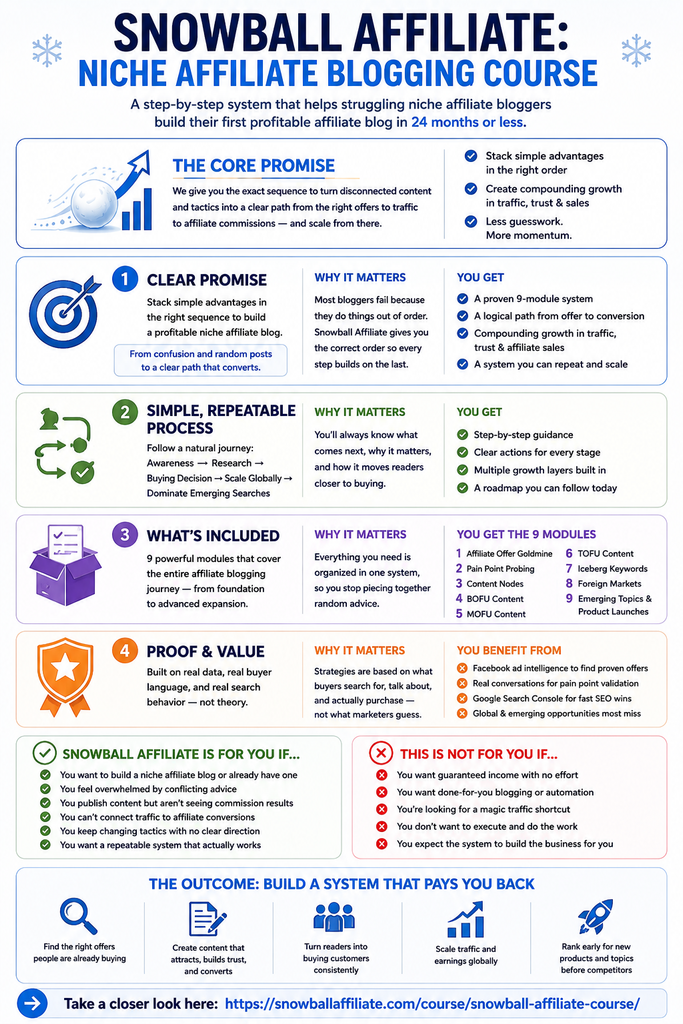
- Anyone whose system already works. If your content-to-commission path is already clear and already producing, you’re solving a problem you don’t have.
- Anyone who actually wants an all-in-one platform — hosting, site builder, community, and training, all bundled together — rather than a focused methodology. That’s a genuinely different kind of purchase, and we’ll separate the two below.
- Anyone with healthy traffic and a narrow monetization gap. If people are already showing up and the problem is specifically conversion, a narrower monetization-focused resource might solve your actual bottleneck faster.
- Anyone hoping for a guarantee. No structured system — this one included — replaces execution, patience, or picking a market that can genuinely support commissions.
7. Course vs. Platform: A Different Question Than You Think
Here’s a decision point that trips up more beginners than almost anything else, and it isn’t really “which course is better.” It’s a layer beneath that: do you even want a course, or do you want a bundled platform — hosting, tools, community, training, all under one roof?
That’s a different kind of decision entirely, and it deserves more room than a passing mention here. If you’re genuinely torn between a focused methodology and sequencing system like Snowball Affiliate and a fuller all-in-one training-plus-platform ecosystem, the right answer depends heavily on how much you’ve already built versus how much structure — versus tooling — you’re actually missing.
We walk through that exact fork in the road — system versus platform, what each one replaces, who tends to end up happier with which choice — in the comparison guide below.
→ Continue to: [Best Affiliate Blogging Courses for Beginners Building a Niche Site]
8. What This Fixes — and What It Honestly Won’t
In the interest of not overselling anything, here’s the split, stated plainly.
What it can genuinely do:
- Give every content decision a reason behind it, instead of a guess.
- Shrink the gap between publishing something and having a commercial reason for it existing.
- Stop the cycle of restarting your niche or your whole strategy every few months.
- Give you a way to judge, early, whether a market can actually pay you back — before you’ve sunk half a year into finding out the hard way.
What it honestly can’t do:
- Promise a specific income number. No course legitimately can, and be wary of any that try.
- Do the writing, researching, and publishing for you.
- Instantly repair a site whose niche and offer were fundamentally mismatched from day one — though the framework will help you spot that early instead of six months too late.
9. The Questions People Actually Ask (Not the Ones a FAQ Generator Would Invent)
I haven’t started a blog yet — is this too advanced for me?
If anything, it’s a better fit for you than for someone retrofitting an existing site. You’ve got no old structure to untangle first. Starting offer-first from day one is easier than rebuilding around it later.
My site already gets traffic, just not sales — will this actually help, or is it built for total beginners only?
It can help, but the entry point looks different for you. You’ll likely want to focus first on the offer-fit and internal-linking pieces of the framework rather than starting over at niche selection — there’s a dedicated diagnosis path for exactly that situation.
Is this one of those “quit your job in 30 days” systems?
No, and honestly, be suspicious of anything that claims otherwise. The entire premise here is that stacking correctly sequenced advantages takes real time — and that skipping the sequence, not lack of effort, is what stalls most beginners.
I don’t know much about SEO — will I be lost?
No prior SEO background is assumed anywhere in the framework. It’s built around teaching you the structure and the sequencing, not assuming you already speak fluent technical SEO.
How is this actually different from the standard “how to start a blog” advice everyone’s already seen?
Standard advice is publishing-first — pick a niche, write consistently, hope traffic and money eventually show up. This is commercially-first — pick a real offer and a real buyer pain point, then build content whose entire job is serving the path toward that decision.
10. Products, Tools & Resources Mentioned in This Review
A few things worth having on hand if you’re moving forward from here, whether that’s with Snowball Affiliate specifically or just tightening up your own process:
Snowball Affiliate — the structured system this review centers on. Best suited to beginner or stalled niche bloggers who need the sequencing piece, not another tactic.
Google Search Console — free, and directly relevant here since Module 7’s “Iceberg Keywords” approach leans on impression data you already have access to right now, sitting unused in your account.
A content-mapping tool of some kind — whether that’s a spreadsheet, a whiteboard, or dedicated software. The Content Nodes concept from Module 3 only works if you can actually see your site’s structure laid out, rather than trying to hold thirty article ideas in your head at once.
Our Buying Guide comparing structured systems to alternatives — if you’re still deciding between a focused methodology and an all-in-one platform, that comparison lives here: Best Affiliate Blogging Courses for Beginners Building a Niche Site.
Our diagnostic piece for stalled-but-trafficked sites — if your issue is specifically traffic without sales, start with: How to Know Whether an Affiliate Offer Actually Fits Your Audience.
Our niche-focus diagnostic — if you suspect your niche itself has drifted too wide, this one’s worth reading next: Is Your Affiliate Niche Too Broad? Signs Your Site Has Lost Focus.