

You tried a content calendar. You quit.
Maybe the calendar wasn’t the problem. Maybe the math underneath it was.
The short answer: A content calendar for an affiliate blog works alongside a full-time job when it’s built on about five focused hours a week. It plans one content node at a time. A node is one buyer-intent post plus the supporting posts that lead readers to it. Each post gets assigned to a specific weekly time block, so every hour has a job before the week starts.
Let’s check the math together. No hype. No guru tricks. Just facts you can verify with a pencil.
Most content calendars are built for people who write full time. So if you have a day job, you copy a plan that assumes hours you don’t have. A few weeks in, you’re behind. Then you’re discouraged. Then you quit. That isn’t laziness. The plan simply never matched your real week. A better fix starts smaller. The free Content Node Planner helps you take one reader problem and turn it into a connected path of posts, from their first click to a confident purchase. It’s sized to the hours you actually have, so you plan once and then work one post at a time. No guesswork, and no calendar you can’t keep. Grab your copy below.
Table of Contents
What You Probably Believe Right Now
Your doubt has a source. A calendar failed you before.
Here’s what that failure likely taught you:
- A real calendar needs ten or more free hours a week.
- More posts automatically means more sales.
- Planning is a luxury. Publishing is the real work.
I’m not going to argue with these beliefs. I’m going to set them aside for a few minutes.
We’ll start with facts nobody can dispute. Then we’ll build one step at a time. If a step feels wrong, stop me there.
Fact 1: Your Week Has a Fixed Number of Hours
A week has 168 hours. Nobody gets more.
Your full-time job takes about 40 of them. Your commute takes more. Sleep takes a big chunk.
Then life takes the rest. Meals. Family. Chores. Rest. For most side-hustle bloggers, about five focused hours remain.
Maybe you have scattered minutes beyond that. But focused time is what produces posts. And focused time is about five hours.
That gives us our first rule. Any plan that needs more than five hours fails on day one. That isn’t pessimism. It’s subtraction.
Fact 2: A Plan Built on Hours You Don’t Have Falls Apart
You’ve seen this happen. Maybe you lived it.
Week one, you schedule three posts. Week two, work runs late. Week three, you miss a deadline. Week four, you quit.
The plan didn’t fail because you lack discipline. It failed because it handed out work to hours that never existed.
A plan built on real hours behaves differently. It survives a bad week. It survives a busy month.
Realistic scheduling prevents burnout and missed publishing weeks. So the first design rule is simple. Build the plan on five hours, and nothing more.
Fact 3: Readers Rarely Buy From the First Post They Land On
Think about your last purchase over fifty dollars. Did you buy from the first page you saw?
Probably not. You searched. You read about what the thing was. You checked whether it fit your problem. Then you compared options. Then you bought.
You didn’t read one post. You had a string of your own questions answered.
Picture a reader with a sore back who wants a standing desk. Their questions might run like this:
- Will a standing desk help my back?
- How tall should the desk be for me?
- What makes a desk sturdy or wobbly?
- Which desk is worth the money?
The first three questions are informational. The last one is commercial. The reader moves from one to the other in order.
That’s the reader journey to purchase. It’s not a funnel trick. It’s how people make decisions.
Fact 4: Posts That Answer Questions in Order Form a Path
Each question above can become a post. Together, those posts form a path.
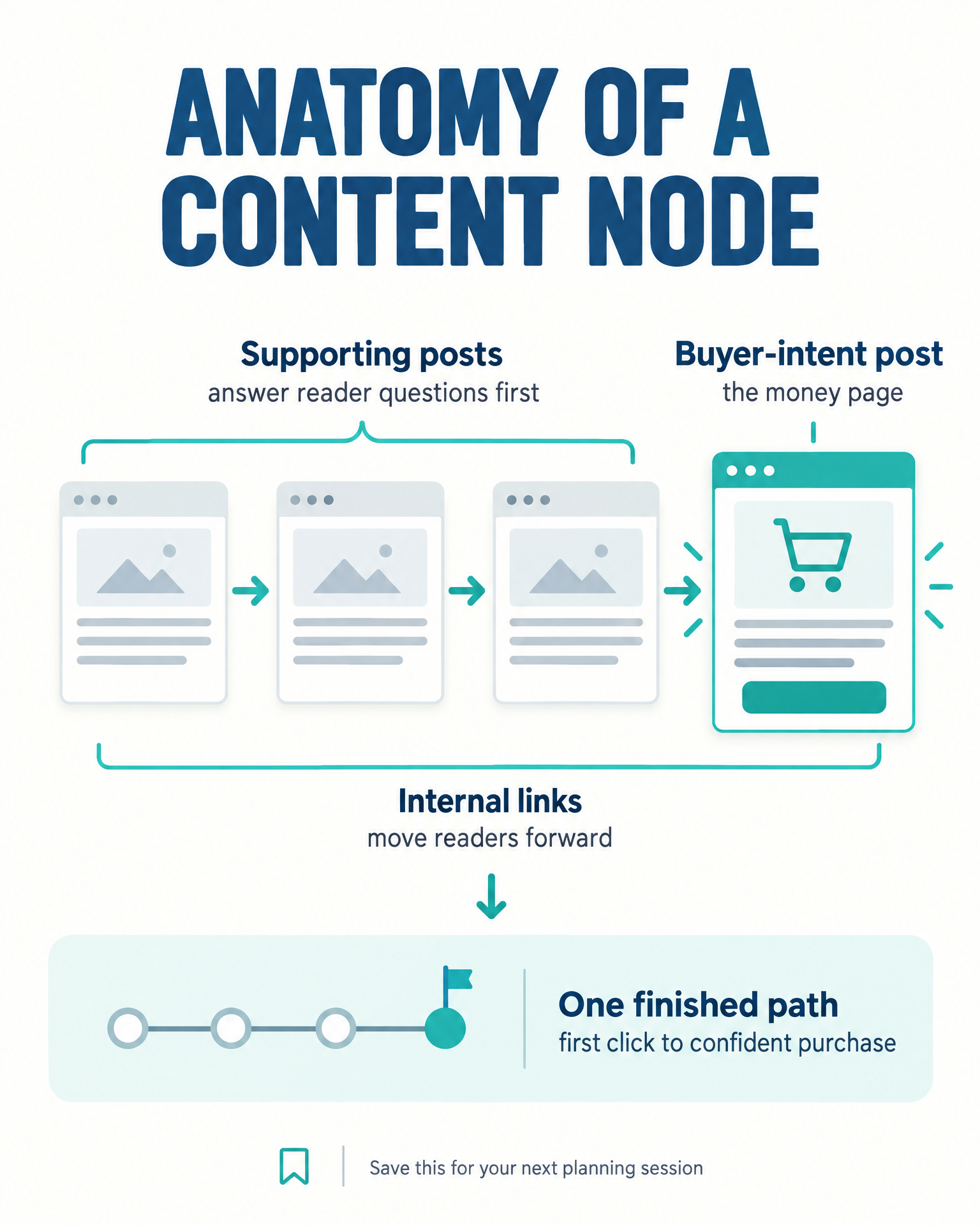
The early posts are supporting posts. They answer what the reader asks before they’re ready to buy. The last post is the buyer-intent post, sometimes called the money page. It’s usually a product review, a comparison, or a “best of” post.
Now add the missing piece. The posts must link to each other.
Internal links guide readers toward product recommendations. Each link is a step on the path. Without links, every post is an island.
An island may get a visitor. But the visitor has nowhere to go. They read, then leave.
A set of linked posts built around one buyer-intent post has a name. Call it a content node. Some people call it a content cluster. The idea is the same.
Fact 5: Count Paths, Not Posts
This fact breaks the second belief. Walk through it slowly.
A post only helps if a reader can walk from it to a purchase decision. A post with no route forward helps the reader learn something. It doesn’t help the blog earn.
So the useful unit isn’t the post. It’s the complete path.
Now compare two blogs. Each has thirty posts.
Blog A wrote thirty posts on thirty unrelated topics. Few of them link anywhere useful. It may have zero complete paths.
Blog B wrote five posts around one reader problem. Every post links toward one money page. It has one complete path, and every reader can walk it.
More posts didn’t create more paths for Blog A. Connection created the path for Blog B.
Count paths, and thirty scattered posts can lose to five connected ones. That’s logic, not opinion.
Fact 6: A Calendar Is Just Posts Assigned to Real Hours
Strip away the fancy templates. What is an editorial calendar?
It’s a list. Each line says which post gets worked on, and in which block of time. That’s all.
A content calendar assigns specific posts to specific weekly time blocks. If the hours are real, the calendar is real. If the hours are fake, it’s fiction.
This answers the third belief. Planning isn’t a separate luxury. It’s one of the blocks inside your five hours.
It also saves time. Sit down without a plan, and you burn precious minutes deciding what to write. A plan removes that cost before the clock starts.
What These Six Facts Build
Put the facts in a row:
- You have about five focused hours.
- Plans that need more hours collapse.
- Readers buy after a sequence of answered questions.
- Linked posts that answer those questions form a path.
- Paths matter more than post counts.
- A calendar just assigns posts to real hours.
Now ask what kind of plan fits all six at once.
It can’t be a wish list of thirty topics. That plan needs hours you don’t have. It also spreads your effort across many unfinished paths.
It has to be small. It has to be connected. It has to fit inside five hours.
That points to one design. Plan one content node at a time.
Step 1: Plan One Node in a Single Short Sitting
A node is one buyer-intent post plus the supporting posts that lead readers to it. You plan the whole thing in one weekly planning session.
Here’s how that sitting can go:
- Pick one reader problem. Make it specific, like the sore back above.
- Do your keyword research for that problem. Look for buyer-intent keywords that point to a product decision.
- Choose the money page topic. This is your review or comparison post.
- List three to five questions a reader asks before buying. Each becomes a supporting post.
- Write a short outline for each post.
- Sketch the internal linking plan. Note which post links to which.
Keep it all in one place. A simple spreadsheet or kanban board works fine. This is your topic map.
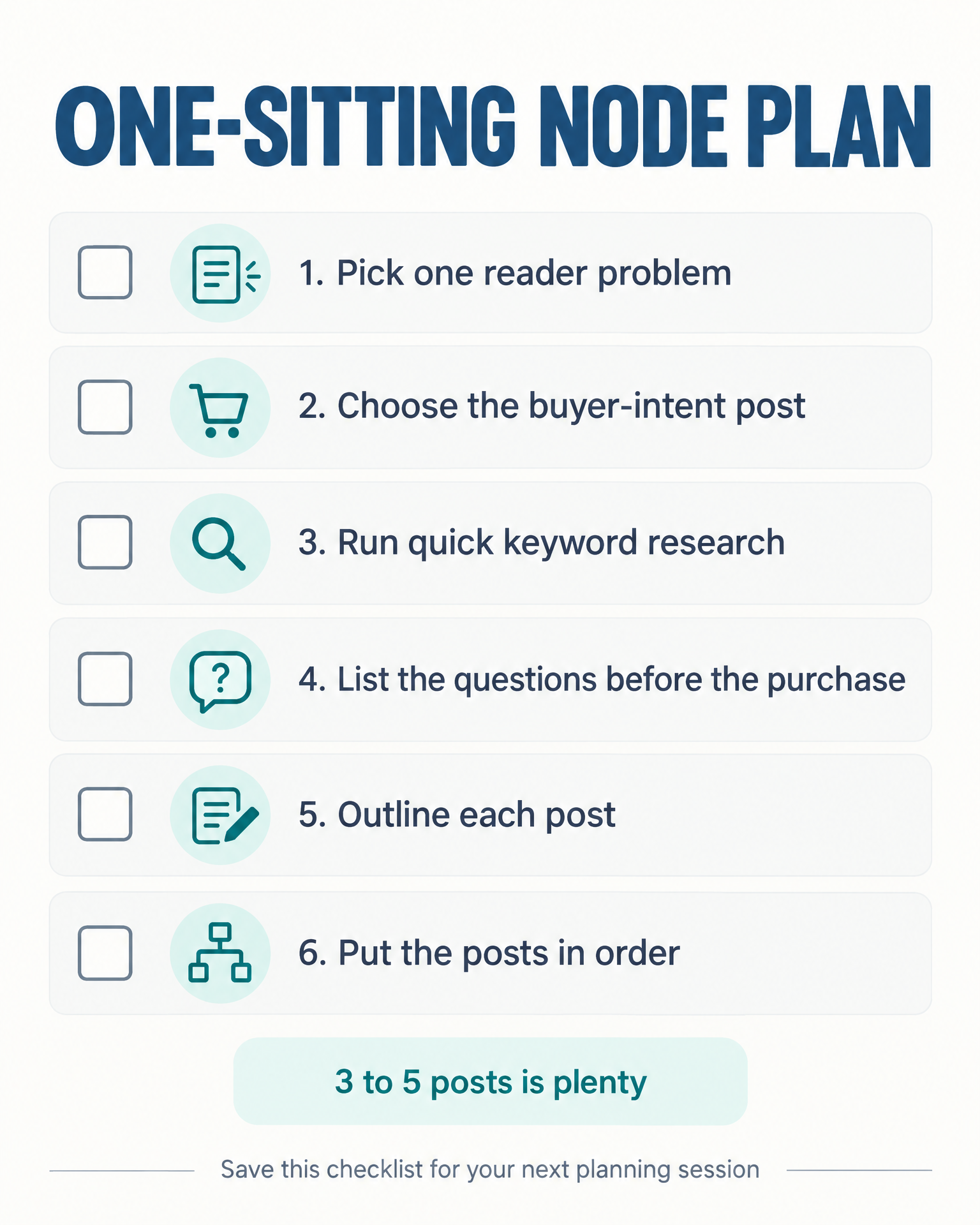
You’re not planning your whole year. You’re planning one path. That’s why it fits in a single sitting.
Step 2: Split Your Five Hours Into Repeatable Blocks
Now assign real hours. Keep the blocks simple, so you never have to rebuild your routine.
Here’s a sample weekly workflow. Treat it as an example plan, not a promise. Move the pieces to fit your own week.
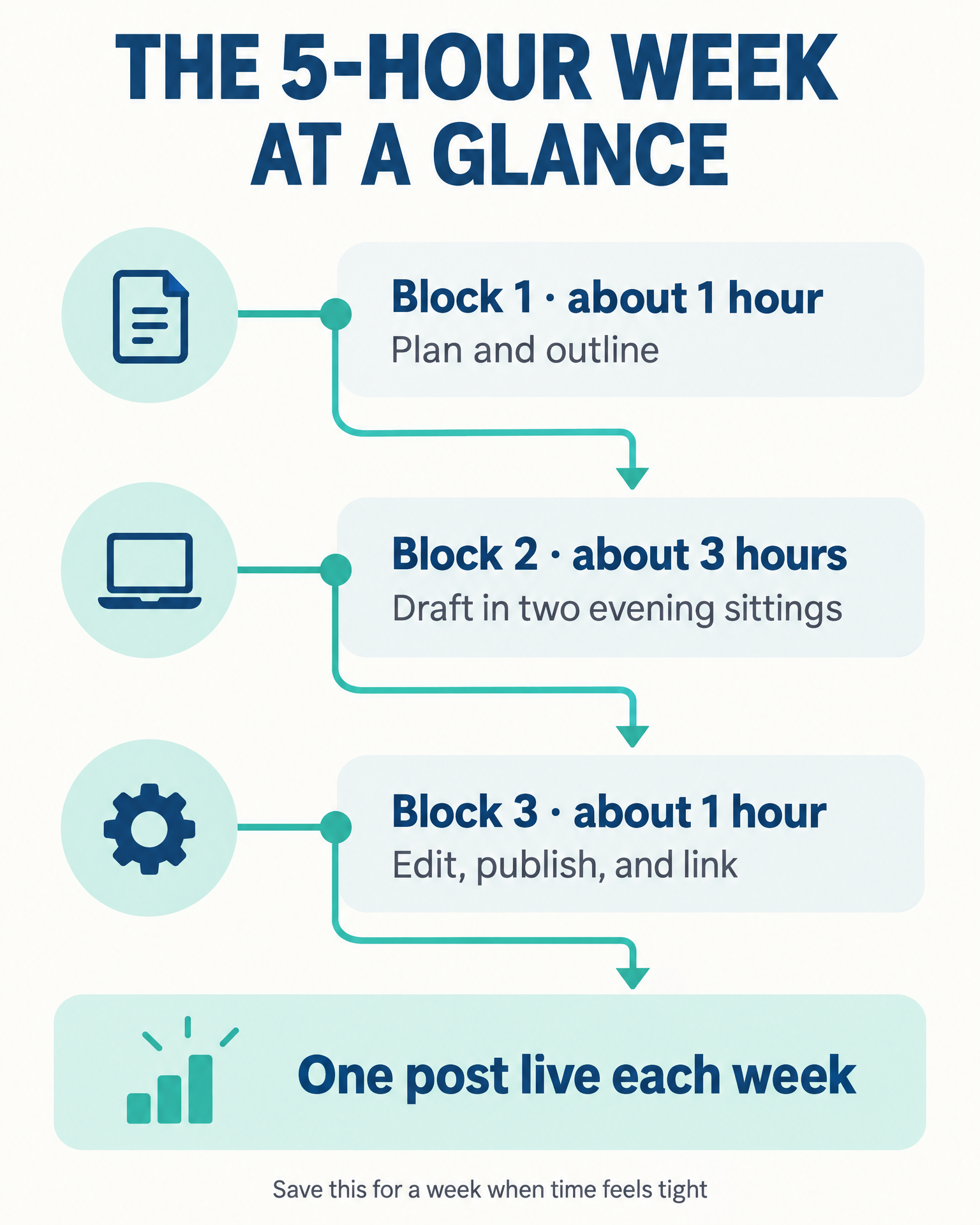
Example 5-hour week:
- Block 1 (1 hour): Planning and outlining. Check the node. Pick the next post. Finish its outline.
- Block 2 (3 hours): Drafting. Write the post from the outline. Protect this block the most.
- Block 3 (1 hour): Publish and link. Edit, publish, and add the internal links.
Notice what this does. Time blocking groups like tasks together. Batching similar tasks reduces context switching.
Jumping between researching, writing, and formatting costs energy. Blocks keep each type of work in its own box.
Your actual numbers may differ. Maybe drafting runs two hours and editing runs two. The exact split isn’t the point. The point is that every hour has a job before the week begins.
Step 3: Finish One Post Before You Start the Next
Resist the urge to start five posts at once. A half-finished post links to nothing and helps no one.
Take one post from the node. Move it through all three blocks. Then pick the next one.
Some posts may take more than one week. That’s fine. If a post needs two weeks of blocks, it takes two weeks.
A sustainable posting frequency is the one your real hours allow. Your publishing cadence follows from your schedule. It doesn’t come from a blog you admire that has a team behind it.
Which post comes first? Consider writing the money page first. Then every supporting post has a destination before it exists.
You can also do it the other way. Either order works, as long as the path gets finished.
Step 4: Link Every Finished Post Into the Path
Publishing isn’t the end of a post. Linking is.
When a post goes live, check three things:
- It links forward to the next step in the path.
- It links to the money page where it fits naturally.
- The money page links back, so readers can find the supporting answers.
Published posts that link to the node’s money page complete the reader path. Skip this step, and you’re back to islands.
The money page also carries your affiliate link placement and your calls to action. Place them where the reader’s question gets answered, not where it’s convenient for you. A reader who feels helped is more likely to click.
Later, track clicks and conversions. Look at which posts send readers to the money page. A content refresh or update to the weakest link can help more than a new post.
Let’s Run the Numbers
Now compare the two plans with real arithmetic. These are made-up figures, used only to show the logic.
Say each post takes you three hours. A wish list of thirty posts needs ninety hours. At five hours a week, that’s eighteen weeks.
For all those weeks, you’d be working through a scattered list. No single topic would be finished early. The reader paths might not be complete until the very end, if ever.
Now say a node has five posts. That’s fifteen hours. At five hours a week, that’s three weeks.
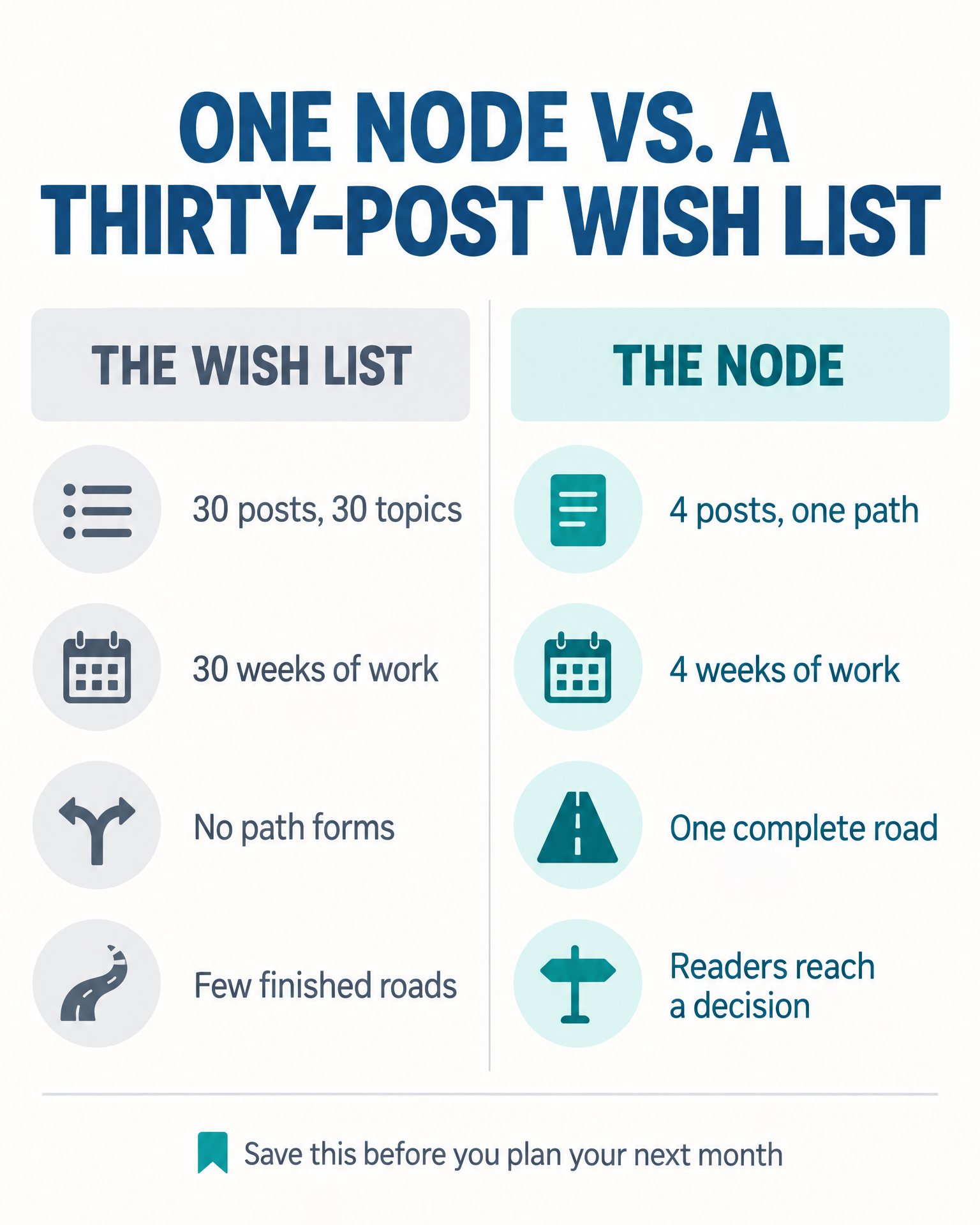
At the end of those weeks, one complete path exists. A reader can enter at a first question and finish at a confident purchase decision.
Your numbers will differ. The shape of the result won’t. A small connected plan finishes. A large scattered plan drags on and often gets abandoned.
Checking Your Three Beliefs Against the Facts
Return to what you believed at the start.
“I need ten or more free hours.” Fact 1 says you don’t have them. Fact 2 says a plan that needs them collapses. So the useful calendar is the one built on five.
“More posts means more sales.” Fact 5 says paths matter, not posts. Connection produces results that volume alone can’t.
“Planning is a luxury.” Fact 6 says planning is a block inside your five hours. And it saves the hours you’d waste deciding what to write.
None of these needed a leap of faith. Each followed from the one before.
Your Next Five Hours
Here’s where the facts lead. A five-hour calendar built around one connected node beats a thirty-post wish list.
It fits your real week. It follows how readers actually buy. And it finishes, which a long list rarely does.
So don’t build a year of content tonight. Build one path.
Pick one reader problem. Write down the questions they ask on the way to buying. Turn those questions into a connected path of posts, from first click to confident purchase.
That’s the Content Node Planner approach in plain form. Open a blank spreadsheet this week. Name one problem, list the posts, and assign each one to a real block of time.
Then start with the first post. The path begins there.
Products / Tools / Resources
- Content Node Planner (free): Turn one reader problem into a connected path of posts, from first click to confident purchase — the one-page planner this article’s whole system is built on. Get the free Content Node Planner.
- A spreadsheet or kanban board: The boring tool from the one-sitting planning session. One row or card per post in the node, kept in path order, is all the calendar you need.
- Google Search Console (free): Once a node is live, pair it with your click tracking to see which posts actually send readers toward the money page — and which ones need a fix.