

If you have blog traffic but no affiliate sales, you pay for it every day.
Open your analytics. Look at last month’s visitors.
Now open your affiliate dashboard. Look at your commissions.
That gap isn’t a mystery. It’s a bill. So why does a blog get traffic but no affiliate sales?
A blog gets traffic but no affiliate sales because readers drop out somewhere between the search and the sale. The usual causes are informational search intent, low reader trust, poor product fit, buried affiliate links, no comparison help, and no follow-up email. Finding the exact drop-off step is the fix.
Every day your traffic doesn’t convert, you’re paying for it in commissions you never see, and the cause is usually one specific break between the first click and the purchase, not your whole site. The free Reader Journey Leak Audit maps one real reader path, inspects each stage along the way, and hands you one leak to fix first. That way you’re not guessing or rebuilding everything at once. Download it below and find the break that’s costing you.
Table of Contents
Do You Just Need More Traffic to Make Affiliate Sales?
You probably think, “I just need more traffic.”
It’s a fair thought. It feels logical. More visitors should mean more sales.
But look at your own numbers. Zero times two is still zero. If your blog traffic brings no affiliate revenue now, doubling it won’t raise your affiliate conversion rate.
I’m not here to sell you a fix. I’m here to show you what this problem costs you today. You don’t have to change anything to see it. You only have to look.
Here’s the core issue. Getting visitors but no affiliate commissions is rarely a traffic problem. It’s a problem somewhere between the search and the sale.
Maybe readers don’t trust you yet. Maybe they came to learn, not to buy. Maybe they wanted to buy and your page gave them no easy way to do it.
You don’t know which one it is. That’s the cost. Let’s count it.
What Does Blog Traffic With No Affiliate Sales Cost You?
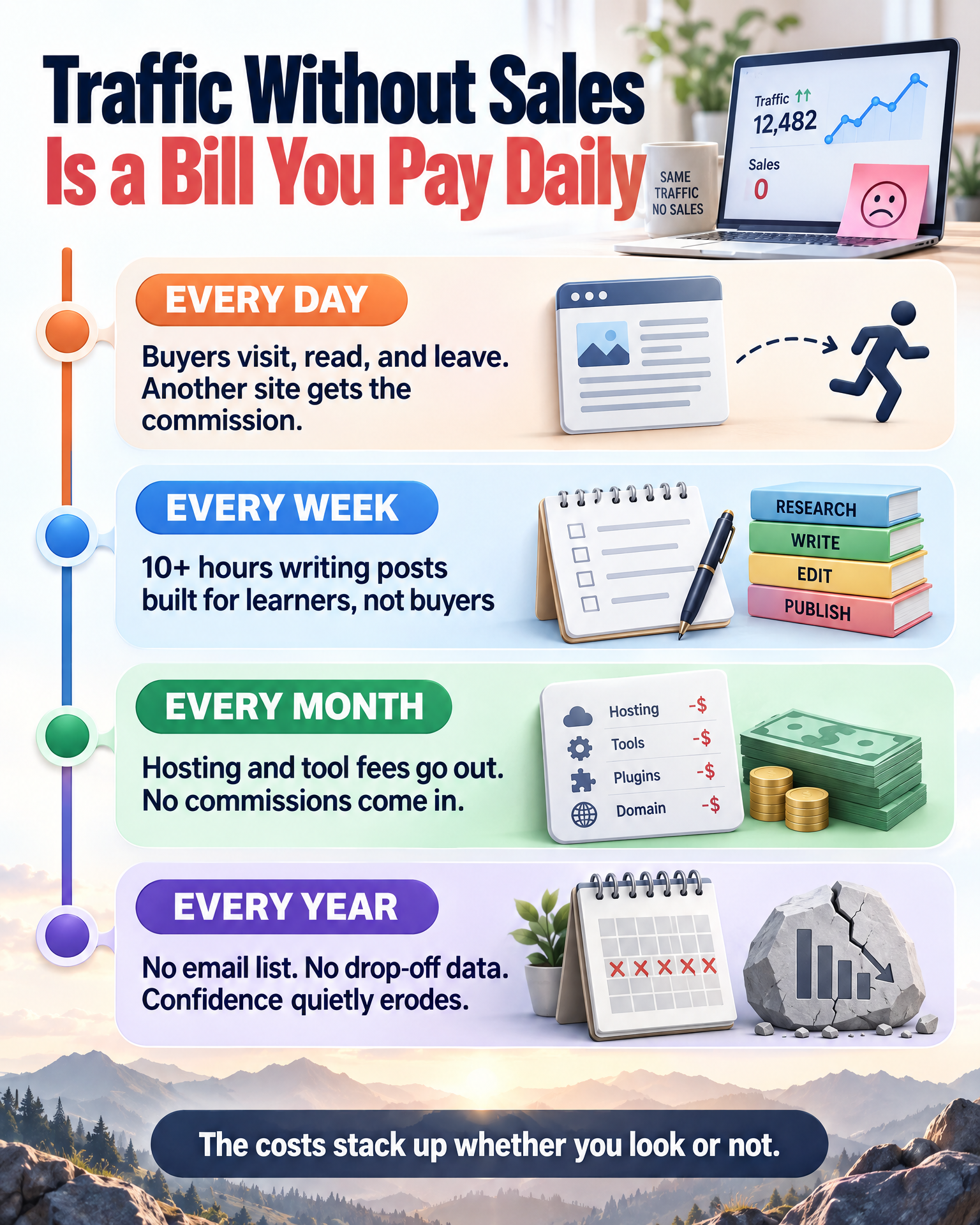
Here is the bill, counted by the day, the week, the month, and the year.
Why Do Blog Visitors Leave Without Buying Through Your Link?
Start with today.
Somebody typed a question into Google this morning. They landed on your post. They read part of it, and then they left.
That person had a problem. Your page talked about a product that might solve it. They walked away with nothing from you, and you got nothing from them.
Some of those readers probably bought something right after. They just didn’t buy through your link. Another site got that commission.
This happens every day, quietly. You never see it. No alert tells you a buyer left.
Then there’s the daily ritual. You open the affiliate dashboard. You refresh it. You see zeros.
You tell yourself tomorrow will be different. Then you do the same thing tomorrow.
Here’s what you pay each day:
- Lost buyers: Readers with real interest leave your page with no next step.
- Attention: You check numbers that never move.
- Energy: Every zero chips away at your drive to write the next post.
None of this feels dramatic on a single day. That’s why you can ignore it. But days stack up.
How Much Time Does Content That Doesn’t Convert Cost You?
Let’s talk time. Time is the cost you feel most.
Say one post takes you five hours. Research, writing, images, editing, publishing. Write two posts a week and you’ve spent ten hours.
Where do those ten hours go? Often into pages built to answer questions, not to help someone buy.
That matters because informational traffic rarely converts into affiliate sales. Someone searching “what is a standing desk” wants to learn. Someone searching “best standing desk for a small apartment” is closer to buying.
If most of your posts attract the first kind of reader, you’re working hard to attract people who aren’t ready. That’s why your affiliate traffic isn’t converting.
Now add the other weekly costs.
You give up a Saturday morning to the laptop. Your partner asks, “Is the blog making anything yet?” You change the subject.
Your friends ask how the blog is going. You say, “Slowly.” You know that’s not the whole truth.
You also spend time reading forum threads and watching videos. Everyone has a new tactic. You try one, then another, and none of it sticks because you never found the real break.
That’s the weekly bill:
- Hours spent on content that may not match buyer intent.
- Weekends traded for work that pays nothing.
- Awkward conversations with people who care about you.
- Time wasted on random fixes instead of one real diagnosis.
Blog Expenses vs. Affiliate Commissions: Are You Losing Money?
Now count the money. You know these numbers better than I do.
Add up your monthly costs. Hosting. Your theme or page builder. An SEO tool. An email service. Maybe a writer or an editor.
Then look at your affiliate commissions for the same month. Put the two numbers side by side.
That’s not a hobby budget anymore. That’s a loss you fund every month.
The real number is bigger, though. Think about earnings per click (EPC). Every visitor should be worth something to you. Right now, that value is close to zero.
You paid for that traffic with research, writing, and link building. When a visit earns nothing, you give that work away for free.
Then there’s the cost you can’t put in a spreadsheet.
You may sleep worse. You may feel a small knot in your stomach when someone asks what you do. You may feel jealous when another blogger posts a good month.
Your mood follows your numbers. When the numbers sit at zero, so does your confidence.
Here’s the monthly bill:
- Cash: Tool and hosting fees with no commissions to cover them.
- Wasted value: Hundreds or thousands of visits that earn you nothing.
- Stress: A low hum of worry that follows you around.
You can keep paying this. Plenty of people do. But it’s a choice, and it’s costing you now.
What Happens When Affiliate Marketing Isn’t Working for a Year?
Zoom out. Look at twelve months.
If you publish two posts a week, that’s 104 posts in a year. That’s 104 chances to build a page that sends readers toward a purchase.
How many of those pages have a clear call to action? How many have a comparison table? How many carry honest pros and cons that help a reader decide?
If the answer is “not many,” you’ve spent a full year building pages that don’t do their job.
Next, think about what you didn’t build.
Every visitor who leaves without joining an email list is gone. You can’t reach them again. You can’t send them a follow-up when they’re ready to buy.
An email list lets you reach warm readers again and again. Retargeting ads work in a similar way. Without them, each visitor gets one shot at buying from you. Most never take it.
A year of that adds up. Thousands of readers came and went, and you have no way to bring them back.
Then there’s the biggest cost of all: who you become.
You started this blog to build something. Little by little, you begin to see yourself as someone with an expensive hobby. You doubt your skills. You ask why your affiliate marketing is not working, and whether it works for anyone.
Some people quit here. Others spend a second year making the same mistake.
That’s the yearly bill:
- A full year of content that may not match buyer intent.
- No email list to bring warm readers back.
- No data on where visitors drop off.
- A weaker belief in your own skills.
Why More Traffic Won’t Fix Low Affiliate Conversions
Let’s go back to the skeptic in your head. The one who says, “I just need more visitors.”
Here’s the problem with that thought. It lets you skip the hard question. And that question is the only one that matters: where do readers stop?
Even stores whose visitors arrive ready to shop only turn a small share of visits into sales. A blog post with a thousand visits and zero affiliate sales isn’t converting slowly. It’s leaking.
Your blog has a sales funnel, whether you built one or not. A reader finds your page. They read. They trust you or they don’t. They click a link or they don’t. They buy or they don’t.
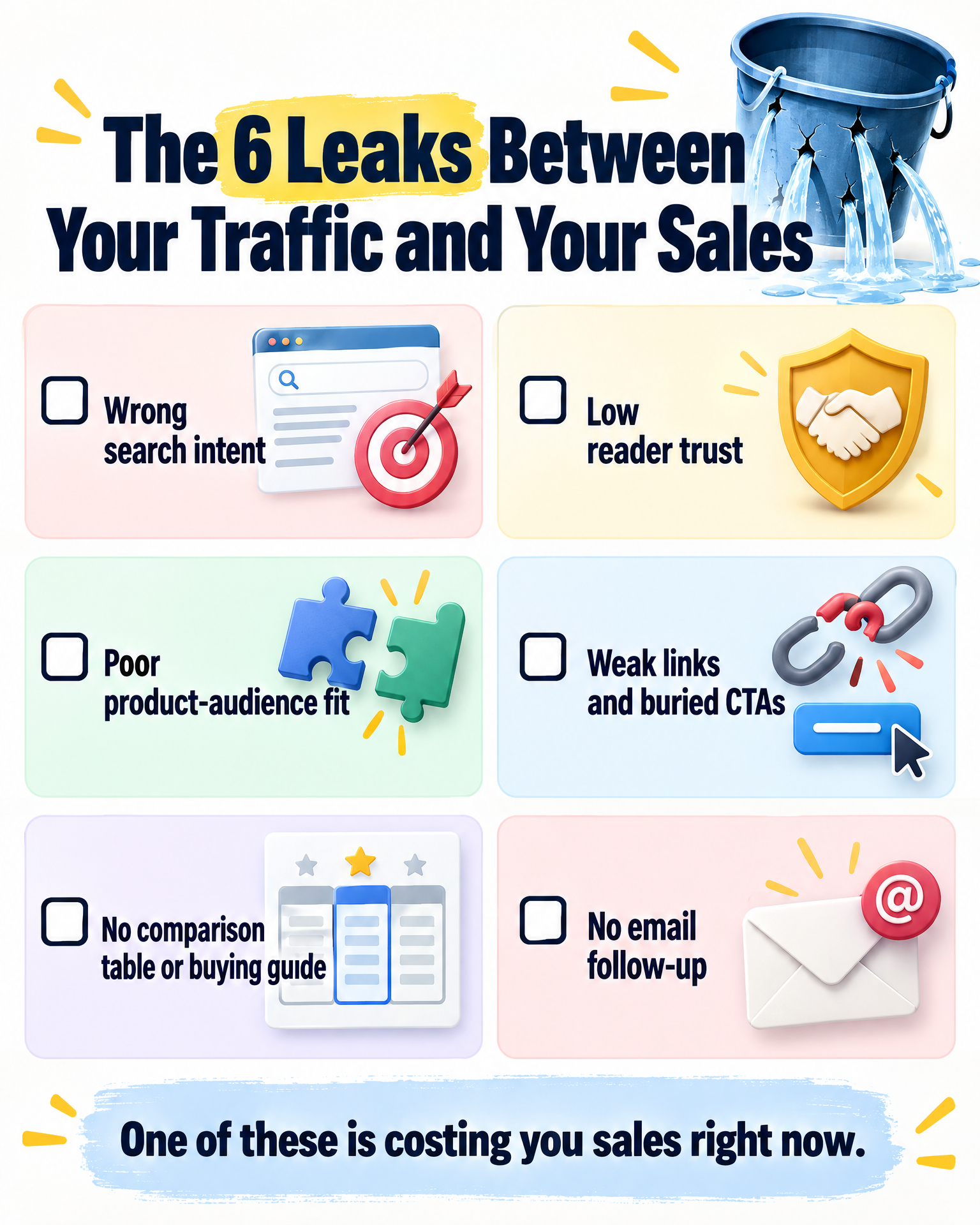
Somewhere along that path, people drop out. Right now you can’t see where. Here are the usual suspects.
Wrong Search Intent: Informational vs. Buyer-Intent Keywords
Informational keywords attract learners. Buyer-intent keywords attract people ready to purchase. If your top posts rank for the first kind, you’ll get traffic and no sales.
Low Reader Trust: Why Reviews That Read Like Ads Fail
Reader trust drives conversions. If your review reads like an ad, people leave. Honest reviews with real pros and cons build confidence. A clear affiliate disclosure helps too.
Poor Product-Audience Fit
You may recommend a product your readers don’t need or can’t afford. Poor fit lowers your earnings, no matter how good the post is.
Weak Affiliate Links and CTAs
Maybe your affiliate links sit in the middle of a paragraph where nobody sees them. Clear call-to-action buttons raise your affiliate link click-through rate (CTR). Buried links don’t.
No Product Comparison Table or Buying Guide
Readers need to compare options. A product comparison table helps them decide faster. Buying guides lower the risk of a purchase.
No Email Follow-Up
If readers leave and never hear from you, you lose them for good.
No Clicks vs. Clicks but No Sales: Which Problem Do You Have?
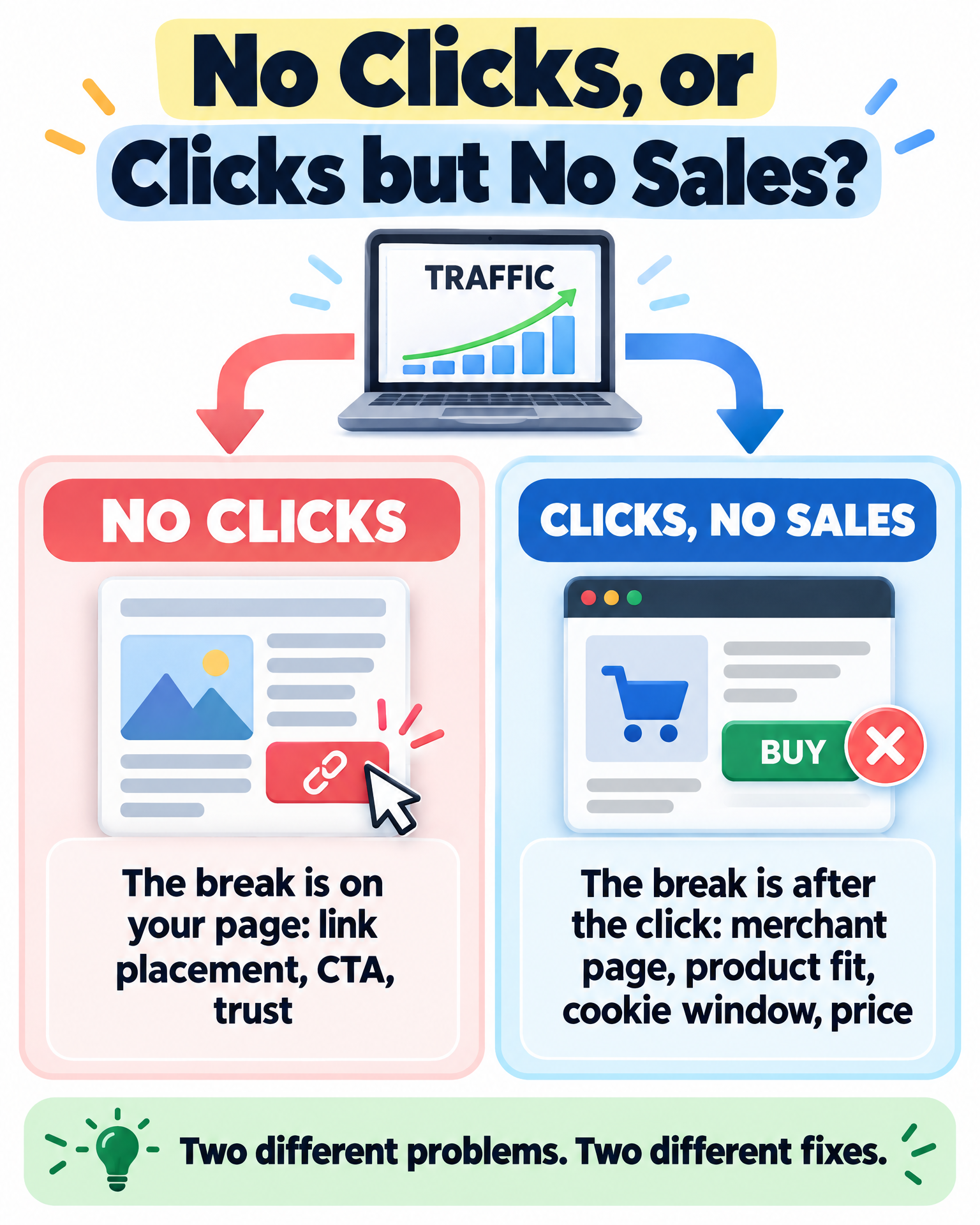
Notice the two different problems hiding in your numbers.
If you’re getting no clicks at all, the break is on your page. Your link placement, your CTA, or your trust level is failing.
If you’re getting clicks but no affiliate sales, the break is after the click. The merchant page may not convince them. The product may not fit. The cookie duration may be too short. The price may scare people off.
Those two problems need two different fixes. You can’t pick the right one by guessing.
How to Find Where Your Affiliate Traffic Drops Off
You don’t need to buy anything to start. Google Analytics is free, and Hotjar offers a free plan. You need to look.
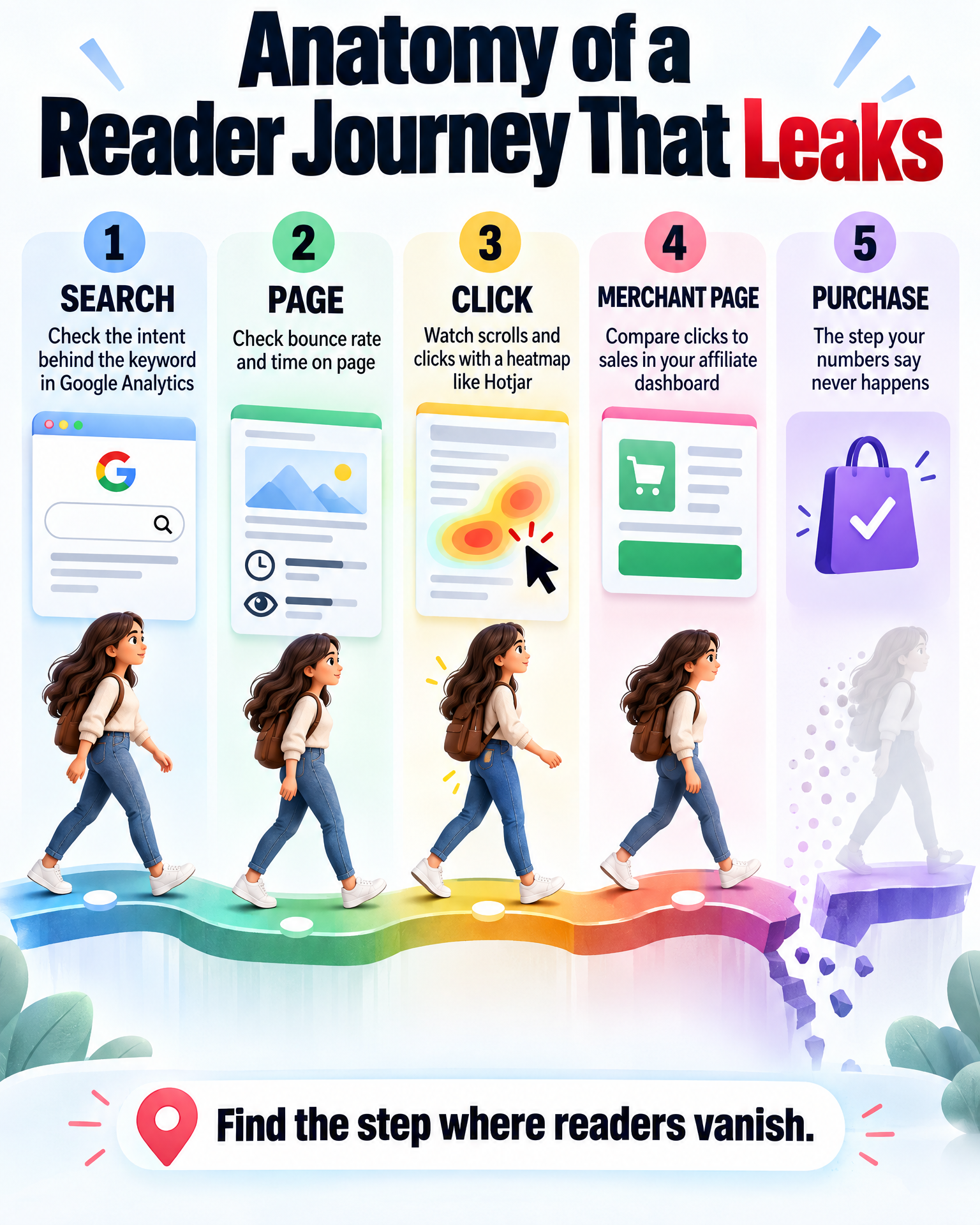
Open Google Analytics. Find the posts with the most traffic. Check the bounce rate and how long people stay.
Then try a heatmap tool like Hotjar. Heatmaps and analytics reveal where visitors drop off. You’ll see where people scroll, where they stop, and what they ignore.
Check your affiliate dashboard next. Compare clicks to sales for each link. That tells you whether your leak sits before the click or after it.
This takes an afternoon, not a month. And it replaces a vague worry with one clear answer.
Find Your Affiliate Conversion Leak Before Your Next Post
Publishing more won’t cure blog traffic but no affiliate sales, and you already know it. Take your best-traffic post and write out the reader’s path: search, page, click, merchant page, purchase. Then dig through your analytics and affiliate dashboard until you find the step where readers vanish. Don’t publish another post until you do.
Products / Tools / Resources
- Google Analytics (free): Find the posts with the most traffic, then check bounce rate and how long people stay to spot where readers leave.
- Hotjar (free plan): Heatmaps that reveal where visitors drop off — where they scroll, where they stop, and what they ignore.
- Your affiliate program dashboard: Compare clicks to sales for each link to learn whether your leak sits before the click or after it.