
You did the hard part already. The writing, the research, the hours spent getting a stranger from a search results page onto your site. They read enough of your words to trust you — enough, at least, to click. And then?
Silence. A cursor hovering somewhere it shouldn't. A merchant tab that opens, sits there for eleven seconds, and closes without a single dollar changing hands.
If that sequence keeps repeating in your analytics, here's the reframe you actually need: you're not bad at affiliate marketing. You're good — maybe even really good — at the awareness part. The breakdown is happening somewhere else, in a stretch of the journey most bloggers never think to examine. Marketers call it the decision architecture, and understanding it changes everything about how you diagnose a stalled funnel, because it tells you precisely where to point your flashlight.
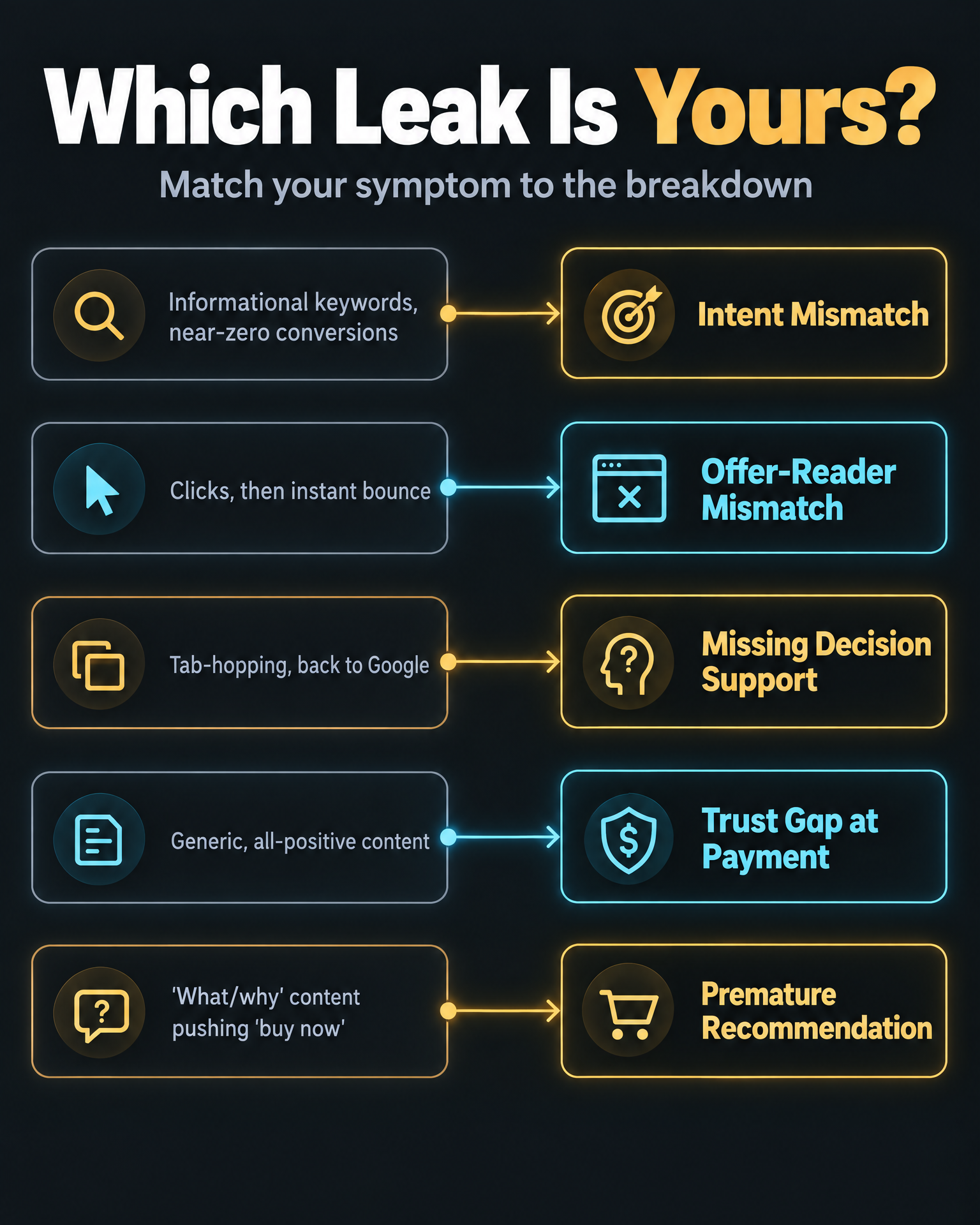
Quick answer, for anyone skimming with a coffee in one hand: when clicks don't turn into sales, the failure almost always lives in one of five spots — offer-reader mismatch, premature recommendation, missing decision support, trust gaps at the transaction moment, or intent mismatch. Each one has its own fingerprint. Each one has its own repair.
Let's take this apart the way a diagnostic tech pulls open a dashboard — not with hope, but with a checklist.
Table of Contents
The Click Isn't the Finish Line. It's Barely the Opening Line.
Rethinking the Click-to-Purchase Gap
Most new affiliates picture the process as a straight line.
Content → Click → Commission.
That mental shortcut is exactly why so many blogs plateau at "decent traffic, no revenue" — a trap I broke down in Why Your Affiliate Blog Gets Traffic but No Sales. Because the real path a buyer walks looks nothing like a line. It looks more like a stairwell with a few landings people pause on:
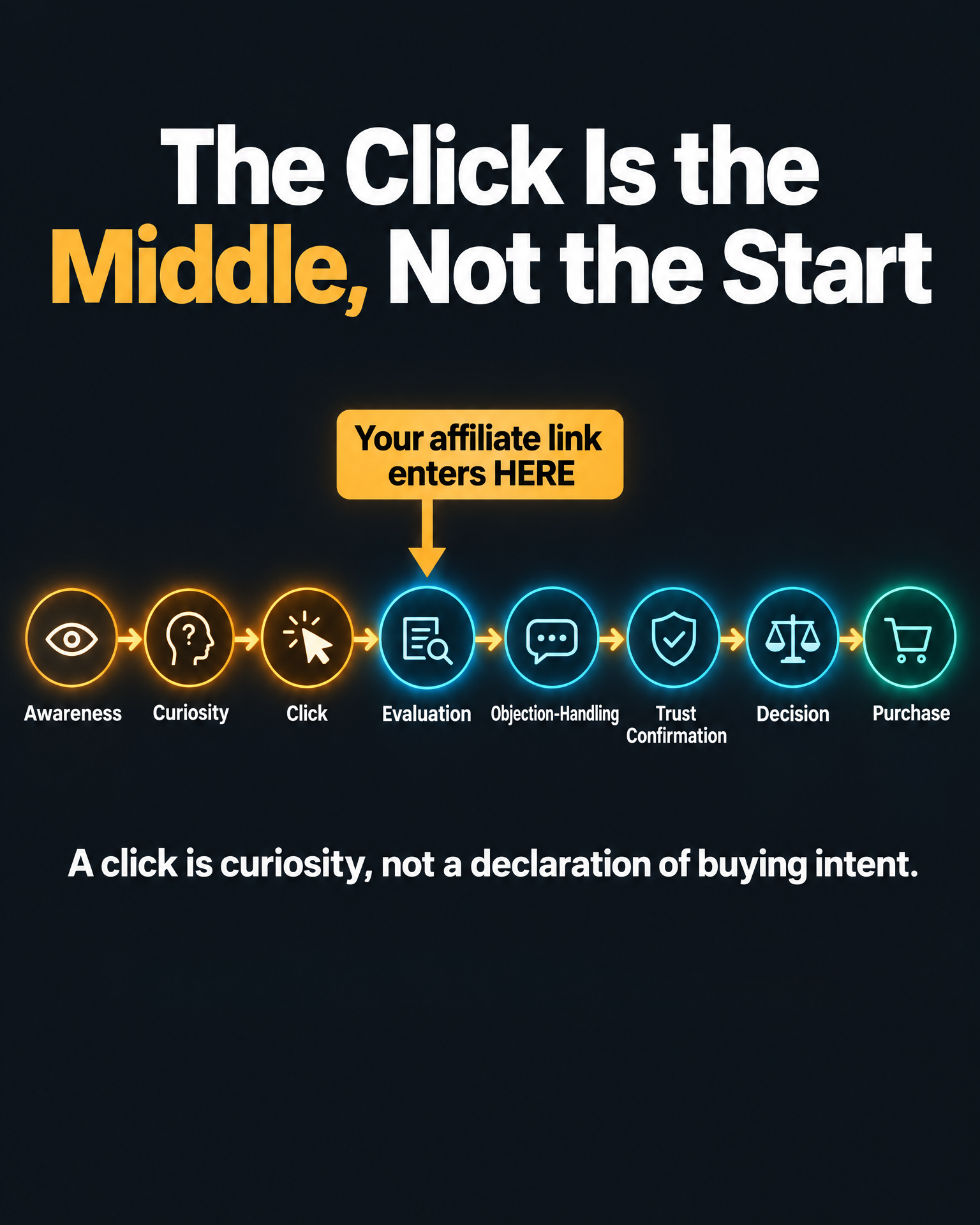
Awareness → Curiosity → Click → Evaluation → Objection-Handling → Trust Confirmation → Decision → Purchase.
Your affiliate link doesn't launch someone straight into "buy." It drops them into the middle — the evaluation stage. And if the reader hasn't finished the steps before that, or if the offer doesn't quite fit what brought them there in the first place, the click becomes a dead-end hallway instead of a door.
This is the part almost nobody says out loud: a click is curiosity wearing the costume of intent. It is not a promise to buy. Mistaking one for the other is where most conversion problems are actually born.
The Five Places the Journey Quietly Falls Apart
Think of this next section as symptom-matching. Read each one the way you'd read a list of possible diagnoses in a waiting room — see which shoe fits, and you'll probably know your real bottleneck before you finish reading.
1. Offer-Reader Mismatch: Close, But Not Actually Close Enough
The real issue: the reader's problem and your product's promise are cousins, not twins. Related enough to earn a click. Not related enough to earn a purchase.
This one hides well because it feels like a win. They clicked, didn't they? But a click born from partial relevance isn't targeting success — it's targeting almost. And "almost" doesn't pay commissions.
Picture this: a post titled "Best Tools for Staying Organized as a Freelancer." Someone reading it is drowning — not in tasks, but in client emails that never stop, messages scattered across four platforms, chaos that has nothing to do with checklists. They click your task-management link anyway, because it's adjacent to their pain. They poke around the merchant page for a minute. Then they leave, because the tool never touched the actual wound.
Signs this is your problem:
- Click-through looks healthy. Conversion looks embarrassing.
- People bounce off the merchant page almost immediately (your UTM tags will tell you this if you're watching)
- Emails or comments say some version of "not quite what I needed"
- You wrote for a keyword, not for a person with a specific, nameable ache
The deeper connection: this is a problem-solution fit issue — the affiliate cousin of product-market fit. Except you're not building the product. You're building the bridge. And a bridge that lands on the wrong bank of the river doesn't get fixed with more traffic. It gets fixed by rebuilding the bridge.
2. Premature Recommendation: Asking for a Yes Before They've Finished the Question
The real issue: you're pushing a decision toward someone who's still forming the question in their head.
Buying follows a psychological order — problem recognition, then solution awareness, then comparing options, then finally, deciding. Skip straight to "here's the best one" while your reader is still stuck on "wait, do I even need this kind of solution?" and you've asked for a commitment before laying any groundwork.
It's the digital version of a salesperson shoving a contract into your hands thirty seconds after you walked through the door. You'd back away too.
Picture this: somebody searches "why is my skin breaking out in my 30s." That's confusion talking, not a shopping list. If your article jumps immediately to a specific treatment with a buy button attached, plenty of people will still click — curiosity does that — but they'll abandon at checkout, because they haven't decided what kind of fix they even want. Diet? Dermatologist? Product? You answered a question they hadn't asked yet.
Signs this is your problem:
- Your traffic arrives on informational, early-funnel keywords
- The affiliate link shows up suspiciously early — before the problem's even been fully unpacked
- People click, then vanish from the merchant page within seconds
- Almost nothing on your page addresses "why this category of solution" before jumping to "why this specific product"
The fix, structurally: build what I'd call an evaluation bridge — a section that sits with the problem for a moment, walks through the categories of solutions, and only then narrows toward your pick. Think rising action before the climax. Not climax on page one.
3. Missing Decision Support: You Handed Them Off With Nowhere to Turn
The real issue: the reader clicked with real interest. Landed on the merchant's page. And then hit a wall of questions nobody answered — with nothing to do but leave.
This one's different from the first two. Your targeting was fine. Your timing was fine. The failure is architectural — you sent them into the merchant's world without arming them for the friction waiting there.
The usual gaps look like this:
- No comparison context — they don't know how this stacks against the other three tabs they have open
- Unaddressed objections — price hesitation, "does this actually work," "will this fit my specific situation"
- No differentiation — "why this one, and not the ten nearly identical options I've already seen today"
- No social proof bridge — they need to hear from someone who feels like them, not more polished marketing copy
Picture this: someone's got five tabs open, comparing three project-management tools side by side. Your article recommended one of them — but never explained why it beats the other two she's already looking at. The merchant page doesn't explain it either; it's built for people who've already made up their mind. She closes all five tabs. Tells herself she'll finish the research tomorrow. Tomorrow, as it usually does, becomes never.
Signs this is your problem:
- Session recordings or heatmaps show visible tab-hopping and comparison behavior
- The merchant's page is solid — good design, decent trust signals — so the leak isn't happening there
- Your article has no comparison table, no FAQ, no section handling objections
- You've never written "alternatives to X" or "X vs Y" (my Snowball Affiliate vs Project 24 post is one example of the latter) — meaning that research is happening somewhere else. Possibly on a competitor's site.
Why this matters beyond conversions: search engines reward content that shows genuine topical range — not just "what is X," but "X vs Y," "is X actually worth it," "X for [specific situation]." A missing decision-support section isn't only a leak in your funnel. It's a gap search engines can spot too, through the way they cluster and evaluate topical coverage.
4. Trust Gaps at the Exact Moment of Payment
The real issue: they trusted you enough to click. That trust didn't survive the walk to checkout — because trusting you and trusting the transaction are two different psychological events, and people conflate them at their own risk (or rather, at yours).
Here's the subtle part almost nobody catches: someone can genuinely like your writing, believe you're honest, and still freeze at the payment screen because of:
- Price doubt that was never addressed — "is this actually worth it for someone in my exact situation"
- Uncertainty about the merchant itself — refund policy, reputation, what happens if this goes wrong
- A flicker of "wait, am I being sold to right now" that surfaces exactly when the credit card comes out
- The absence of a specific, human reason you actually believe in this thing — versus a vague, forgettable "this is great"
Picture this: someone reads your blog regularly, trusts your tone, clicks without a second thought. But your review never mentioned a real limitation. Never got specific about price. Read like every other affiliate post they've scrolled past this month. At the final step, that sameness resurfaces as doubt — is this person just selling me something? — and that flicker, small as it is, is often all it takes to close the tab.
Signs this is your problem:
- Your review is positive but vague — no drawbacks, no "who this isn't for"
- Your affiliate disclosure is buried or missing (hiding it usually erodes trust rather than protecting it — counterintuitive, but true)
- Your review sounds like the other twenty reviews of the same product — and low differentiation reads as low authenticity (compare that with Snowball Affiliate Review, which is built on specifics)
- There's no first-person specificity anywhere — nothing that proves you've actually touched the thing you're recommending
The deeper layer: this connects straight to the "experience" and "trustworthiness" side of how content quality gets evaluated. Writing that shows first-hand, specific, non-generic understanding doesn't just rank better. It converts better — because algorithms and humans, oddly enough, are pattern-matching for the exact same signal: earned authority that wasn't manufactured.
5. Intent Mismatch: You Answered a Question They Weren't Asking Yet
The real issue: the reader never searched with buying on their mind. They searched to understand something. You put a transactional offer in front of a mind that's still in research mode, and the friction of that mismatch kills the conversion before it has a chance to breathe.
Search intent tends to fall into four buckets — informational, navigational, commercial investigation, and transactional. Affiliate links do their best work in the commercial-investigation or transactional zones. Not in the middle of someone's research phase, uninvited.
Picture this: somebody types "what causes low energy in the afternoon." That's pure information-seeking — sleep, diet, blood sugar, stress, who knows. They want to understand before they want to shop. An article that respects that arc — walks through causes thoughtfully, then naturally arrives at "if diet's your likely cause, here's how people typically address it" — honors the sequence. An article that opens with a supplement pitch skips the sequence entirely. Even a curious click there tends to evaporate at checkout, because the reader's brain hasn't finished understanding yet, let alone decided to buy.
Signs this is your problem:
- Your ranking keywords carry informational fingerprints — "what is," "why does," "how to understand"
- Your link placement doesn't line up with any natural "now I want a solution" moment
- CTR looks great, conversion looks nearly nonexistent — a textbook intent-mismatch signature
- Analytics show people bouncing back to Google after clicking — refining their search, which is a loud signal that the offer arrived too early
The Self-Diagnostic Walkthrough: Which One's Actually Yours?
Don't guess. Walk through this like a decision tree, one branch at a time.
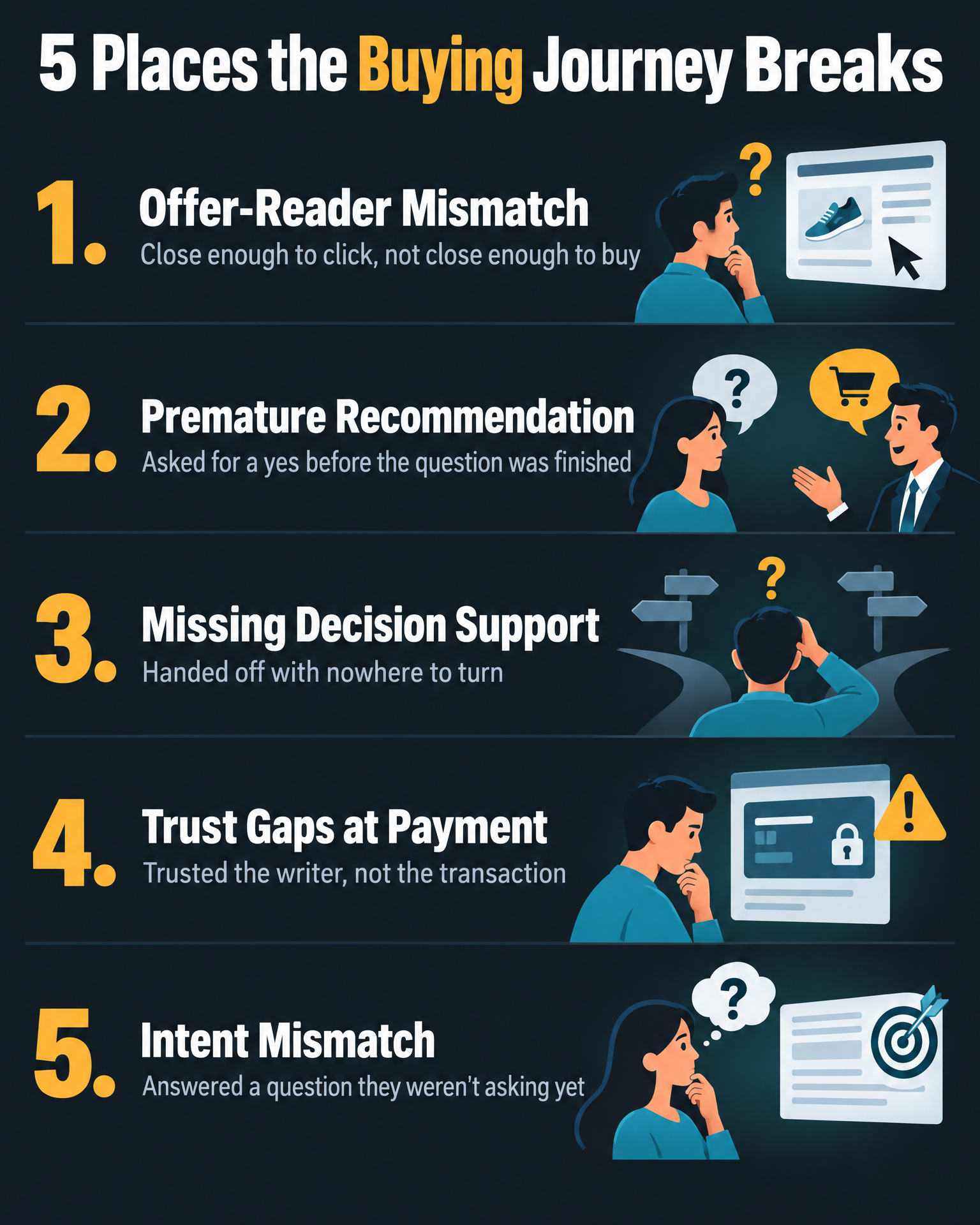
Step 1 — Look at keyword intent. Is the traffic informational (what, why, how) or commercial (best, review, vs, alternative)? Informational traffic clicking transactional links points straight at intent mismatch.
Step 2 — Compare click-through rate against time-on-merchant-page. People clicking, then vanishing almost instantly? Look toward offer-reader mismatch or premature recommendation.
Step 3 — Watch for comparison behavior. Multiple tabs, returns to search after clicking? That's the fingerprint of missing decision support. A side-by-side breakdown is the classic fix — see Snowball Affiliate vs Wealthy Affiliate.
Step 4 — Read your own content honestly. Generic, all-positive, indistinguishable from every other review out there? That's a trust gap showing up at the transaction moment.
Step 5 — Check the funnel stage your content actually lives in. Answering "what/why" but pushing "buy now"? That's premature recommendation, often layered with intent mismatch riding shotgun.
Here's the honest part: most stalled blogs aren't dealing with just one of these. Usually it's two or three, tangled together. Which sounds discouraging but really isn't — because fixing the structural issues (decision support, intent alignment) tends to quietly fix the softer ones too. Well-sequenced content builds trust as a byproduct. It filters the right reader toward the right offer almost automatically.
The One Question Underneath All Five
Strip away the categories, and it all comes down to a single question:
Does this specific offer match this specific reader's specific readiness to buy — right now, at this exact point in the content?
Search systems are increasingly built to detect the same thing. Modern ranking signals — and the AI overviews now sitting on top of search results — reward content that shows coherent intent-matching, content that resolves the actual need behind a search rather than just brushing against a keyword. A mismatched offer isn't only a lost commission anymore. In today's search landscape, it's quietly becoming a visibility problem too, because thin, mismatched content struggles to prove the kind of topical depth these systems are hunting for.
Offer fit was never a copywriting trick to sprinkle on at the end. It's decided upstream — in the keyword you chose, in how you structured the page, in whether you actually understood where your reader was standing when they landed on it.

Questions People Actually Ask Me About This
Why do people click my affiliate links and then just… not buy? Because the click usually means curiosity, or partial relevance — not a fully-formed decision to purchase. Everything unresolved — doubt, comparison shopping, mismatched timing — lives in that gap between click and checkout. And that gap doesn't close itself. You have to close it with content.
How do I actually know if intent mismatch is my problem? Look at the words people typed to find you. "What," "why," "how to understand" sitting next to transactional links and a conversion rate near zero — that combination is about as clear a signal as you'll get.
Should I just stop putting affiliate links in informational content? Not necessarily. Reposition them instead. Informational content can absolutely still link to a solution — as long as it validates the problem first, frames the category of solutions, and only then narrows down to your specific pick.
What does "offer-reader mismatch" actually mean in plain terms? It's when what you're promoting is topically related to what someone searched, but doesn't touch their actual, specific, felt problem. They click out of curiosity. They leave because the deeper need underneath the search was never really addressed.
Does adding comparison content genuinely move the needle on conversions? Yes — because a huge share of "non-buying clicks" are really just unfinished research sessions. Comparison tables, "alternatives to" posts, objection-handling FAQs — these give readers what they need to actually finish deciding, instead of closing the tab to "think about it."
Why would someone trust my writing but still hesitate right before paying? Because trusting a writer and trusting a transaction aren't the same event psychologically. Someone can love your content, click without hesitation, and still stall at checkout — usually because the review felt generic, skipped over real limitations, or never gave them a concrete, specific reason to believe this purchase was the right one for them.
Products, Tools & Resources Worth Bookmarking
If you're serious about actually closing this gap instead of just reading about it, here's what's worth having in your corner:
For tracking where the leak actually is: Hotjar or Microsoft Clarity — session recordings will show you, in real time, whether people are tab-hopping, bouncing instantly, or scrolling with intent. Clarity's free, which makes it an easy first step before you spend on anything else.
For understanding search intent at the keyword level: Ahrefs or Semrush, specifically their keyword intent labeling — both now flag whether a keyword skews informational, commercial, or transactional, which takes a lot of the guesswork out of Step 1 in the diagnostic above.
For building comparison and objection-handling content faster: A simple comparison-table plugin (Table Press, or the native blocks in most modern WordPress themes) makes it far easier to build the "X vs Y" and "alternatives to" content that closes decision-support gaps.
For strengthening trust signals on review content: Trust Pulse or a similar social-proof widget, paired with a clearly written, honest disclosure statement placed near the top of the page — not buried in a footer link nobody clicks.
For testing whether your fix actually worked: Google Analytics 4, specifically event tracking on outbound affiliate clicks paired with merchant-side conversion data (where your affiliate program provides it) — without this loop closed, you're diagnosing blind.
For deepening topical coverage around a product category: AnswerThePublic or AlsoAsked — both surface the exact "what," "why," and "vs" questions real people are typing, which is often the fastest way to spot the decision-support content you haven't written yet.