
Someone types “best hiking boots for wide feet” into Google. Or maybe it’s “is [category] worth it in 2025” — you know the phrasing, you’ve probably typed something like it yourself at 11pm while trying to decide if you actually need a new blender. They land on your post. They read the whole thing, start to finish. You can practically feel them nodding along.
Then they close the tab.
No click to your comparison page. No detour to the buying guide you spent hours building. No conversion. Nothing.
If you’ve run an affiliate site for more than a few months, you already know this story a little too well. It’s one of the quietest, most under-discussed problems in the whole content game: traffic that behaves beautifully and converts terribly. Not because the writing was weak. Not because the reader wasn’t interested. But because there was never a path laid out for them to follow once their curiosity was satisfied. Internal linking, done with actual intention, is that path. Done carelessly — a link dropped in because it felt relevant, another because a plugin nudged you toward it — it stops being a path and turns into background noise.
This piece is about treating internal links as a deliberate system. Something that walks a reader from curiosity, into comparison, and finally into a decision — using principles that hold up across niches, without leaning on specific tools, invented statistics, or magic numbers.
Mapping one link path is useful, but real traction comes from seeing how every piece of content connects toward a sale. The free Content Node Planner helps you turn one reader problem into a connected path from first click to confident purchase. Grab it below and start building paths instead of scattered posts.
Table of Contents
Why Internal Links Are the Bridge Between Content and Conversions
Search engines reward sites that show real topical depth and a structure that makes sense. Readers, meanwhile, reward sites that seem to already know what they need next — almost like the site is one step ahead of them. Internal linking sits right where those two things overlap.
Every single internal link is doing three jobs at once, whether you planned it or not. It tells a crawler how your pages relate to one another. It tells a reader what to do next. And it tells you, quietly, how much authority and relevance is actually flowing toward the pages that matter most to your revenue. Most affiliate blogs treat internal linking like a box to check — “link to three other posts, done” — without ever asking what job that link is supposed to perform.
A link’s job isn’t decoration. It either builds understanding (informational-to-informational) or it builds momentum (informational-to-commercial). Mixing those two purposes up is exactly why so many sites have strong search visibility and weirdly flat revenue. If that pattern sounds familiar on your own site, it’s worth reading Why Your Affiliate Blog Gets Traffic but No Sales — the cause is almost never the content itself. It’s structural.
Hold onto this idea as you read the rest of the piece: internal links are a conversion mechanism wearing a navigation costume. Plan them like one.
Understanding the Reader Journey Before You Link Anything
You can’t design a path for someone whose starting point you haven’t figured out. This is where search intent stops being an abstract term from an SEO course and becomes something you can actually use.
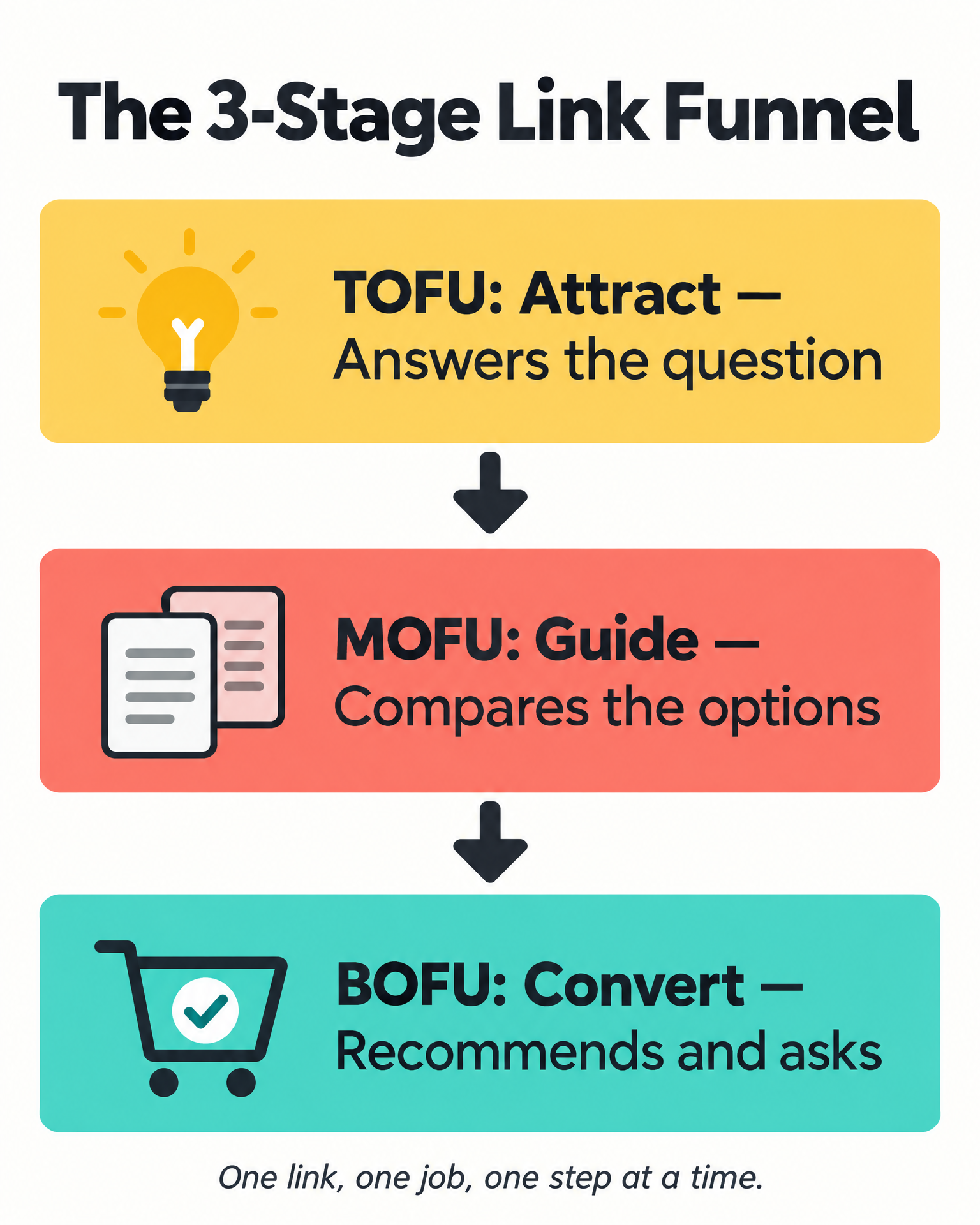
Most search queries fall into one of three stages:
- Awareness (TOFU): The reader’s poking at a problem, not a product. “Why does my skin dry out in winter.” Nothing on their mind yet except discomfort.
- Consideration (MOFU): They know roughly what kind of solution they’re after. “Best moisturizers for dry skin.” Now they’re comparing.
- Decision (BOFU): They’re close. “Product A vs Product B.” Or the classic, “Is [product] actually worth buying.”
Here’s the mistake almost everyone makes at some point — linking a TOFU post straight into a single product review, skipping the comparison stage entirely. It’s a bit like meeting someone at a party and bringing up marriage before you’ve swapped last names. The reader isn’t there yet. The jump feels pushy instead of helpful, even if your intentions were good.
The better structure sends TOFU content into MOFU content first — the comparison post, the roundup, the “types of X” article — and lets that MOFU content carry the reader forward into a BOFU review or buying guide. This mirrors how people genuinely make purchase decisions: understand first, compare second, decide last. For a fuller look at how these three content types should work together from the ground up, see How TOFU, MOFU, and BOFU Content Fit Together on an Affiliate Site.
What is a link funnel in affiliate content?
Think of it as a deliberate sequence — an informational post hands off to a comparison or category post, which hands off to a decision-stage page like a review or buying guide. It’s built to mirror the way people actually shop, not to force a shortcut they’re not ready for.
Mapping Your Content So Every Post Has a Job
Before you can build any of this, you need to actually see what you’ve already published. Most blogs that have been around a while have far more content than the owner remembers — and a lot of it is just… sitting there. Ranking for something. Bringing in traffic. Connected to absolutely nothing.
Give every post one job, and only one:
- Attract — pulls in search traffic through broad, informational queries.
- Guide — helps the reader compare, narrow down, build confidence.
- Convert — presents the specific product or recommendation and asks for the click.
Once every post has a job assigned, linking stops being guesswork and becomes sequencing. Attract posts link forward to Guide posts. Guide posts link forward to Convert posts. Convert posts can link sideways to other Convert posts — alternatives, head-to-head comparisons — but rarely need to reach backward into TOFU territory, except maybe for a bit of context.
This is also where your category structure starts to matter more than people expect. If “skincare tips,” “skincare products,” and “best skincare” are all a jumbled mix of TOFU and BOFU posts, you’re going to struggle to see what should feed what. Clean categorization turns link planning into something almost mechanical instead of a guessing game. If your current setup feels tangled — and you’ll know if it does — it’s worth sorting that out first with How to Organize Blog Categories Without Overlapping Topics, since a clear architecture makes everything else in this article move faster.
Even a simple spreadsheet helps here — URL, primary keyword, intent stage, “links to.” It turns a fuzzy idea into something you can actually work through, post by post.
Designing the Link Path: From Curiosity to Comparison to Decision
Once intent stages are mapped and jobs are assigned, the real work is placement, sequencing, and — this one surprises people — restraint.
Placement matters more than most people assume. A link buried in a closing paragraph, after the reader has already mentally clocked out, gets a fraction of the clicks a well-placed one gets. Drop it where the question naturally arises. If a paragraph just explained why humidity affects indoor plants, the next thought in the reader’s head is “okay, so which humidifiers actually work for this” — and that’s exactly where your comparison link belongs. Not three paragraphs later, after the moment’s passed.
Sequencing keeps readers from shutting down. Don’t send a single TOFU post into five different BOFU reviews at once. That’s not guidance — that’s a wall of options, and it recreates the exact decision fatigue that stops people from buying anything at all. One clean link into a MOFU comparison — Snowball Affiliate vs Making Sense of Affiliate Marketing: Which Problem Are You Actually Trying to Solve? — and let that comparison post branch out from there. Each page handles one decision at a time.
Restraint is what earns trust. A post stuffed with links to every commercial page on your site reads as a sales pitch, and readers can smell that from a mile away. A post with two or three links, clearly relevant, reads as someone actually trying to help. The goal is for the reader to feel like they found the next step on their own — not like they were shoved toward it.
How many internal links should a blog post have?
There’s no magic number here, and anyone who tells you otherwise is guessing. A better rule is proportionality — enough links to move the reader forward and reinforce topical relationships, often somewhere around three to six in a standard post, placed where they answer a question the reader is already forming. Not chosen because a number felt satisfying.
Anchor Text and Context: Writing Links That Feel Like Guidance, Not Ads
The words wrapped around a link often matter more than the link itself. Anchor text is a small but loud signal — to readers and to crawlers alike — about what’s waiting on the other side.
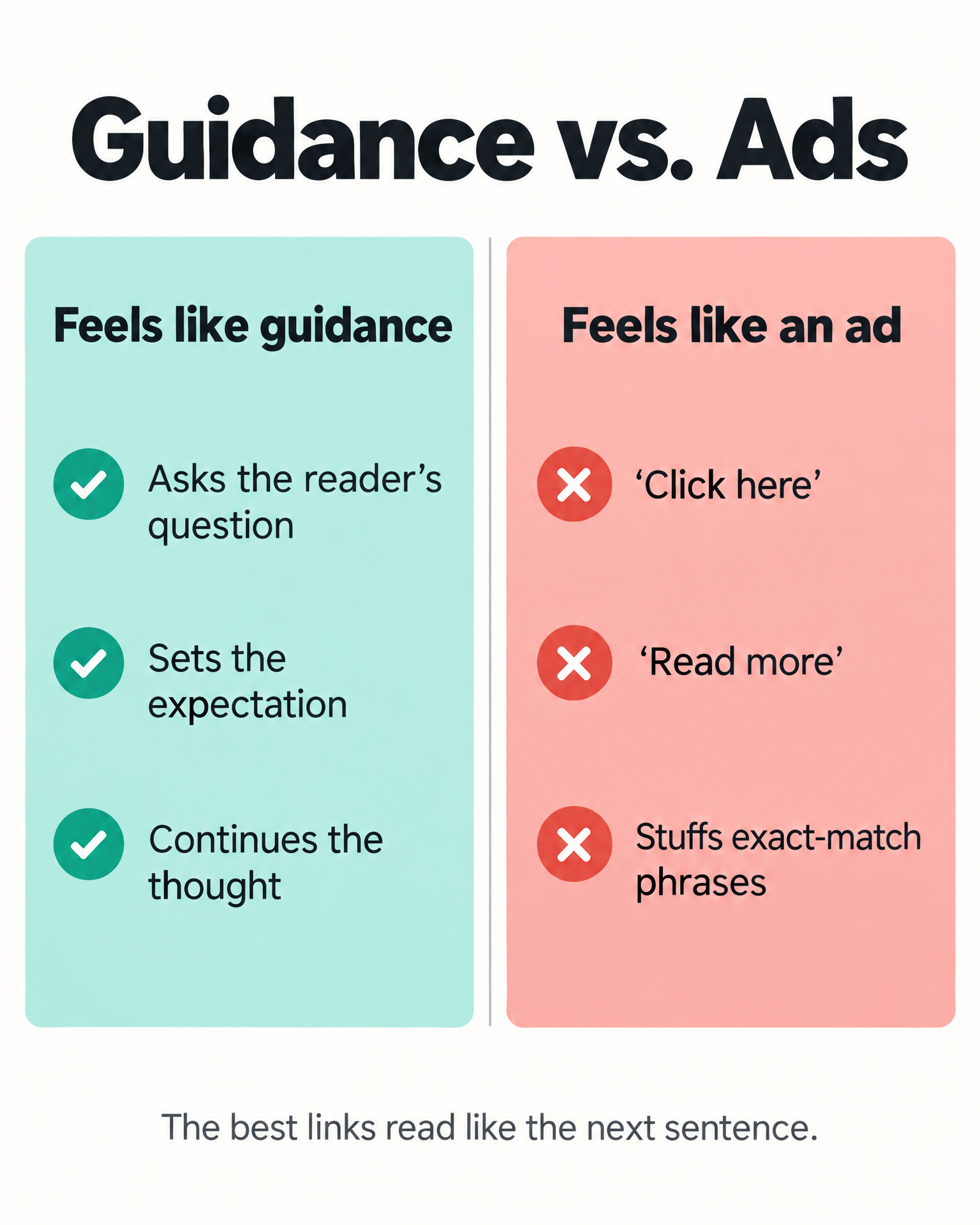
“Click here.” “Read more.” These waste the opportunity completely. They tell a crawler almost nothing about the destination, and they give the reader zero reason to bother clicking. Now compare that to something like “how the top-rated models compare on battery life” — descriptive, sets an expectation, and continues the sentence’s train of thought instead of interrupting it.
The best internal links don’t even register as links. They read like the next sentence in a conversation you were already having. This is where the copywriting idea of a curiosity loop applies almost perfectly to internal linking — you open a small question in the reader’s mind (“does one of these actually hold up better over time?”) and the link becomes the answer they were already reaching for, not an ad cutting in.
A few patterns that tend to work:
- Ask the question the reader’s probably already forming, then let the link answer it.
- Point out a distinction your current post didn’t fully settle, and frame the linked post as where that gets resolved.
- Use comparative phrasing (“some options handle this better than others”) that primes the reader for a comparison-style landing page.
Steer clear of anchor text stuffing — hammering the same exact-match commercial phrase into every link across your site. It reads as unnatural to a human, and it can look manipulative to systems trained to catch over-optimization. Vary the phrasing, keep the topic consistent underneath it. That’s exactly the kind of contextual nuance modern, language-aware ranking systems are built to notice and reward.
Auditing and Fixing Dead-End Posts
Even a carefully planned site collects dead ends over time. Posts published early — before you had any real linking strategy — that simply stop. The reader hits the last paragraph and there’s nowhere intentional left to go.
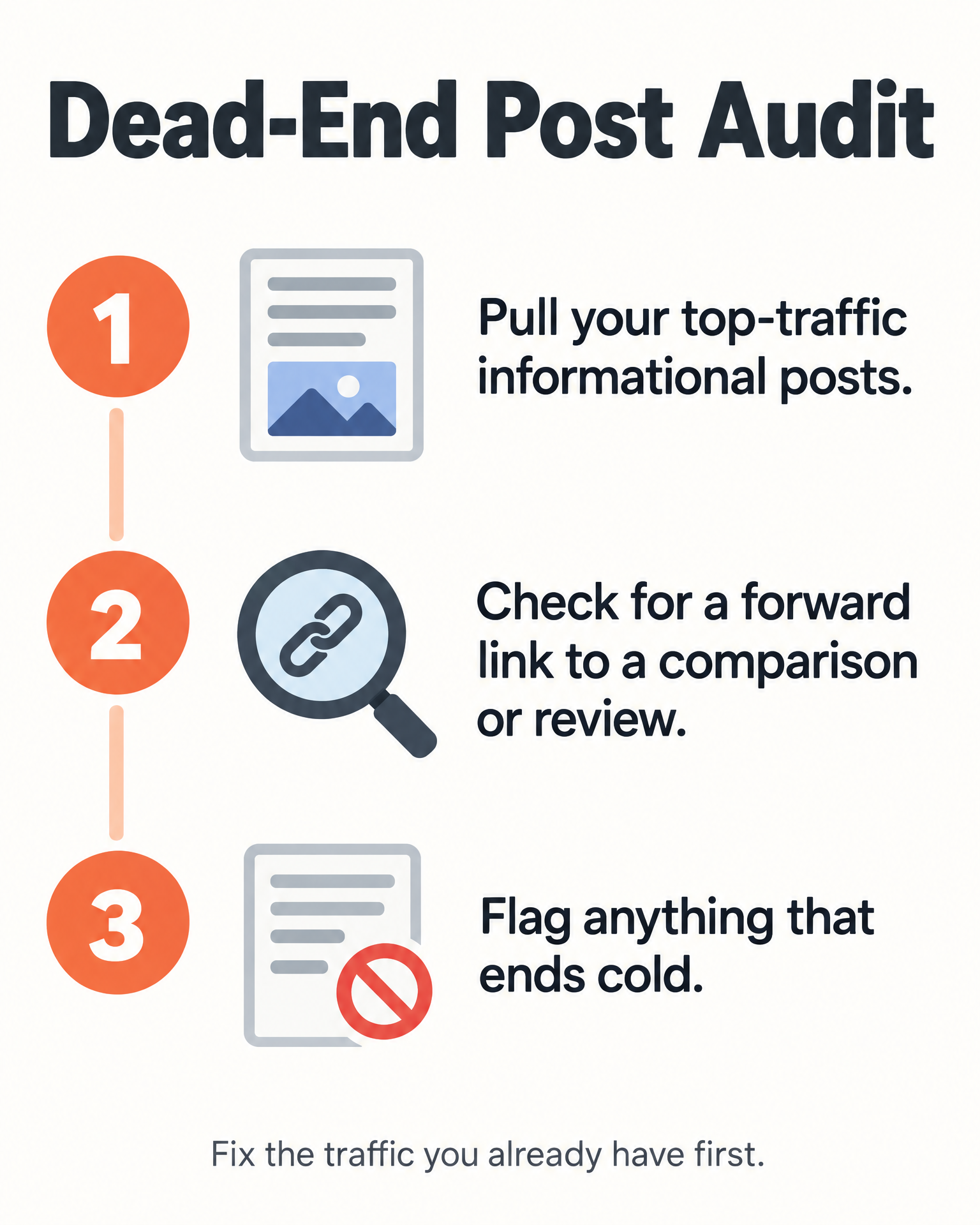
The audit itself isn’t complicated:
- Pull your top-traffic informational posts.
- Check whether each one links forward to a relevant MOFU or BOFU page.
- Flag anything that ends cold, or only links sideways to another TOFU post.
These flagged posts are usually your highest-leverage fixes, and it’s almost unfair how easy they are compared to writing something new. The hard part — earning the traffic — is already done. What’s missing is a direction to point it in. One well-placed, well-worded link into an existing comparison or review can turn a purely informational page into something genuinely revenue-contributing, often faster than any new post you could write from scratch.
This same audit process is usually the fastest way to diagnose that traffic-without-sales problem mentioned earlier. If most of your dead-end posts sit near the top of your traffic list, that’s rarely a coincidence. It usually means your most visible content was built to attract and never once asked to guide. That thread gets explored further in Why Your Affiliate Blog Gets Traffic but No Sales, which pairs naturally with a link audit like this one.
Maintaining the Funnel Over Time
A link funnel isn’t a “set it and forget it” project, even though it’s tempting to treat it that way once it’s built. Comparison posts age. Buying guides reference conditions or standards that quietly shift underneath you. A link that made perfect sense a year ago might now point at a page that’s outdated, thin, or simply no longer what the reader needs.
Two questions tend to come up again and again during maintenance.
Should this old post get updated, or does the topic deserve something new? Updating keeps existing rankings and backlinks intact, and it’s usually the right move when the core topic and intent haven’t shifted — only the details have. A new post makes more sense when the intent itself has genuinely changed, or when the old post’s structure is too narrow to expand without confusing the audience that already trusts it. Worth thinking through deliberately rather than defaulting to the same choice every time — When Should You Update an Old Blog Post Instead of Writing a New One? walks through that decision in more depth.
Does the link path still hold up after an update? When you refresh a MOFU comparison, check that its outbound links to BOFU reviews still point somewhere accurate, and that its inbound links from TOFU posts still describe it correctly. A funnel is only as strong as its weakest connection — one outdated link buried in the middle of an otherwise solid path can quietly stall conversions without ever throwing up an obvious red flag.
Set a recurring review cadence — quarterly for your high-traffic pillar content, less often for smaller supporting posts — so link paths get checked alongside content accuracy instead of treated as some separate afterthought nobody gets around to.
Measuring Whether Your Internal Links Are Actually Working
Planning the funnel is only half the job. Confirming it behaves the way you intended means watching actual behavior, not just trusting that a good structure automatically produces good results.
Signals worth tracking:
- Internal click-through rate on the specific links you’ve placed — most analytics platforms can isolate outbound clicks by destination URL, so you can see exactly which links people follow and which ones they scroll straight past.
- Path exploration reports, showing the sequence of pages a visitor actually moves through — whether they’re following your intended TOFU → MOFU → BOFU sequence, or bailing out somewhere in the middle.
- Assisted conversions, where a page didn’t get the final click but clearly contributed earlier in the visit — proof that your mid-funnel posts are doing real work even when they don’t get the credit of a direct affiliate click.
- Scroll depth paired with click position, which tells you whether readers are even reaching the spot where your link lives, or leaving before they ever see it.
If click-through on your forward links is low despite solid traffic, look at placement and anchor phrasing before you start blaming the destination page. If that destination page gets healthy traffic from multiple sources but converts poorly once people arrive, that’s a completely different problem — and it’s worth separating the two clearly instead of treating every conversion issue as a linking issue by default.
Internal link performance isn’t something you fix once and walk away from. It’s a loop — plan, watch how people actually behave, adjust the placement or the phrasing, check again. Sites that treat this as ongoing maintenance tend to quietly outperform the ones that build a structure once, feel good about it, and never look back.
Products / Tools / Resources
- Analytics platforms — GA4 or a comparable web analytics tool — for tracking internal click-through, path exploration, and assisted conversion behavior over time.
- Search Console or an equivalent search performance tool — useful for understanding which queries are actually bringing readers into your TOFU content and how those entry pages are performing.
- Site crawling and audit tools — Screaming Frog, Sitebulb, or something similar — for catching orphan pages, broken internal links, and dead-end posts at scale, rather than hunting for them manually.
- Internal link management plugins, available across most major CMS platforms, for surfacing link opportunities between related posts and flagging pages that currently have no outbound links at all.
- Session recording and heatmap tools for watching, quite literally, where readers scroll, pause, and click — genuinely useful when you’re trying to refine link placement instead of guessing at it.
- A spreadsheet or lightweight database for keeping your content map current — intent stage, assigned job, and the inbound/outbound link relationships for every post you’ve published.