

The Blank Content Calendar Problem
You picked a niche. You confirmed there’s a real buyer and a real pain point behind it. And now you’re staring at an empty content calendar, and somehow this part feels harder than the part that came before it.
That’s not just you. Once the niche is settled, most people expect the next step to feel obvious — like the hard decision is over and the rest is just execution. Instead there’s a blank page, a dozen half-formed topic ideas, no clear reason to pick one over the others, and this nagging feeling that whatever you publish first matters more than it probably should.
That feeling, actually, is correct. Just not for the reason most people assume. Your first article doesn’t matter because of how well it performs on its own. It matters because of what it sets into motion — or, just as easily, what it fails to.
The answer to ‘what first’ is simpler than you think: start with one reader problem and build the connected path around it. The free Content Node Planner walks you through exactly that — 10 steps from first click to confident purchase. Get your copy below.
Table of Contents
The Trap of Writing Whatever’s Easiest
Here’s the default move almost everyone makes: pick whatever topic feels easiest, most familiar, or most fun to write about right now. It feels like momentum. It feels like progress. Most of the time, it’s neither.
An article that’s easy to write and an article that’s actually strategically necessary are frequently two completely different pieces of content. Lead with ease, and you tend to end up with an opening handful of posts that share no direction at all — which is exactly the pattern that, six months later, produces a site full of unrelated pages with no internal logic tying any of them together.
The fix isn’t forcing yourself to write something harder just because it feels more virtuous. It’s choosing based on function. What does this article need to do — not how much fun is it to write.
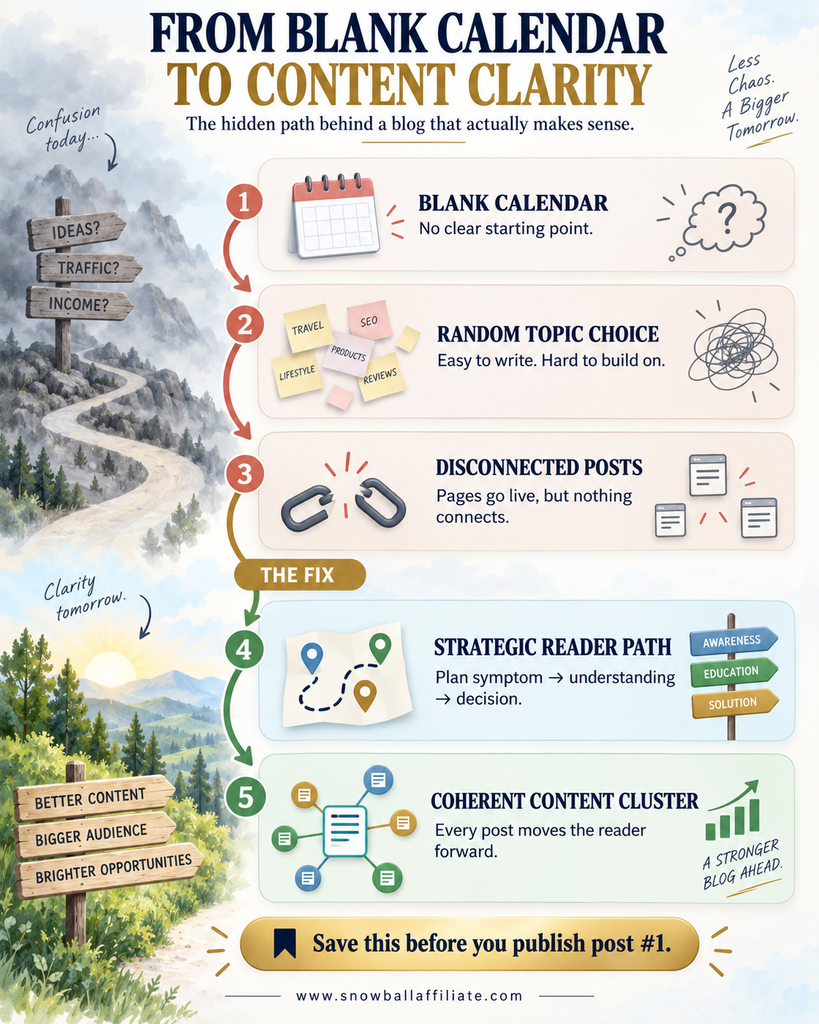
A Better Question Than “What Do I Write First”
Instead of asking “what’s my first article,” try a question that actually gets you somewhere: “what’s the smallest complete path I can build that takes one specific reader from a real problem all the way to a real decision?”
That small, complete path — not one isolated post floating by itself — is what determines your first several articles. A symptom-level entry point. One or two pieces that build real understanding. A bridge toward an actual decision. Your first article is just the opening step in that sequence, chosen because it’s the entry point a real person, mid-search, would actually type into Google first.
What That First Article Actually Needs to Be
Assuming your niche, buyer, and pain point are already confirmed, that first article should be a TOFU symptom piece — informational, meeting a reader before they even know a structured solution exists, built entirely around the specific frustration or confusion driving their search in the first place.
There are three reasons this works as a starting point, and none of them are arbitrary:
- It meets the reader where they actually are. Almost nobody’s very first search is “best product for X.” It’s usually a symptom search — “why is X happening to me,” “how do I know if this is even a real problem,” “what’s wrong with the way I’ve been doing X.” Start there, because that’s where the real person is standing.
- It asks the least of a brand-new site with zero track record. Informational, symptom-level searches are typically easier to compete for than high-intent commercial ones. That makes them a realistic place to actually get traction while you’re still building authority from nothing.
- It hands every later article a reason to exist. A symptom article naturally creates the need for an understanding article right after it. That creates the need for a buying guide. That creates the need for a review. The whole chain starts right here, with this one post.
Planning Five Articles Before You Write the First One
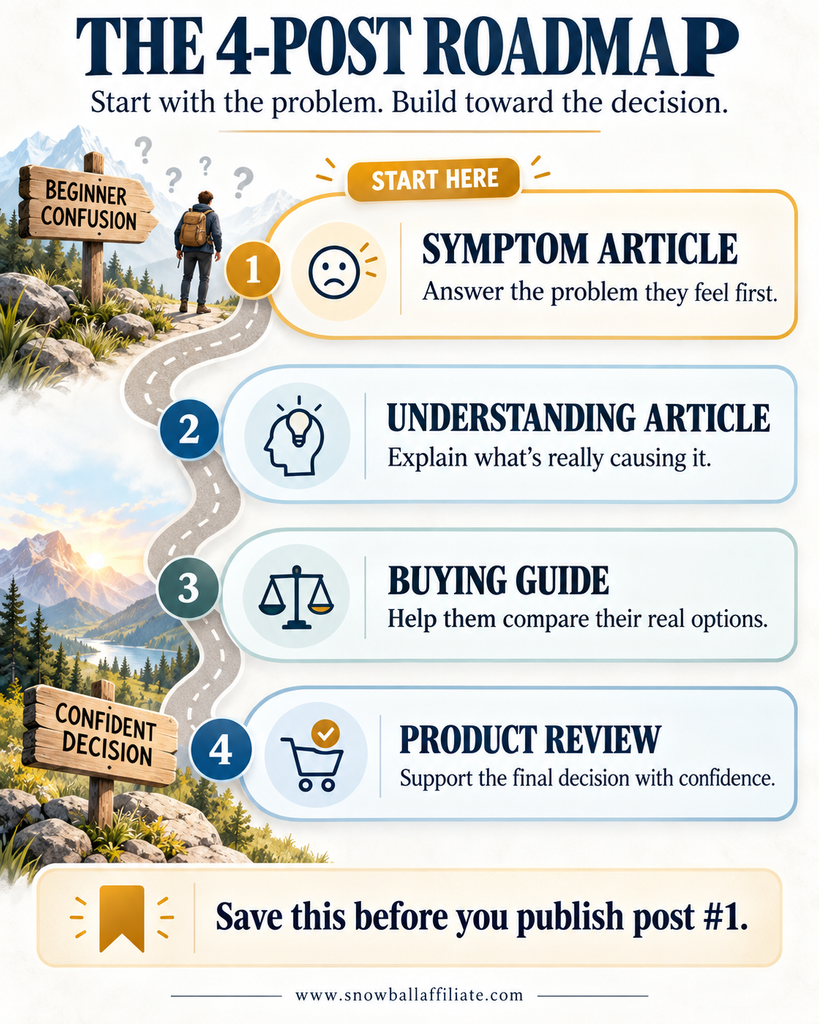
Before you write a single word, sketch the small cluster your first article actually belongs to. A workable starting cluster usually looks something like this:
- One or two symptom articles — the real entry points people are already searching for.
- One or two understanding-bridge articles — content that connects the symptom to something the reader didn’t realize they needed to understand yet. Why this is actually happening. Why the obvious fixes tend to fail.
- One buying guide — helping the reader, now that they understand the problem, actually weigh their real options.
- One product review — the commercial endpoint for the reader who’s ready to decide.
Map all of that out before you write anything, and something shifts: your first article gets written already knowing where it’s headed. Every sentence can be built with the destination already decided, instead of bolting a link onto the end after the fact and hoping it fits.
Three Stages, One Simple Filter
If all of that still feels a little abstract, here’s a simpler version — three checkpoints you can run every early article through:
Symptom stage: Here’s the problem you’re feeling, described the way you’d actually describe it yourself, not the way a textbook would.
Understanding stage: Here’s what’s really causing that problem, and here’s why the obvious fixes usually don’t work the way you’d expect.
Decision stage: Here’s how to actually weigh your real options, and which one fits your specific situation.
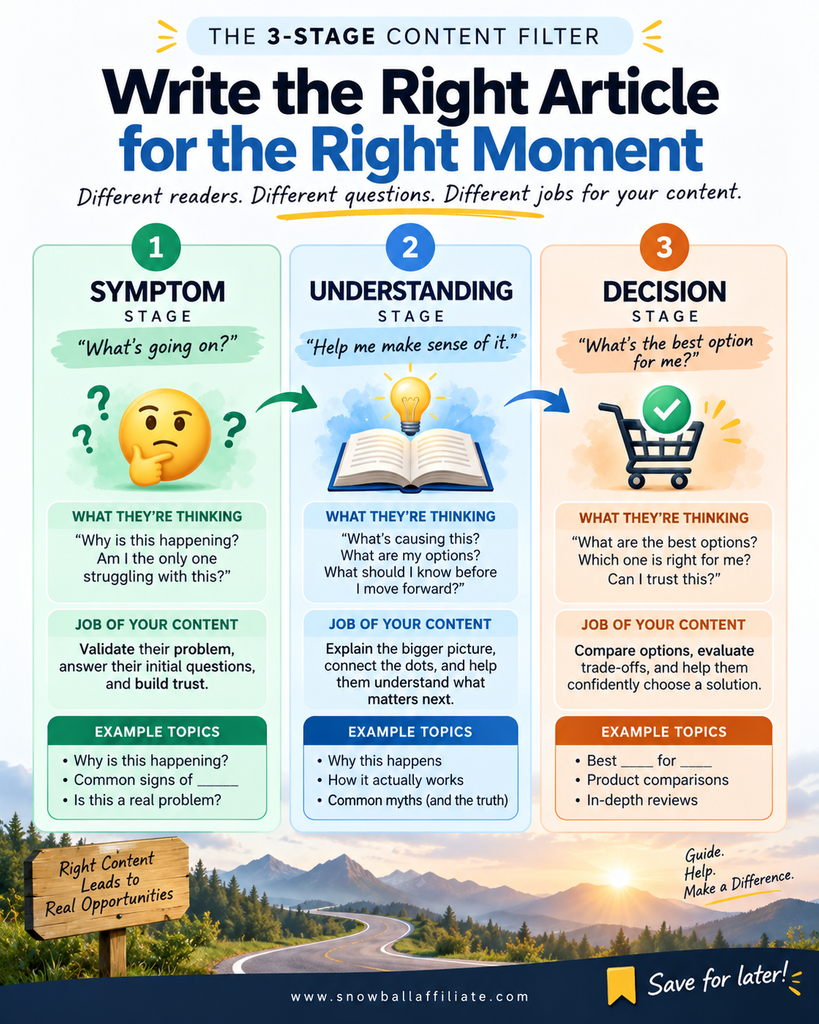
Every article in that first cluster should sit clearly inside one of these three stages. Never trying to do all three at once in a single post. Never published without already knowing which stage comes right after it.
What Not to Publish Early, Even If It’s Tempting
A handful of mistakes worth naming plainly, because they’re tempting and they all feel productive in the moment:
- A general “welcome to my blog” or “about this niche” post. It doesn’t answer any real search, and it doesn’t move a single reader closer to anything.
- A product review before any symptom or understanding content exists to feed it. A review with no upstream traffic path is a great page with nobody standing in front of it.
- A keyword chosen purely because it had decent search volume, with no connection back to the specific buyer and pain point you already confirmed.
- A string of unrelated topics, published one after another, before a single complete reader journey actually exists. This is the fastest, quietest way to end up with a site that technically gets traffic to several pages and still has no coherent path through any of them.
What People Ask Before They Hit Publish
Does my first article need to rank right away for this to work?
No. Its job early on is just to be the correct entry point in a connected path. Rankings tend to build over time regardless, and a well-placed article that ranks slowly is worth more than a disconnected one that ranks fast and leads absolutely nowhere.
I have a niche, but I’m not totally sure about the specific pain point yet — should I write anyway?
Nail down the pain point first. Publishing before that’s clear risks building your whole opening cluster around the wrong problem, which quietly undermines everything that’s supposed to follow it.
Should I mention the affiliate offer in this first article at all?
Generally, no. This article’s whole job is building trust and understanding, not selling anything. Bringing up a specific offer this early can feel jarring to a reader who doesn’t even fully understand their own problem yet, let alone a solution to it.
How many articles do I actually need to plan before I start writing?
A small, complete cluster does the job — usually four to six pieces spanning symptom, understanding, buying guide, and review. That’s enough structure to write your first article with a real destination in mind, without needing the entire site mapped out before you type a single word.
Products, Tools & Resources Mentioned in This Article
A simple content-mapping doc or spreadsheet — nothing elaborate, just enough to sketch out the symptom, understanding, buying guide, and review stages for your first cluster before you start writing.
Your confirmed niche, buyer, and pain point notes — everything above depends on this being settled first. If it isn’t, that’s genuinely the actual first step, not this one.
Snowball Affiliate’s Content Nodes framework — for anyone who’d rather follow a structured method for building these clusters than sketch one out from scratch on their own; it’s covered in full in our review.
Our full Snowball Affiliate review — for more on how this kind of first-article planning fits into a complete, sequenced approach to building a site: Snowball Affiliate Review: Is It Right for Building a Niche Affiliate Blog?
Our buying guide comparing structured systems — if you’re still weighing whether a full framework is worth adopting for this kind of planning: Best Affiliate Blogging Courses for Beginners Building a Niche Site.