

Somewhere between checking your analytics for the third time that day and refreshing your affiliate dashboard hoping the number changed, a thought settles in: I just need more people to see this. It makes sense, honestly. Traffic is the number that moves, the graph you can watch climb, the thing that feels controllable. So you write another post. You promote a little harder. You chase a few more keywords. And the revenue line just… sits there, flat and unbothered, like it didn’t get the memo.
This article is about why that happens. Not in a vague, motivational-poster way, but specifically — the two real reasons traffic and revenue stop talking to each other, how to figure out which one is happening to you, and what actually deserves your attention first.
Why “More Traffic” Feels Like the Answer (Even When It Isn’t)
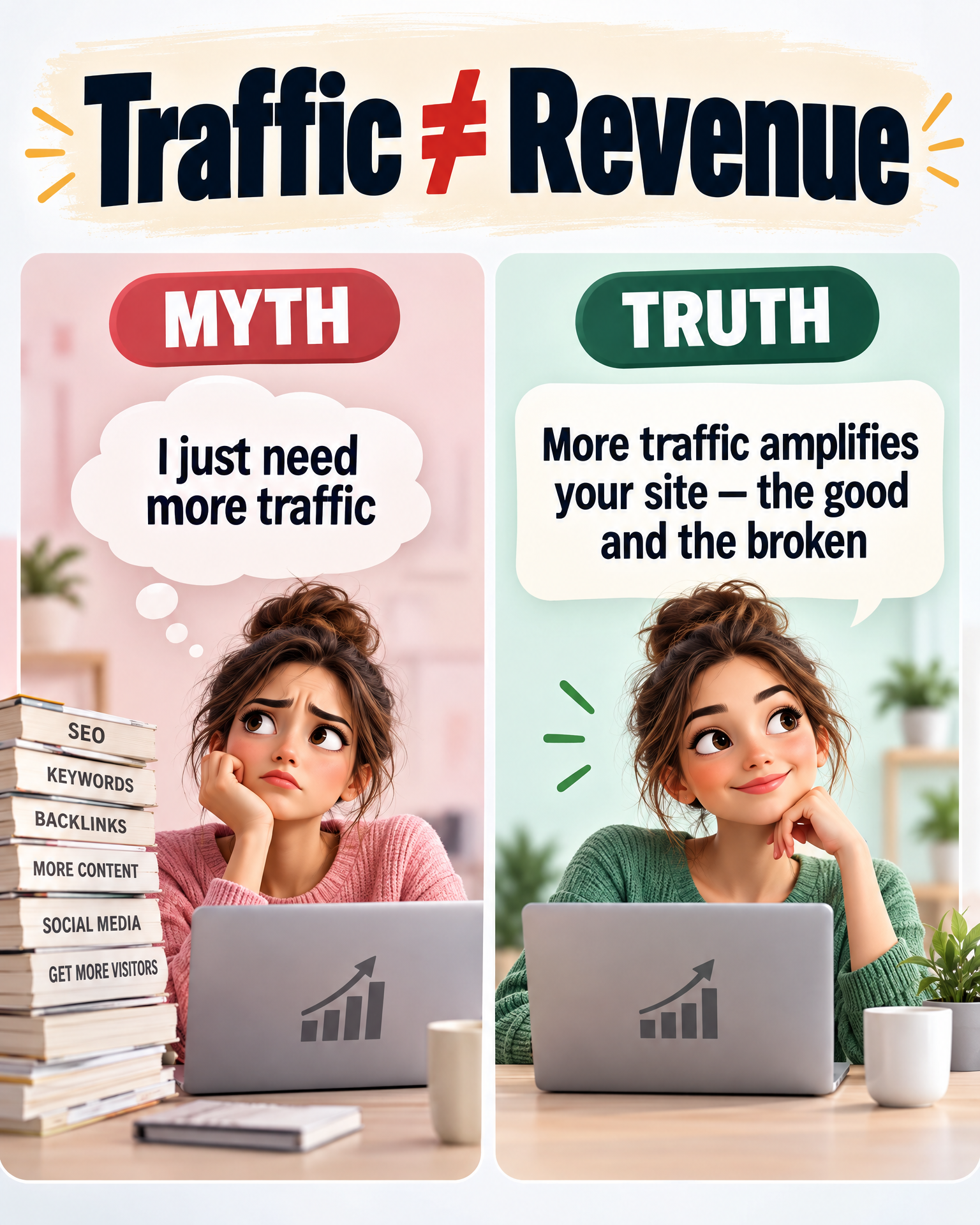
Traffic and revenue look like they should move together. They’re related, sure. But they’re not measuring the same thing at all. Traffic tells you people showed up. Revenue tells you the right people showed up, and found something worth handing their money over for. Confuse the two, and you end up stuck in a loop that’s exhausting in a very specific way — you grow an audience that still doesn’t buy anything, you pour more hours into feeding that audience, and the actual broken thing underneath never gets touched.
Here’s the part worth sitting with for a second: more traffic doesn’t fix your site, it amplifies it — the good and the broken, equally. If the people reading you now aren’t converting at 500 visitors a month, they’re not suddenly going to start converting at 5,000. You’ll just get to watch more people not convert, in higher definition.
One Symptom, Two Very Different Diseases
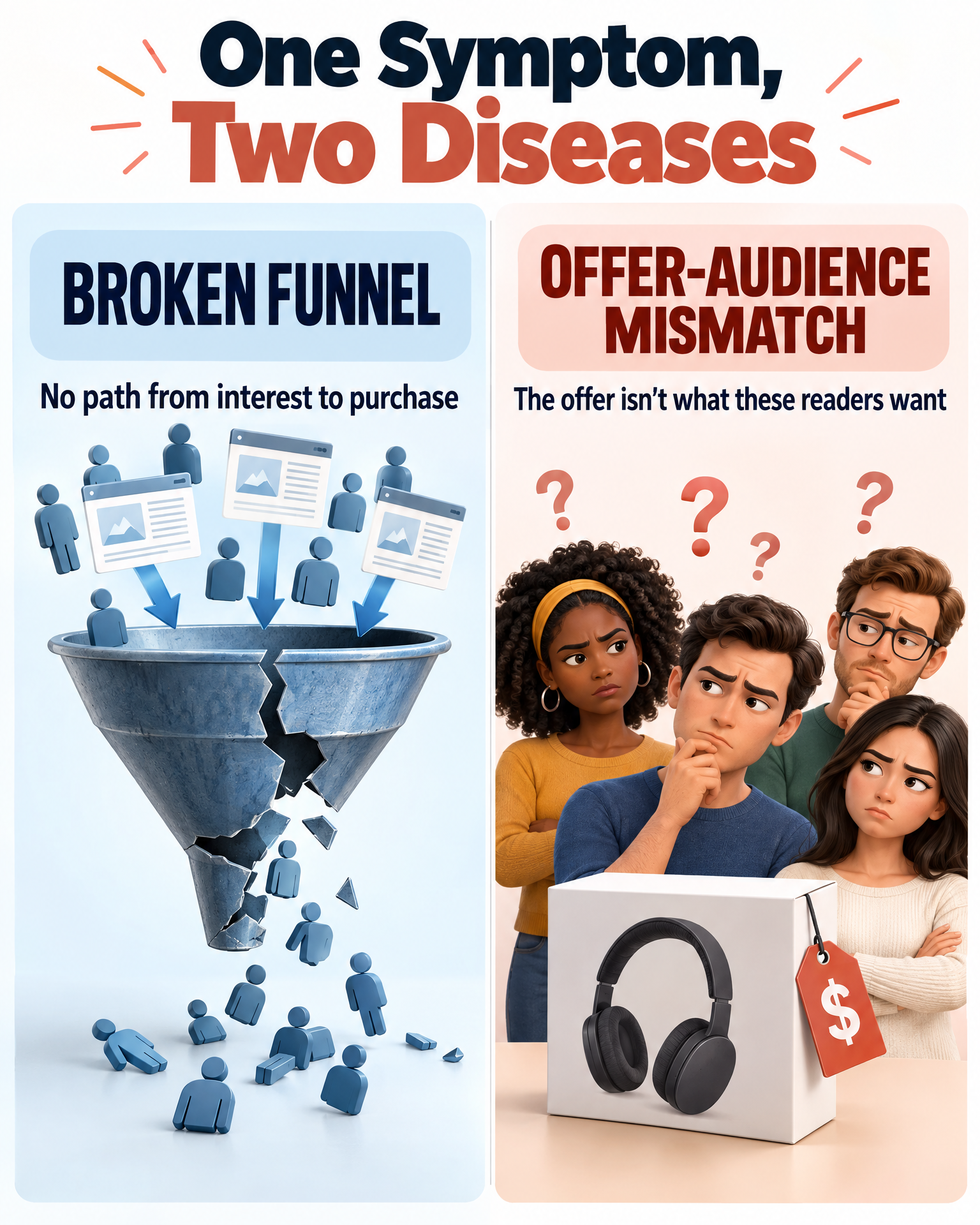
“Traffic but no sales” isn’t a diagnosis. It’s just what the problem looks like from the outside. Underneath that surface, there are two genuinely different things that could be going on — and they need completely different fixes:
- Your funnel is broken, or it never really existed. Content’s there. Traffic’s there. But nothing is actually guiding a reader from “I found this interesting” to “I’m ready to buy something.”
- Your offer and your audience don’t match. The funnel might work fine. The problem is the specific thing you’re pointing people toward isn’t what these specific people actually want.
From a distance, these two look identical. Both show up as traffic with nothing to show for it. And that’s exactly the trap — if you guess wrong about which one you’re facing, you can burn weeks fixing something that was never broken.
When the Problem Is the Path, Not the People
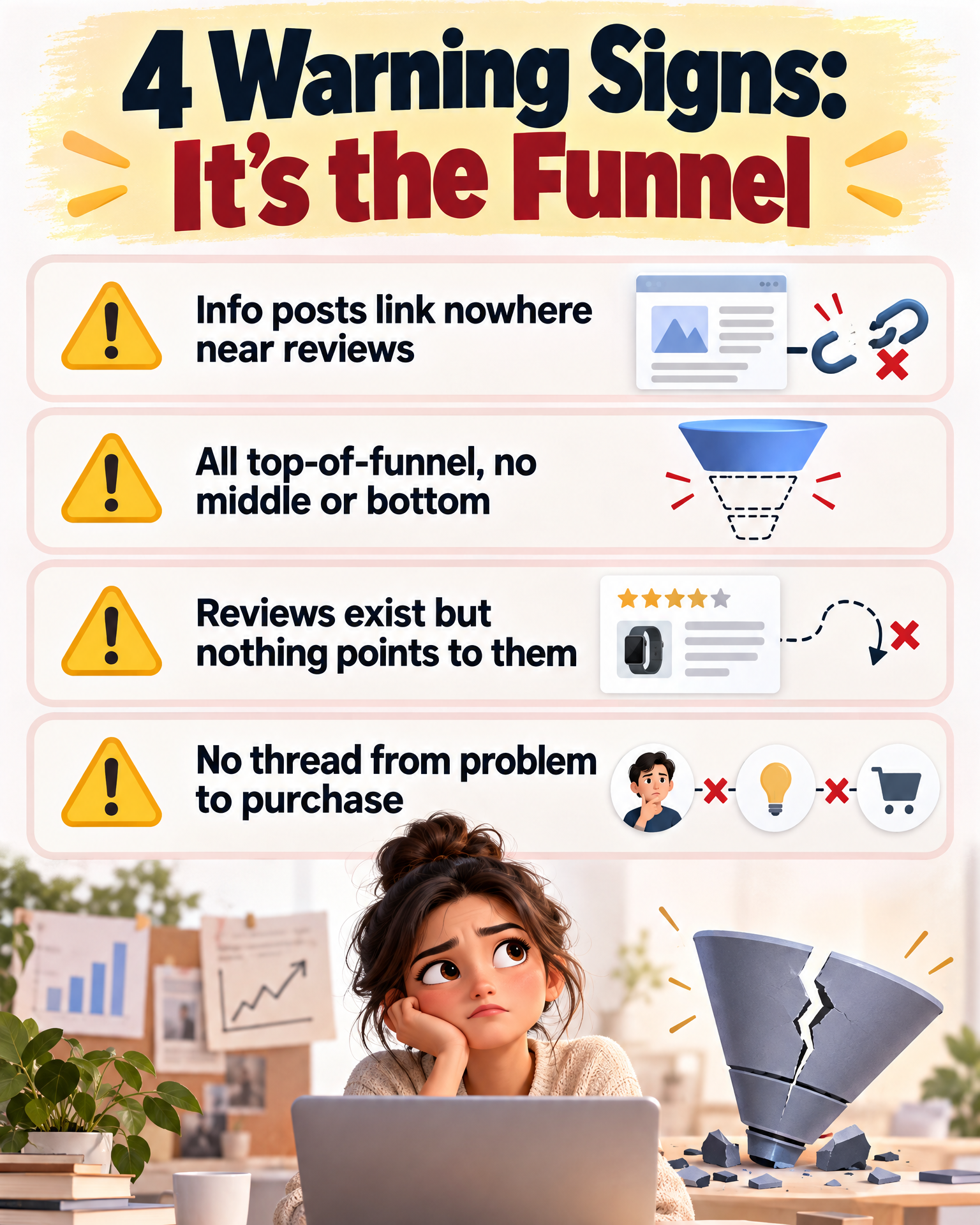
This is the structural version of the problem. Someone lands on an informational post, reads it, maybe even likes it — and then leaves. Nothing pulled them toward a next step, because there wasn’t one. A handful of signs point here:
- Informational posts that don’t link anywhere near a comparison page or a review.
- A site that’s almost entirely top-of-funnel content, with barely anything living in the middle or the bottom.
- Reviews and buying guides that technically exist somewhere on the site, but nothing upstream ever sends anyone toward them.
- No real thread connecting a reader’s specific problem to a specific purchase decision.
In this version, your traffic is actually doing exactly what it’s supposed to do — bringing interested people to your site. The failure happens after the click, not before it. It’s the same architecture issue we’ve talked about before on this blog: a site made of scattered pieces instead of a connected structure will always produce this exact pattern.
When the Path Is Fine, But It Leads Somewhere Wrong
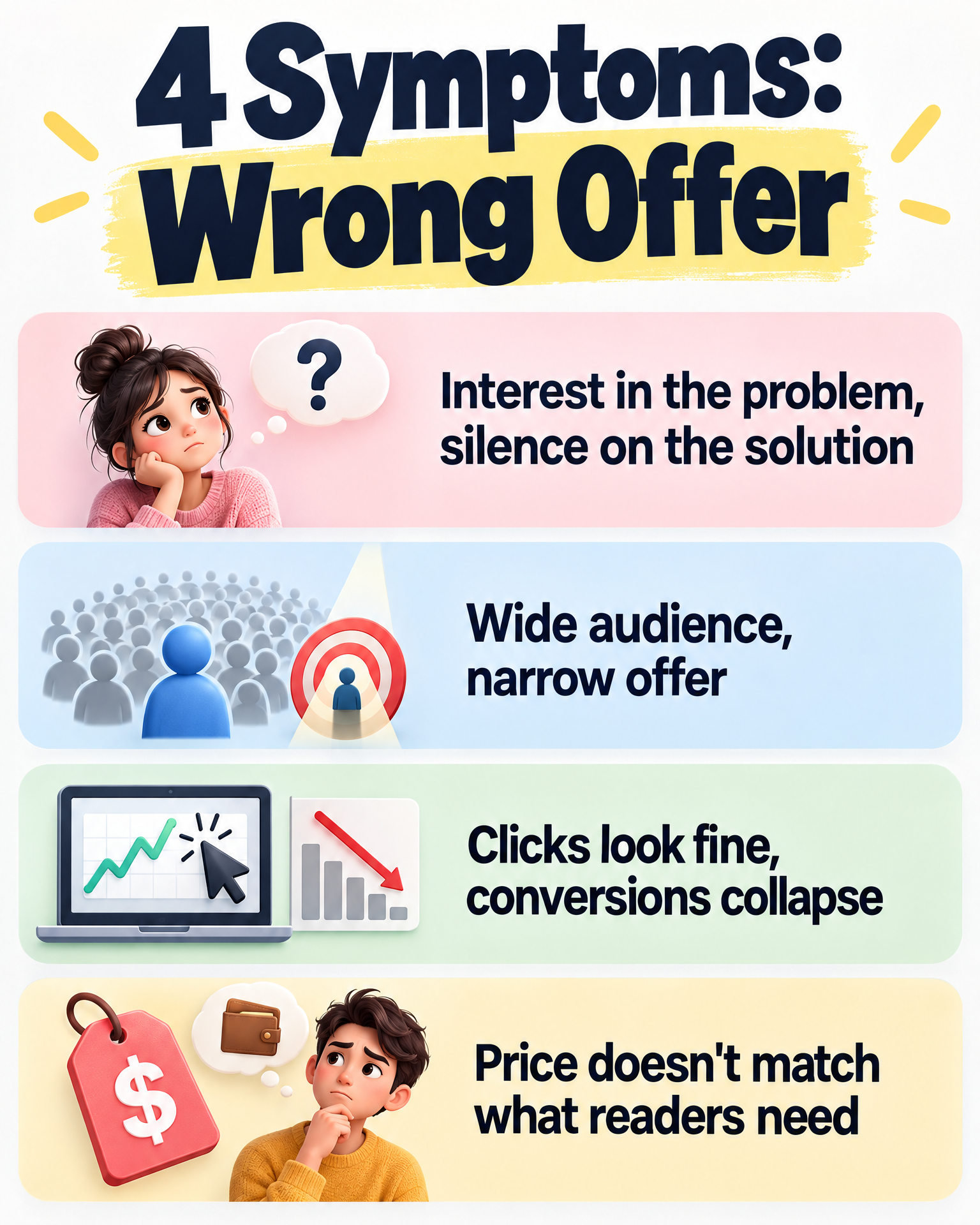
This one hides better, because the funnel can be doing everything right. The problem is more subtle — the offer waiting at the end of that path just isn’t what the person walking it actually wants. Watch for:
- Content that speaks to a wide audience, paired with an offer that only really serves a thin slice of it (or the other way around).
- Comments and engagement that show genuine interest in the problem — but a strange silence around the specific solution you’re pointing at.
- An offer whose price, positioning, or use case just doesn’t line up with what your readers keep saying they need.
- Click-through that looks perfectly healthy, but conversion after the click falls apart — usually a sign the click was curiosity dressed up as intent.
A beautifully built funnel pointed at the wrong offer will still fail. Every time. It doesn’t matter how clean the journey feels if it ends somewhere the reader never wanted to go.
Why Pouring in More Traffic Won’t Save Either One
Neither of these gets fixed by shoving more visitors through the pipe. It’s worth saying out loud, because it’s the first thing almost everyone reaches for anyway. A broken funnel with more traffic just gives you more people arriving and leaving unconverted — same failure, just louder. An offer-audience mismatch with more traffic gives you more clicks that go nowhere, for the exact same reason as before.
Either way, more traffic mostly makes the problem more expensive to look at. All that writing, all that SEO work, all that promotion — it starts earning a return so far below what it should that it stings a little. Diagnose first. Fix what’s actually broken. Only then does it make sense to scale traffic into a funnel and an offer that were built to hold it.
So Which One Is It, Really?
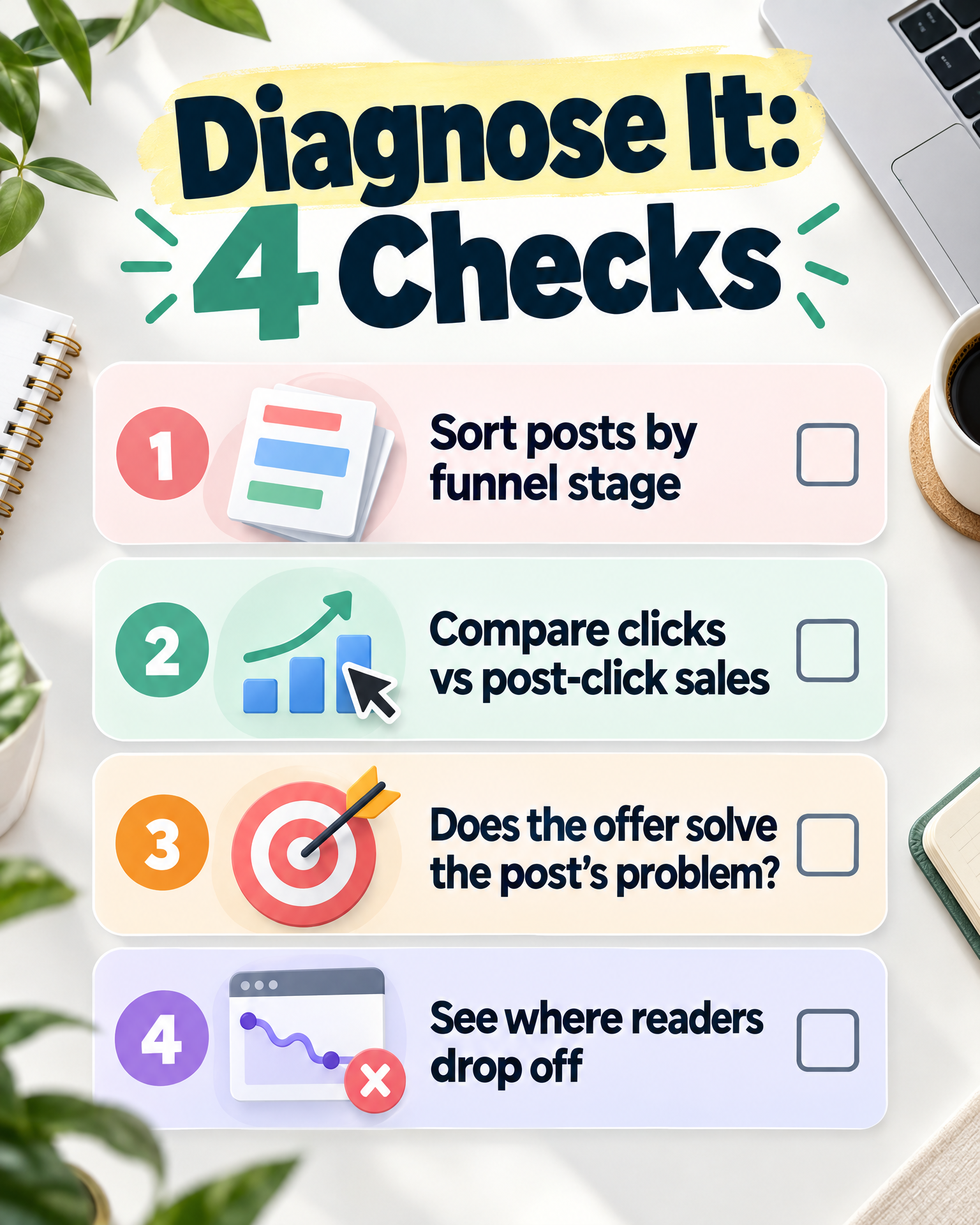
A few honest checks tend to make this clearer — or reveal that you’re dealing with a bit of both at once, which happens more often than you’d think:
- Sort your content by funnel stage. Go through your posts and tag each one as top (informational), middle (comparisons, guides), or bottom (reviews, buying guides). If top-of-funnel content dwarfs everything else, or your middle and bottom pages barely get linked to from anywhere, that’s a funnel problem announcing itself.
- Put click-through and post-click conversion side by side. Solid clicks paired with weak conversion afterward points toward a mismatch far more than it points toward a funnel gap.
- Go back and reread your best-performing post. Ask yourself, honestly, if the offer solves the problem you just described. If that connection feels like a reach even to you — the person who wrote it — take that seriously.
- Check where people actually drop off, if your analytics let you see that far. Dropping off before they ever reach commercial content signals a funnel gap. Dropping off right at, or right after, the offer itself signals a mismatch.
Most sites carrying this symptom have a little of both quietly going on. A funnel that never got built with intention, and a picture of the real audience that’s a bit blurrier than anyone wants to admit — the two tend to grow together, unnoticed, over time.
What Actually Deserves Your Attention First
If you’re staring at both problems at once, fix the funnel first. Here’s why: even a perfectly matched offer can’t convert anyone if there’s no real path leading them to it. And once that path exists — informational content flowing into comparisons, comparisons flowing into a review — judging whether your offer actually fits gets a lot easier, because the funnel stops muddying the water.
Concretely, here’s where to start: pick your three highest-traffic informational posts and add natural links from each one into your best comparison or review content. If there’s no review for your main offer yet, that’s your next post. Every commercial page on your site should have at least one incoming link pointing to it — nothing should be sitting there orphaned, waiting for traffic that was never routed toward it.
If the funnel’s already solid and the mismatch is the clear culprit, the fix stops being structural. It becomes a question of honesty — does the offer you’re promoting actually match the person your content has been attracting? Sometimes the answer means swapping the offer entirely, not rewriting content to fit a square peg. Look at your comments, your survey answers, the actual questions readers keep asking. Then look at who the offer was built for. Sit with the gap, if there is one.
What People Ask When Traffic Won’t Turn Into Sales
Can I have great content, real traffic, and still be promoting the wrong offer?
Yes — and it’s more common than most people expect, honestly. You can do everything right with your content, build an audience that genuinely trusts you, and still be pointing them toward something that was just never meant for them.
Should I swap offers first, or fix my funnel first?
Fix the funnel first, if it looks like both are happening. It’s nearly impossible to tell whether an offer is wrong for your audience when that audience never had a clear path to reach it in the first place.
How do I tell “my audience isn’t ready to buy yet” apart from “the offer is wrong”?
Watch for real, visible interest in the problem paired with a strange lack of interest in your specific solution — that combination points to mismatch more than timing. If people are clearly invested, clearly engaged, and conversion still stays low despite a clean funnel, the offer itself is probably the thing to question.
Can this happen to experienced bloggers, or is it just a beginner mistake?
It can happen to anyone, at any stage. Offer-audience mismatch especially tends to creep in slowly, as your content shifts and your real audience quietly becomes someone slightly different than who you started writing for — even when the original offer made total sense back when you picked it.
Products / Tools / Resources Mentioned in This Article
Your site’s analytics and click-through data — genuinely the first thing to look at before you touch anything else. It’s what separates a funnel problem from an offer-mismatch problem, instead of guessing.
A funnel-stage content audit — just sorting your existing posts into top, middle, and bottom of funnel can be surprisingly revealing about a structural gap you didn’t fully realize was there.
Snowball Affiliate’s offer-first approach — worth a look if you’d rather nail down offer-audience fit from the start, instead of diagnosing a mismatch after the fact. Covered in full in Snowball Affiliate Review: Is It Right for Building a Niche Affiliate Blog?
Our comparison guide — helpful if you’re weighing which structured system better addresses a funnel gap or an offer-alignment issue: Snowball Affiliate vs Project 24: Which System Fits a Niche Blogger Better?