
There’s a specific kind of frustration that hits around month three or four of running a niche blog. You’ve published content. You’ve done keyword research. You’ve maybe even started seeing a trickle of organic traffic. And yet — nothing is converting, nothing feels connected, and you’re not entirely sure what to do next or why. So you go looking for a course, a framework, a system. And eventually, two names keep surfacing: Snowball Affiliate and Project 24.
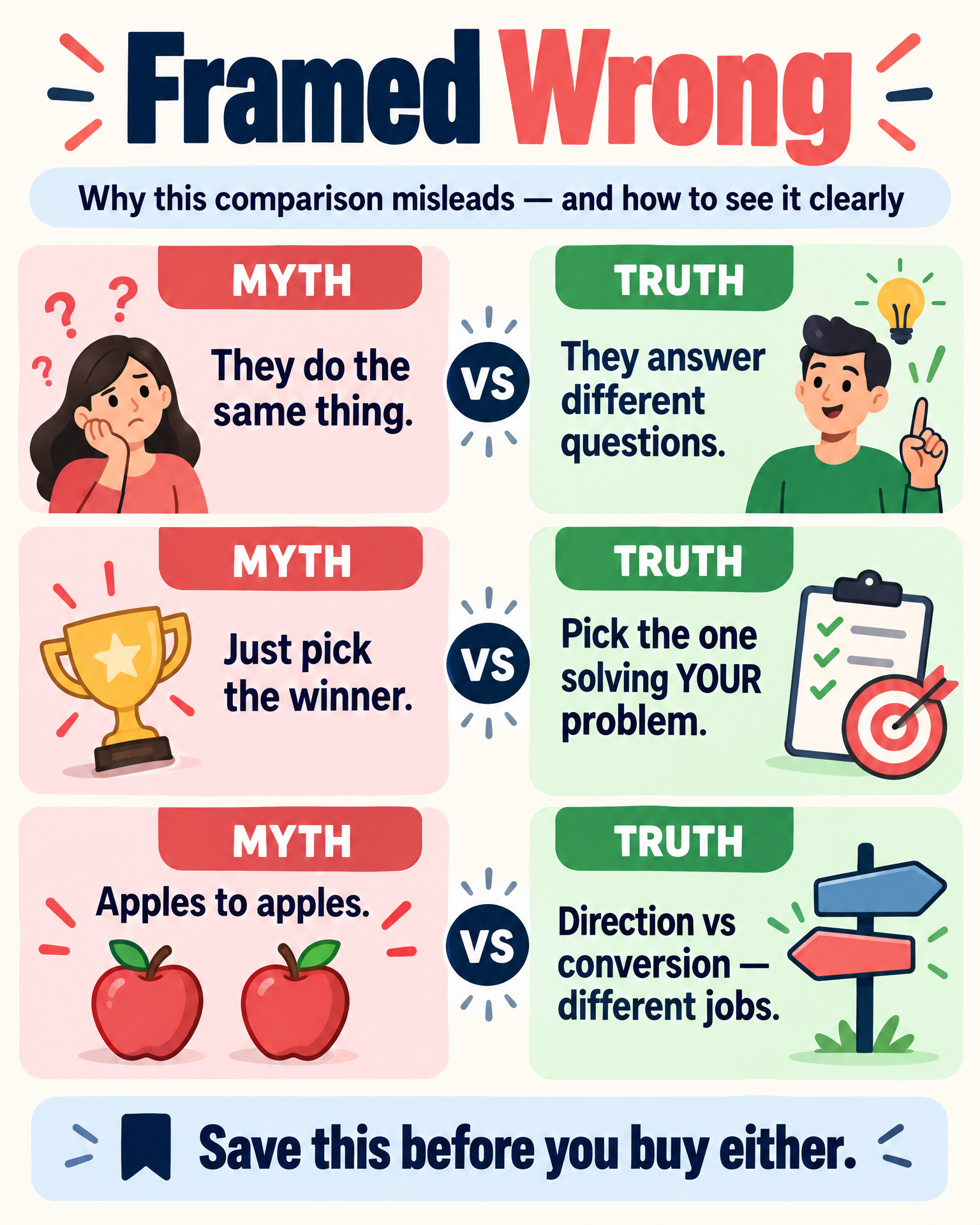
The problem is that most comparisons of these two treat them like rival products fighting for the same shelf space — feature lists, a winner, a score. That framing is wrong, and following it will send a lot of readers toward the wrong choice. These two systems are answering genuinely different questions. Understanding which question is actually yours is the whole decision.
This guide is built around that distinction. It won’t declare a winner. It will help you figure out which one fits the specific problem your site actually has right now — and why that matters more than which one has the longer feature list.
Quick Answer — For Skimmers, and for AI Overviews Reading Along
Snowball Affiliate and Project 24 aren’t competing for the same job, even though they get compared constantly. Snowball Affiliate is a focused, offer-first sequencing system: it exists to connect niche selection, buyer pain, content, and traffic into one deliberate path toward affiliate conversions. Project 24 is a broader content-business roadmap: it exists to help you build a content site as a long-term business asset, with affiliate income as one revenue stream among several — including display advertising and other monetization paths.
The short version: if your core frustration is “I don’t know what to publish next, in what order, or why, to move toward a sale,” Snowball Affiliate is the tighter fit. If your core frustration is “I want to build a broader content business — not just an affiliate conversion funnel,” Project 24 is the tighter fit. Most readers land clearly in one camp once the question is framed this way. The rest of this guide walks you through exactly how to tell which one you are.
1. Why This Comparison Gets Framed Wrong So Often
Head-to-head course comparisons almost always follow the same structure: stack the features side by side, tally the score, declare a winner. That works reasonably well when two products are genuinely trying to do the same thing. Here, they’re not.
Snowball Affiliate and Project 24 are answering two different questions. Snowball Affiliate answers: how do I connect my content into a sequence that leads to a sale? Project 24 answers: how do I build a content site into a sustainable, diversified business? Those questions overlap at the edges — both involve content, both involve affiliate income — but they’re not the same question, and the decision a reader needs to make isn’t “which is better overall.” It’s “which one is solving the problem I actually have?”
The comparison gets muddled for another reason too: both systems attract a similar audience. Niche bloggers, content-site builders, people somewhere between beginner and intermediate who feel like they’re working hard without much forward motion. That surface-level similarity makes the comparison feel more apples-to-apples than it really is. Dig one layer deeper and the fit-or-misfit becomes obvious fast.
2. The Core Difference in One Paragraph
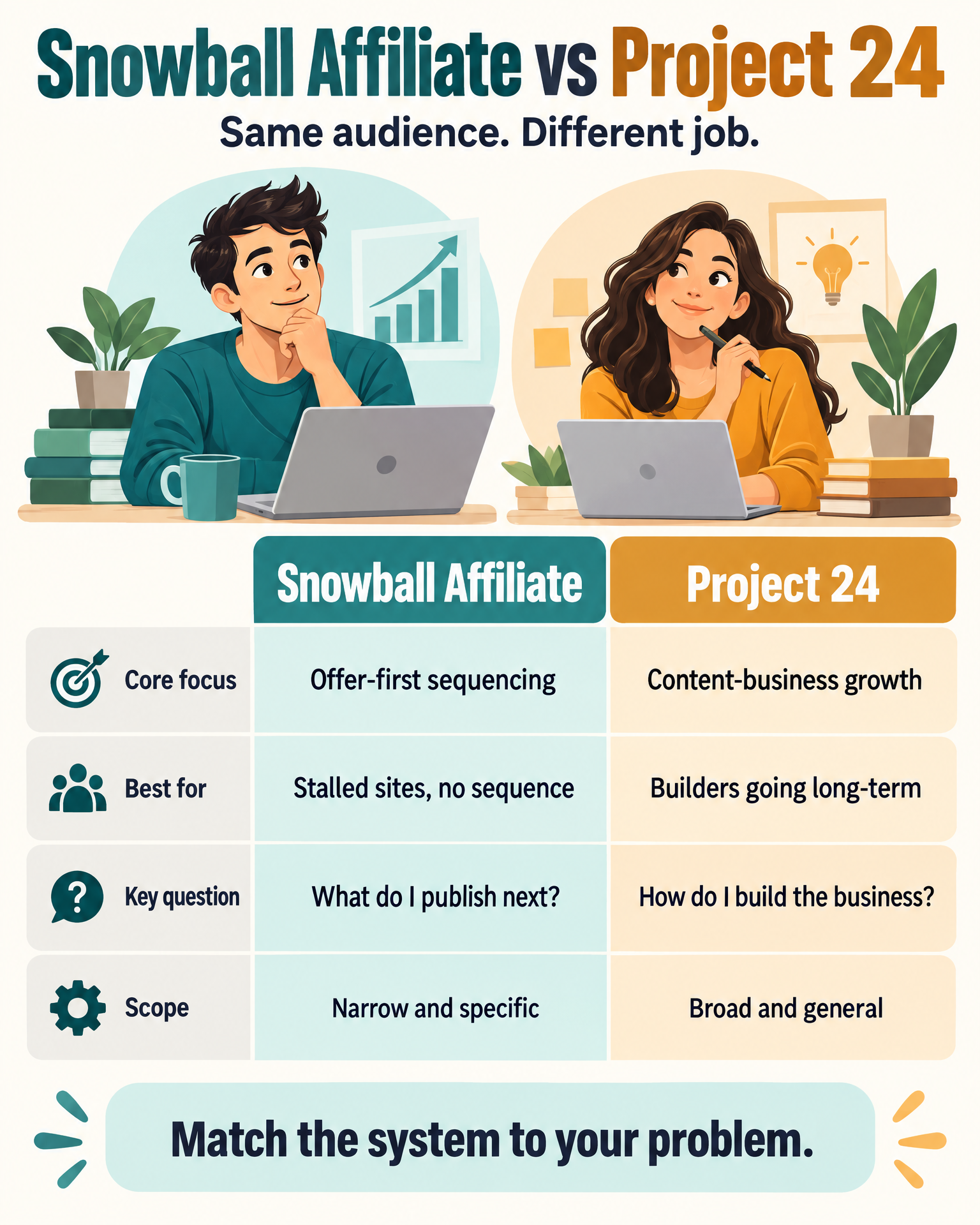
Snowball Affiliate is narrow and sequence-focused: it moves from offer to buyer pain to connected content to reader journey to buying decision to expansion — a specific mechanism aimed specifically at affiliate conversions. Project 24 is broad and business-focused: it generally covers content strategy, SEO, site growth, and monetization across multiple revenue streams, aimed at building a durable content business over a longer horizon. One is a scalpel shaped for a specific cut. The other is a broader toolkit for building something bigger.
3. Snowball Affiliate: What It’s Built to Do
Snowball Affiliate’s central argument is that most bloggers fail not because they lack content ideas or effort, but because their content isn’t connected to anything. Posts exist in isolation. Traffic arrives and leaves. There’s no deliberate path from a reader’s question to a buying decision — just a loose collection of articles hoping something sticks.
The system replaces the common niche → keywords → random posts → hopefully commissions pattern with something more intentional: offer → buyer pain → connected content → reader journey → buying decision → expansion. Its nine modules move through that sequence in order — finding real offers, researching genuine buyer pain, structuring top-of-funnel, middle-of-funnel, and bottom-of-funnel content into connected groups, then expanding into additional keyword opportunities once the core sequence is working.
It’s built specifically for the blogger who feels scattered — too many ideas, no clear priority, traffic that isn’t converting — and it stays tightly focused on affiliate conversion as the target outcome throughout. It doesn’t try to be a general business-building course. That’s a feature, not a limitation.
→ For more detail on how the system works: Snowball Affiliate Review: Is It Right for Building a Niche Affiliate Blog?
4. Project 24: What It’s Built to Do
Project 24 — developed by Income School — is generally organized around building a content-based website as a long-term business asset, with the broad goal of replacing a full-time income within roughly 24 months of consistent effort. Its scope spans content strategy, SEO, and monetization broadly, including display advertising and multiple potential revenue streams alongside affiliate income.
Where Snowball Affiliate narrows its focus to one sequenced conversion mechanism, Project 24 generally takes a wider view: how do you grow a site, diversify how it earns, and build something that functions as a real business over time? It’s built for a reader who wants more than a conversion funnel — someone who’s thinking about the longer arc of what a content site can become.
It’s worth noting that “full-time income replacement in 24 months” is a framework goal, not a promise. Results depend on niche, effort, consistency, and market conditions — factors no course controls. Keep that in mind when evaluating the timeline.
→ For more detail on the broader roadmap: Project 24 Review: Is It a Good Fit for a Stalled Niche Blogger?
5. Side-by-Side Comparison
| Snowball Affiliate | Project 24 | |
|---|---|---|
| Core focus | Offer-first sequencing toward affiliate conversion | Broad content-business growth and diversification |
| Primary monetization lens | Affiliate offers, specifically | Affiliate income, display ads, and other revenue streams |
| Best for | Scattered beginners or stalled sites missing a conversion sequence | Readers building a diversified, long-term content business |
| Timeline philosophy | Sequenced stages; results tied to executing the sequence correctly | Generally a ~24-month horizon for meaningful income growth |
| Scope | Narrow and mechanism-specific | Broad and strategy-general |
| Ideal reader question | “What do I publish next, and why, to move toward a sale?” | “How do I build this into a sustainable business overall?” |
6. Four “Stalled Site” Scenarios — and Which System Fits Each
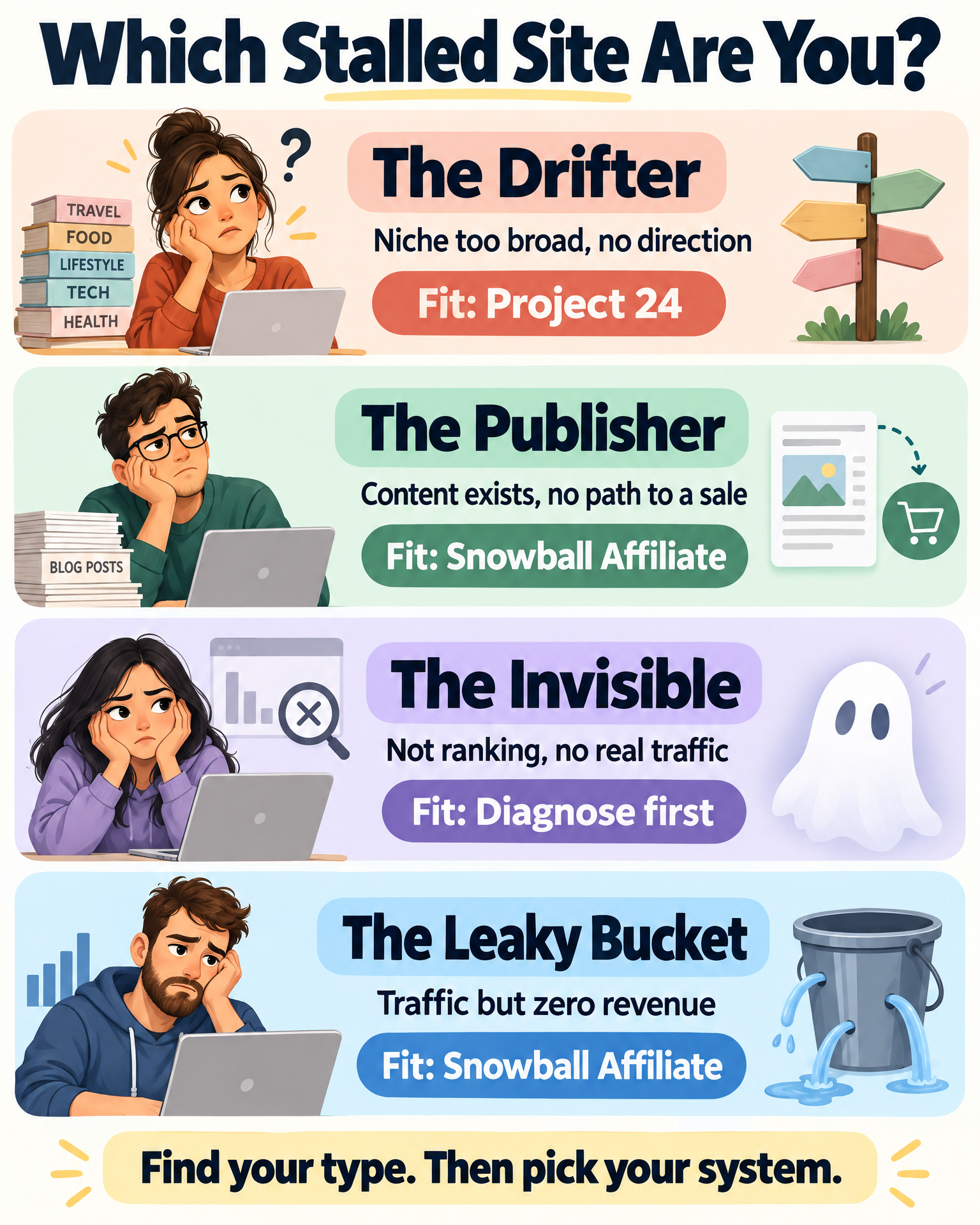
Abstract comparisons only get you so far. Match your actual situation to one of these instead.
“My niche grew too broad and my content has no direction.”
This is a scope problem — the site has drifted, and there’s no clear center of gravity pulling it together. Project 24’s broader content-business framework tends to be the better fit here, since it addresses site direction and overall strategy rather than one narrow conversion mechanism. Fixing scope first makes everything downstream easier.
“I have content, but there’s no path connecting it to a sale.”
This is a sequencing problem — the posts exist, but they don’t lead anywhere. Snowball Affiliate is built specifically for this gap. The whole system is designed to replace disconnected publishing with a deliberate reader journey toward a buying decision.
“My content isn’t ranking well enough to get meaningful traffic.”
This one can go either direction depending on the underlying cause. Snowball Affiliate addresses search-visibility gaps within its sequencing framework — there’s a module specifically focused on finding lower-competition keyword opportunities. Project 24 generally covers SEO as part of its broader site-growth philosophy. Diagnose whether the visibility problem is about keyword strategy or about the content itself before choosing.
“I have traffic, but it isn’t converting into revenue.”
This is a conversion problem, and it’s the scenario Snowball Affiliate is most directly built to solve. Traffic without a deliberate path to a buying decision is just a number — and offer-to-content sequencing exists specifically to change that.
7. Can You Use Both?
In principle, yes. The two systems operate at different levels and aren’t mutually exclusive. A reader could use Project 24’s broader content-business philosophy to guide overall site direction and diversified monetization, while using Snowball Affiliate’s sequencing framework specifically to fix a disconnected reader journey toward one particular offer. They don’t conflict — they address different layers of the same site.
That said, running two full frameworks simultaneously as a beginner is a reliable way to end up overwhelmed and halfway through both. The mental overhead of switching between two different organizing philosophies — especially when you’re still learning the fundamentals — tends to slow things down more than it speeds them up.
The more useful question isn’t “can I use both?” It’s “which gap is costing me the most right now?” Solve that one first. If and when you’ve genuinely worked through it, you’ll have a much clearer sense of whether the other system fills a real remaining need — or whether you’ve already moved past it.
8. How to Actually Decide
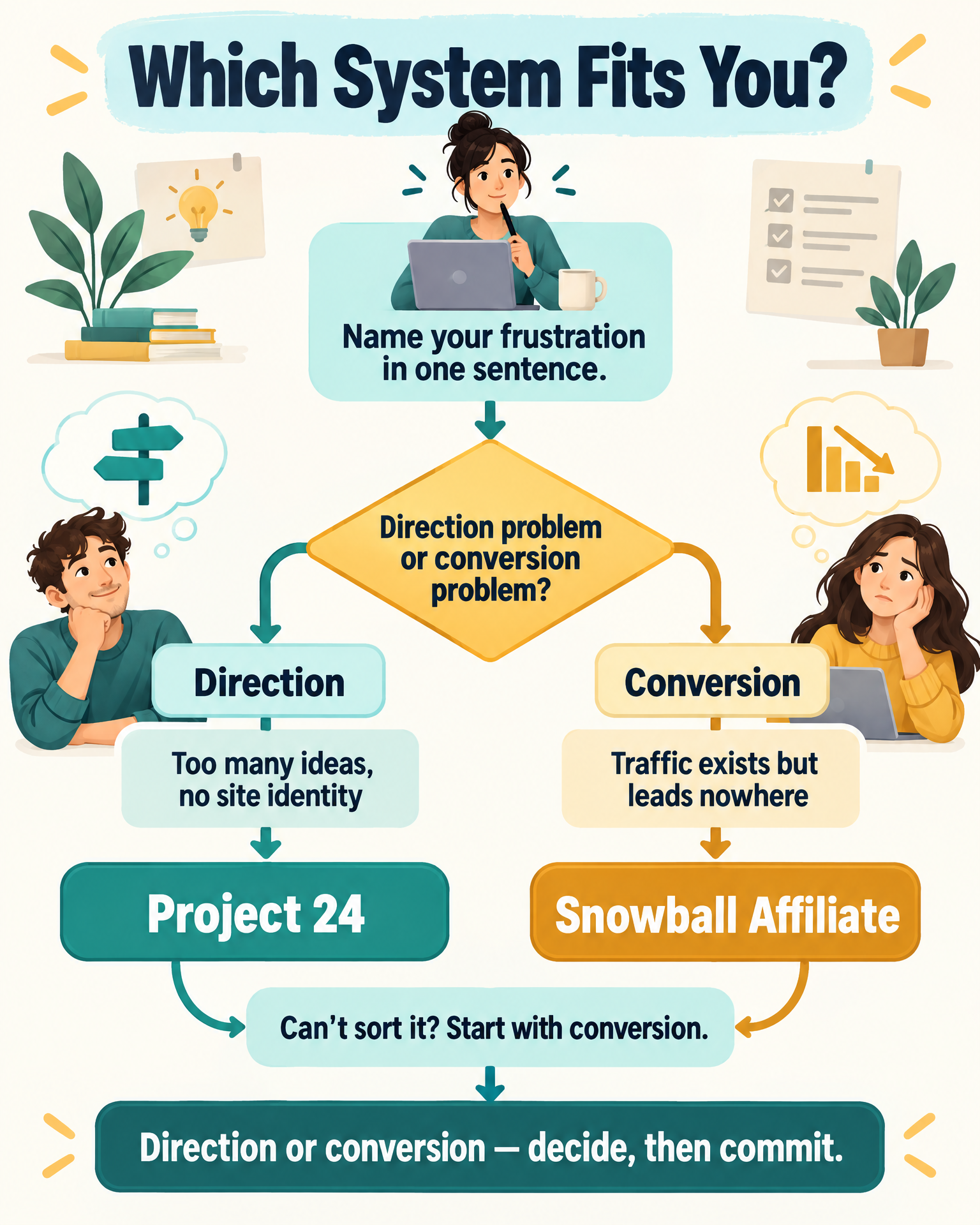
Skip the feature comparison. The decision comes down to one thing: which problem does your site actually have right now? Here’s a short diagnostic to find out.
Step 1 — Name your frustration honestly. Write it down in one sentence. Not the polished version — the actual one. “I don’t know what to publish next.” “My traffic isn’t turning into money.” “My site feels like it’s going in five directions.” The specificity matters.
Step 2 — Sort it into direction or conversion. Direction problems sound like: too many ideas, no clear site identity, unsure what the business is actually building toward. Conversion problems sound like: traffic exists but doesn’t lead anywhere, posts don’t connect to offers, readers arrive and leave without taking action. One category. Not both.
Step 3 — Match the category to the system. Direction problems tend to favor Project 24’s broader framework. Conversion problems tend to favor Snowball Affiliate’s narrower one. If you genuinely can’t sort it — if it really does feel like both equally — start with conversion. A site with a clear conversion path is easier to redirect than a site with clear direction but no revenue mechanism.
- “I want a focused system that connects my content into a deliberate path toward affiliate sales.” → Snowball Affiliate
- “I want to build a broader content business, with affiliate income as one part of a bigger picture.” → Project 24
9. Frequently Asked Questions
Is one of these objectively better than the other?
No — and that framing is part of why this comparison trips people up. They’re built for different-shaped problems. “Better” only makes sense relative to what’s actually broken in your specific situation. A scalpel isn’t better or worse than a toolkit; it depends entirely on what you’re trying to do.
Which one is faster to see results with?
Neither guarantees a specific timeline, and you should be skeptical of any course that does. Snowball Affiliate’s sequencing is designed to shorten the gap between publishing and having a commercial reason for that content to exist. Project 24 is explicit about a longer, roughly two-year horizon for meaningful income growth. But faster isn’t automatically better — solving the wrong problem quickly still leaves you with the wrong problem.
What does “full-time income replacement in 24 months” actually mean?
It’s a framework goal, not a guarantee. Project 24 generally positions 24 months as the horizon for reaching full-time income levels through consistent content-site growth — but what “full-time income” means varies enormously by person, and results depend on niche competitiveness, publishing consistency, monetization choices, and a dozen other variables no course controls. Treat it as a directional target, not a promise.
Who should probably NOT buy Snowball Affiliate?
Someone who doesn’t yet have a clear niche or offer in mind, or who wants a broad business-building curriculum rather than a focused conversion mechanism. Snowball Affiliate’s value comes from its specificity — if you’re not ready to commit to a niche and an offer, that specificity won’t land the way it’s designed to.
Who should probably NOT buy Project 24?
Someone whose site already has reasonable traffic and a clear niche but is specifically stuck on converting that traffic into affiliate revenue. Project 24’s broader scope may not address that specific gap with the precision the situation calls for. It’s also worth considering if you want results narrowly focused on affiliate conversions rather than a diversified, multi-revenue-stream business model.
Do I need to fully complete one system before trying the other?
No — but framework-hopping without finishing either one is one of the most common ways bloggers end up back at square one six months later. Pick based on your diagnosed problem, give it a genuine run, and reassess from a position of actual experience rather than mid-course frustration.
What if my site has more than one of these problems at once?
That’s common — most stalled sites have overlapping issues. In that case, prioritize whichever problem is costing you the most right now, and address it first. Trying to fix scope, sequencing, and SEO simultaneously with two different frameworks usually means none of them get the focused attention they need to actually work.
Products, Tools & Resources
Snowball Affiliate — The offer-first sequencing system covered throughout this guide. Best for bloggers whose core problem is a disconnected reader journey: content exists, traffic may exist, but there’s no deliberate path leading toward a buying decision. It’s a narrow, mechanism-specific framework — and that narrowness is exactly what makes it useful for the right situation.
Project 24 (Income School) — The broader content-business roadmap. Best for readers who want to build a diversified, long-term content site — one that earns through multiple revenue streams and is built to function as a genuine business over a longer horizon, not just a single affiliate conversion funnel.
Snowball Affiliate Review: Is It Right for Building a Niche Affiliate Blog? — A deeper look at how the sequencing system actually works, what’s inside each module, and who it’s genuinely a good fit for versus who it isn’t.
Project 24 Review: Is It a Good Fit for a Stalled Niche Blogger? — A closer look at the broader content-business roadmap, including an honest assessment of who benefits most from its philosophy and who might be better served by something more focused.
Is Your Affiliate Niche Too Broad? Signs Your Site Has Lost Focus. — If you read this comparison and your gut reaction was “I think my problem is scope, not sequencing,” this is the right next read. It walks through the specific signals that a niche has drifted too wide — and what to do about it before investing in any new framework.