

Somewhere around your fiftieth blog post, a quiet dread sets in. You’ve written about something you love — plants, cameras, minimalist decor, whatever pulled you in — and the traffic might even be trickling up. But the bank account isn’t moving. Not even a little. And buried in that silence is a question nobody warned you about: does anyone actually buy anything here? Passion will tell you what to write. It has nothing to say about what people are willing to pull out their wallet for. That gap — the one between what you love and what sells — is exactly where so many beginner affiliate sites go to die, usually around month six, usually with a folder full of posts and a bank balance that hasn’t budged.
Table of Contents
The Real Question Isn’t Niche vs. Offer — It’s Sequencing
Here’s the thing nobody frames correctly: this was never a battle between two camps. You need a niche. You also need an offer. Eventually, both show up. What actually matters — the thing that quietly decides your fate months down the line — is which one you nail down first. Because whichever comes first ends up shaping everything that follows it, like the first domino in a very long, very expensive line.
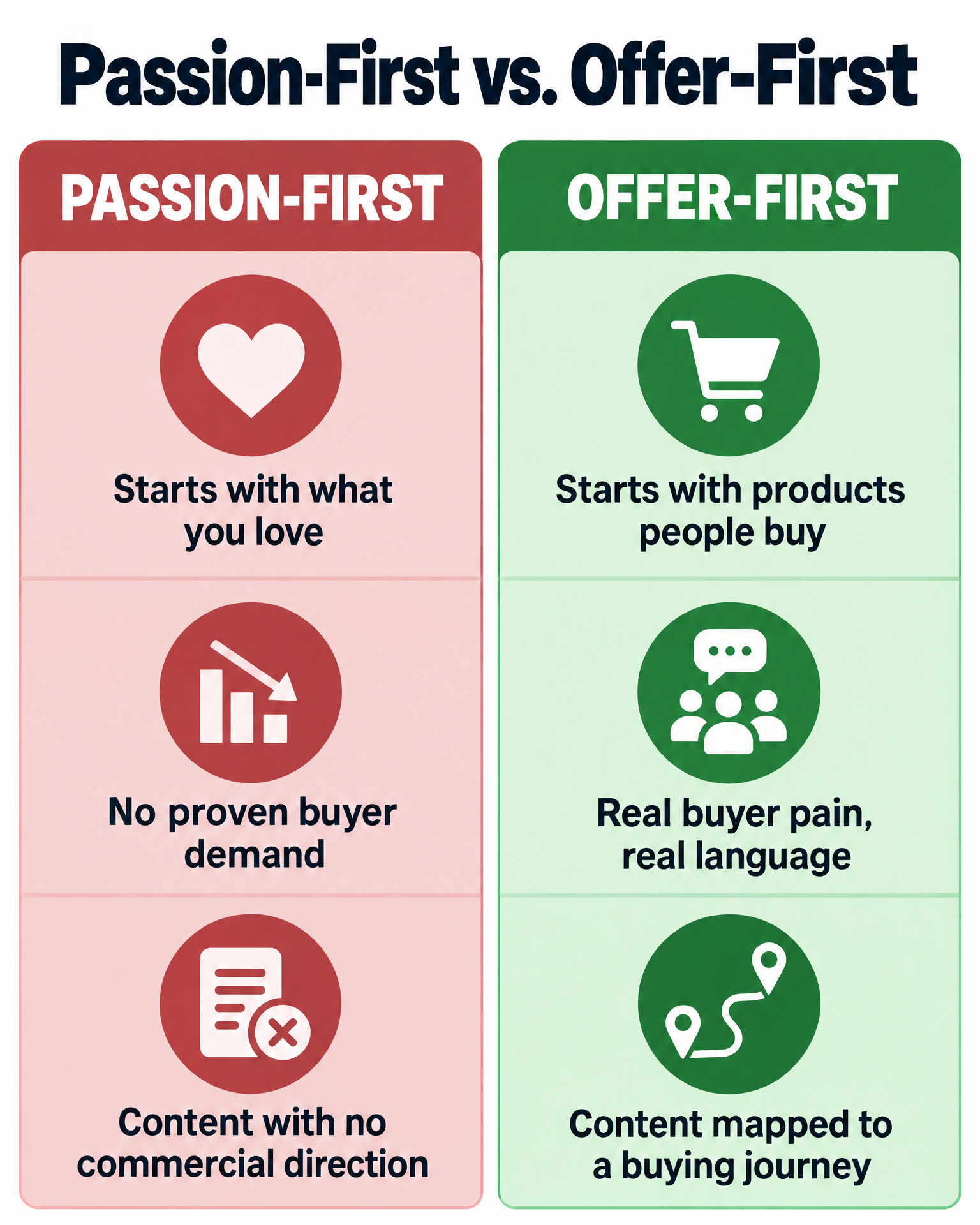
Start with passion, and you spend months trying to reverse-engineer monetization into a topic that may never have supported it in the first place. Start with the offer, and something strange happens — the niche practically assembles itself, built on buyer behavior that’s already proven to work. One path forces a topic to become commercial after the fact. The other bakes commercial intent into the foundation, before you’ve written a single word.
Why Passion-First Niche Picking Produces Directionless Sites
Let me paint the picture, because you’ve probably lived some version of it. Someone falls hard for houseplants. Or vintage cameras. Or that clean, minimalist aesthetic everyone’s obsessed with lately. They start a blog. The writing is honest, even good — care tips, history, the emotional pull of the aesthetic. Then, months later, they try to bolt monetization onto what they’ve built, and that’s when the floor drops out. The affiliate programs in that space are thin. The commissions barely register. The products people buy are one-time purchases with no real ecosystem of comparisons and buying guides built around them.
Nothing about the content is wrong. The audience might even be real, might even be growing. But there’s no commercial engine humming underneath any of it, so all that traffic just… passes through. It doesn’t convert. It doesn’t become revenue. What you’re left with, quietly and without much ceremony, is a hobby wearing a URL.
Passion-first doesn’t fail because passion is somehow the enemy. It fails because it answers the wrong question. “What do I want to talk about” and “what are people already spending money to solve” are not the same question — not even close — and only one of them keeps the lights on. Let the wrong one steer for a year and the topic usually sprawls wider instead of sharpening — here are the signs Is Your Affiliate Niche Too Broad?
What Offer-First Selection Actually Looks Like
Now, offer-first gets misunderstood constantly, so let’s clear the fog. It doesn’t mean picking a topic you secretly hate because the commission looks good on paper. It means you start your research one layer deeper — at the commercial layer, not the topical one. In practice, you’re hunting for three things simultaneously, almost like triangulating a signal:
- Products or services with visible, ongoing demand — not a fad that’ll fade by spring, not a one-off purchase, but something people research, compare, and buy again and again across an entire market.
- Affiliate programs or networks that genuinely pay for referring that demand, with terms you can actually locate and verify straight from the source — not rumored, not assumed.
- Buyer pain, spoken in real, unpolished language — people typing “which one should I get,” “is X even worth it,” “X vs Y” into forums, review sections, comment threads.
When those three things line up — really line up, not sort of — you’ve found something worth building on. Notice what hasn’t happened yet: you haven’t picked a “niche.” You’re still down in the weeds with products and problems, not topics. That comes later.
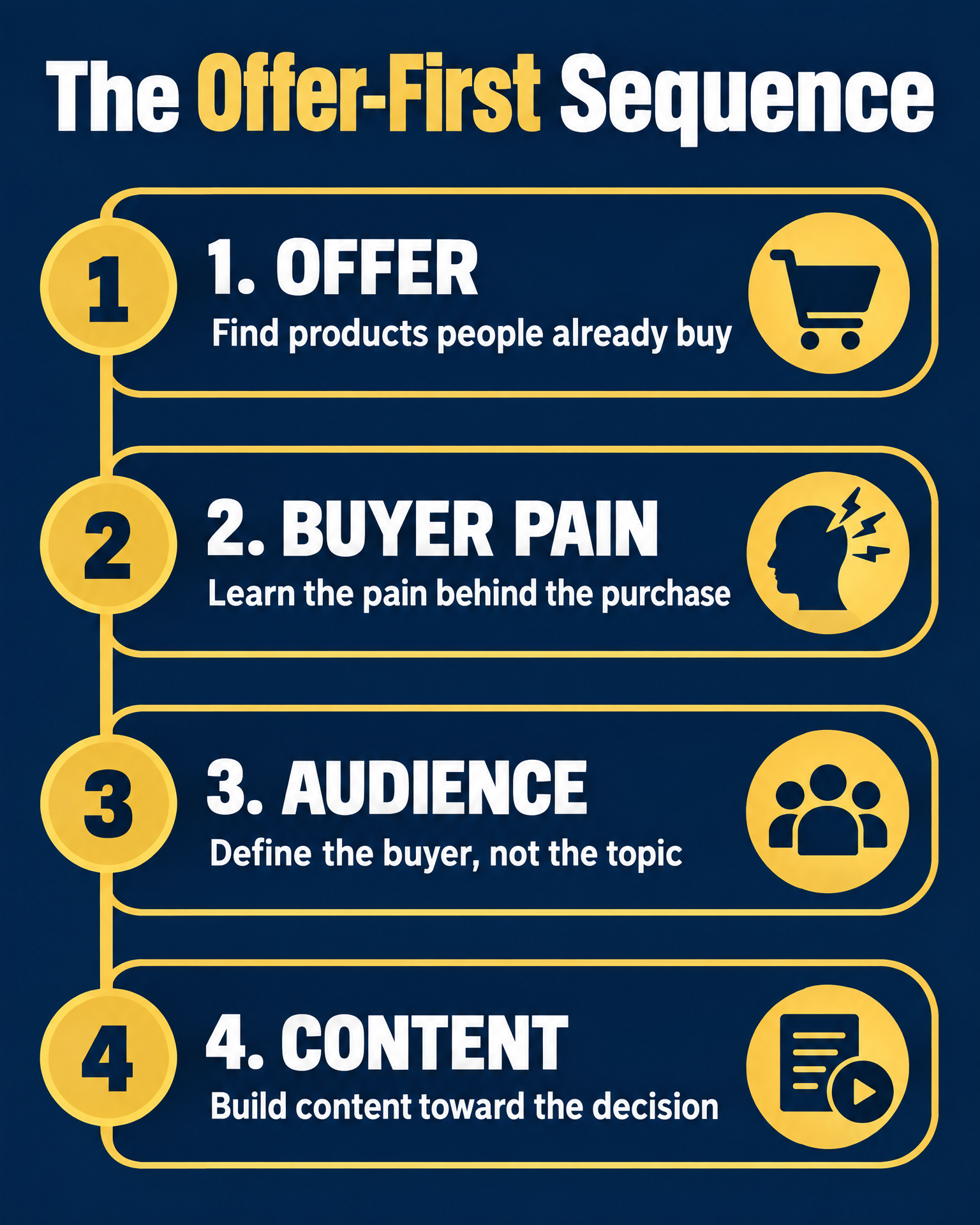
The Simple Sequencing: Offer → Pain → Audience → Content
Once that commercial signal shows up, the niche doesn’t need to be forced. It reveals itself, piece by piece, in order.
Offer. You’ve found a product category with real buyers behind it and a workable affiliate structure underneath — home security cameras, budgeting apps, ergonomic office gear, doesn’t matter what.
Buyer pain. Now you dig into the why. Not the shallow “they want a camera” version, but the real one — “they’re scared of package theft and don’t trust the cheap brands” or “they got burned once by a subscription that wouldn’t let them cancel.” This is the friction, emotional and practical, that your content exists to untangle.
Audience definition. This is where the niche finally emerges. Not “home security” as some faceless category, but “renters who legally can’t drill into a wall” or “parents who need eyes on a new nanny” or “small business owners locking down a storefront overnight.” The audience falls out of the pain — it doesn’t come first, and it never should.
Content. Only now — only after all of that — do you plan a single article. Buying guides. Comparisons. “Best for X situation” posts. Troubleshooting content. All of it built to meet a buyer who already has money in hand and intent in their head, standing at a very specific point in their decision. And once you know what to write, the next question is how the pieces connect — see How TOFU, MOFU, and BOFU Content Fit Together on an Affiliate Site.
Follow that order and every post you publish has a reason to exist — a commercial reason, not just a topical one. Reverse it, and you’re left hoping, quietly and for a long time, that your content eventually stumbles into a buyer.
How to Sanity-Check a Candidate Niche for Commercial Depth
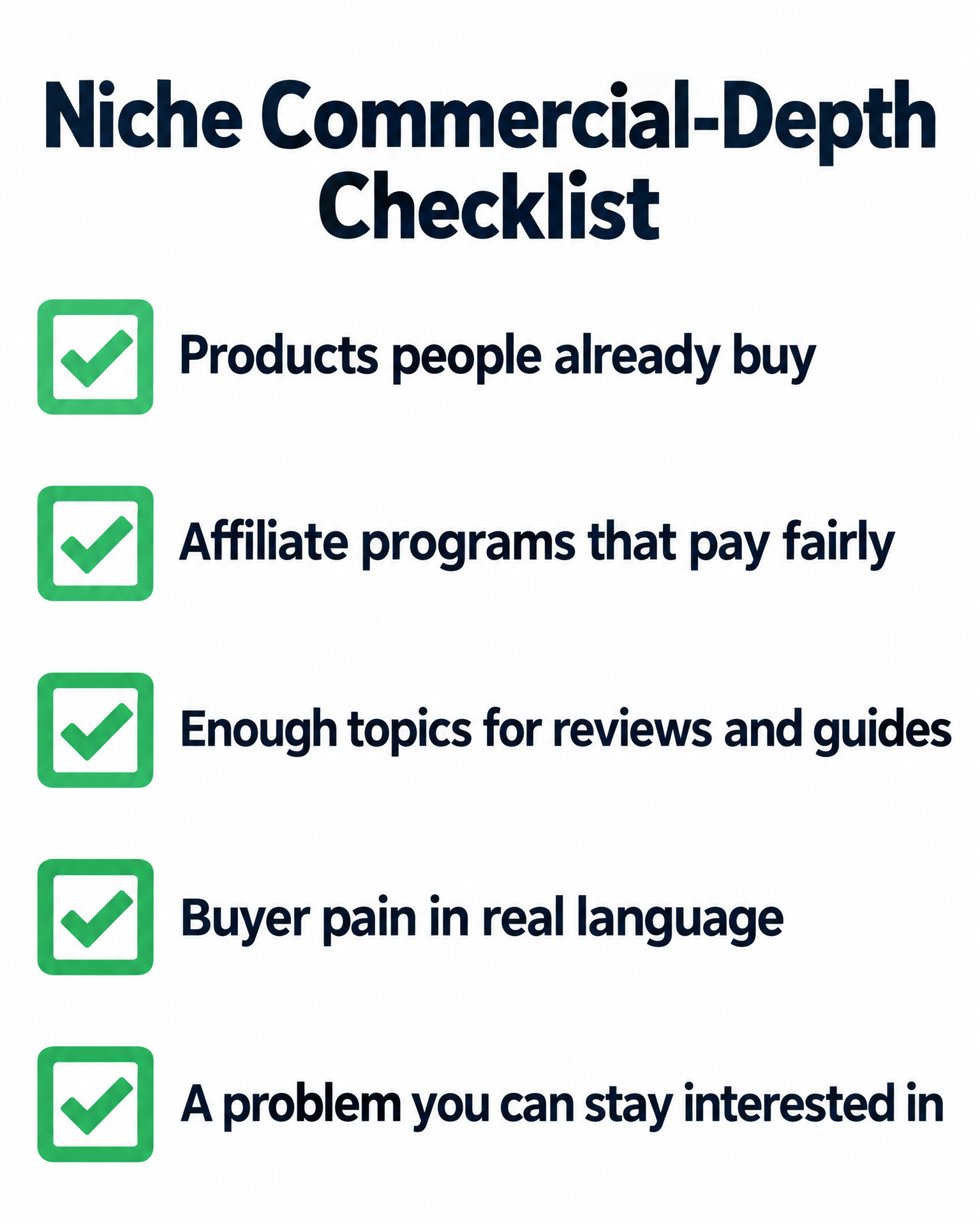
Before you commit — really commit, months-of-your-life commit — stress-test the market the same way you’d kick the tires on a used car before handing over cash. A niche with genuine commercial depth should let you answer yes to most of these, without stretching:
- Can you name at least 8–10 distinct products or services worth reviewing on their own merits, not just slight variations of the same thing wearing different labels?
- Are there natural comparison angles people are actually searching for — brand vs. brand, budget vs. premium, this feature vs. that one?
- Do buyers tend to research before they buy, rather than grab something on impulse? Impulse categories are brutally hard to influence with content, no matter how good the writing is.
- Is there room for a “best for [specific situation]” structure — best for beginners, best for small spaces, best for someone counting every dollar?
- Do the affiliate programs in this space have terms you can actually find and read, without guessing or hoping?
If you can only sketch three or four articles before you’re circling back on yourself, repeating the same ideas in slightly different words — that’s your answer. The niche is too shallow to carry a site long-term. That’s not a signal to force it. It’s a signal to widen the lens or walk away entirely.
Where to Actually Find Buyer Pain in Real Language
This is the part most beginners quietly skip, because it doesn’t feel like “real work.” It feels like lurking. But this — this exact hour of scrolling and reading — is the highest-leverage thing you’ll do before you ever hit publish.
Go sit inside the forums, subreddits, and Facebook groups where your candidate audience actually spends time, and read the questions people ask before they buy, not the smug reviews they leave after. Pull up review sections on retail sites and go straight for the three-star reviews — skip the five-star fluff and the one-star meltdowns, because the honest, complicated truth almost always lives in the middle. Look at “compare” and “vs” searches to see exactly where people get stuck, where their thumb hovers over the buy button and doesn’t press down. Read the Q&A sections under product listings, the ones nobody else bothers to check.
You’re not fishing for a clever headline here. You’re collecting the exact words real people use to describe a problem they haven’t solved yet — because those words, almost unchanged, are what should end up in your headlines, your intros, your buying guides. People recognize their own language instantly. It’s how they know you actually understand them.
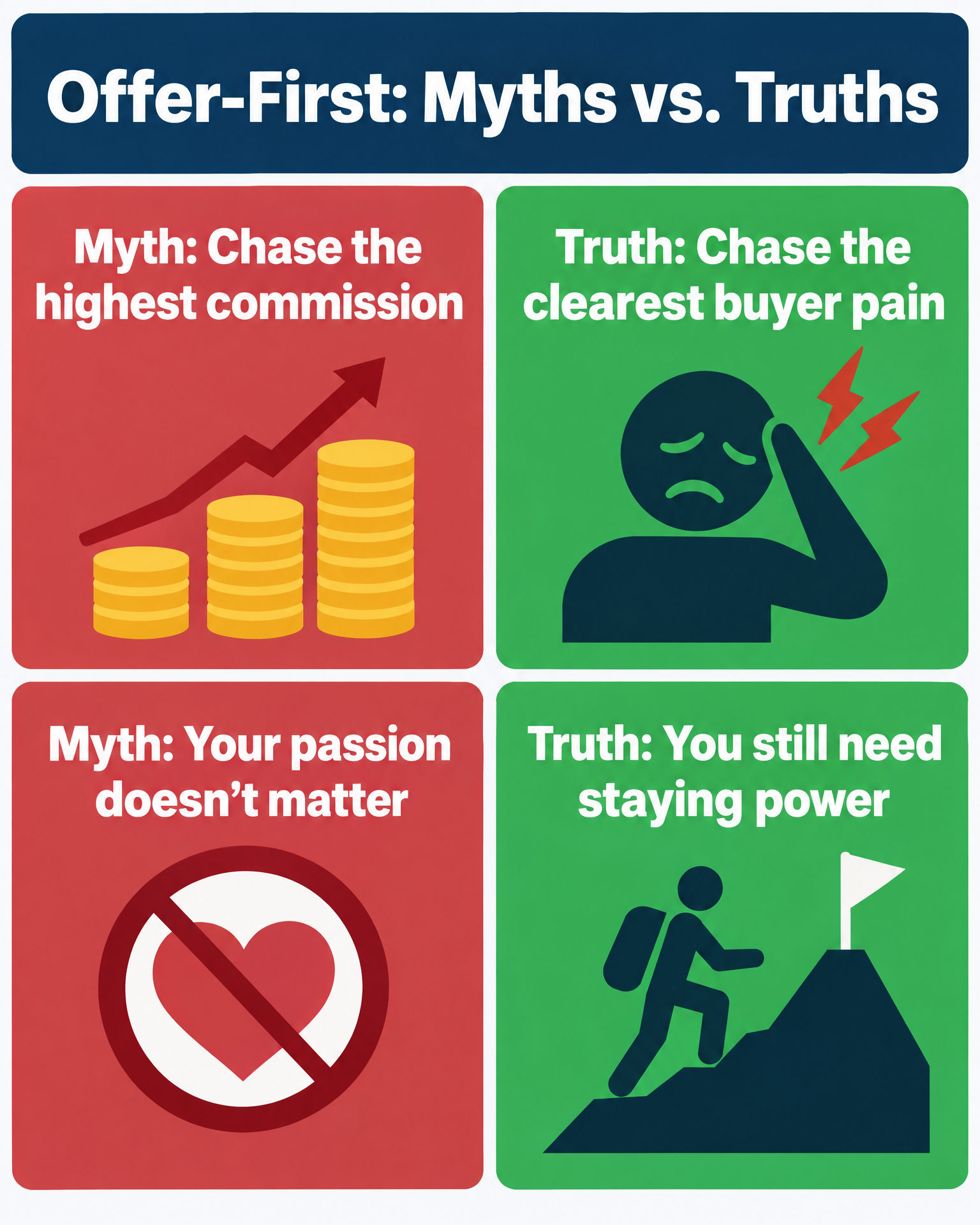
Honest Caveat: Offer-First Isn’t “Chase the Highest Commission”
Let’s be blunt for a second, because this is exactly where offer-first advice quietly breaks down — just as often, honestly, as passion-first advice does. Chasing a niche purely because the commission rate looks juicy, without any regard for whether you can stomach the subject for years, builds a different kind of dead site. One where the writer taps out around month four, exhausted, because they never actually cared about the topic to begin with.
Offer-first means your search begins with proven demand. It was never meant to mean ignoring your own tolerance for the subject matter. You’re going to spend years inside this topic — reading about it, answering the same handful of questions in fifty slightly different ways, tracking new products as they launch and old ones as they fade. If the subject bores you to tears, no commission structure on earth fixes that particular problem.
What you’re really hunting for is the overlap — a market with real commercial weight that you can also tolerate living inside for the long haul. And that overlap is usually bigger than people assume. Most product categories splinter into enough angles — use cases, budgets, skill levels, life stages — that somewhere in there is a version of the niche you don’t secretly resent.
A Decision Framework You Can Run in an Afternoon
Here’s the compressed, no-nonsense version — something you can actually run through this weekend, not just nod along to and forget by Tuesday.
- Step 1 — List candidates. Write down 5–8 product or service categories you have at least mild interest in, or some real exposure to.
- Step 2 — Check for programs. For each one, confirm there’s an affiliate program or network you could realistically join — and actually read its terms, not just assume they’re fine.
- Step 3 — Search the pain. Give each candidate 20 honest minutes inside forums and review sections, hunting for complaints and comparison questions.
- Step 4 — Count the angles. Try sketching 15–20 realistic article titles — guides, comparisons, “best for” posts. If it feels like pulling teeth, cross it off.
- Step 5 — Gut check. Of whatever’s left standing, which one could you still be writing about three years from now without wanting to scream?
Whatever survives all five rounds is your starting niche — arrived at through the commercial door, not the enthusiasm one, but still something you can genuinely live with.
What This Looks Like Once You Start Publishing
In practice, an offer-first site’s first ten to fifteen posts tend to lean hard into comparisons and buying guides, simply because that’s where all the buyer pain you dug up actually lives. Informational content — the “how it works” stuff — still matters, don’t get me wrong. But it plays a supporting role here, answering questions that orbit the purchase decision instead of replacing that decision entirely.
Compare that to the typical passion-first blog, where the first fifteen posts sprawl across broad topical ground, and commercial content gets bolted on later — usually only after someone finally notices there’s no money coming in. Sequencing the offer first simply means the commercial structure is load-bearing from day one. It’s not something you retrofit after the fact and hope holds up. If you want help mapping that first batch of posts, start with What Should You Write First on a New Affiliate Blog?
Products / Tools / Resources
A handful of tools worth having open in a browser tab while you work through this process — nothing exotic, just the practical stuff:
- Keyword research tools (the usual paid and free suspects) — handy for confirming actual search volume around comparison and “best” queries once you’ve narrowed your shortlist down.
- Affiliate networks and program directories — browsing these category by category is the fastest way to spot which product spaces have mature, well-paying programs versus ones that are thin or barely functioning.
- Forums and community platforms (Reddit, niche-specific forums, Facebook groups) — your best raw source for real buyer language and genuine pain points, not someone else’s watered-down summary of it.
- Review aggregator sites and retail Q&A sections — especially good for mining those middling three-star reviews, where the real friction and hesitation tend to hide in plain sight.
- A simple spreadsheet — genuinely, this is the best tool for running the five-step framework above. You don’t need anything fancier to track candidates, programs, and article angles side by side.