

There's a moment right before you start typing — before the headline, before the outline, before you've even opened a new draft — where one question decides more than anything you'll write afterward. It's not about the commission. It's not about how polished the sales page looks or how many five-star reviews are stacked underneath it.
The question is simpler, and somehow harder to actually sit with: would the people who read my site pull out a card for this?
Not "could someone buy this." Not "is this objectively a good product." Would your readers — the actual humans who land on your pages, at whatever stage of trust they're in with you right now, with whatever budget they're working with and whatever problem is keeping them up — realistically buy this specific thing.
This is offer-audience fit. And if you've been doing affiliate marketing for more than a few months, you've probably already felt the absence of it without having a name for it. You pick an offer because the commission number caught your eye, or a name you respect vouched for it, or it was simply sitting there in your niche waiting to be promoted. You build content. You wait. Nothing happens. So Why Your Affiliate Blog Gets Traffic but No Sales. You blame the writing. You blame some invisible algorithm shift.
Sometimes that's true. But more often — more often than most people want to admit — the outcome was decided before a single sentence got written. The offer just never belonged with that audience.
This piece isn't about finding your niche. You've likely already done that. It's not about How to Tell If an Affiliate Niche Has Enough Products to Monetize, either. It's narrower, and more useful than either of those: given an offer sitting in front of you right now, how do you actually know if it belongs with the people who trust you? If you're still weighing which comes first — the offer or the niche — Should You Choose a Niche or an Affiliate Offer First? walks through that sequencing decision before you run this test.
Running one offer through 7 questions tells you a lot, but fit is easier to judge when you can see it stacked against your other ideas. The free Niche & Offer Fit Scorecard lets you compare your ideas side by side and decide what deserves your work. Grab it below and stop guessing which offer is worth the writing time.
Table of Contents
What Fit Really Means (And Why "Good Offer" Isn't the Same Question)
Offer-audience fit comes down to four things lining up at once: the problem your readers genuinely have, the price they're comfortable spending, the stage they're in when they're deciding whether to buy anything at all, and the trust they've extended to you so far. When those four things align, promoting an offer stops feeling like selling. It starts feeling like handing someone the exact thing they were already circling.
Misalign even one of those four, though, and no clever copywriting saves it. You can polish the headline for hours. Doesn't matter.
Here's the part that trips people up: a product can be excellent. Great reviews, fair pricing, a reputation that checks out — and still be completely wrong for your specific readers, because they were never who it was built for. Fit isn't a quality you find inside the product. It's a relationship between the product and the person standing in front of it. That distinction changes everything about how you should be evaluating offers.
So throw out the question "is this a good affiliate offer?" It's not useless, but it's incomplete. The real question — the one that actually predicts whether you'll make money — is: is this a good offer for the specific people who already trust me?
The Fit Test: Seven Honest Questions Before You Write a Word
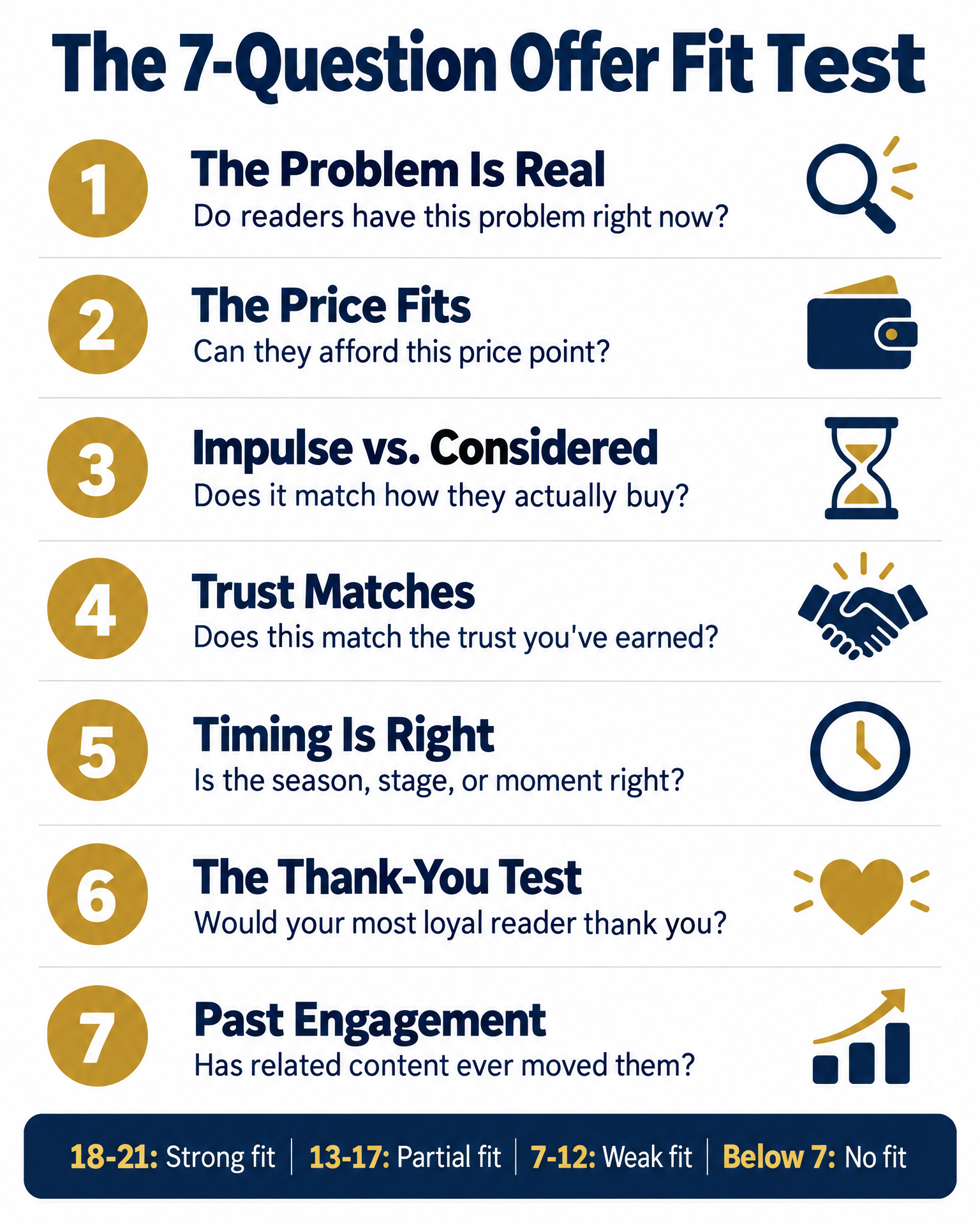
Here's a diagnostic you can run on literally any offer, in about ten minutes, before you commit a single hour to content around it. Score each question 1 (no, or weak), 2 (unsure, somewhat), or 3 (yes, strongly). The catch — and it's a real one — is that this only works if you're willing to sit with an uncomfortable "no" instead of talking yourself into a "yes."
1. Do my readers have this problem right now — not someday, not eventually? There's a world of difference between solving a problem someone will probably have down the road and solving one that's sitting on their chest today. Urgency and relevance feed each other. Strip one out and the other weakens too.
2. Can they actually afford this, based on what I've watched them spend before? Not "could a reasonable person afford it." Has your audience — the real one, the one in your inbox and comments — shown any pattern of spending in this range on anything comparable?
3. Is this a considered purchase or an impulse buy — and does that match how people actually consume my content? Some purchases get researched for weeks. Compared. Slept on. Others get bought on a whim between two tabs. These require entirely different trust levels and entirely different content approaches. Confuse the two and you'll wonder for months why nothing's converting, without ever suspecting the real cause.
4. Does this match the trust I've actually earned — not the trust I wish I had? A small blog three months old, with a handful of casual readers, hasn't built the kind of credibility that supports recommending something expensive or high-commitment. Trust accumulates in layers. Your recommendations need to scale with it, not outrun it.
5. Is the timing actually right — seasonally, situationally, in terms of where they are in life? Some offers work year-round. Others only make sense at a specific moment — a season, a life stage, a particular fork in someone's decision-making. Push a seasonal offer in the wrong month, or a beginner product at people who've outgrown beginner problems, and conversions die quietly, without ever announcing why.
6. Would my most loyal reader thank me for this — or feel a little let down? Picture your longest-standing reader, the one who's actually read a dozen of your posts and trusts your opinion, clicking through and buying. Does that image sit well with you? Or is there a flicker of "I hope they don't notice I'm reaching here"?
7. Has my past content in this topic area actually gotten engagement — or am I guessing my audience cares? This isn't only about the offer. It's about whether the territory the offer lives in has ever actually moved your audience before. Guessing isn't research, even when it feels like intuition.
What Your Score Actually Tells You
- 18–21 — Strong fit. Build here with confidence. This is where your content hours should go first.
- 13–17 — Partial fit. Don't kill it yet. There's usually a repositioning fix available before you write it off (more on that below).
- 7–12 — Weak fit. As currently framed, this probably isn't right for this audience. Dig deeper before you invest real time.
- Below 7 — No fit. Don't build a content cluster around this. Mention it in passing if you must, but don't build a strategy on it.
The number itself isn't the point — precision was never the goal. The point is that scoring forces you to answer all seven questions individually, instead of letting one loud "yes" (commission, usually, or price) drown out three quiet "no's" you'd rather not hear.
The Warning Signs That Show Up Before the Numbers Do
Some mismatches only reveal themselves once you run the test above. Others are louder. They announce themselves if you're actually paying attention, rather than pushing forward on momentum. And if the mismatch is showing up as clicks that never become purchases, Why People Click Your Affiliate Links but Still Don't Buy breaks down exactly where the journey falls apart.
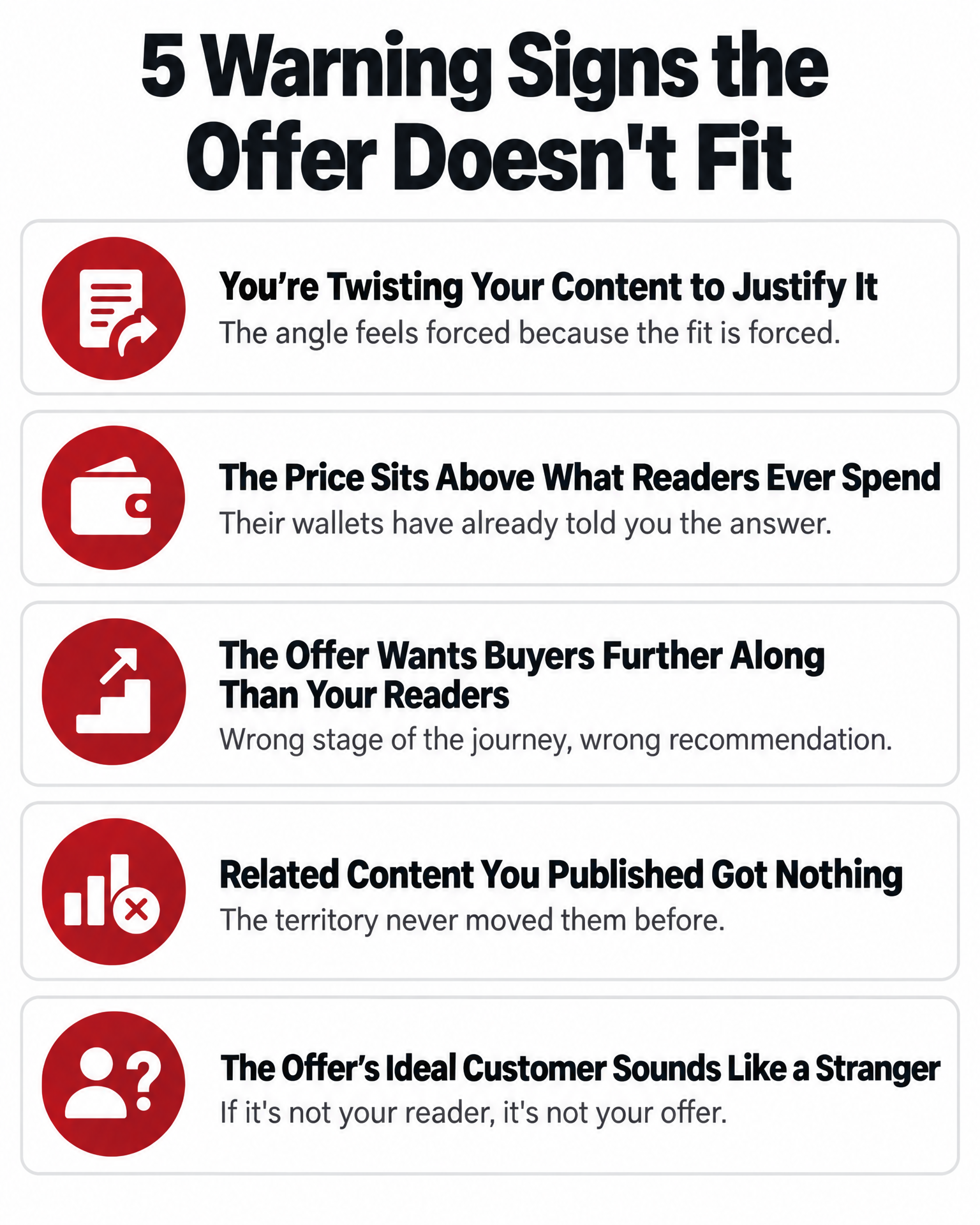
You're twisting your own content to justify it
If you catch yourself writing a strained "here's why you might need this" intro, or forcing a bridge between what you normally write about and this offer — that resistance is data, not a writing problem. Offers that genuinely fit don't need rhetorical gymnastics to introduce. They slide into a sentence you were probably going to write anyway.
The price sits well above what your readers have ever shown you they'll spend
If your best-performing content has always leaned budget-conscious, scrappy, DIY — and this offer sits in a premium tier — that's not something better copy fixes. That's a structural wall.
The offer wants buyers who are further along than your readers
Some content speaks to people who don't yet know they have a problem. Some speaks to people actively comparing options. Some speaks to people who are ready to buy today. An offer built for that last group, dropped into content that's only ever educated people at the first stage, will underperform no matter how good the product is. It's not a writing problem. It's a stage mismatch.
Related content you've already published got nothing
If you've written on adjacent topics before and it landed with a thud — minimal traffic, people bouncing fast, nothing in the comments — take that seriously. Interest patterns tend to repeat. A topic that's been quiet before rarely wakes up just because you attached a commission to it.
The offer's "ideal customer" sounds like a stranger
Somewhere in a product's marketing — in the reviews, in the sales copy, in the founder's own words — there's usually a description of who it's really built for. If that description reads like a different income bracket, skill level, or life stage than your actual readers, believe it. Sellers are often more honest about who their product serves than affiliates are willing to accept.
You're leaning on hope instead of evidence
This one's subtle. If your reasoning for promoting something sounds like "I think my audience would like this" rather than "I've watched my audience respond to things like this before" — you're speculating, not diagnosing. Hope feels like a signal. It isn't one.
Doing the Homework Before You Commit
The reassuring part: none of this requires guesswork, and almost none of it costs money. Fit research is cheap. Far cheaper than the hours you'll otherwise pour into a content cluster built on an assumption that never held up.
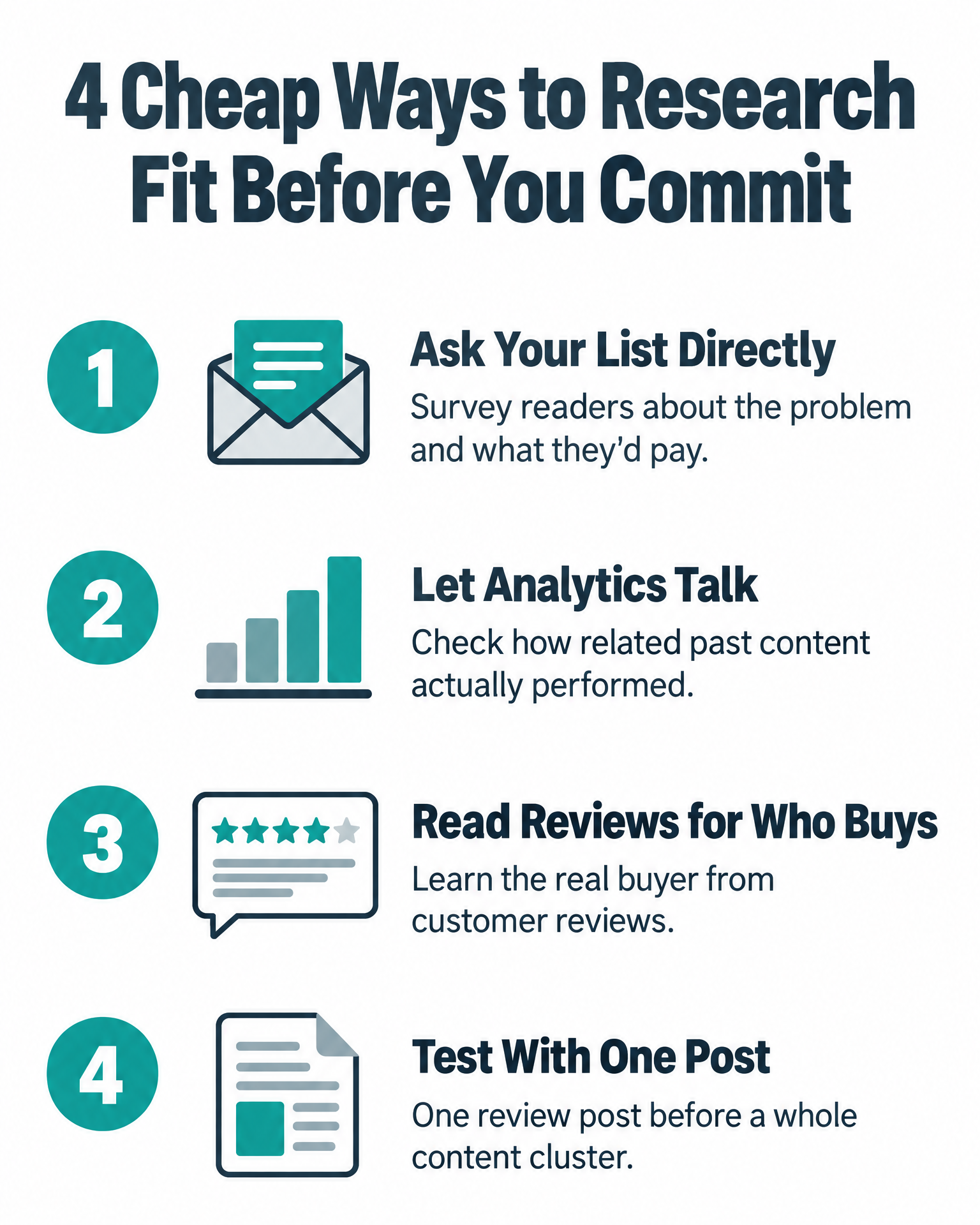
Ask your list directly
A short, three-question survey to your email list, or even a quick poll to your most engaged followers, will tell you more in an afternoon than weeks of quiet speculation ever could. Ask about the problem the offer solves. Ask if they've considered anything like it. Ask what they'd expect to pay. Direct answers from real people beat every other research method on this list, and they cost almost nothing.
Let your analytics do the talking
Go back and look at time-on-page, scroll depth, internal link clicks, return visits — for anything you've already published that's adjacent to this offer. Past behavior predicts future buying interest far more reliably than a hunch about what "should" resonate.
Read reviews for a different reason than usual
Don't read a product's reviews to reassure yourself it's good. Read them to figure out who actually bought it. Look at the experience level, the budget signals, the use case, the specific problem the reviewer says got solved. If that composite picture doesn't look like your audience, you have your answer — no matter how glowing the reviews are.
Test with one post before you build a cluster
You don't need a month of content to validate an offer. Write one honest review or comparison piece, publish it alone, and watch how it behaves — click-through, time on page, any early signal at all — before deciding whether to build a supporting cluster around it. That single post turns an expensive bet into a cheap experiment.
Ask if this would've passed six months ago — and whether it'll still pass six months from now
Fit shifts. Audiences grow, mature, get more sophisticated in what they need. Re-run this test periodically even on offers you're already promoting successfully — not just new candidates. Fit can quietly decay under offers that used to convert just fine, and you won't notice until the numbers already show it.
What Good Fit Feels Like, Told Through a Contrast
Bad fit is easier to spot than good fit is to describe, so here's a hypothetical worth sitting with.
Say you write for budget-minded beginners — people just starting to learn a skill, still figuring out the basics. Now imagine you're eyeing a high-priced, high-commitment mastermind program built for seasoned professionals. Run the test: the price is far outside anything your audience has ever shown you they'll spend, the purchase demands a level of trust your young blog hasn't earned yet, and the program's own marketing describes an "ideal customer" who sounds several stages ahead of your actual reader. Nearly every question scores low. That's not a bad product — it's just not for the people reading you.
Now flip it. Same beginner audience. But this time it's an inexpensive, low-commitment tool solving one specific, immediate problem your readers have already told you — in comments, in replies, in a survey — that they struggle with. The price matches what they've spent before. The purchase leans impulse rather than considered. The trust required is modest. And your past content on this exact problem has already performed well. That's a strong fit — not because the tool is objectively superior, but because it matches the people actually standing in front of it.
Good fit rarely feels like persuasion. It feels like confirming something your audience was already leaning toward before you said a word.
When the Fit Comes Back Wrong
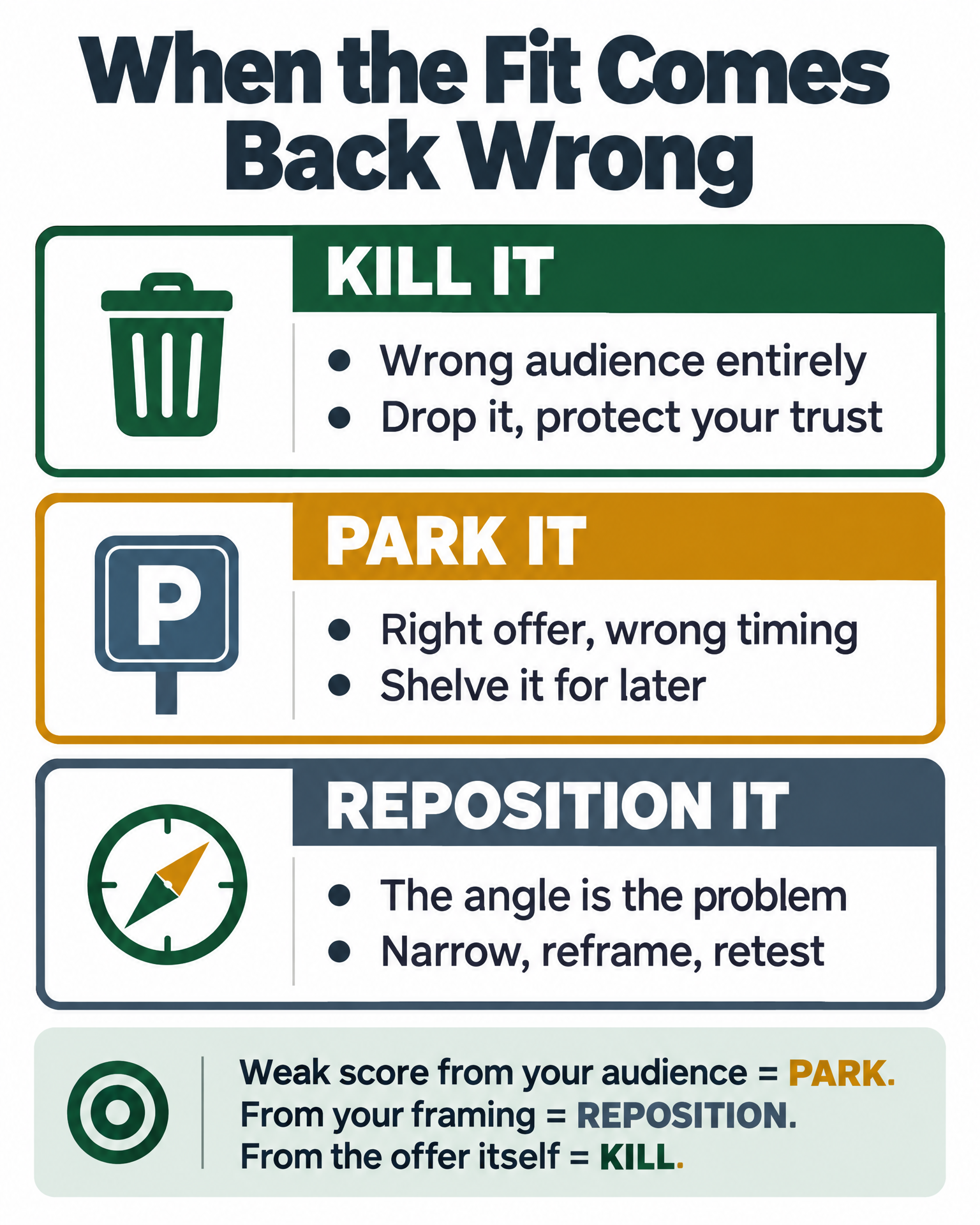
Once the test tells you something's off, you've got three honest paths forward. Which one applies depends entirely on where the mismatch is actually coming from.
Kill it
If the mismatch runs deep — wrong price tier, wrong stage of readiness, an ideal customer who looks nothing like your reader — the right move is to let it go and stop hunting for an angle that isn't there. This is the hardest option to swallow, especially when the commission looked tempting. It's also the cheapest option, measured in hours you didn't waste.
Park it
Sometimes an offer isn't wrong forever — just wrong for right now. If you can see your audience visibly maturing toward becoming this offer's ideal customer over the coming months, note it and shelve it. Revisit the fit test once you actually see that shift show up in your analytics or your survey answers — not before.
Reposition it
Worth trying before you kill anything scoring in that 13–17 partial-fit range. Sometimes the offer isn't the problem — the angle is. Repositioning might mean narrowing who within your audience you're actually speaking to, switching from a hard sell to a comparison post, or reframing the problem in the language your readers actually use to describe it, instead of the language the offer's own marketing leans on. This works when three or four of the seven questions score well and only one or two are dragging things down. It rarely works when most of the test came back weak. And if your repositioning points toward comparison-style content, see Why Your Buying Guides Feel Like Product Lists Instead of Decision Tools to learn how to build them as decision tools instead of product lists.
The quick gut-check
Still not sure which path fits? Ask yourself: is the weak score coming from where my audience currently is (park it), from how I'm framing the offer (reposition it), or from something structurally wrong about the offer itself (kill it). That one distinction untangles most of the indecision.
The Questions People Actually Ask Themselves About This
How many offers am I supposed to test before I settle on one? There's no magic number. The whole point of running this test is to filter out the wrong ones, not to force a decision on the first offer you look at. Test everything you're seriously weighing, and only move forward with what actually scores well.
Can a poor-fit offer still make a sale here and there? Sure — occasionally. A low score doesn't mean zero sales, it means a low rate of sales for the effort you're pouring in. Those occasional wins rarely justify the content hours, especially once you compare them to what a genuinely well-fit offer could produce with that same time.
Does fit actually matter more than the commission rate? For anything sustainable, yes. A generous commission on something nobody in your audience buys still adds up to zero. A modest commission on something that consistently fits compounds — quietly, steadily — as you add more content and more trust over time.
How often should I actually recheck fit on stuff I'm already promoting? Whenever something shifts — new subscribers changing the makeup of your audience, a noticeable change in what content performs, feedback suggesting your readers have outgrown beginner-level problems. Fit can erode silently, even on offers that used to convert perfectly well.
Products / Tools / Resources
- Website analytics platforms — whatever's built into your hosting or CMS, or a standalone tool you already trust. This is where you go to see how past content on related topics has actually performed: time on page, click-through, whether people came back.
- Simple survey tools — for sending short, direct questions to your list or your most engaged readers. Ask about the problem, ask what they'd expect to pay, ask if they've looked at anything similar before.
- Public review sections on major retail and marketplace sites — read them not to confirm quality, but to figure out who's actually buying, in their own words, independent of the seller's pitch.
- Your own archive — genuinely the most underused resource on this list. Go back through old posts on adjacent topics and treat the engagement numbers as real, current audience data — not dusty old content.
- Related reading on this site — the companion pieces on choosing a niche, on whether a niche has enough products to sustain a real content strategy, and on diagnosing why traffic isn’t converting all sit naturally alongside this fit test. Worth reading together, not in isolation.