
The Quiet Torture of Page 2
Something about being stuck on page 2 gets under your skin in a way that zero impressions never quite manages. Zero impressions is clean, almost. It tells you plainly that something hasn’t happened yet — the crawl hasn’t finished, the domain’s too young, there’s a gap you can point to. Page 2 doesn’t give you that mercy.
It means Google found you. Read you. Understood what you were trying to say well enough to slot you in as a legitimate answer. And then, for reasons that feel maddeningly invisible, decided you weren’t quite good enough to sit in the top ten.
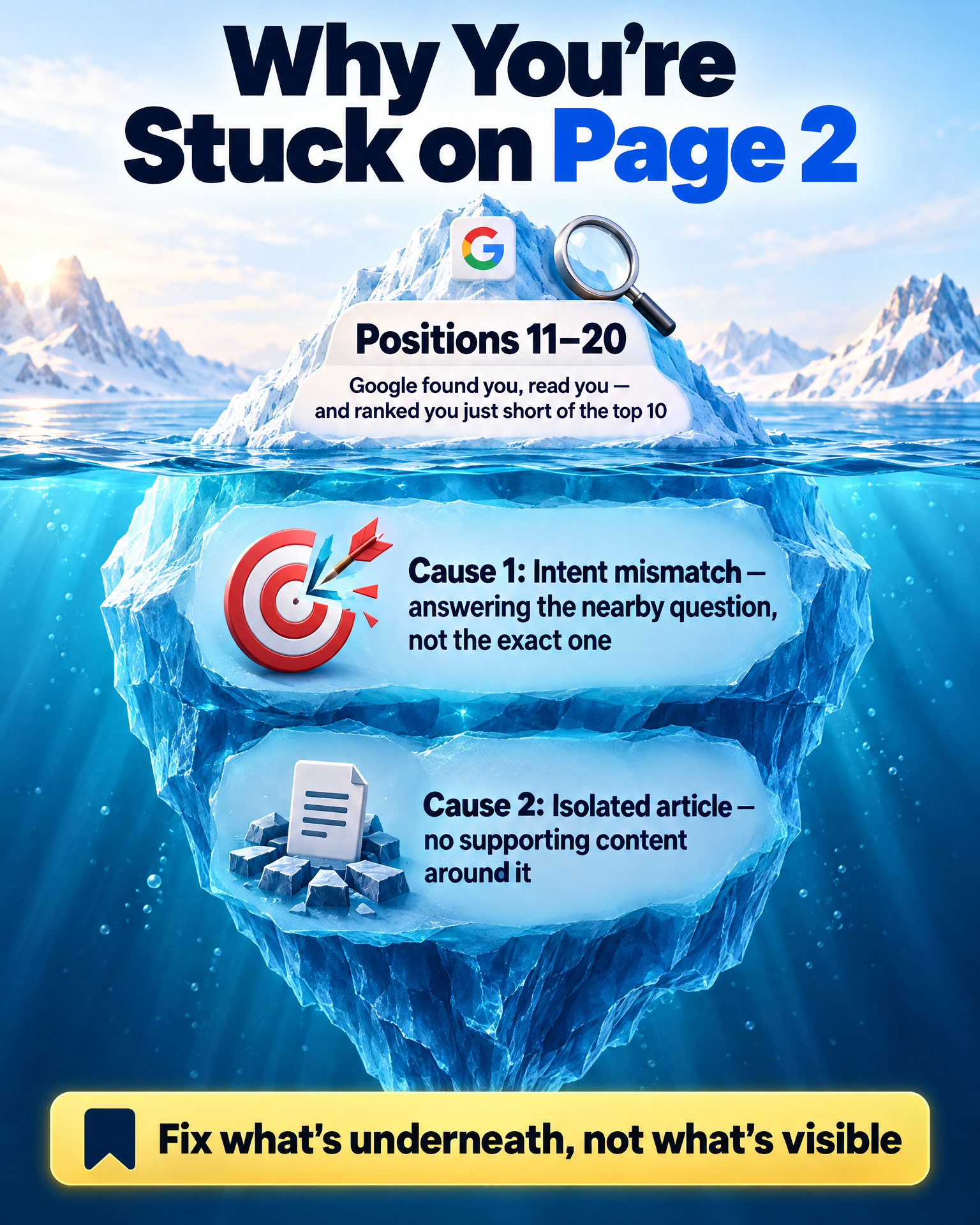
That’s a strange kind of sting, isn’t it — the feeling that you did the work, followed the advice, wrote something genuinely useful, and still landed a few inches short of where it counts. But here’s the part worth sitting with: it usually isn’t some deep, mysterious failure. Most of the time, it traces back to two specific things going missing. Neither one means tearing the article apart and starting from a blank page.
Positions 11 through 20 aren’t a rejection. They’re closer to feedback. Google’s telling you, in its own blunt way, that your content is a real, relevant answer to the question being asked — just not currently the most convincing one on offer. That’s a completely different diagnosis than not ranking at all, which almost always points to something technical or a genuine relevance mismatch. Page 2 is Google saying: you’re in the right room. Something else in the room is just making a stronger case than you are.
The Two Things That Are Usually Missing
Close — But Not Quite Answering the Right Question
Search intent alignment gets talked about so often that the phrase has started to lose its teeth. But it’s not some abstract SEO concept. It’s simply this: are you answering the exact question behind a specific search, in the shape and depth people expect when they type that exact phrase into the box?
Two articles can circle the same general subject and still be answering entirely different questions. Google has gotten unsettlingly good at spotting the difference, even when the gap feels small to a human reader.
A few mismatches that quietly keep a decent article parked on page 2:
- Answering the broader version of a question instead of the specific one. Someone searching “best X for beginners” isn’t looking for a general article about X with no beginner lens applied to it. Related, yes. The same thing? No.
- The wrong shape for the query. Some searches want a list they can scan in thirty seconds. Others want one deep, unhurried answer. Others want a straight side-by-side comparison. Nailing the topic while missing the expected format can hold a page back even when every sentence in it is genuinely well-crafted.
- Leaving out something almost every top-10 result includes. When nine out of ten top-ranking pages for a query all share something — a pricing table, a comparison chart, a specific subtopic — and yours doesn’t, that’s not a coincidence. That’s the market telling you what a complete answer looks like.
None of this is about writing quality in the way most people picture it — clean sentences, good grammar, a strong hook. It’s about precision. It’s about answering the actual question someone typed, not the nearby, comfortable, closely-related version of it.
An Article Standing Completely Alone
The second cause is less about the words on the page and more about what surrounds it — or doesn’t. An article sitting by itself, with nothing else on the site reinforcing the same subject, is structurally isolated in a way that quietly caps how far it can climb.
Google’s read on a single page was never purely isolated to begin with. The broader site’s demonstrated depth on a topic feeds directly into how much authority any one page on that topic gets credited with.
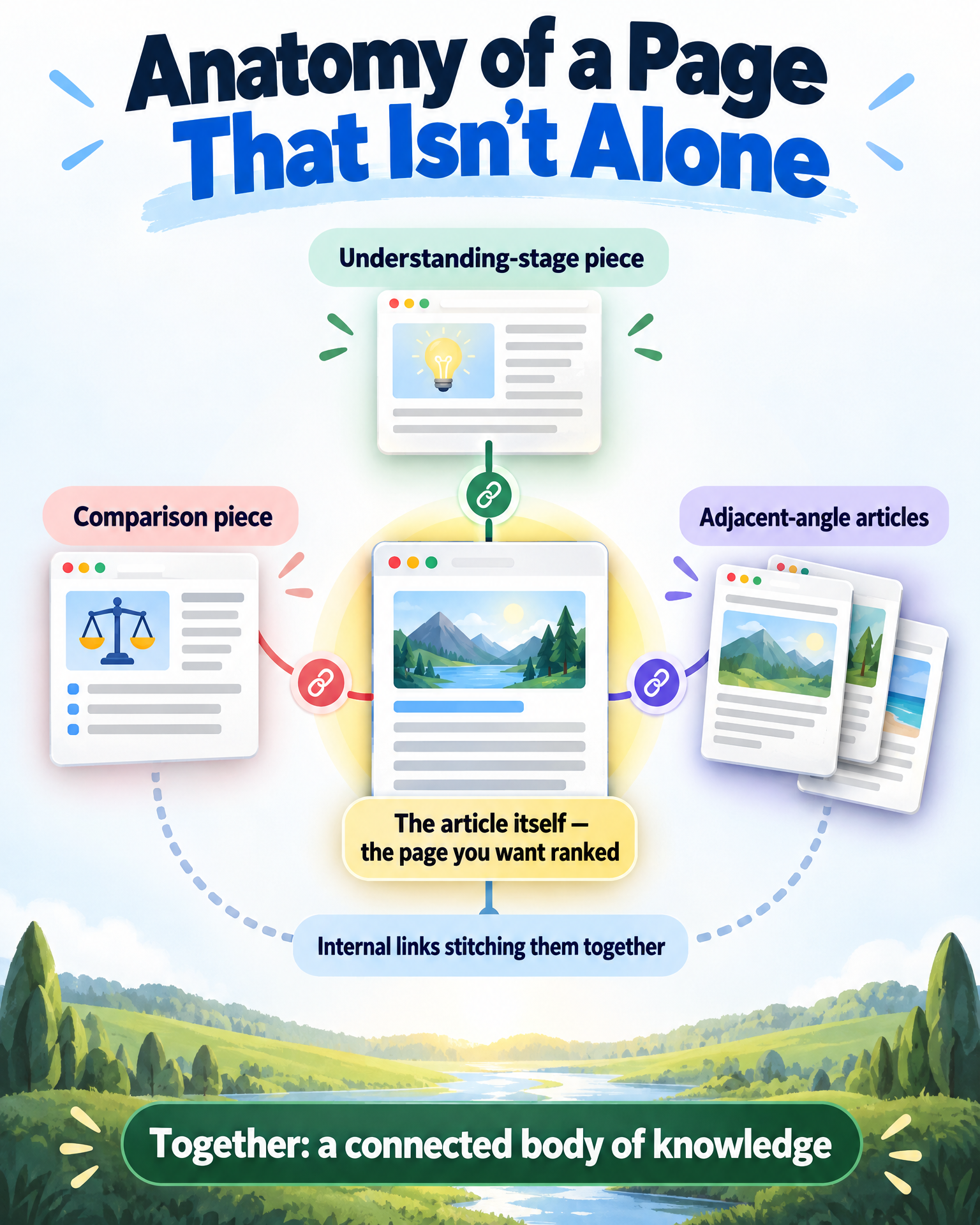
Picture an article about a specific product category, sitting on a site that has nothing else about that category, that buyer, or anything even adjacent to it. That page is essentially asking to be trusted as a complete, authoritative answer with almost no supporting evidence that the site actually knows the terrain. Now picture that same article backed by a related informational piece, a comparison article, and internal links stitching them together. That sends an entirely different signal — not just “here’s an answer,” but “here’s a site that has clearly thought this through, more than once, from more than one angle.”
Why a Lonely Article Struggles Even When the Writing Is Genuinely Good
This is exactly where rankings loop back into something structural. An article written in isolation — no cluster around it, no understanding-stage piece, no comparison content standing anywhere nearby — is handicapped in precisely the way that keeps content stuck at position 15, no matter how well it reads on its own.
Content built off a flat keyword list, rather than a connected structure, tends to produce pages that look reasonable in isolation but lack the surrounding depth search engines increasingly reward. Page 2 is often just the visible symptom. The real gap is invisible, sitting underneath the whole site.
Figuring Out Which One Is Actually Holding You Back
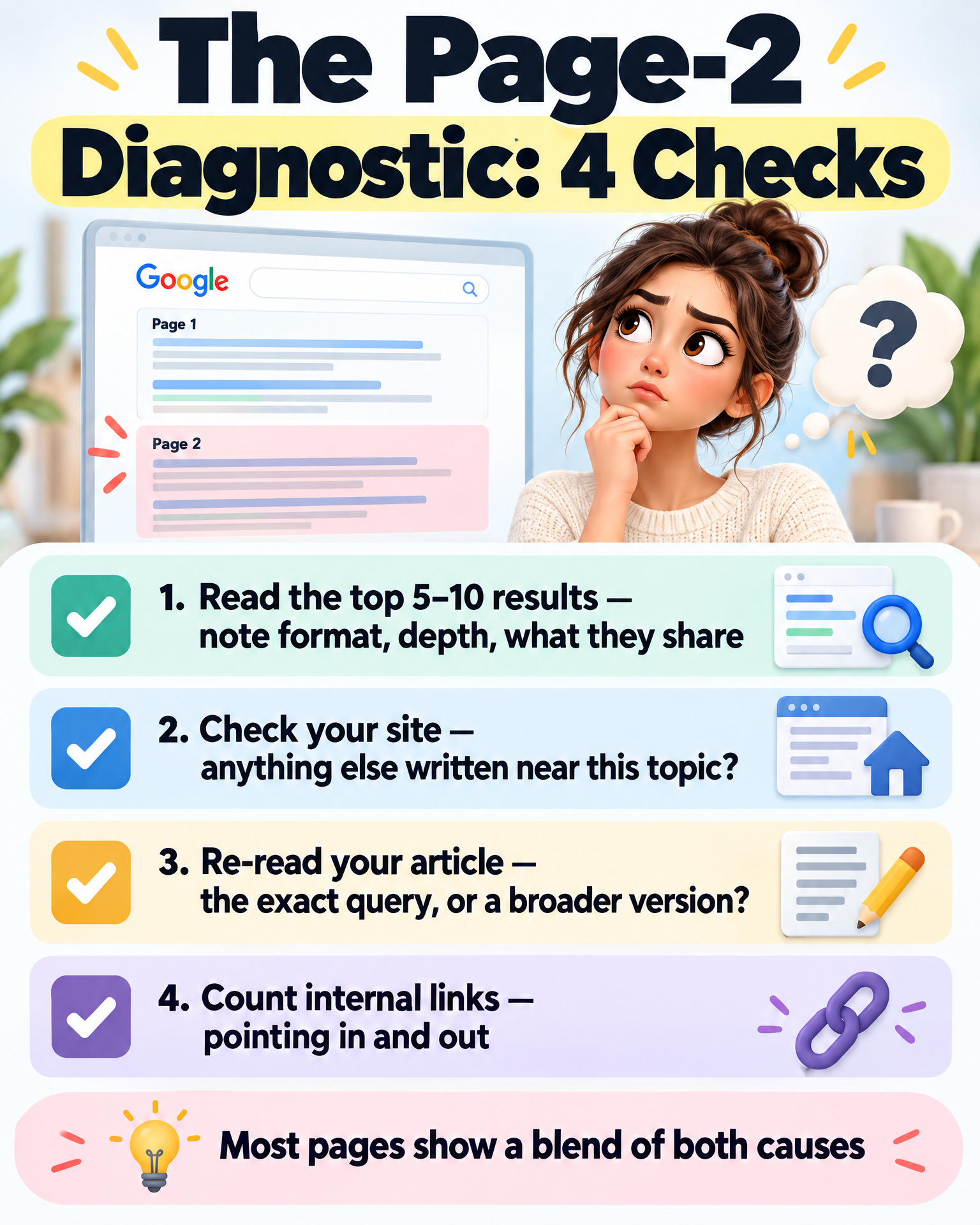
To work out whether intent misalignment, missing supporting content, or a mix of both is what’s keeping a specific article stuck:
- Actually read the current top 5 to 10 results for your target query — not skim, read. Note their format, their depth, and anything they share in common (tables, a specific subtopic, a particular structure) that your article is missing.
- Check whether your site has anything else nearby, subject-wise. If this article is the only thing you’ve ever written anywhere near this topic, that’s a strong sign the missing-support cause applies to you.
- Re-read your own article and be honest with yourself about whether it answers the exact query, or a slightly broader or narrower version of it. This is the step almost everyone skips, because it means admitting the piece might need real revision rather than a quick polish.
- Look at the internal links pointing in and out of the article. A page with barely any internal links, or none at all, struggles to prove real topical relevance no matter how strong the content itself is.
Most page-2 articles show some blend of both causes, rather than one in clean isolation. That’s exactly why fixing only one sometimes produces a smaller lift than you were hoping for — you patched half the problem and wondered why the whole thing didn’t move.
What Actually Fixing This Looks Like
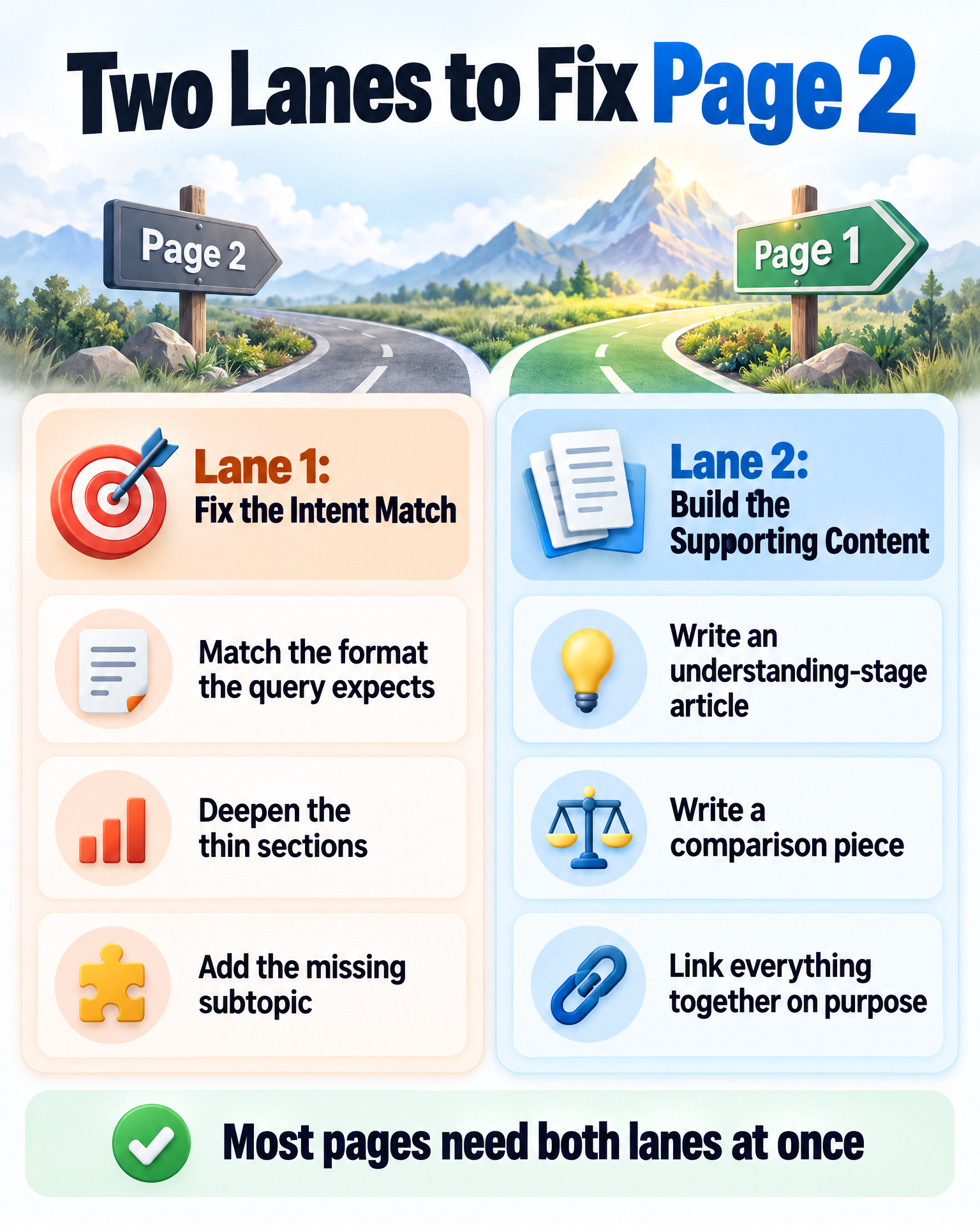
Once you’ve figured out which cause applies, the fix generally falls into one of two lanes.
For intent misalignment: revise the article to more precisely match what the top-ranking pages and the searcher’s actual expectations are telling you. That usually means adjusting format, deepening a thin section, or adding a subtopic you’re missing — not rewriting the whole piece from the ground up.
For missing supporting content: build the pieces that should already exist alongside it. An understanding-stage article. A comparison piece. Related content covering adjacent angles or symptoms. Then link them together on purpose, so the once-isolated article becomes part of something that actually reads as a connected body of knowledge.
Honestly, most of the time, both fixes are needed at once. Sharpen the intent match, and give the page real surrounding context. Either one alone rarely drags a page from position 15 to position 5 on its own — but together, they answer both halves of what page 2 was quietly telling you the whole time.
What People Are Really Asking When They’re Stuck at Position 15
Okay, but how long before I actually see this move?
There’s no clean number here, and anyone who gives you one is guessing. Meaningful shifts after a real revision or new supporting content typically take several weeks to surface, simply because Google needs time to re-crawl and re-evaluate both the page and everything now sitting around it. And when the traffic does arrive, remember it still has to convert — your affiliate blog getting traffic but no sales is its own separate problem worth ruling out.
Should I fix the intent problem first, or build the supporting content first?
If your site has almost nothing else related to this topic, start with supporting content — it tends to lift several related articles at once, not just the one currently stuck. If that supporting content already exists and the article is still underperforming, intent misalignment is probably the remaining piece.
Can a lonely article ever actually crack page one with nothing around it?
It’s possible, particularly for lower-competition searches, but the odds get thinner as competition climbs. For most commercially meaningful queries, some real supporting context around the article meaningfully improves your chances.
Is landing on page 2 always something I should be worried about?
Not necessarily — especially not for brand-new content. Sitting on page 2 shortly after publishing is a normal, almost expected part of Google working out where you belong. It becomes a more telling signal once a page has been live for months, hasn’t moved, and the content is genuinely solid despite that.
Products, Tools & Resources
- Google Search Console — the first place to confirm exactly where a page currently sits and which specific queries it’s actually competing for, rather than guessing.
- A direct, unhurried read of the current top 10 results — free, and often the fastest way to catch a format or subtopic mismatch that’s quietly holding a page back.
- Your site’s internal link report — shows you whether a page is genuinely orphaned or just thin on support from the content around it.
- Snowball Affiliate’s content structuring approach — for anyone who’d rather build supporting content around existing articles in a deliberate, structured way than diagnose and patch gaps one page at a time.