

The Flat Line in Search Console
You published. A week went by, and you checked Search Console the way you’d check a text message you’re waiting on — and the impressions graph is just flat. Not down. Not concerning in an obvious way. Just… nothing. A quiet, discouraging kind of nothing.
That’s a strange kind of frustrating, because unlike most problems in this line of work, this one doesn’t hand you an obvious cause to fix. Nothing crashed. Nothing got rejected. Your content is just sitting there, published and apparently invisible. If you’re picturing your niche choice, your writing, your entire strategy as the culprit right now — pause on that. There are two much more likely explanations, and neither one means you did anything wrong.
Almost no impressions means there’s no signal yet — and the worst move is assuming the content failed. The free Search Visibility Action Planner starts with the ‘Barely Visible’ lane: inspect the basics, confirm the page answers one clear problem, and know when the right call is to leave it alone. Get it below.
Table of Contents
First, Confirm You’re Actually Indexed
Before you diagnose anything more complicated, check the most basic fact there is: has Google actually indexed your content in the first place? Impressions physically cannot happen for a page Google hasn’t crawled and indexed yet — it doesn’t matter how good that page is if it isn’t in the index at all.
Open Search Console, pull up the Coverage or Pages report, and look at what’s indexed versus what’s been excluded. If you see “Discovered, not indexed” or “Crawled, not indexed” next to your pages, that’s actually reassuring news, in a strange way — it tells you this is a technical, preliminary issue, not a verdict on your writing or your niche.
New sites — especially ones without a submitted sitemap, or without any existing backlinks pointing to them yet — can genuinely take anywhere from days to several weeks just to get fully crawled and indexed. Impressions can’t start until that part’s finished.
Why New Sites Take Time, Even When the Content Is Genuinely Good
Even after indexing, most new sites go through a slower-than-expected start — something people often call a “sandbox” period, though it’s worth knowing Google has never actually confirmed a formal mechanism by that name. What’s closer to the truth: new domains simply haven’t built up the trust signals yet — track record, backlinks, engagement data, sheer domain age — that heavily shape how quickly and how visibly a site starts showing up in results.
It isn’t a penalty. Think of it more like the first few weeks at a new job. You’re qualified. You’re capable. But nobody’s handing you the highest-stakes project on day one, because there’s no track record yet to justify that kind of trust. Google’s evaluation of a brand-new site works a lot like that — cautious, gradual, earned over time rather than granted immediately.
Two Different Problems That Look Identical From the Outside
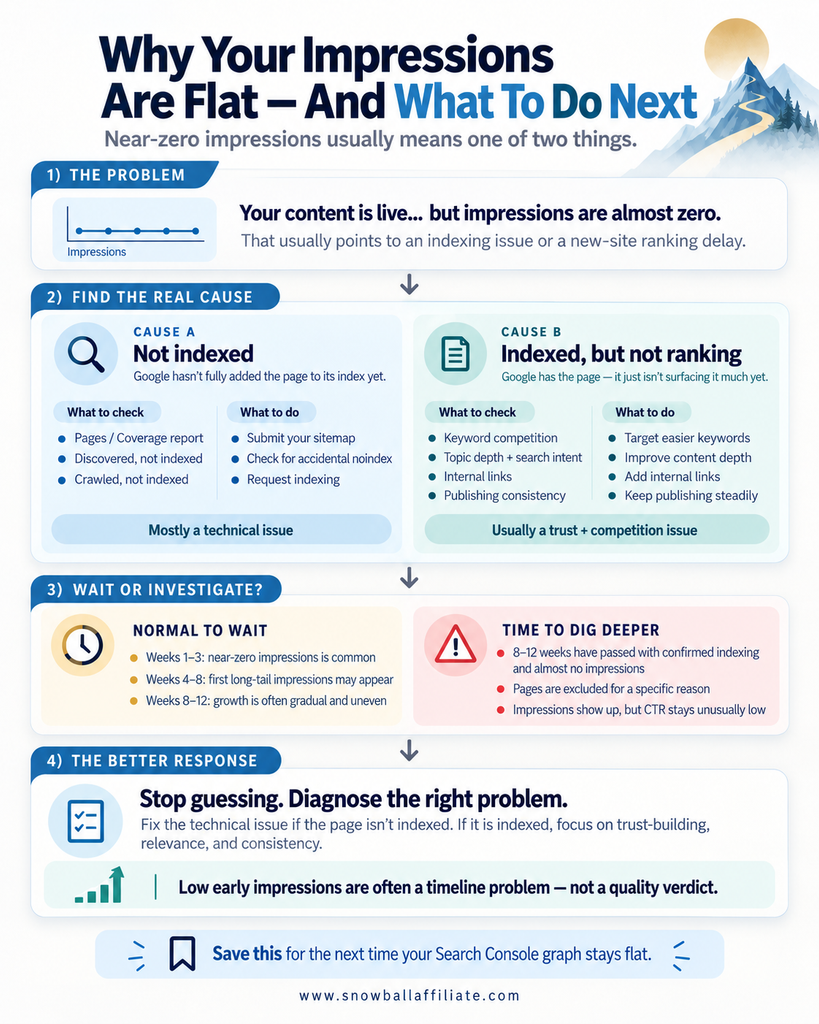
Here’s where people waste real time: treating two genuinely different problems as if they were the same thing.
Not indexed at all means your page simply isn’t in Google’s index yet. The fix here is mostly technical — confirm your sitemap actually got submitted, check there’s no accidental noindex tag sitting on the page, and if it’s been live for weeks with zero movement, request indexing directly through Search Console.
Indexed, but not ranking — or ranking so far down that impressions stay near zero — means Google already has the page, it’s just not surfacing it for relevant searches yet. This is far more often a trust-and-competition problem than a technical one, and honestly, it’s the far more common situation for a genuinely new site with reasonable, well-put-together content.
Figure out which of these two you’re actually dealing with before you spend a weekend chasing a technical fix for what’s really just a patience problem — or the other way around.
The Mistakes That Actually Do Slow This Down
Time is the biggest factor here, full stop. But a handful of real mistakes can stretch that wait out longer than it needs to be:
- Going after broad, heavily competitive keywords right out of the gate. A brand-new site trying to rank for a term that established, high-authority sites already dominate isn’t going to generate impressions quickly — no matter how well the page is written.
- Content that’s thinner than the topic actually deserves. Search intent matching is real. A page that doesn’t fully answer what someone was actually searching for is less likely to get surfaced, even once it’s sitting in the index.
- No internal links pointing to the page. Orphaned pages — the ones nothing else on your site links to — can be harder for Google to prioritize crawling and evaluating, especially on a new site that hasn’t earned much crawl budget yet.
- Publishing in bursts, then going quiet for weeks. A steady, active site sends a different signal than one that publishes five posts and then disappears. Long silences can genuinely slow the evaluation process down.
None of this means starting over. It means adjusting the inputs you actually control while the timeline underneath them keeps running.
What Normal Looks Like in the First 90 Days
There’s no single number that fits every niche or every site, but here’s a reasonable general shape for a new, decently structured affiliate blog:
- Weeks 1 through 3: Near-zero impressions is genuinely common while initial indexing finishes up. This part is normal, even when it feels like a bad sign.
- Weeks 4 through 8: Impressions typically start appearing, usually for the longer-tail, lower-competition searches first — not the big, obvious keywords yet.
- Weeks 8 through 12: Growth tends to be gradual and uneven. Some weeks tick up, some go flat, while Google keeps evaluating how consistent and relevant the site actually is over time.
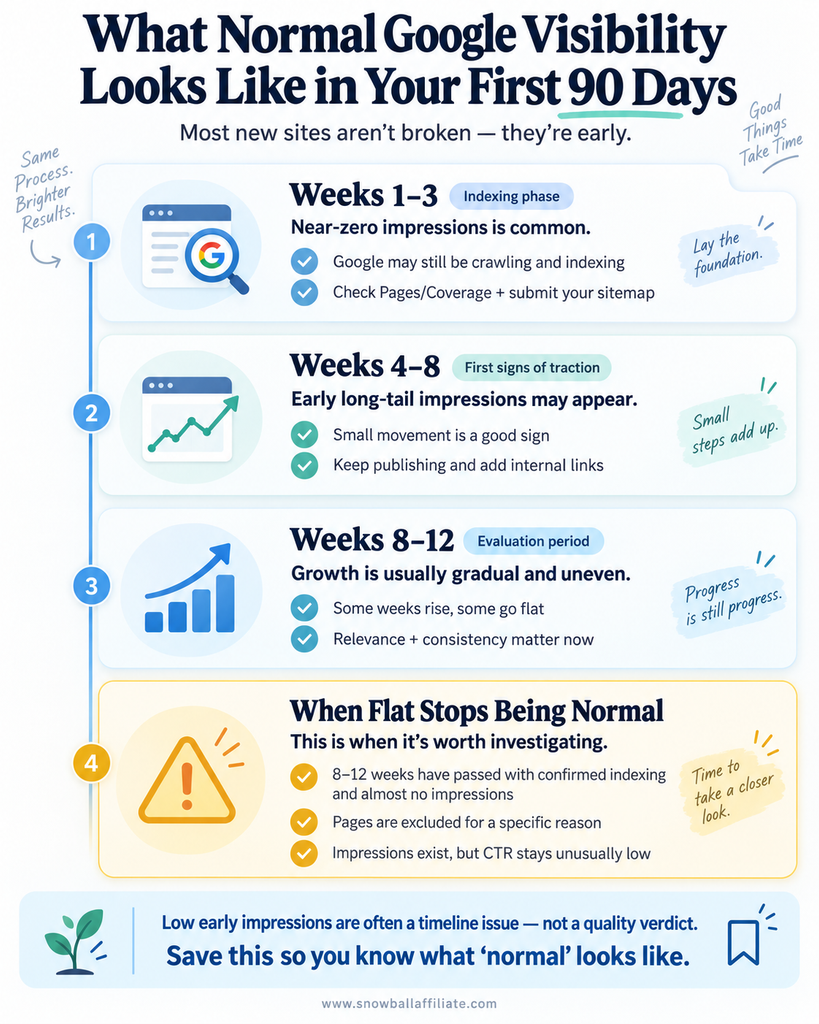
Treat this as a general expectation, not a promise. Niche competitiveness, content depth, and how consistently you publish will all push that timeline earlier or later.
When Flat Impressions Stop Being Normal
Time resolves most of this on its own. But a few specific patterns deserve real attention rather than more waiting:
- Zero impressions after 8 to 12 weeks, with indexing already confirmed. If Search Console shows your pages are indexed and impressions are still sitting at essentially nothing after two or three months, something beyond the normal timeline is likely going on — often a mismatch between what you’re writing and whether real search demand for it actually exists.
- Impressions showing up, but click-through rate staying oddly low over a long stretch. That can point to a gap between what your title and meta description promise and what people actually expected when they clicked.
- Pages indexed but consistently excluded for a specific reason Search Console names outright — duplicate content or canonicalization issues are common culprits here.
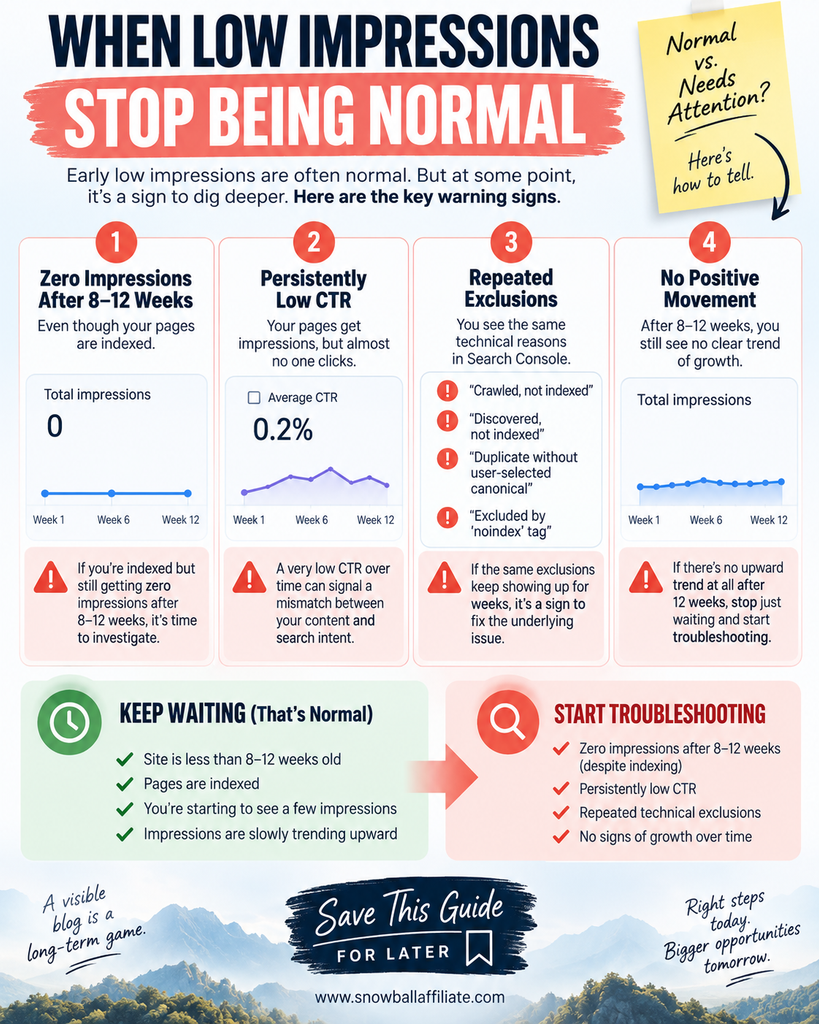
If any of that sounds familiar, you’ve likely moved past “normal new-site timeline” and into “something specific needs fixing.” Worth digging into directly instead of continuing to wait it out.
What to Actually Focus On While You Wait
Here’s the thing worth sitting with: low impressions in these early weeks are almost always a timeline issue, not a content issue. Which means the most productive thing you can do isn’t refreshing Search Console every morning like it’s going to change if you just check often enough. It’s making sure whatever you’re publishing during this waiting period is actually built to matter once it does start showing up — connected to a real reader journey, not just another standalone post hoping to rank on its own merits.
→ Continue to: [What Should You Write First on a New Affiliate Blog?]
What People Ask When the Graph Won’t Move
At what point should I actually start worrying instead of waiting?
Somewhere around 8 to 12 weeks of confirmed indexing with essentially zero impressions is a reasonable line. Before that, it’s usually still within the normal range. After that, it’s worth digging in rather than assuming it’ll fix itself.
Will publishing more content just speed this whole thing up?
It can help show Google you’re running an active, maintained site — but volume alone doesn’t override the underlying trust-building timeline. Consistent, genuinely well-structured content matters more than sheer quantity ever will.
Do backlinks fix this faster than anything else could?
They can help build trust signals faster, sure, but they’re one factor among several, not a guaranteed shortcut. And low-quality or spammy backlinks can create a whole new problem in place of the one you were trying to solve.
Is this basically the same thing people mean by the “Google sandbox”?
The pattern most people describe as the sandbox is generally pointing at this same new-site evaluation period — though Google’s never confirmed a distinct, formally named mechanism by that title. Thinking of it as a trust-building timeline, rather than a punitive box you’ve been thrown into, is both more accurate and considerably less discouraging.
Products, Tools & Resources Mentioned in This Article
Google Search Console — free, and genuinely the single most useful tool for figuring out what’s actually happening here instead of guessing from the outside.
An XML sitemap, submitted through Search Console — a basic technical step, but one that makes sure Google can actually find and crawl your new content efficiently.
A consistent publishing rhythm — not a tool exactly, but a real input that matters. Even a modest, steady pace tends to outperform sporadic bursts followed by long silent gaps.
Snowball Affiliate’s Iceberg Keywords module — for anyone who wants a structured way to find lower-competition, higher-opportunity search terms that actually match a new site’s current level of authority; covered in full in our review.
Our full Snowball Affiliate review — for more on how search-visibility strategy fits into a complete, sequenced approach to building a site: Snowball Affiliate Review: Is It Right for Building a Niche Affiliate Blog?