

Table of Contents
It Never Feels Broad While It’s Happening
Here’s the strange thing about a niche that’s grown too broad: it almost never feels like a mistake in the moment. It feels like flexibility. Freedom to write about whatever seems interesting this week, cover a few more search terms, avoid boxing yourself in too early. That instinct feels responsible, even smart. It’s usually the opposite of both.
Broadness is a quiet kind of problem, precisely because it never announces itself. Nothing crashes. No single article obviously fails on its own. The site just slowly loses its shared sense of direction — one reasonable-sounding topic decision at a time — and you only really see it once you step back and look at the whole site instead of any one post in isolation.
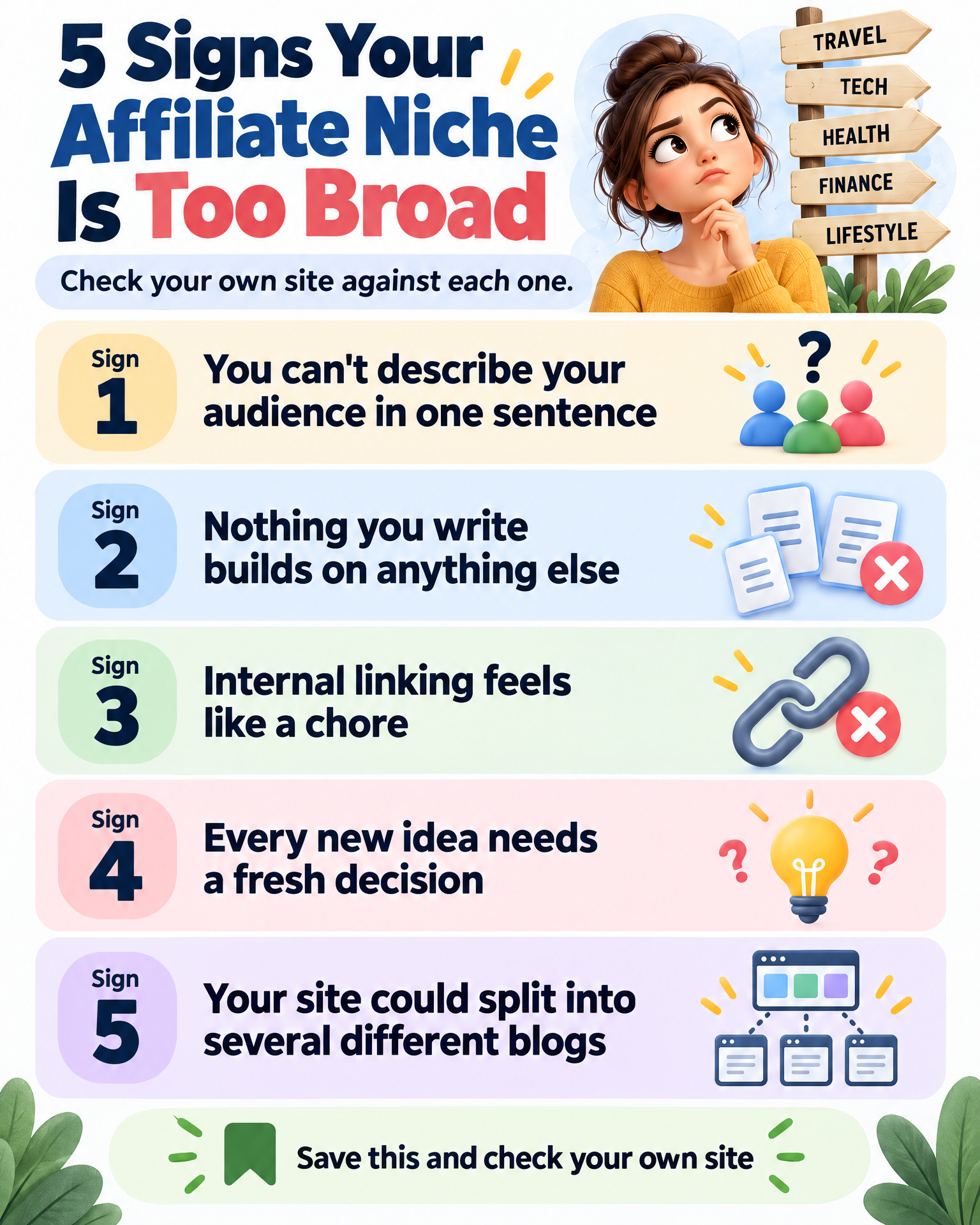
Sign One: You Can’t Describe Your Audience in a Single Sentence
Try this right now, out loud if you have to: describe who your site is actually for, in one specific sentence, without using the word “and” more than once. If that sentence keeps sprouting extra clauses — “it’s for people interested in X, and also kind of Y, and sometimes Z too” — that’s telling you something real. The niche has drifted wider than a single, coherent buyer can hold.
A niche that’s genuinely working produces an easy sentence, almost without effort: “this site is for someone recovering from a specific injury who needs to figure out what home recovery equipment actually works.” A niche that’s quietly grown too broad produces a paragraph instead of a sentence — because there isn’t really one person being served anymore. There are several, loosely tied together by a general topic and not much else.
Sign Two: Nothing You Write Builds on Anything Else
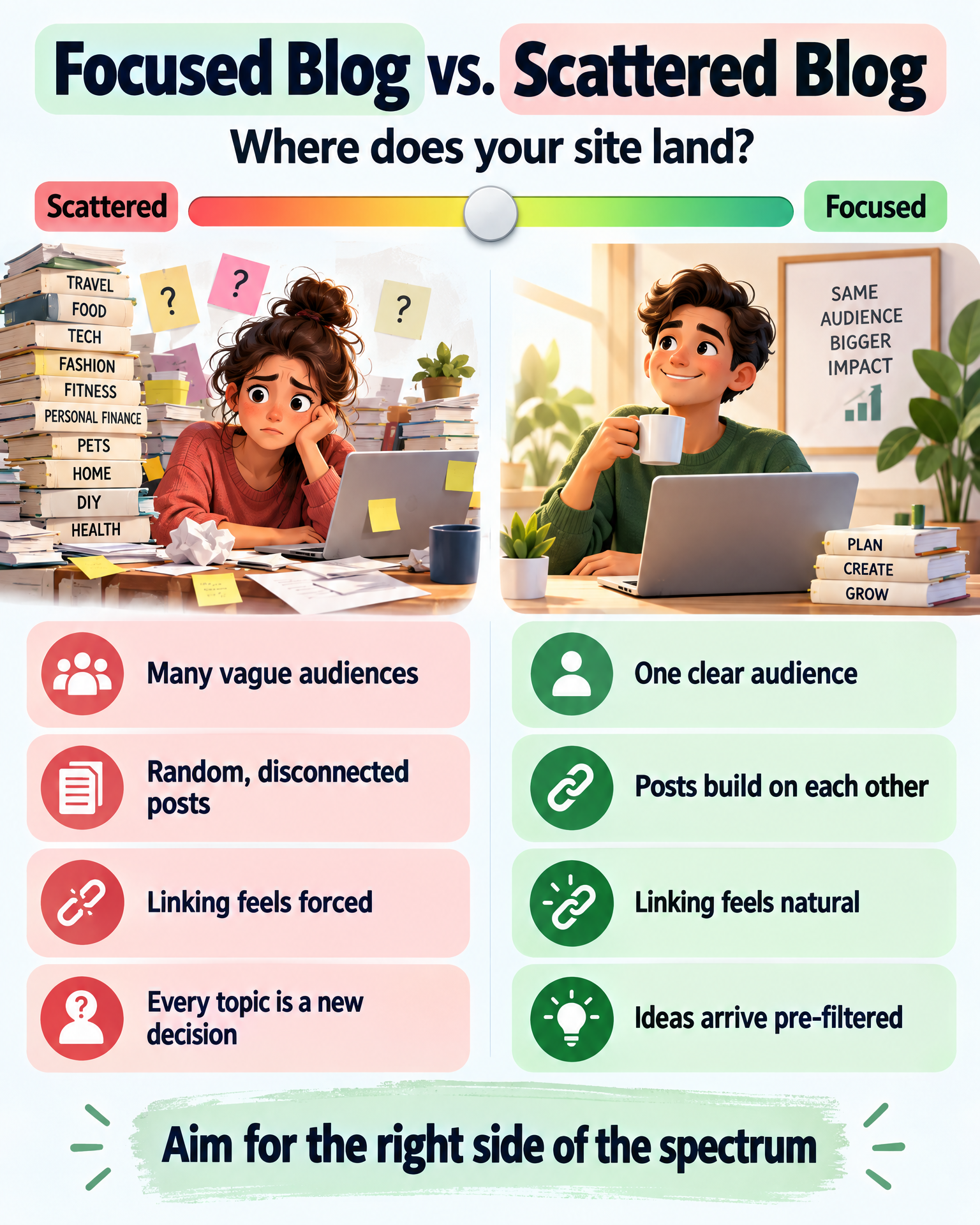
In a properly narrow niche, articles lean on each other. A symptom piece sets up an understanding piece. An understanding piece sets up a buying guide. Each one makes the next one easier to write, because they’re all quietly serving the exact same reader.
If your existing content feels more like a pile of separate, unrelated pieces than a connected sequence — if writing something new never makes an older post more relevant, and the reverse never happens either — that’s telling you the niche is too broad to generate its own internal logic. A working site should get easier to plan over time, as early articles compound into something bigger. If yours isn’t doing that, broadness is a likely reason why.
Sign Three: Internal Linking Starts Feeling Like a Chore
In a properly scoped niche, internal linking should feel obvious, almost lazy — this article naturally leads into that one, because they’re serving the same reader at two different points in the same problem. When a niche has grown too broad, linking turns into a small chore. You end up hunting for tenuous connections between articles that don’t actually share an audience, and the links you do add feel less like a genuine next step for a real person and more like an SEO checkbox you’re ticking off.
If you keep catching yourself linking two articles because “well, they’re both sort of related to the niche,” rather than because one clearly continues the other’s story, that’s a direct symptom of a niche that’s stretched too wide.
Sign Four: Every New Idea Requires a Fresh Decision
In a well-scoped niche, most new content ideas basically evaluate themselves — quickly, cleanly. Does this serve the specific buyer and pain point I already defined? Yes or no. Done. In a broad niche, every single idea needs its own standalone decision, because there’s no consistent filter running underneath it — nothing narrow enough to make the answer obvious without a debate.
This shows up as a specific, exhausting kind of decision fatigue, and it has nothing to do with how good a writer you are. If choosing your next topic consistently feels harder than actually writing the article once you’ve picked one, the niche itself is probably the source of that friction — not a lack of ideas, and definitely not a lack of discipline.
Sign Five: Your Site Could Split Into Several Different Blogs
Here’s a useful gut check: look at everything you’ve published and ask whether it could plausibly split into two or three entirely separate blogs, each with its own coherent audience. If the honest answer is yes — if a real chunk of your posts would sit comfortably on a different site serving a different buyer entirely — that’s a clear sign your current niche is functioning as several loosely related topics, not one focused market.
This is different from simple variety within a niche, worth saying clearly. A single, well-scoped niche can cover plenty of angles on one buyer’s journey without ever feeling like it belongs to more than one site. The test here is coherence, not how many topics you’ve covered.
Why This Happens Even to Careful, Thoughtful Bloggers
Niche broadening is rarely one bad decision made all at once. It’s a slow drift, and it happens for reasons that make complete sense in the moment — fear of limiting your own search volume, genuine excitement about something tangentially related, or just not having a clear filter in place from the start to catch the drift before it compounds.
That’s exactly why the fix below focuses on rebuilding a consistent filter, not on assigning blame. A niche that’s grown too broad is a solvable, structural problem. It’s not a personal failing, and it doesn’t mean you did anything wrong on purpose.
What Narrowing Actually Looks Like in Practice
Narrowing doesn’t have to mean deleting everything and starting from zero. In practice, it usually looks more like:
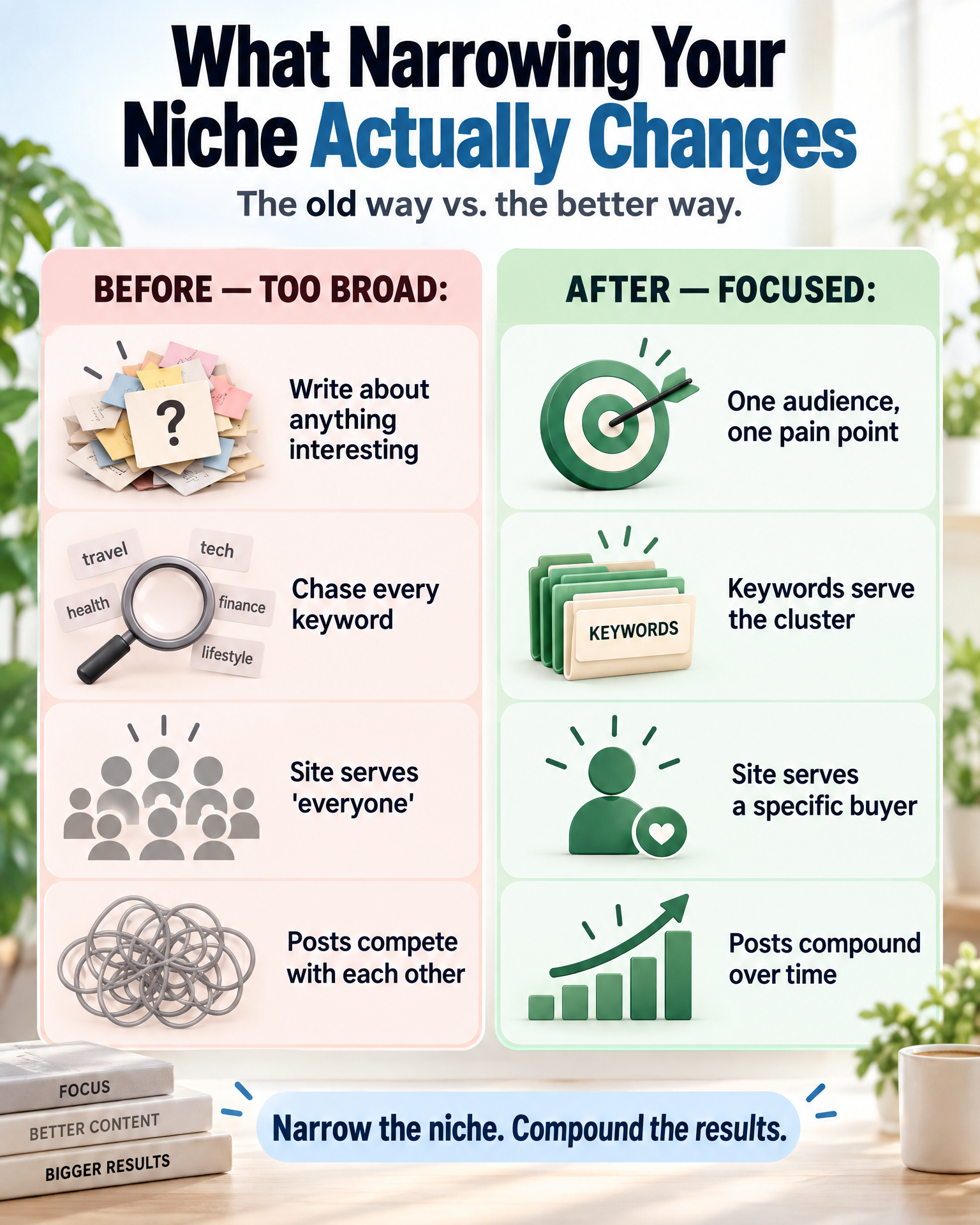
- Choosing one primary buyer and pain point as the site’s core focus going forward, even if your existing content already covers more ground than that.
- Auditing what you’ve already published against that primary buyer, and being honest about which pieces genuinely serve them versus which ones are just tangential.
- Prioritizing new content that reinforces the primary focus, instead of continuing to add more tangential topics because they seemed interesting at the time.
- Letting genuinely unrelated existing content just sit there quietly, rather than forcing artificial connections that don’t actually hold up under scrutiny.
The goal was never perfection. It’s giving your future content decisions a consistent filter to run through, so the site stops quietly accumulating the same kind of scattered, disconnected pages a too-broad niche naturally produces.
What People Ask Once They Recognize This
Does a broad niche mean I have to start completely over?
No. Narrowing is usually a redirection of what you write next, plus a light audit of what already exists — not a full restart. Most sites can genuinely narrow their focus going forward without throwing out everything they’ve already published.
How do I know if I’ve gone too narrow, in the other direction?
If you genuinely can’t find any existing buyer conversations, offers, or competing content anywhere in a proposed niche, that might mean too narrow rather than appropriately focused. A workable niche should feel specific, but there should still be some real evidence of it existing out in the world.
Can a niche still be too broad even if it’s getting some traffic?
Yes, absolutely. Traffic landing on individual pages doesn’t mean those pages are actually serving one coherent buyer or building toward a shared commercial outcome. A broad niche can generate scattered traffic across several small, disconnected audiences without ever producing anything that converts.
What’s the actual next step after realizing this is my problem?
Understanding why disconnected content specifically fails to build toward anything — and what a properly connected content structure looks like instead — is the natural place to go next, before you try to narrow or restructure anything on your own.
Products / Tools / Resources
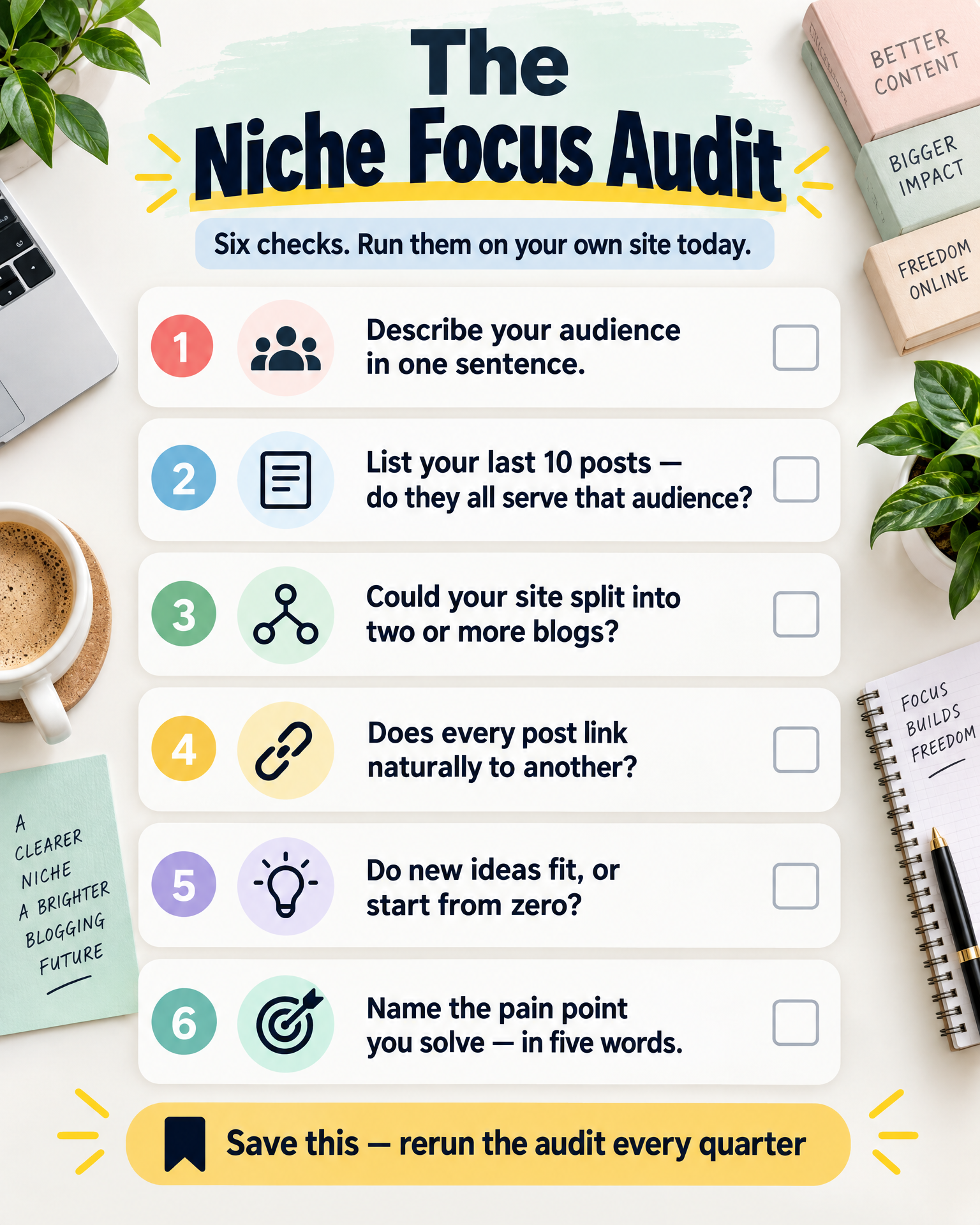
A simple audience-definition worksheet or notes doc — useful for drafting and stress-testing the one-sentence audience description this article uses as a diagnostic.
Your existing published content, reviewed as one full list — genuinely the most direct way to see whether your site could plausibly split into multiple separate blogs.
Snowball Affiliate’s Pain Point Probing module — for anyone who’d rather follow a structured method for defining a specific buyer and pain point than work it out entirely from scratch; covered in full in our review.
Our Full Snowball Affiliate Review — for more on how a clearly defined niche fits into a complete, sequenced approach to building a site: Snowball Affiliate Review: Is It Right for Building a Niche Affiliate Blog?