

What a Keyword Actually Tells You — and What It Never Will
There’s a particular kind of tired that comes from doing everything you were told to do. Picture the blogger who spent a weekend building the spreadsheet — forty keywords, a column for search volume, one for competition, a status column crawling from “to write” to “drafted” to “published.” Thirty articles later, that status column glows green almost all the way down. Traffic shows up, a few hundred visitors a month, the occasional affiliate click that feels less like a strategy working and more like a coin landing heads. And still, the site feels like a row of locked rooms. Someone wanders in, reads one thing, and leaves. Nobody clicks deeper. Nobody buys.
This blogger followed the advice almost everyone gives — find keywords, check volume, check competition, write the thing. None of that is wrong. It’s just half of something. A spreadsheet full of decent keywords feels like a plan, but a list isn’t a plan any more than a pile of ingredients is a meal. It’s an inventory, and an inventory can’t tell you the one thing a website actually needs to hold together: how its pieces relate to each other.
What’s missing isn’t a sharper keyword tool. It’s a layer almost nobody talks about: content architecture — the underlying structure that turns a stack of individual articles into a place a reader can actually walk through.
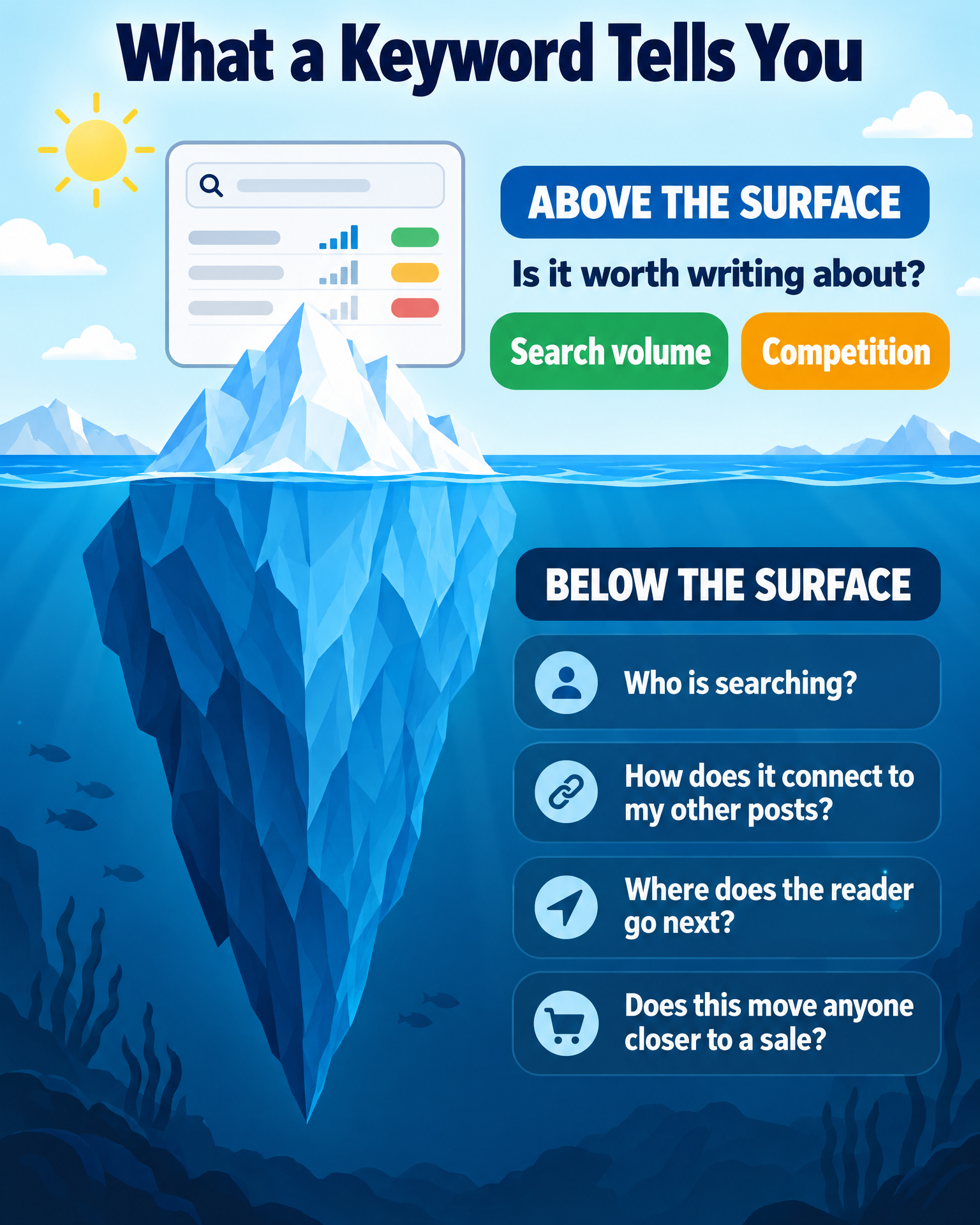
Give a keyword tool “coffee grinder” and it’ll hand you something real: people search “best coffee grinders under $100,” here’s roughly how many, here’s roughly how hard it’ll be to rank. Useful data. But there’s a whole category of questions no tool will ever answer — is this person just noticing their coffee tastes wrong, or two clicks from pulling out a credit card? Does this keyword connect to the one three rows down your spreadsheet? Once someone finishes this article, where do they go next? Does answering it move you any closer to a sale?
A keyword list answers exactly one question: is this worth writing about. It has nothing to say about the question that matters more — how does this fit with everything else I’m building. Only one of those questions ever shows up on a research spreadsheet, and that’s precisely how a site ends up stuffed with articles that are each individually “worth writing” and collectively add up to nothing.
Table of Contents
Why “High Volume, Low Competition” Isn’t Actually a Strategy
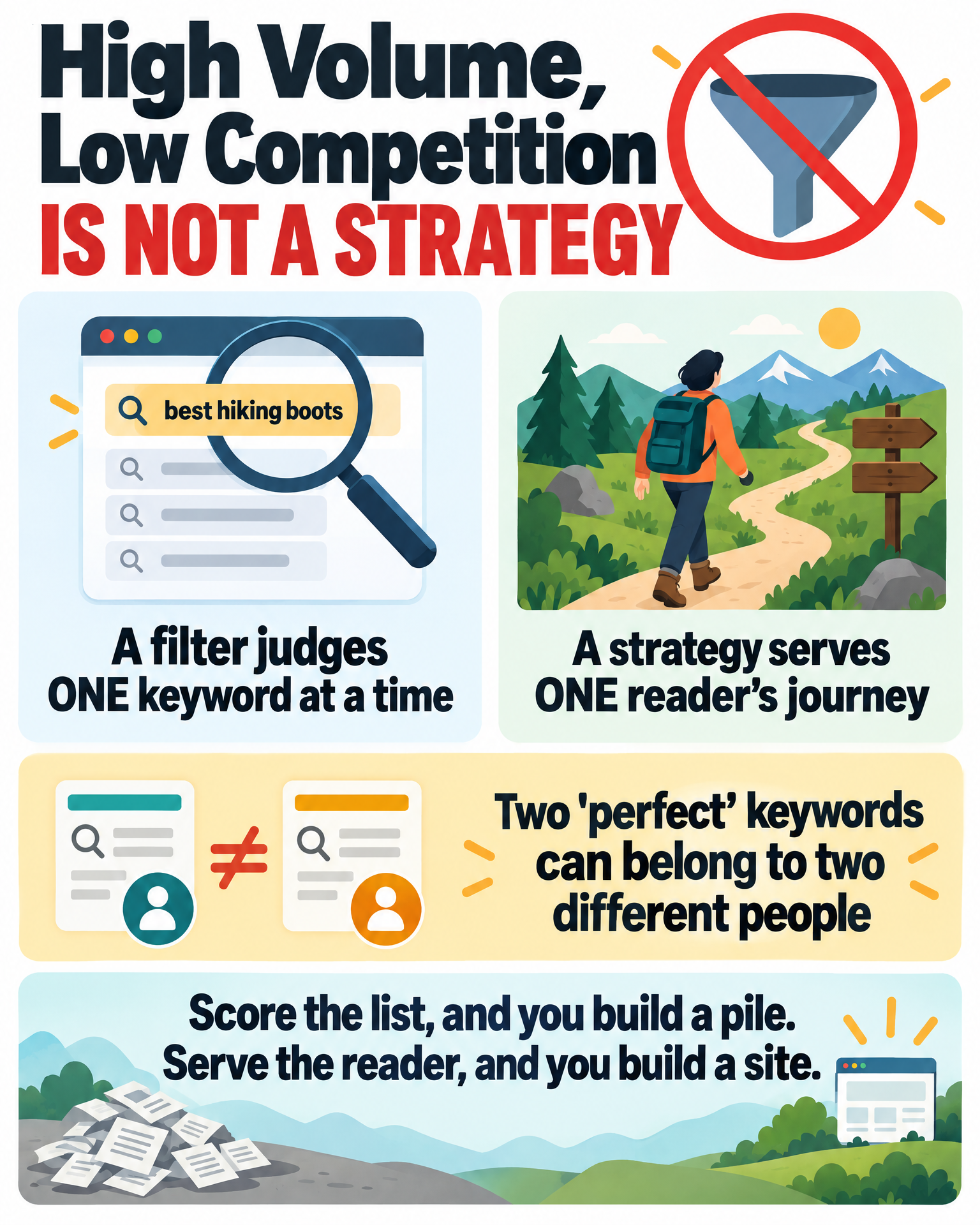
As a filter for one keyword at a time, “high volume, low competition” works fine. Treated as a whole strategy, it produces exactly the scattered pattern above. The uncomfortable truth underneath: two keywords can both look gorgeous on volume and competition and still belong to two entirely different people.
Back to the coffee blogger. “Why does my coffee taste bitter” scores well. So does “best coffee subscription boxes.” So does “how to clean an espresso machine.” Each could justify itself as a standalone article. But chase whichever keyword scores highest, week after week, and you’re optimizing for a number on a spreadsheet — not for a real person moving through a real decision. What comes out the other end looks fine on paper. Decent rankings, a trickle of traffic. And no visitor experiences it as something connected, something worth staying on for more than one page.
The Layer Nobody Talks About: Content Architecture
Content architecture lives one level above keyword research, not in place of it. It’s the deliberate grouping of related articles around one specific buyer and one specific journey, so that finding a keyword becomes the first step of a process instead of the entire process. The question shifts. Instead of “is this keyword worth targeting,” you ask: where does this keyword’s answer actually sit inside my reader’s journey — and what needs to sit on either side of it?
That shift changes what a solid content plan looks like. Instead of a flat, scattered list of promising keywords, you end up with a handful of connected clusters — each built around a distinct buyer and pain point, each carrying a defined path from first contact to decision. For our coffee blogger, that means noticing that “bitter coffee,” “french press vs pour over explained,” and “baratza encore review” all belong to the same reader walking the same path — while “best coffee subscription boxes” belongs to somebody else entirely, on a different errand.
What a Content Node Really Is
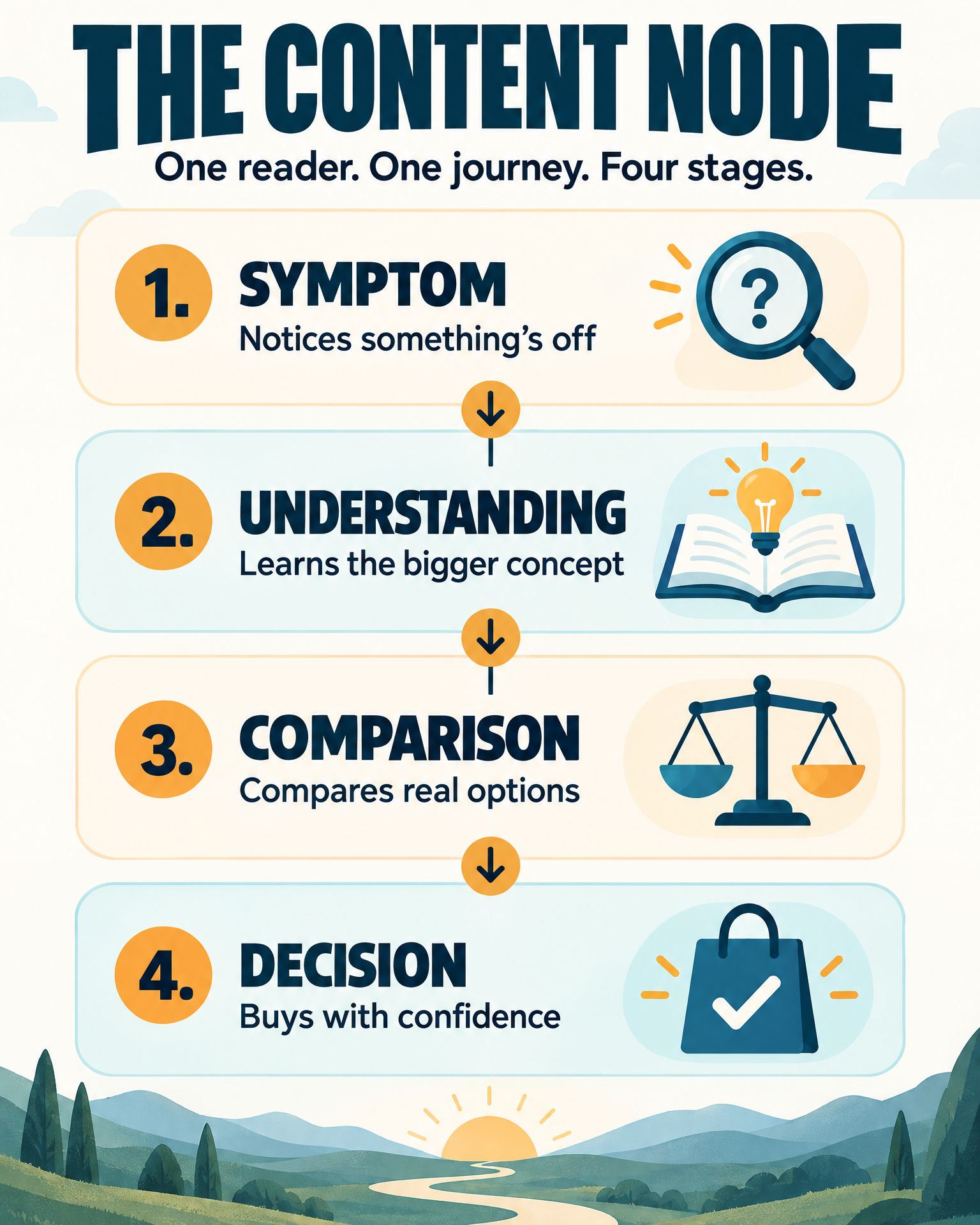
A Content Node is the actual, buildable unit of content architecture — a small, self-contained cluster that carries one kind of reader from a specific symptom, through real understanding, into an actual decision. Instead of dozens of articles that don’t know each other exist, a site organized around Content Nodes becomes a handful of these clusters, each serving one distinct reader situation. Most nodes move through four stages.
Symptom
Where the reader actually enters — the phrase someone types the moment they’ve noticed something’s off but before they’ve framed it as a purchase. In home-brewing, that’s “why does my coffee taste bitter” or “why is my pour-over taking forever.” Nobody typing that is ready to buy anything yet. They just want to know what’s wrong.
Understanding
Once the reader has a name for the problem, they need a bigger idea before comparing products makes sense. “French press vs pour over explained” lives here — still educational, but bridging the symptom to a broader concept the reader needs before shopping enters the picture.
Comparison
Now the reader has accepted they’ll need to buy something and wants to see the field. “Best coffee grinders under $100” is textbook comparison-stage — the decision to spend money has already happened; what’s left is deciding on what.
Decision
The commercial finish line. “Baratza Encore review” is decision-stage — the reader has narrowed the field and wants one last nudge before checkout. Every keyword inside a working node earns its place by where it sits in that sequence, not because a tool flagged promising numbers in isolation.
Turning a Keyword List Into an Actual Structure
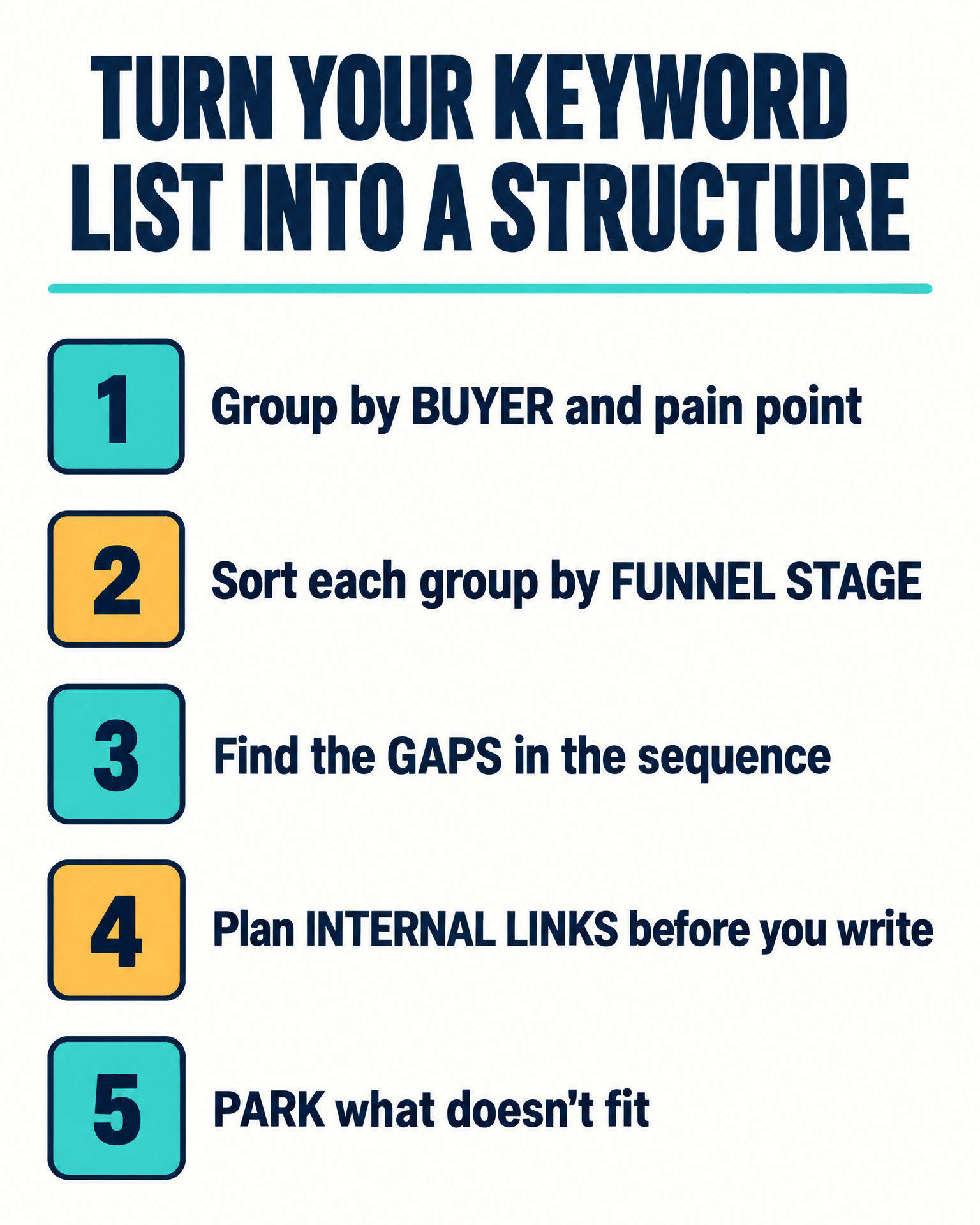
If you’ve already got a keyword list gathering dust in a spreadsheet, that’s not a wasted afternoon — it just needs a structure laid over it. Here’s a process you can run this week, on the list you already have.
Step 1: Group by buyer and pain point, not surface topic
For each keyword, ask: who’s searching this, and what are they actually dealing with right now? “Best coffee subscription boxes” and “best coffee grinders under $100” both mention coffee, but one is a convenience shopper and the other a hobbyist assembling a home setup. Different person, different node.
Step 2: Sort each group by funnel stage
Inside each group, label every keyword symptom, understanding, comparison, or decision — based on intent, not just surface wording. “Why does my coffee taste bitter” is symptom. “French press vs pour over explained” is understanding. “Best coffee grinders under $100” is comparison. “Baratza Encore review” is decision.
Step 3: Look for gaps in the sequence
A group stacked with symptom-level keywords and nothing at comparison or decision is an unfinished node — every visitor that traffic brings in has nowhere commercial to land. Fix that gap before writing another word.
Step 4: Decide your internal linking before you write anything
Sketch out exactly which article should point to which, so the symptom piece leads to the understanding piece, then the comparison piece, then the decision-stage review. Write that path down before a single draft starts.
Step 5: Set aside what doesn’t fit
Whatever’s left — keywords that refuse to slot cleanly into any node’s sequence — gets parked. Not deleted, just not a priority right now, no matter how attractive its numbers look in the spreadsheet.
Run even a modest list through these five steps and something interesting happens: most keyword lists contain a small handful of genuine Content Nodes, plus a leftover pile that isn’t worth chasing yet.
A Quick Before-and-After
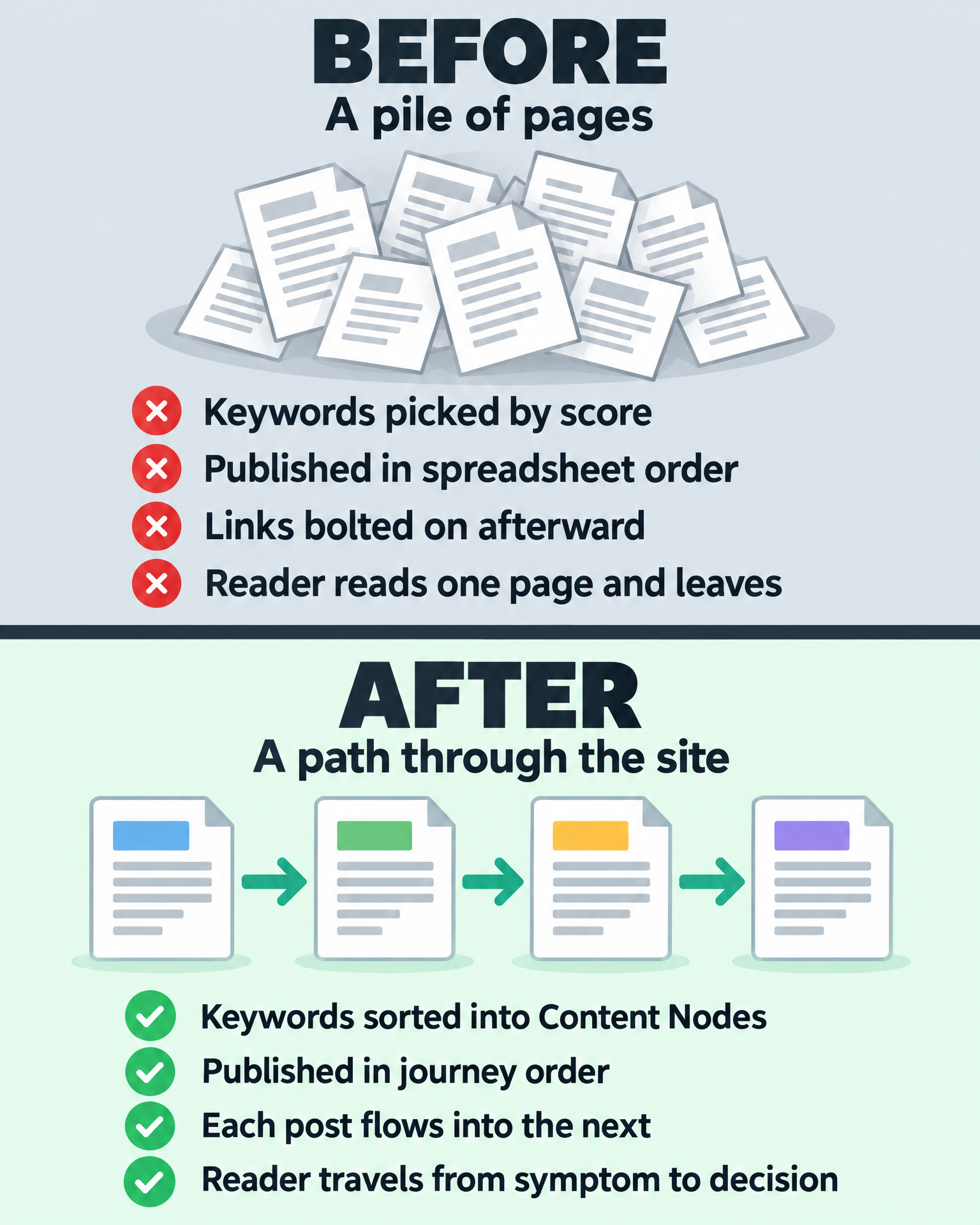
Before, the keyword-list way looks like this: ten coffee-related keywords, all scoring reasonably well, all loosely orbiting the same topic. Articles get written in whatever order the spreadsheet happens to be sorted by that week, with internal links, if any, bolted on afterward.
After, the architecture way looks completely different. Those same ten keywords sort into two distinct Content Nodes. Node one — bitter coffee — holds three articles: the symptom piece, the understanding piece, and a grinder buying guide, published in that order and linked deliberately, one flowing into the next. Node two mirrors that shape for a reader wrestling with slow pour-over flow instead. Whatever’s left, like a keyword about subscription boxes that fits neither sequence, gets set aside rather than published just because it was already on the list.
Nothing about the keyword research itself changed. What changed is the structure resting on top of it — and that structure is the entire difference between a pile of pages and a site with an actual path running through it.
Where This Leaves You
Once you start seeing your keyword list as a handful of half-finished Content Nodes instead of a flat inventory, the obvious next question is how to actually build or repair that structure. Sometimes that means going back through what you’ve published and mapping which node each post belongs to — and being honest about which nodes are missing their comparison or decision stage. Sometimes it means pausing on new symptom-stage articles until the nodes you’ve already started have somewhere commercial for that traffic to land. And sometimes it means looking at a structured system built to handle this planning for you, rather than piecing the framework together one article at a time — worth a look if you’re weighing a focused sequencing system like Snowball Affiliate Review against a broader content-business roadmap covered in Snowball Affiliate vs Project 24.
What People Ask Once They See the Gap
Do I need to throw out my existing keyword research and start over?
Not even close. Keyword research is still a necessary first filter for deciding what’s worth writing about. Content architecture doesn’t replace that step — it adds the layer of relationships between keywords that no research tool was designed to give you.
How many keywords does one real Content Node actually need?
There’s no magic count, but a workable starting node usually needs at least one keyword at each stage — symptom, understanding, comparison, decision — even if some stages eventually grow into two or three articles apiece.
What happens to the keywords that don’t fit anywhere?
Set them aside rather than rushing them into publication. A keyword with no clear place in a reader’s journey is far more likely to become an orphaned page than a real contributor to your site’s coherence — no matter how good its numbers look.
Can two articles share the same funnel stage inside one node?
Yes, easily. The symptom stage especially can hold several articles, each covering a different angle of the same pain point — bitterness, sourness, weak flavor — as long as they all eventually funnel into the same understanding and decision content further down the path.
Products / Tools / Resources
Your existing keyword research spreadsheet — nothing about it goes to waste; it’s just missing the structural layer on top, and the process above works directly with what you’ve already built.
A simple grouping or mapping document — whatever tool you’re comfortable in, useful for sorting keywords by buyer, pain point, and funnel stage before any get assigned to a node.
Snowball Affiliate’s content nodes approach — for anyone who’d rather follow a structured method for building this architecture than assemble one from scratch.
Snowball Affiliate Review — for a closer look at how content architecture fits into a full, sequenced approach to building a site from the ground up.
Snowball Affiliate vs Project 24 — for anyone weighing a focused sequencing system against a broader content-business roadmap for actually putting this structure into practice.