

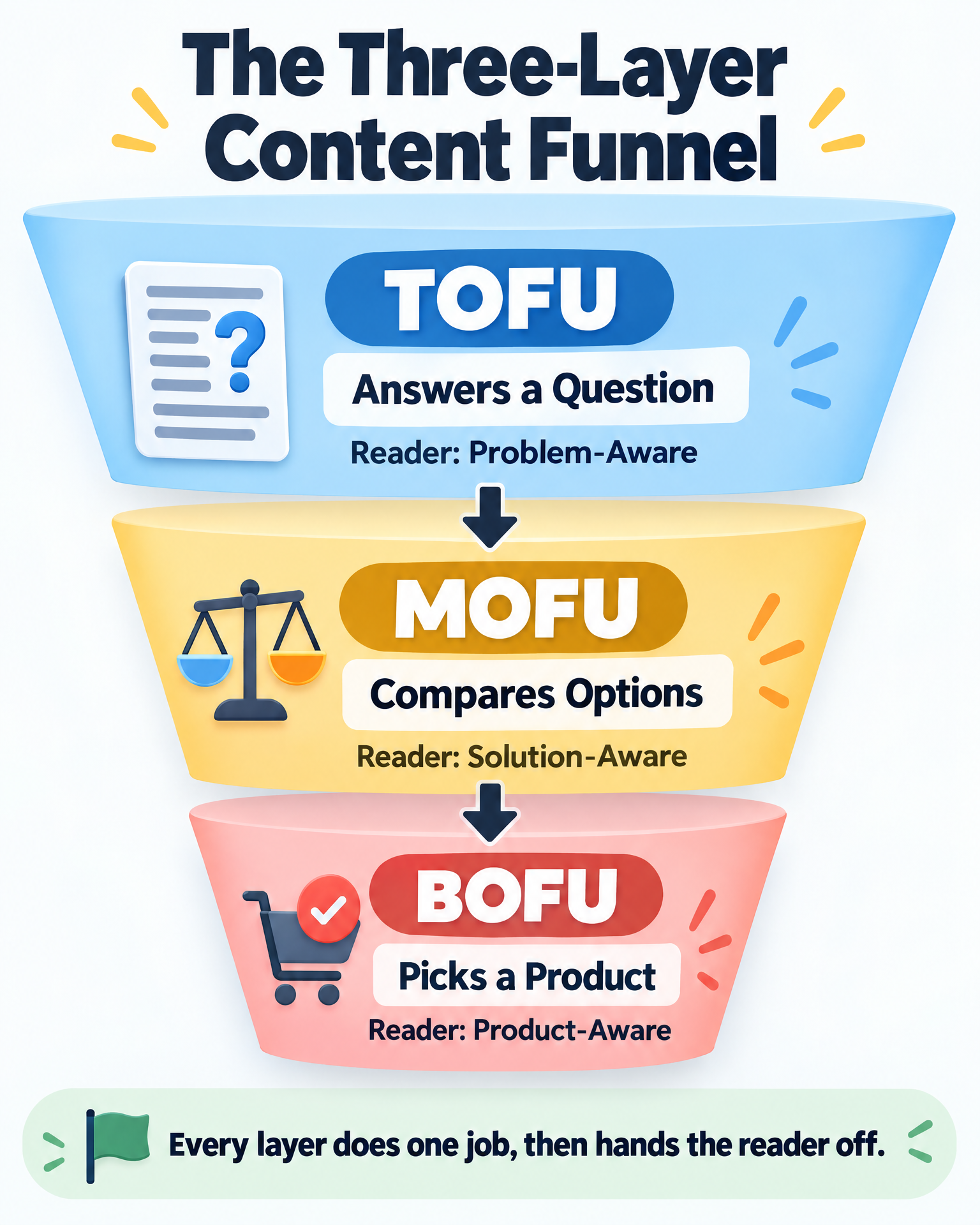
Every piece of content you publish is doing a job, whether you planned it that way or not. Top-of-funnel content answers a question. Middle-of-funnel content weighs options against each other. Bottom-of-funnel content helps someone finally pick a product and click “buy.” Simple enough on paper.
But these aren’t just marketing labels you stamp on a post after it’s written. They describe something more human than that — where a reader’s head is at the moment they land on your page. Someone typing “why does my coffee taste bitter” into Google is in a completely different mental state than someone typing “best burr grinder under $150.” One is confused and mildly frustrated. The other has already decided to spend money and just needs a nudge toward the right choice.
If your site treats every article the same way — write a blog post, bolt an affiliate link onto the bottom, hope for the best — you’re ignoring something readers already know intuitively: not everyone who visits your site is ready to buy. The funnel isn’t a trick you’re pulling on people. It’s just an honest map of how humans actually think before they hand over their credit card.
What TOFU, MOFU, and BOFU Really Mean for the Person Reading Your Site
The Confused Beginner: Where TOFU Content Earns Its Keep
TOFU content exists for the person who has a problem but hasn’t the faintest idea what’s causing it, let alone what fixes it. In home coffee brewing, that looks like “Why Does My Pour-Over Coffee Taste Sour” or “How Water Temperature Affects Coffee Extraction.” These aren’t glamorous topics. They won’t win any awards. But they matter enormously.
This reader isn’t shopping. They’re problem-aware, not solution-aware, and there’s a real difference. Your job here isn’t to sell — it’s to be useful enough that they trust you, and then gently point them toward the next question they didn’t even know they had yet.
TOFU is also, unsurprisingly, where the bulk of your organic traffic will land, simply because people ask far more questions than they make purchase decisions. That’s not a flaw in your strategy. That’s just how search behavior works. The only real mistake is letting all that curious traffic arrive, read, and leave with nowhere else to go.
The Comparison Shopper: What MOFU Content Is Actually For
Somewhere between confusion and purchase, a reader crosses a quiet threshold. They now understand the category of solution — they just haven’t picked a lane yet. They’ve moved from “why is my coffee bad” to “what’s the difference between a pour-over and a drip machine,” and that shift changes everything about what they need from you. This is the terrain of buying guides — “Pour-Over vs. Drip Coffee Maker: Which Fits Your Morning Routine,” or “Best Types of Coffee Grinders for Beginners.” Notice what MOFU content doesn’t do: it doesn’t push one specific product. It narrows the field instead, trimming down a wide-open question into something manageable.
Think of MOFU as a translator, standing between a vague question and a specific purchase decision, taking someone who’s solution-aware by the hand and walking them toward becoming product-aware. A head-to-head breakdown is MOFU in its purest form — for a live example, see Snowball Affiliate vs Wealthy Affiliate.
The Almost-Buyer: Where BOFU Content Closes the Loop
This is where your affiliate links finally do the heavy lifting they were built for. BOFU content means individual product reviews, “best of” roundups naming actual models, and head-to-head showdowns between two specific products the reader is genuinely torn between.
A BOFU piece in this niche might read something like “Baratza Encore Review: Is It Worth It for Home Espresso” or “Top 5 Burr Grinders for Pour-Over Coffee in 2025.” By the time someone reaches this page, they already know what category of product they want. They just need someone to help them pick the specific one — and reassure them they’re not wasting money.
BOFU content converts better than anything else on your site, but only under one condition: the reader has to arrive already educated. Drop cold, confused traffic straight onto a product review, and you’ve skipped every step of trust-building that made the sale possible in the first place.
Following One Reader From Confusion to Checkout
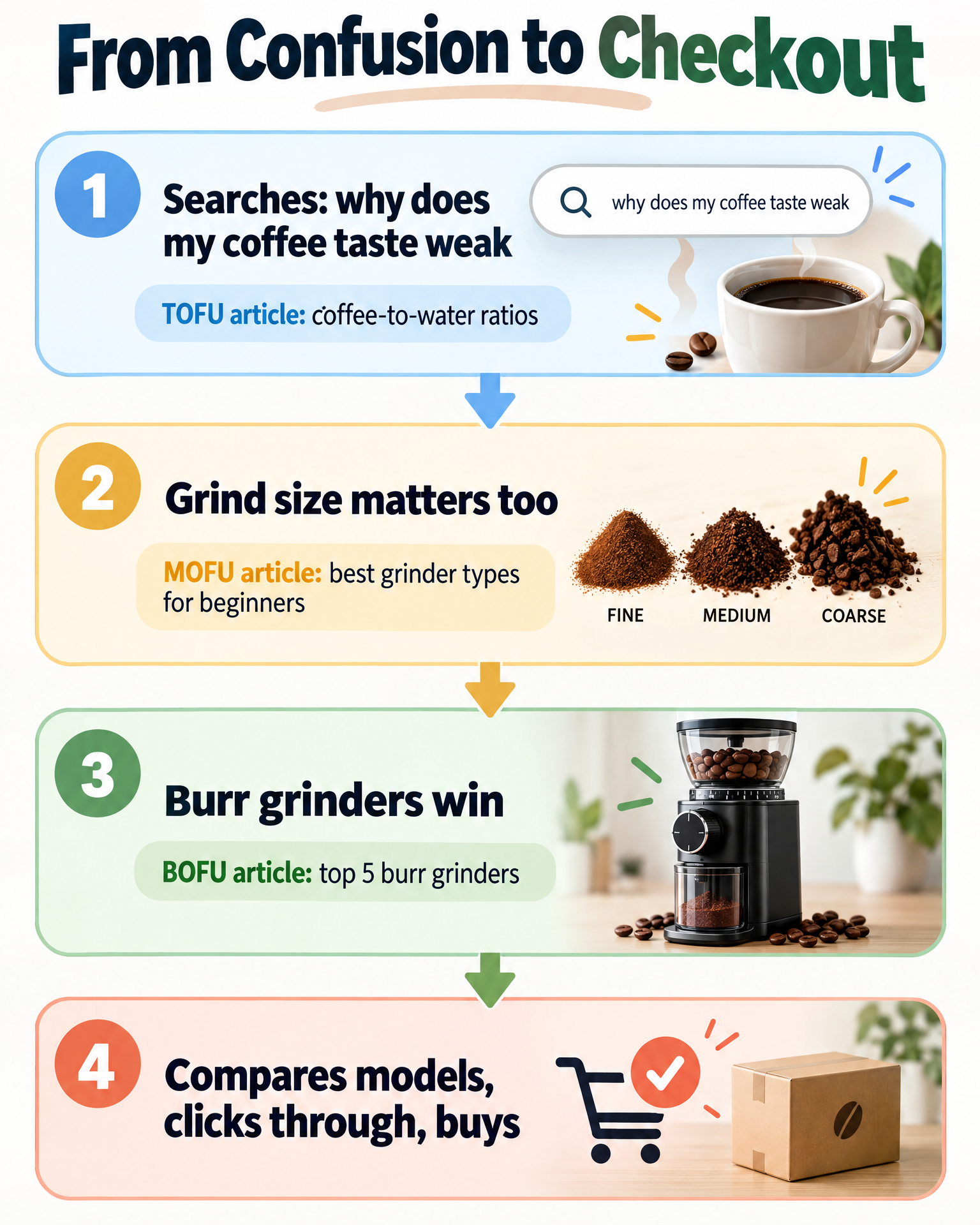
Let’s make this concrete. Picture someone who just bought a basic drip coffee maker, took one sip, and felt disappointed. Here’s what a well-built site does with that person:
- They search “why does my coffee taste weak” and land on a TOFU article breaking down coffee-to-water ratios.
- Somewhere in that article, a single sentence mentions that grind size matters too — with a link to a MOFU piece, “Best Types of Coffee Grinders for Beginners.”
- That MOFU article narrows things down, making the case for burr grinders as the smarter long-term buy, and links onward to a BOFU roundup: “Top 5 Burr Grinders for Pour-Over Coffee.”
- The reader compares three models side by side, weighs the pros and cons, and finally clicks through to buy the one that fits their budget.
Notice what didn’t happen — no single article tried to do everything at once. Each layer handled its own piece of the job, then handed the reader off like a relay baton. That handoff, quiet and almost invisible when it works, is the entire point of building a funnel instead of just piling up disconnected posts.
Three Ways This Structure Quietly Falls Apart
Most stalled affiliate sites fall into one of three traps. It’s worth checking your own site honestly against each one.
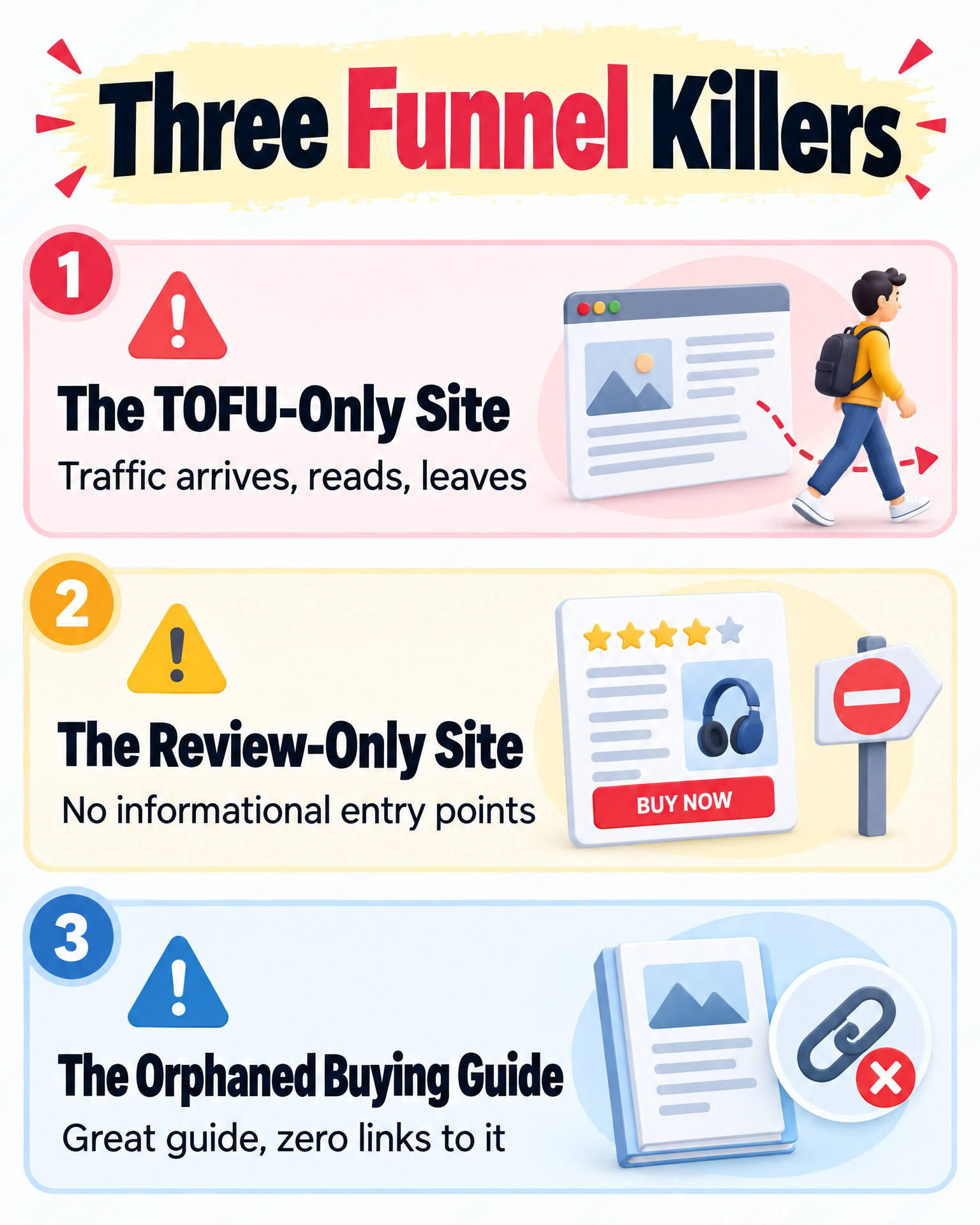
The TOFU-only site. Dozens of informational articles, a handful of affiliate links stuffed in awkwardly at the bottom, and no real MOFU or BOFU structure underneath. Traffic shows up, reads, leaves — and never comes back. If that sounds uncomfortably familiar, the deeper reasons behind it are covered in Why Your Affiliate Blog Gets Traffic but No Sales.
The review-only site. The opposite failure: page after page of product reviews and comparisons, but nothing informational drawing people in from search. These sites often survive on paid traffic alone, or barely survive at all, because commercial search queries are a tiny fraction of what people actually type into Google.
The orphaned buying guide. Sometimes you write a genuinely excellent MOFU article — and then nothing ever links to it. No TOFU post mentions it, no path leads a reader there naturally. It just sits on your site, unfound and unlinked, doing no bridging work at all. A guide with no traffic path is functionally invisible, no matter how well-crafted the writing is.
Internal Links: The Connective Tissue Nobody Notices Until It’s Missing
Internal links are what actually move a reader between these layers. Strip them away and you don’t have a funnel with three stages — you have three separate piles of content that happen to share a domain name and not much else.
A few rules keep this working in practice:
- Every TOFU article should link to at least one relevant MOFU piece, placed exactly where the topic naturally comes up — never crammed into a sentence where it doesn’t belong.
- Every MOFU article should link forward to the BOFU content that lets the reader act on the comparison they just finished reading.
- BOFU content can link back up to MOFU or TOFU pieces for readers who aren’t quite ready yet, though this matters far less than the downward flow toward a decision.
Sites that skip this step usually started somewhere they shouldn’t have — with a random list of keywords instead of an actual structure. That’s a common root cause, and it’s explained in more detail in Why Random Keyword Lists Create Disconnected Affiliate Sites.
One Question That Tells You Exactly Where an Article Belongs
Before you write a single word, ask yourself this: what does the reader already know, and what are they trying to figure out next?
If they’re asking “why” or “what is,” that’s TOFU territory. If they’re asking “which type” or “what’s the difference,” you’re in MOFU. If they’re asking “which specific one” or “is this thing actually good,” that’s BOFU, plain and simple.
This one question also protects you from a sneakier problem — scope creep. If you keep writing TOFU content in areas that have no matching MOFU or BOFU path anywhere on your site, you might be drifting outside your niche without noticing. It’s worth checking that against the warning signs laid out in Is Your Affiliate Niche Too Broad? Signs Your Site Has Lost Focus.
Matching Content to the Reader’s State of Mind
The three layers line up almost perfectly with three stages of awareness, and keeping this in your head makes planning far less guesswork and more architecture.
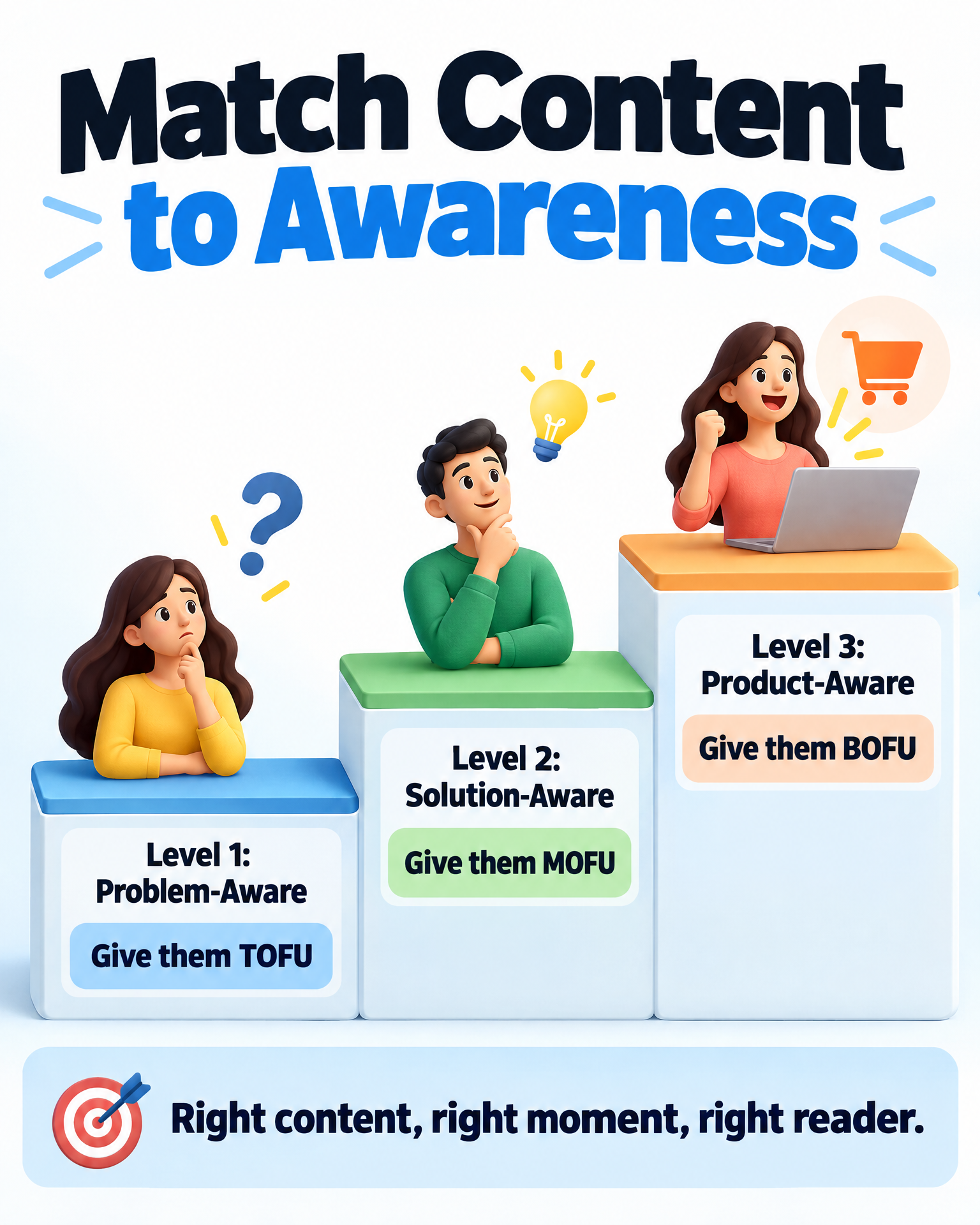
- Problem-aware readers land on TOFU content. They know something’s wrong, but not yet what to do about it.
- Solution-aware readers land on MOFU content. They know the category of fix but haven’t settled on a specific product.
- Product-aware readers land on BOFU content. They know roughly what they want and are weighing specific options against each other.
Every article you plan should have a clear, honest answer to “which awareness stage is this actually for” — and a clear link forward toward the next one. If you can’t answer that question before you hit publish, the article probably isn’t finished yet, even if the writing looks polished.
Products / Tools / Resources
If you’re building this kind of funnel for a home coffee brewing site, a handful of product categories tend to anchor the MOFU and BOFU layers naturally: burr grinders, pour-over drippers, gooseneck kettles, digital scales, and entry-level espresso machines. Keyword research tools are worth having on hand too, since they help surface the informational questions that feed your TOFU layer in the first place. Beyond that, don’t overthink the tracking side — a simple spreadsheet or basic content map is usually all you need to keep track of which MOFU and BOFU pages each TOFU post should be quietly pointing toward.