

You found a niche you can’t stop thinking about. Ideas keep coming — three in the shower this morning alone — and the audience already feels alive in your head, nodding along, clicking. You can practically see the traffic graph tilting upward before you’ve published a word.
But here’s the question almost nobody asks first: will this niche actually pay you?
Passion gets you excited. Traffic potential gets you hopeful. Neither gets you paid. What decides whether your site becomes a real business — or a well-written hobby — is quieter and less romantic: commercial depth. Is there enough genuinely sellable stuff here? Do real affiliate programs stand behind it? Will any of that still be true a year from now, or does it evaporate once the seasonal spike passes?
What follows is a structured, repeatable way to test that — before you sink another hour into content for a niche that was never built to convert.
Table of Contents
Why Niche Passion Means Nothing Without Products to Sell
Passion tells you what to write about. It says nothing about what you’ll get paid for. Conflating those two questions is probably the most common mistake in niche selection.
Plenty of topics generate real enthusiasm — genuine search volume, an engaged little community, lively comment sections — and still collapse as affiliate businesses because there’s nothing substantial behind the content to sell. General life philosophy. Casual hobbyist chatter. Ultra-specific interests that draw a devoted but tiny crowd who aren’t really buying anything. People show up, read, leave. Nobody clicks through to purchase, because there isn’t much of a “through” to click.
Affiliate marketing is a commercial layer sitting on top of content. The content earns trust and pulls in traffic; the products convert that trust into actual dollars. Strip the product layer away — or leave it thin and unstable — and no amount of keyword optimization saves you. You can rank page one for everything relevant and still make almost nothing, because ranking was never the bottleneck. The absence of anything worth selling was.
This is why niche selection needs a commercial audit alongside the topical one. Before committing real months to a niche, it helps to know whether it has:
- Products spread across different price points and use cases
- Brands that visibly support affiliates
- Search demand that smells like buying intent, not just curiosity
- A product ecosystem with room to grow instead of stalling after ten articles
Skip this and you risk building a site around a topic that was never structurally capable of supporting affiliate income, no matter how good the writing is. It’s a version of the trap explored in Should You Choose a Niche or an Affiliate Offer First? — falling for a topic before checking whether the offers behind it even exist.
The reassuring part: commercial depth is testable. You don’t need a gut feeling — you need a checklist. That’s next.

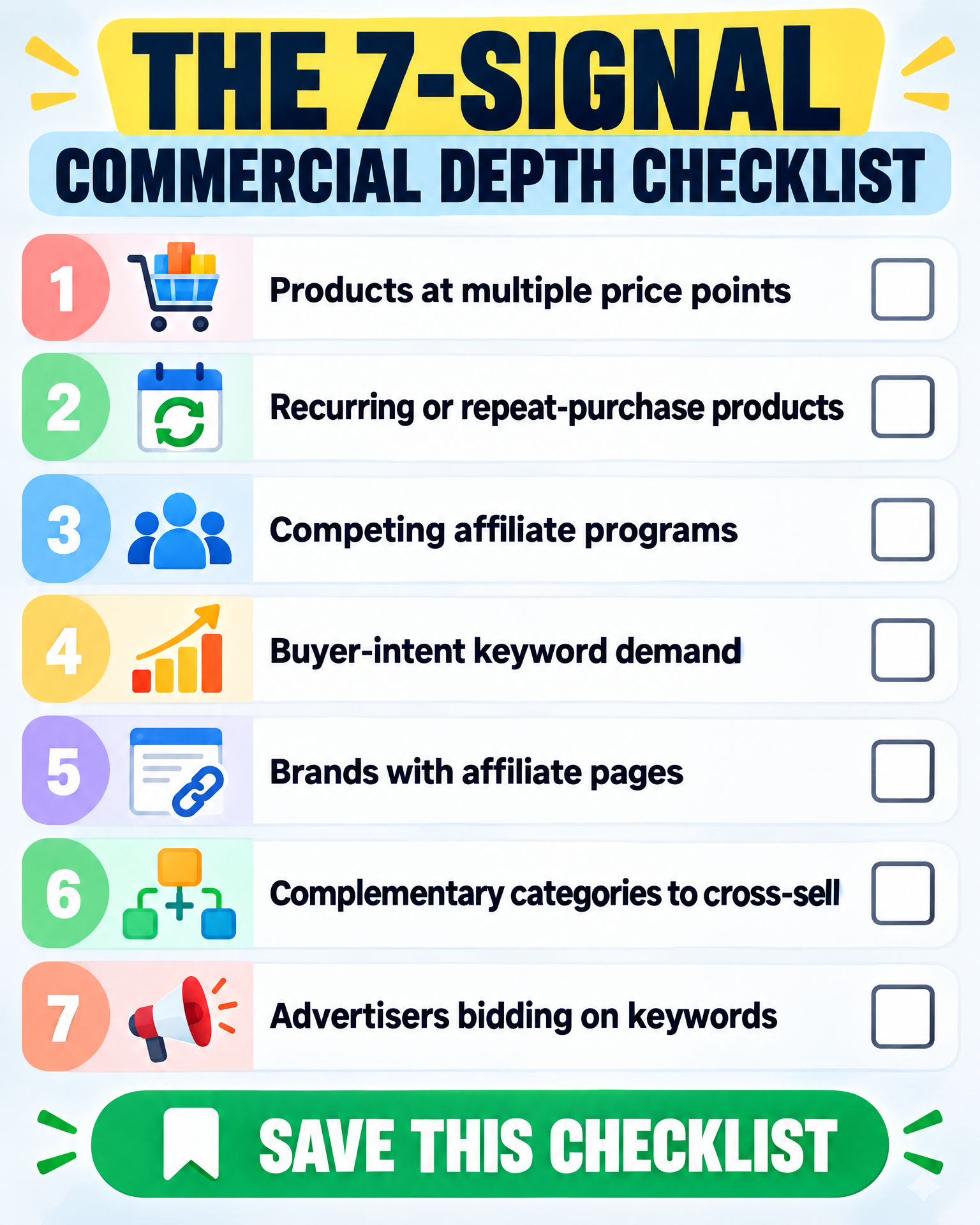
The Commercial Depth Test: 7 Signals a Niche Can Pay You
Run your candidate niche through these seven signals. The more it checks, the more monetizable infrastructure sits underneath it. Failing most of these doesn’t make a niche worthless as a topic — it just might not be worth building an affiliate business around.
1. Multiple Products Across Price Points
Healthy niches offer a ladder — something cheap for budget shoppers, mid-tier for mainstream buyers, premium for those who’ll pay for the best.
Why it matters: readers land at wildly different stages of readiness and comfort with money. A niche stuck at one price tier limits how many honest articles you can write before recycling the same three products under new headlines.
Quick check: search “[niche] budget,” “[niche] premium,” and “[niche] best” separately. If each returns genuinely distinct real products, you’re in decent shape.
2. Recurring or Repeat-Purchase Products
A one-time purchase has a ceiling. Niches built around consumables, subscriptions, refills, or seasonal repurchases give more content angles (“how often should you replace this”) and revenue that isn’t chained entirely to new-visitor acquisition.
Single-purchase niches can still work — but between two otherwise similar ideas, the recurring-purchase niche usually has the structural edge.
3. Competing Affiliate Programs for the Same Products
Search for a specific product in your niche. If several retailers, brands, or platforms all run affiliate programs around similar products, that signals a mature category with enough proven demand to support multiple sellers.
A niche where one obscure company sells the thing, and nobody else touches it, should make you uneasy — you don’t want your monetization plan resting on a single vendor’s mood.
4. Buyer-Intent Keywords With Real Search Demand
This is where keyword research stops being about volume and starts being about behavior. You’re asking whether people search like they’re about to spend money.
Look for patterns like:
- “best [product] for [use case]”
- “[product A] vs [product B]”
- “[product] review”
- “where to buy [product]”
- “[product] alternatives”
If your keyword list skews toward “what is,” “how does,” “history of” — with barely a comparison or review query — you might have a curious audience with no wallet in hand. This is part of why grabbing keywords without a commercial filter causes quiet failures, a pattern broken down in Why Random Keyword Lists Create Disconnected Affiliate Sites — topics chosen for volume, never checked for buyers.
5. Brands With Dedicated Affiliate or Partner Pages
Search “[brand] affiliate program” or “[brand] partners” for the major names in your space. If multiple real brands maintain active, updated affiliate pages, the category is established enough that companies have built formal infrastructure to support people like you.
Its absence isn’t fatal — some brands lean entirely on third-party networks — but seeing it is a strong green light, and seeing it nowhere across an entire niche deserves a second look.
6. Complementary Product Categories for Cross-Selling
Strong niches rarely live alone. They touch adjacent categories — accessories, upgrades, maintenance tools, bundles — and that adjacency keeps your content plan from running dry.
A niche with zero natural neighbors boxes you in early. It’s the mirror image of the issue raised in Is Your Affiliate Niche Too Broad? — except here the problem isn’t too much room, it’s none at all.
7. Advertisers Actively Bidding on the Niche’s Keywords
Search your core buyer-intent terms and glance at the paid ads above the organic results. If real advertisers consistently pay to show up there, someone with a real budget and conversion data has already decided that traffic turns into customers. Nobody keeps burning ad spend on keywords that don’t pay them back.
Thin or missing paid competition on your core terms is worth sitting with — it might mean the commercial pipeline is shallower than the search volume suggests.
Once you know which categories have real commercial depth, see How to Organize Blog Categories Without Overlapping Topics to structure them without cannibalizing your own keywords.
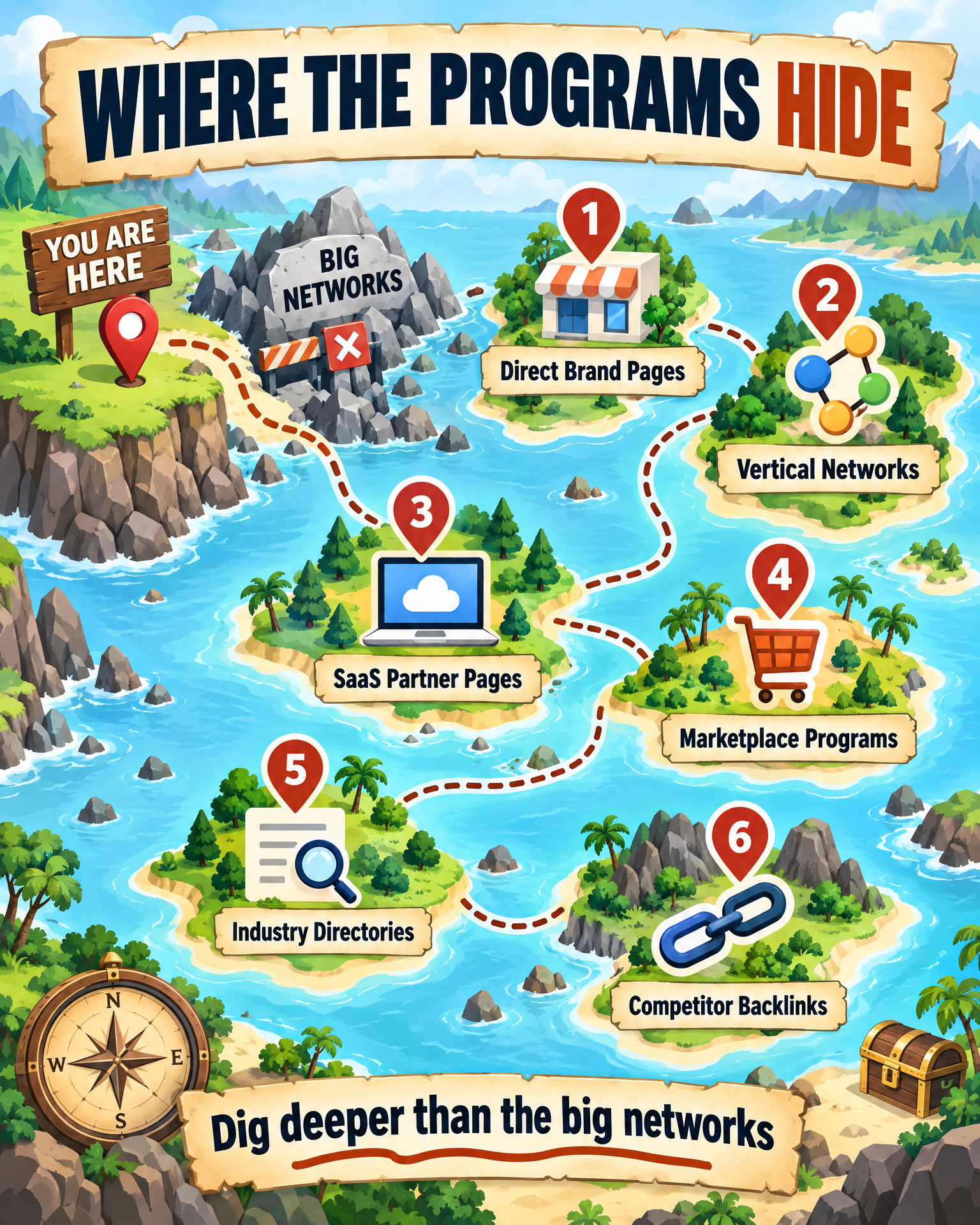
Where to Look for Affiliate Programs (Beyond the Obvious Networks)
Most new affiliates check the big networks, find a handful of programs, and stop — quietly assuming they’ve seen the whole picture. They haven’t. Some of the strongest niche-specific programs never touch major networks at all, and skipping this deeper search can make a good niche look thinner than it is.
Here’s where else to dig:
Direct brand searches. Many mid-size and niche-focused companies run in-house programs instead of listing through a network. Search “[brand] affiliate,” or scroll to a brand’s footer — often labeled “Affiliates,” “Partners,” or “Referral Program.”
Niche-specific or vertical networks. Outside the giant general-purpose networks, industries like software, health, and finance often have their own smaller, specialized networks — less crowded, more targeted.
Software and SaaS partner pages. If your niche brushes up against tools or apps, check for a “Partners” page on the product’s own site. SaaS companies love running their own programs.
Marketplace seller programs. Large marketplaces often run affiliate-style programs covering enormous catalogs — a practical starting point for niches full of smaller or unbranded products.
Industry associations and trade publications. These sometimes keep vendor directories that surface brands you’d never have found otherwise, even when the association isn’t itself an affiliate resource.
Competitor site analysis. Look at sites already ranking in your niche, see which brands and products they link to, and figure out which programs are actually paying for placement. It’s one of the fastest ways to confirm real commissions move through a niche — because someone’s already proven it.
The point isn’t just building a list of programs to join. It’s getting an honest read on how deep and healthy the commercial ecosystem really is before committing the next year of your life to it.
How Many Products Is Enough? The Numbers That Actually Matter
There’s no magic number, and anyone who hands you one is oversimplifying. But there are useful ways to reason through it.
Think in terms of content runway, not raw product count. How many genuinely different articles could you write before repeating yourself? A handful of products might support one roundup and a couple of reviews — then what, in month four? Dozens of distinct products across price points and use cases can carry roundups, reviews, comparisons, buying guides, and use-case content for a long time.
Think in terms of program diversity, not just product diversity. A niche can look packed with products while only one or two companies actually run affiliate programs for any of it. That’s a program-diversity problem hiding behind apparent abundance. You want multiple real programs, not multiple products gatekept by a single company.
Think in terms of buyer-intent volume, not total volume. A niche can post huge overall search numbers while the buyer-intent slice — comparisons, reviews, purchase language — is a sliver of that total. Segment your research by intent and judge that bucket on its own.
Think in terms of durability across the full year. A niche can look commercially rich for six weeks and go silent the rest of the year. Products spread across enough use cases tend to smooth that out. If your whole catalog lives inside one buying window, that’s a real capacity limit, even if the raw count looks fine on paper.
As a loose orientation, not a hard rule: niches that support long-term affiliate content tend to have multiple viable brands, more than one active program among them, a healthy mix of comparison, review, and purchase-intent keywords, and enough neighboring categories to keep expanding without recycling the same three products forever. If every angle keeps surfacing the same handful of products, you’ve probably found the ceiling.
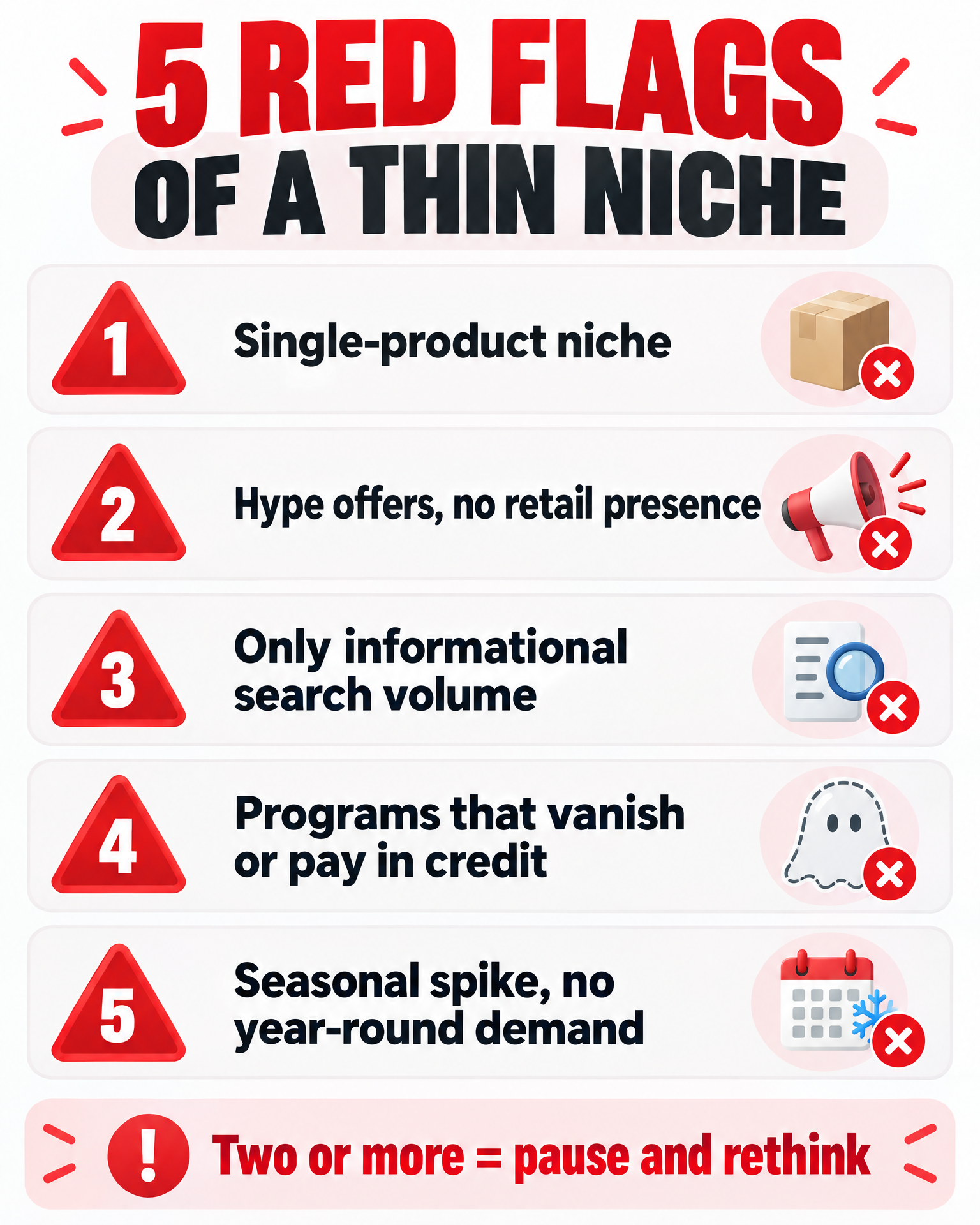
Red Flags: 5 Warning Signs Your Niche Is Too Thin to Monetize
Even promising niches can fail once you dig. Here’s what to watch for.
1. Single-product niches. If your whole content plan leans on one product or brand, you have zero room to move if that program changes terms, discontinues the product, or disappears. Diversification isn’t a nice-to-have in affiliate work — it’s basic risk management.
2. Hype-only offers with no retail presence. Some offers live almost entirely inside marketing funnels — heavy ad spend, flashy landing pages, but nowhere in mainstream retail, independent reviews, or ordinary conversation. That pattern usually signals instability, not a durable category.
3. Search volume stuck in informational queries. A niche can look enormous on paper while almost none of that volume reflects anyone ready to buy. If your keyword research keeps turning up “what is” and “how to” with barely a “best,” “review,” “vs,” or “buy” in sight, take that seriously.
4. Programs that pay in store credit or vanish frequently. Payment structure and track record both matter. Be wary of niches where available programs are inconsistent, hard to verify, or visibly shut down and relaunch under new names. That instability usually points to a shaky market underneath, not just one bad actor.
5. Seasonal spikes with no year-round demand. A niche that lights up for a few weeks and goes dark the rest of the year makes it hard to build anything that compounds. Seasonal niches can still work as a secondary layer — just don’t build your whole strategy on one narrow window.
Two or more of these showing up at once? Pause before pouring real content-production hours into it.
What to Do If Your Niche Fails the Test
A failed test doesn’t mean starting over. Usually it just means adjusting scope, not walking away from the topic entirely.
Widen the niche slightly. If it’s too narrow to support multiple products and programs, expand it to include adjacent products, use cases, or audience segments. It’s the inverse of the problem raised in Is Your Affiliate Niche Too Broad? — sometimes the fix isn’t narrowing further, it’s finding the middle ground between too broad to rank and too narrow to monetize.
Layer in complementary categories. If the core product is thin but naturally connects to other categories, plan your content around the whole cluster instead of the single product type. More angles, more programs, more room to diversify.
Re-run the keyword research with an intent filter. Sometimes the niche didn’t actually fail — your first pass at keyword research just wasn’t filtered for buyer intent. Go back and search specifically for comparison, review, and purchase phrasing before writing the niche off.
Check adjacent verticals for stronger program infrastructure. If direct brand searches come up empty, look sideways. Sometimes the audience is exactly right but the specific product category has weak program support, while a neighboring category — same readers, different shelf — has much stronger infrastructure behind it.
Treat it as a content-only or authority-building topic, not a revenue pillar. Some topics are worth keeping for trust-building, backlinks, or topical authority, even if they never convert well on their own — as long as you’re not depending on that topic to carry your income.
A failed test is information, not a verdict on your judgment. It’s a reason to redraw the lines a little differently, not to abandon the process.
FAQ
Can I actually monetize a niche with only a handful of products? Maybe. It’s riskier and tends to cap your content runway fast. A small number of genuinely strong products backed by real, active affiliate programs can work — especially with room to grow into complementary categories down the line. The raw number isn’t the issue; whether it leaves you room to grow is.
Do I need my own dedicated affiliate relationships, or is a general marketplace program enough? Marketplace-style programs are a reasonable starting point, particularly in niches full of smaller or unbranded products. But leaning on one broad program alone puts all your eggs in a single basket. Checking for brand-specific or vertical programs alongside the marketplace option gives you a sturdier foundation.
How do I know if the search volume I’m seeing reflects real buyers, and not just curious scrollers? Split your keyword list by intent. Buyer-intent language looks like comparisons (“vs”), qualifiers (“best,” “for [use case]”), reviews, and purchase words (“buy,” “price,” “deal”). If those categories are thin next to a mountain of purely informational searches, you’ve probably got an engaged audience that isn’t actually shopping.
What if the niche I’m genuinely passionate about fails this test — do I just drop it? Not necessarily. Widen the scope a little. Add complementary categories. Re-check your keyword research for intent you might have missed. Sometimes the topic is fine and the problem was simply where you drew the boundary around it.
Is it possible for a niche to pass every signal here and still not make money? Yes — the commercial depth test tells you whether the infrastructure exists to get paid, not whether your content, traffic, and conversion strategy will execute well against it. Passing the test derisks the niche; it doesn’t guarantee the outcome. Think of it as clearing the ground before you build, not the building itself.
Products / Tools / Resources
If you want to run this commercial depth test yourself, here’s roughly what you’ll want on hand:
- A keyword research tool that lets you separate search terms by intent — informational versus commercial or transactional
- Some way to check paid advertising presence on your core keywords (most keyword tools include a competition or advertiser-density metric worth glancing at)
- Direct access to brand websites in your niche so you can check footers and partner pages for affiliate programs
- One or two affiliate networks relevant to your niche’s vertical, used alongside — not instead of — direct brand research
- A simple spreadsheet, nothing fancy, where you log products, programs, price points, and complementary categories as you go — this becomes your running scorecard for the niche’s commercial depth
None of this requires an elaborate setup or paid subscriptions. What matters is doing the research consistently, the same way every time, so you’re comparing niches on equal footing instead of going on instinct.