

You did everything by the book. Keyword research, clean headings, a solid 2,000 words — and there it is, page one. Traffic’s climbing. Analytics look like a health chart in a doctor’s office you’re proud of.
Then you open the affiliate dashboard.
Hundreds of visitors. A handful of clicks. Almost nothing in sales.
Something’s off, and it’s not your imagination. This is one of the strangest, most disorienting moments in affiliate marketing — the gap between what looks like success on the surface and what’s actually happening underneath. Most people respond by writing more. More keywords, more sections, another “content refresh.” But here’s the thing nobody tells you early enough: ranking and revenue are not the same signal. They never were. Treating them like they are is exactly where this problem starts.
Table of Contents
The Ranking Trap: Why “Rank = Revenue” Is a Myth
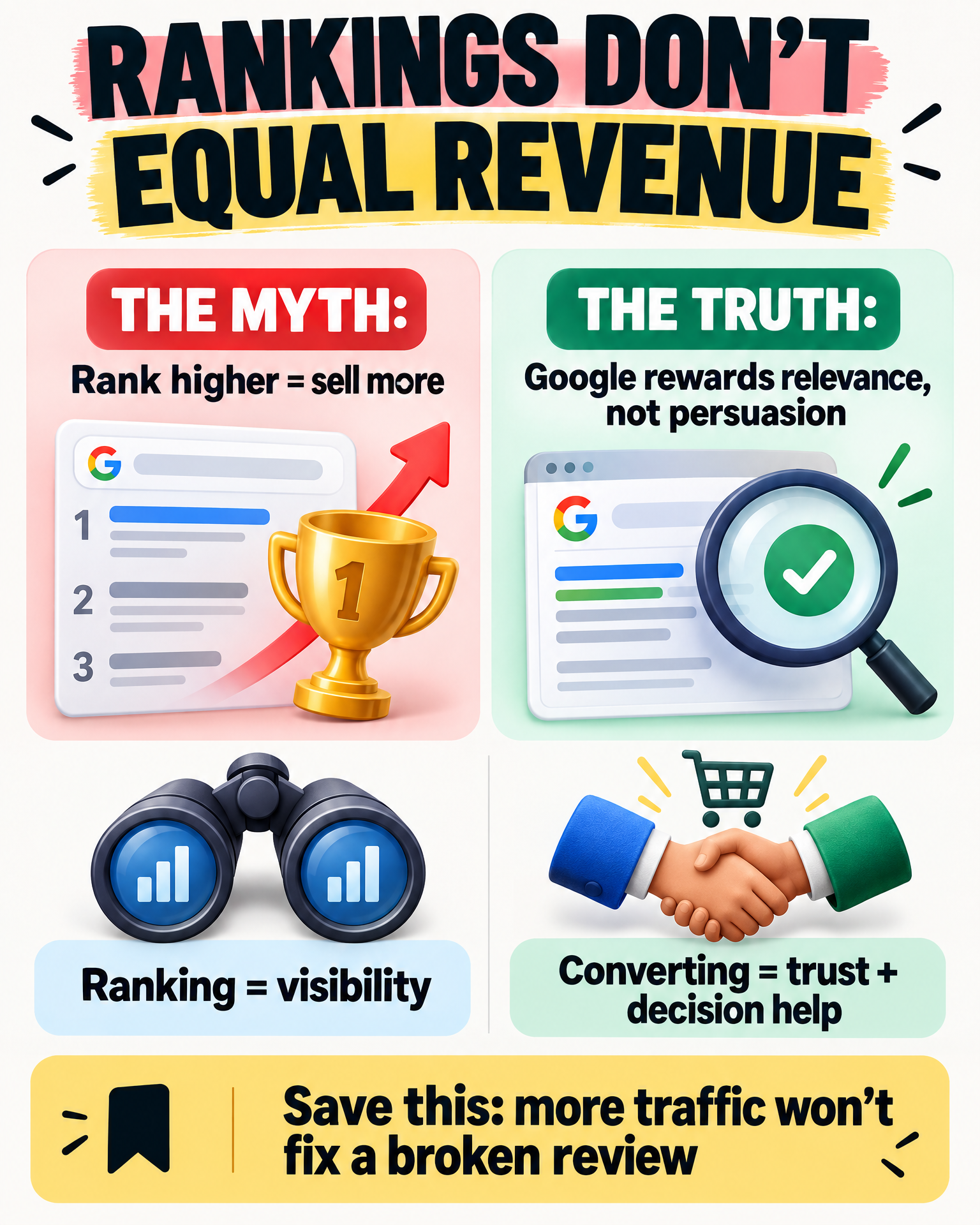
Google isn’t in the business of making sales. It’s in the business of matching a question with an answer. Relevance, not persuasion — that’s the entire job description. Two completely different skill sets, wearing the same content as a disguise.
A page can check every box Google cares about and still fail the one test that actually matters: does a human being believe it? Ranking well tells you your content answered a question. It says nothing — nothing at all — about whether it answered the right one, at the moment someone actually needed it answered.
That’s the trap. Visibility starts to feel like influence, and it isn’t. You’ve won attention. Attention isn’t trust. And trust, quietly, is the only currency that matters once someone’s hovering over a checkout button.
Most of us optimize for the algorithm’s version of “quality.” Meanwhile, real buyers are running their own private scorecard — built on hesitation, side-by-side comparison, and a low-grade fear of getting it wrong. If this sounds familiar across your whole site — steady traffic, flat commissions — Why Your Affiliate Blog Gets Traffic but No Sales digs into the wider version of this pattern. But if ranking itself is the struggle, that’s a different problem — Why Good Blog Posts Get Stuck on Page 2 of Google walks through the most common causes.
Search Intent Mismatch: Ranking for Readers, Not Buyers
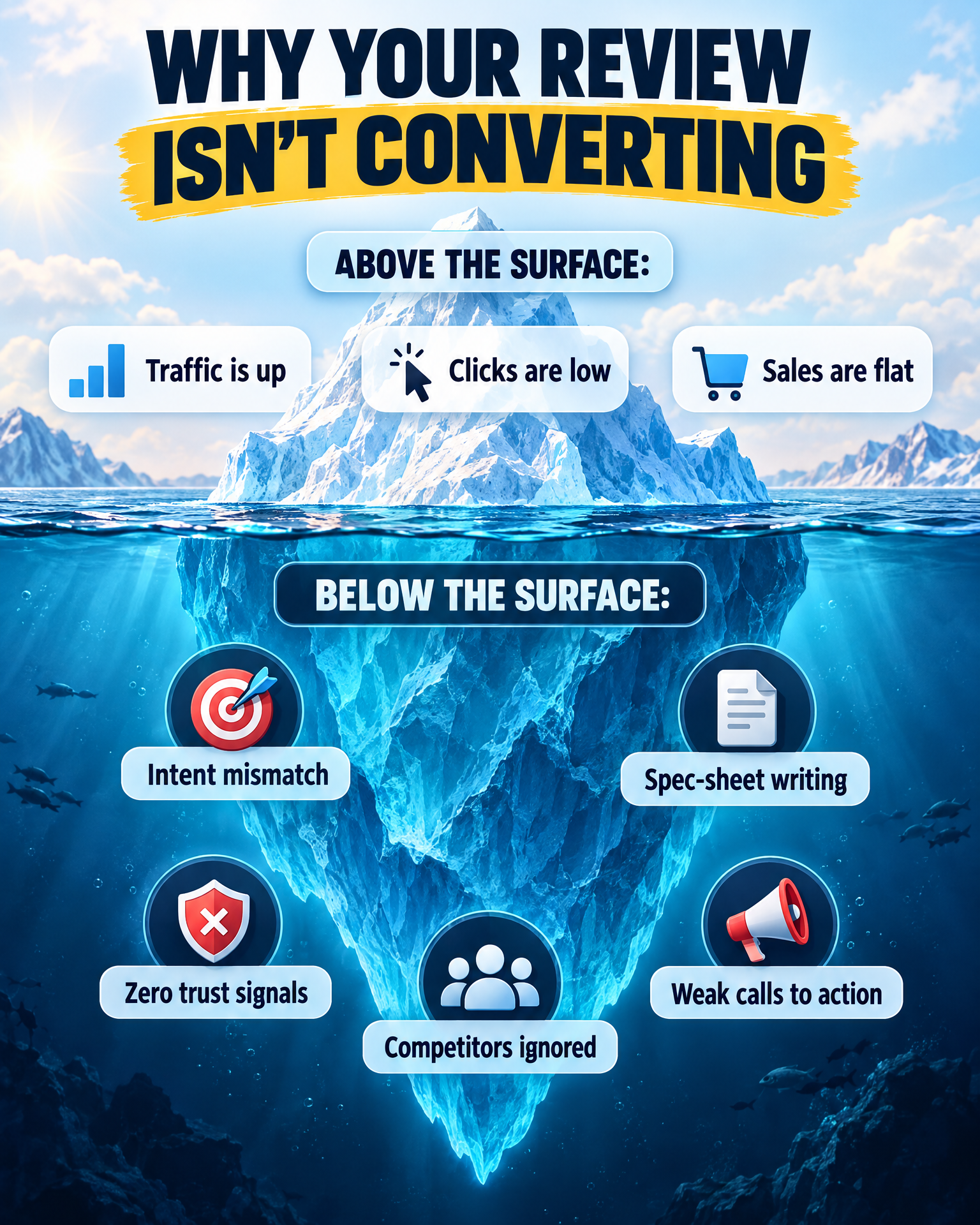
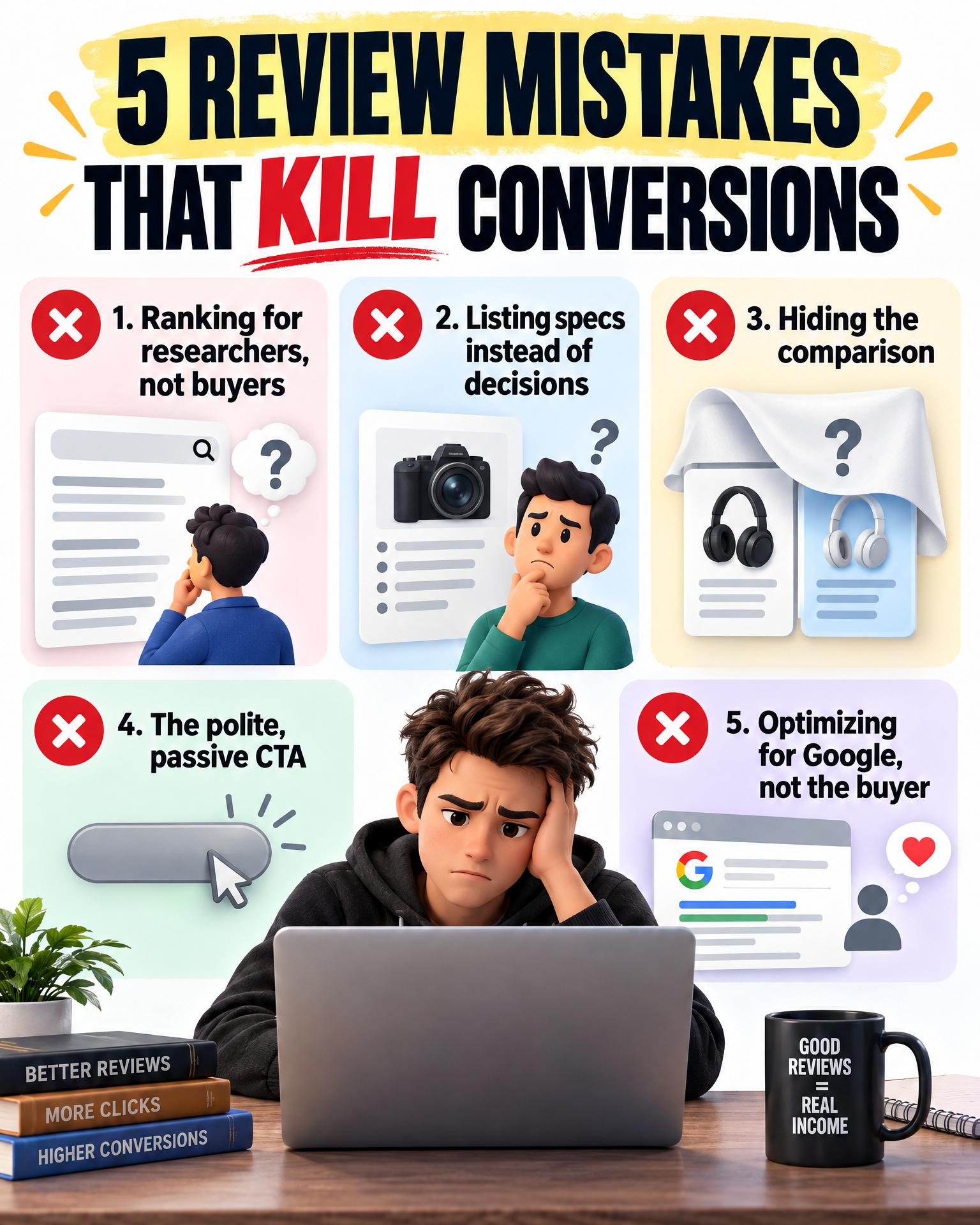
Not everyone typing “[product] review” into Google is ready to pull out a credit card. Some are just curious. Some have five tabs open and no real urgency yet. Some are stalling a decision they haven’t emotionally made peace with. Google ranks for the query. It doesn’t rank for where that person is standing emotionally — whether they’re browsing or about to buy.
That gap is where things quietly go wrong. You write to rank for a broad keyword, and the traffic that arrives is a blend — researchers, tire-kickers, and near-buyers, all landing on the exact same page. But a near-buyer doesn’t want what a researcher wants. Not even close.
Researchers are looking for context. Near-buyers are looking for permission — a nudge that says yes, this is the right call. When your content talks to the wrong crowd, explaining what a product is instead of confirming it’s the right choice, you lose exactly the readers who were one sentence away from converting.
That’s search intent mismatch in its purest form: you rank for the informational layer of a keyword while completely skipping its transactional layer. And Google — along with the AI summaries increasingly sitting above your listing — is getting sharper at telling those two layers apart. If your review reads like a Wikipedia entry, it’ll keep ranking. It’ll also keep quietly underperforming, month after month, and you might never know why. For a system built specifically around buyer-intent keyword targeting, see Snowball Affiliate vs Blog Growth Engine.
Your Review Reads Like a Spec Sheet, Not a Buying Guide
Here’s the uncomfortable part. Most product reviews are just spec sheets wearing a friendlier voice. Bullet points. Feature lists. A pros-and-cons section that reads suspiciously like it was lifted straight from the manufacturer’s page — because, often, it was.
Specs answer “what does this thing do?” But someone standing at the edge of a decision is asking something else entirely: “Is this right for me?” That’s not a factual question. It’s personal. Comparative. A little bit emotional, even if the reader would never admit it.
When you list features without translating what they mean, you’re handing someone raw data and quietly hoping they’ll do the emotional math themselves. Most won’t bother. They’ll drift to the next open tab, where someone already did that translating for them.
Look at the difference:
“Includes adjustable resistance levels.” versus “Good if you’re starting light and expect to push harder in a few months.”
The first is information. The second is a decision, handed to the reader on a plate. It tells them what the feature means for their specific life — and that’s the real distinction between describing a product and actually helping someone choose it.
This is the quiet failure point buried inside most reviews: they inform, but they never decide anything for the reader. And people who feel undecided don’t click “Buy Now.” They click “back,” and they don’t look back.
The Trust Gap: Why Readers Believe Google, Just Not You
Sit with this for a second, because it’s stranger than it sounds: your page might rank because Google trusts it, while the actual human reading it doesn’t trust you at all. Algorithmic trust and human trust are built from entirely different materials.
Google trusts structure. Backlinks. Freshness. Topical signals stacked neatly on top of each other. Humans trust something messier — specificity, a hint of vulnerability, proof that you actually held the product in your hands. A page can have one of these and completely lack the other. Most do.
Readers have gotten sharper, too — and more guarded. Too many of them have been burned by reviews that were really just ads wearing a costume. The overly generous praise. The suspiciously balanced pros-and-cons list. The complete absence of a single real complaint. These are trust-breaking signals people now sense on instinct, even when they couldn’t name what tipped them off.
What rebuilds that trust isn’t more enthusiasm — it’s the opposite, almost. It’s specificity. A real review mentions the thing that surprised the reviewer. The moment they almost sent it back. The one detail they’d warn a friend about over coffee. Details like that are hard to fake, and that’s precisely why they land as believable.
This is where E-E-A-T stops living in an SEO checklist and starts doing actual work. Demonstrated experience isn’t just something Google rewards anymore. It’s the deciding factor in whether a total stranger hands you their trust — and their money — before they’ve even reached a checkout page that isn’t yours.
The Comparison Problem: How Shoppers Use Your Review Against You
Almost no one buys off a single page anymore. Somewhere out there, your reader has your review open in one tab and three competitors’ reviews sitting quietly in the others. This is just how people shop now. And most reviews were never built to survive that kind of company.
If your content pretends the alternatives don’t exist, you leave a hole. And readers, being human, fill holes with suspicion. They didn’t mention the other option — either they don’t know about it, or they’re hiding something from me. Neither reads well.
That’s the comparison problem. Somewhere in the reader’s head, a silent “versus” battle is already running, whether or not your content shows up to it. Staying quiet about competitors doesn’t make you neutral. It makes you absent from the one conversation that actually decides where the sale lands.
The reviews that convert at the bottom of the funnel get ahead of this. They name the obvious competitor. They meet the “but what about—” question head-on instead of dodging it. They explain, plainly, why the recommendation still holds up next to the alternative. Not by trashing the competitor — just by acknowledging the comparison is happening, and stepping in to guide it instead of pretending it isn’t real.
A review that ignores this can still rank beautifully for its keyword. It’ll still lose, consistently and quietly, in the fifteen open tabs where the actual decision gets made.
The Polite Ask: Why Weak Calls to Action Kill Conversions
After a few thousand words of careful, thoughtful analysis, so many reviews just… fizzle out. “Overall, this is a solid option worth considering.” A link. That’s it. That’s the whole ask.
Call it the polite ask — a CTA so soft it barely registers as one. It respects the reader’s independence so thoroughly that it forgets to give them a reason to act now, instead of later — which, let’s be honest, almost always means never.
Weak CTAs tend to share a few fingerprints. They’re vague (“check it out”). They’re passive (“you might want to consider”). They show up without urgency or context (“here’s the link”). None of these give a reader’s brain a concrete next step, and a next step left undefined gets shelved indefinitely.
Now compare that to a CTA doing real work: “If you’ve read this far because you’re torn between the standard and upgraded version — the upgraded one is worth it if [specific condition]. Here’s where to check current availability.” This CTA meets the reader exactly where they’re standing, clears up the doubt still sitting in their chest, and then points them somewhere to act. The gap between a click and a purchase is its own subject — Why People Click Your Affiliate Links but Still Don’t Buy breaks it down in detail.
This isn’t about turning up the salesmanship. A bottom-of-funnel reader is already leaning toward buying something — they’re just figuring out what, and from whom. A confident, specific CTA doesn’t feel pushy to someone in that headspace. It feels like relief. Like someone finally said the thing they were quietly hoping to hear.
The Fix: Rebuilding Your Review Around Purchase Intent
Fixing a review that ranks but doesn’t sell isn’t about tearing it down and starting over. It’s about re-architecting what’s already there around actual buyer psychology, instead of keyword coverage.
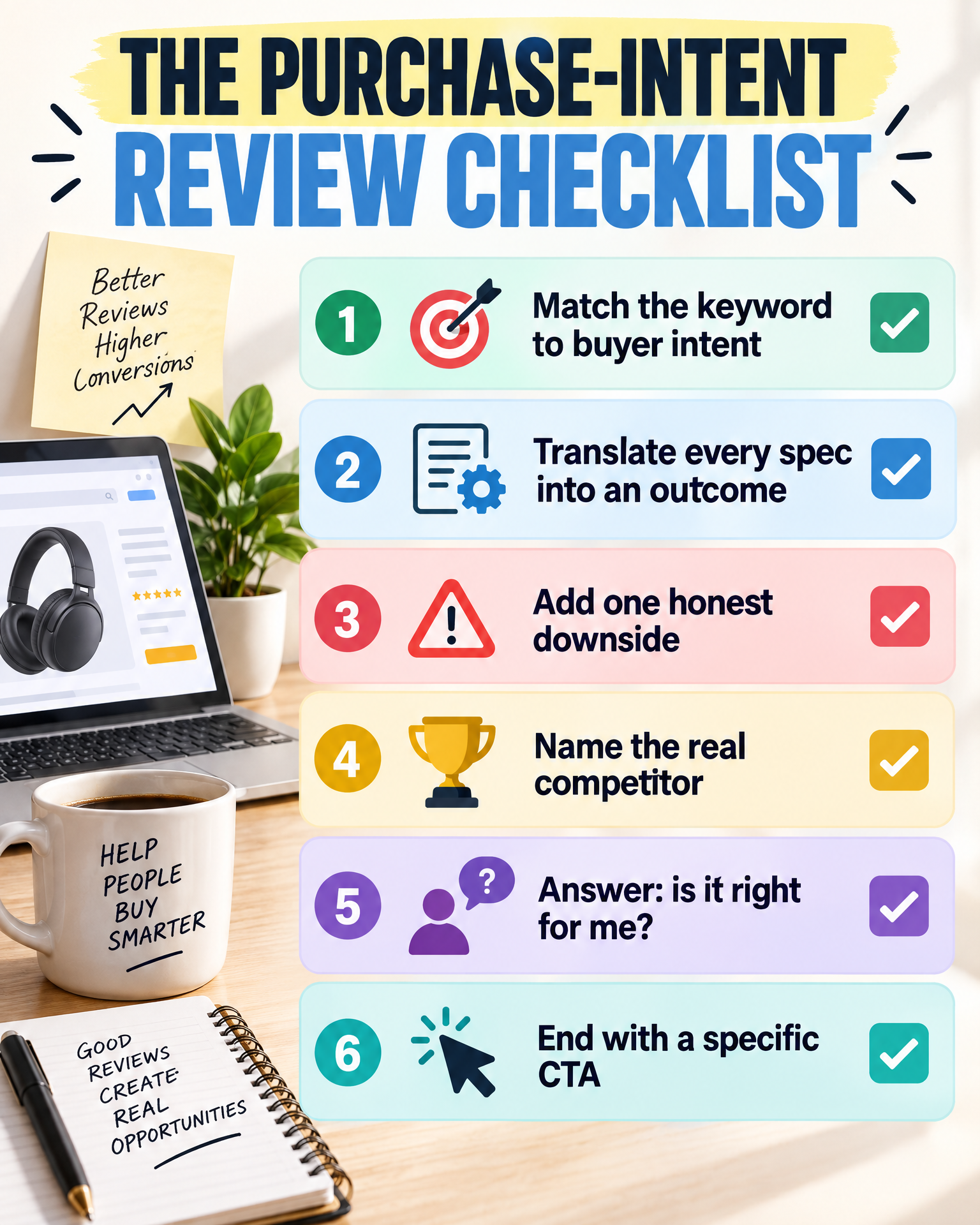
Start by being honest with yourself about search intent. Is the keyword you’re chasing genuinely bottom-of-funnel — or are you trying to squeeze a purchase decision out of a query that was never built for one? Sometimes the fix isn’t the page at all. It’s the keyword you picked in the first place.
Then, swap feature lists for decision statements. For every spec, add the sentence that answers “so what does this actually mean for the person reading this right now?” If you can’t answer that, the spec probably shouldn’t be there.
Add the kind of specificity that reduces friction instead of adding polish. Mention what almost went wrong. Mention who this product is not for. Counterintuitively, that’s what builds trust — it signals you’re not just chasing a commission, you’re actually telling the truth.
Face the comparison instead of tiptoeing around it. Name the obvious alternative your reader is probably weighing you against, and say plainly why your pick still stands. Silence here doesn’t read as neutral. It reads as evasive.
And finally, rewrite your CTA so it functions like a decision aid, not a courtesy link tossed in at the end. Give the reader a specific reason tied to where they’re likely standing, and place it where the decision is actually happening — not buried once, at the very bottom, hoping someone scrolls that far.
None of this needs a single new visitor. It just needs the content you already have realigned with the psychology of the person already reading it. That’s usually the highest-leverage fix sitting right in front of you, on a page that’s already doing half the work.
What Readers Actually Ask About This
Why is my review ranking well but nobody’s buying anything? Because ranking measures relevance to Google, not persuasion to a human. Your page can answer the search query perfectly and still fail to answer the quieter question your reader actually walked in with — “should I buy this?”
Is it my writing, or is it the keyword I chose? Honestly — check the keyword first. If it’s inherently informational (“what is [product]”), no amount of persuasive rewriting will force transactional behavior out of top-of-funnel traffic. Sometimes the content’s fine. The keyword just was never built to convert.
Do I need to trash competitors to address comparisons? No — and please don’t. Acknowledging an alternative exists and explaining, calmly, why your pick still holds up does more for trust than dismissing the competition ever could. Readers can smell defensiveness from a mile away.
How specific is “specific enough” for a CTA? Specific enough that it could only apply to your actual reader’s situation — not a generic audience. If your CTA could be copy-pasted onto any review on the internet, it’s too soft to move anyone.
Can I fix this without writing a whole new review? In most cases, yes. This is usually a realignment job, not a rebuild. Swap specs for decision statements, name the comparison, sharpen the CTA — the existing structure often just needed better psychology layered into it.
Products / Tools / Resources
If you’re going through your own reviews line by line with this in mind, a handful of tools genuinely help — treat them as a lens, not a shortcut:
- Keyword intent analyzers — these help you tell informational, commercial, and transactional intent apart, so you’re not accidentally writing a bottom-of-funnel review for a top-of-funnel keyword.
- Heatmap and scroll-tracking tools — worth installing just to see, in cold detail, exactly where readers stall or skip your CTA entirely. Analytics alone rarely shows you this.
- On-page SEO auditors — good for confirming you’re still hitting the semantic range Google expects, without letting that coverage quietly crowd out the persuasive writing that actually closes the sale.
- Competitor comparison trackers — these keep tabs on what else is ranking alongside your review, so you know precisely what your reader has open in those other browser tabs.
- Simple feedback or exit-survey widgets — sometimes the fastest way to learn why a review isn’t converting is embarrassingly simple: just ask the person leaving what almost stopped them from clicking through.