

You’re staring at Google Trends again. There’s a line curving upward, and something in your chest tightens — that familiar flicker of this could be the one. You open a new draft. You start typing.
Three weeks pass. You hit publish. You check the SERP with that particular mix of hope and dread every affiliate blogger knows too well.
Twelve articles are already there. Ahead of you. Some of them, if you’re honest, look like they were thrown together in an afternoon. No real depth. No craft. And yet — there they sit, soaking up impressions, collecting backlinks, while your carefully built, properly researched post gathers dust on page three, wondering what it did wrong.
Sound familiar? If you’ve lived this moment more than once, you’ve probably already asked yourself the question that haunts every content creator eventually: why am I always the last one to find things?
Here’s the truth, and it might sting a little before it helps you — it’s not your writing. It’s not your research. It’s not that you’re somehow less capable than the people beating you to the punch. It’s that you’ve been relying on discovery tools that are, by design, already too late. You’re spotting trends at the exact moment they stop being trends and start being battlegrounds. And the encouraging part? This isn’t some innate talent you either have or don’t. It’s a skill. One you can build, refine, and repeat. Let’s pull it apart.
Spotting a trend early is only half the job — you still need to know which page to act on first. The free Search Visibility Action Planner helps you diagnose the signal, prioritize the page, and choose the next move. Grab it below and get ahead of the next trend instead of chasing it.
Table of Contents
The Discovery Lag Cycle — Why You’re Always a Few Steps Behind
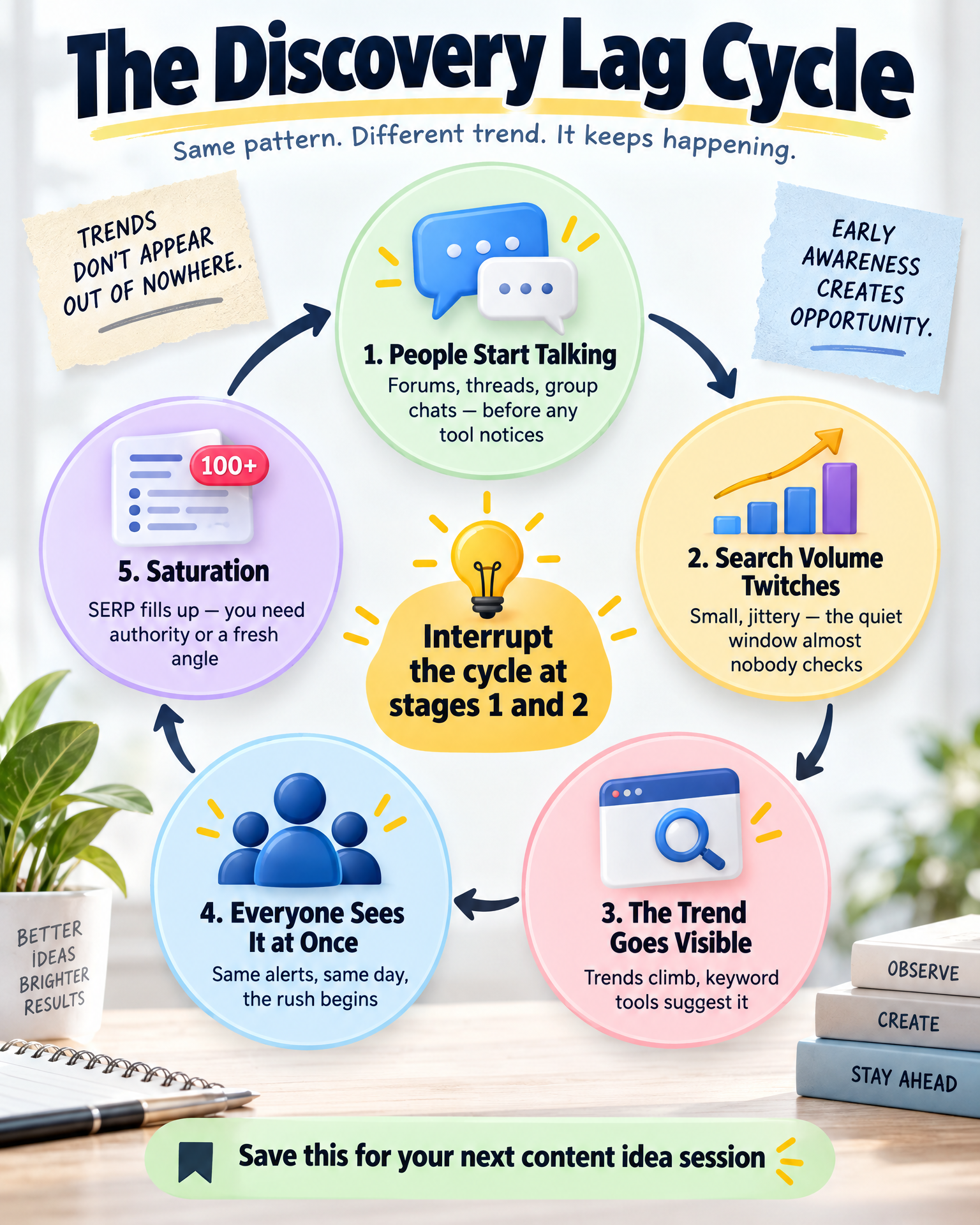
Every trend — a product surge, a cultural shift, a new way people phrase an old problem — moves through a lifecycle. It’s remarkably consistent once you know what to look for, and understanding it is really the whole foundation of getting ahead.
Here’s how it typically unfolds:
- A handful of people start talking. Not searching yet — just talking. In forums, in comment threads, in group chats. Long before any tool notices. 2. Search volume starts to twitch. It’s there, but it’s small and jittery — too faint for most keyword tools to register with any confidence. This is the quiet window almost nobody bothers to check. 3. The trend goes visible. Google Trends shows the line climbing. Keyword tools start suggesting it. Content calendars everywhere quietly add it to the list. 4. Everyone sees it at once. Every blogger with a content strategy and a keyword tool subscription gets the same alert on the same day, and the rush begins. 5. Saturation. The topic peaks, the SERP fills up, and now you need real authority or a genuinely fresh angle just to get noticed.
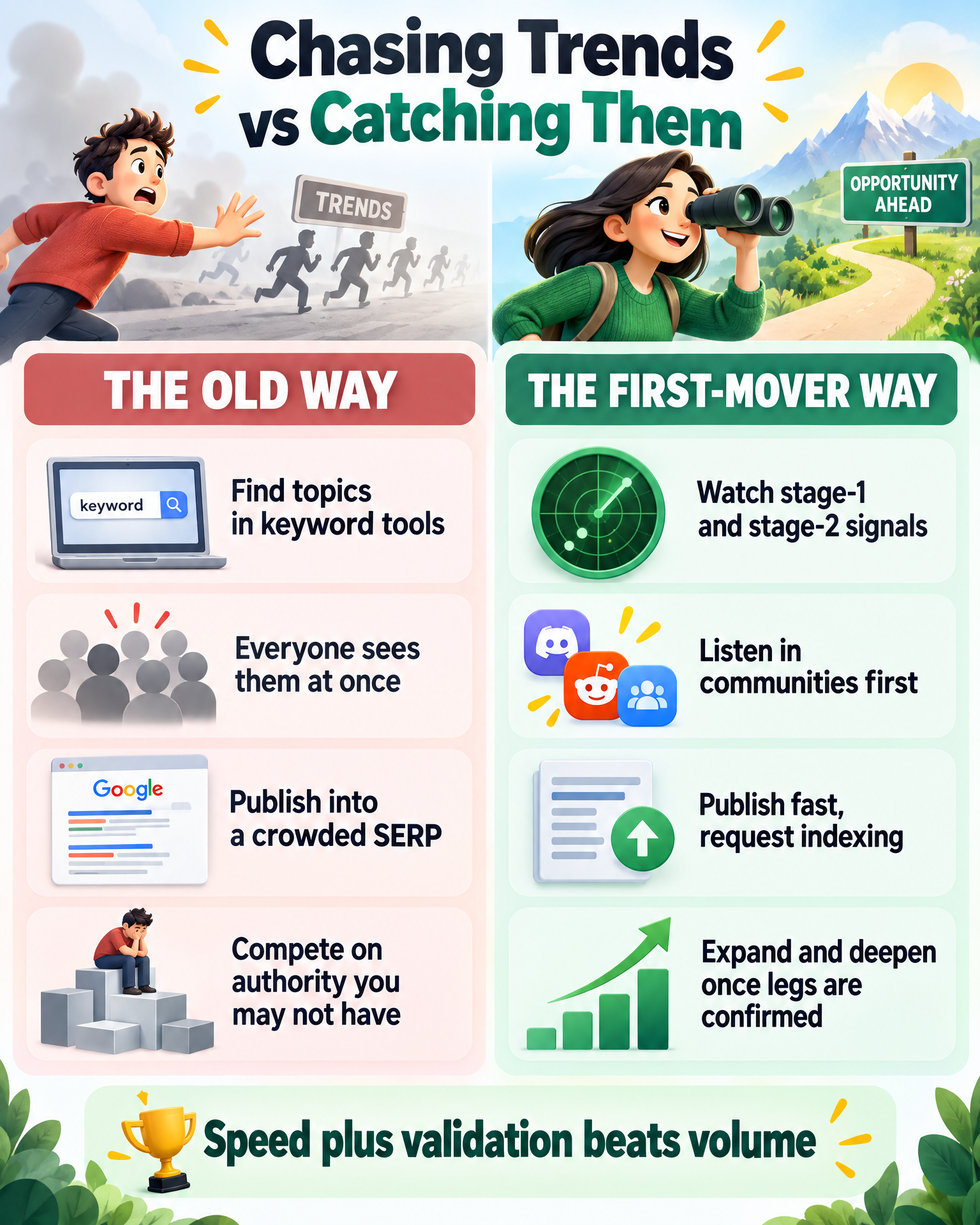
Most bloggers live permanently in stages three and four. They find topics the second a tool tells them to — which, by definition, means they’re finding topics at the exact same moment as thousands of other people using that same tool. That’s not discovery. That’s a synchronized reaction, like everyone’s phone buzzing at once.
The people who seem to always be “ahead” haven’t cracked some secret code. They’ve just pulled their habits back into stage one and two — where the signal is quieter, messier, and mercifully uncrowded.
This is also, by the way, part of why perfectly good posts sometimes just… sit there. Solid research, clean structure, and still nothing happens. If that’s been bothering you, it’s worth reading Why Good Blog Posts Get Stuck on Page 2 of Google — timing and competition density can matter just as much as how well something is written.
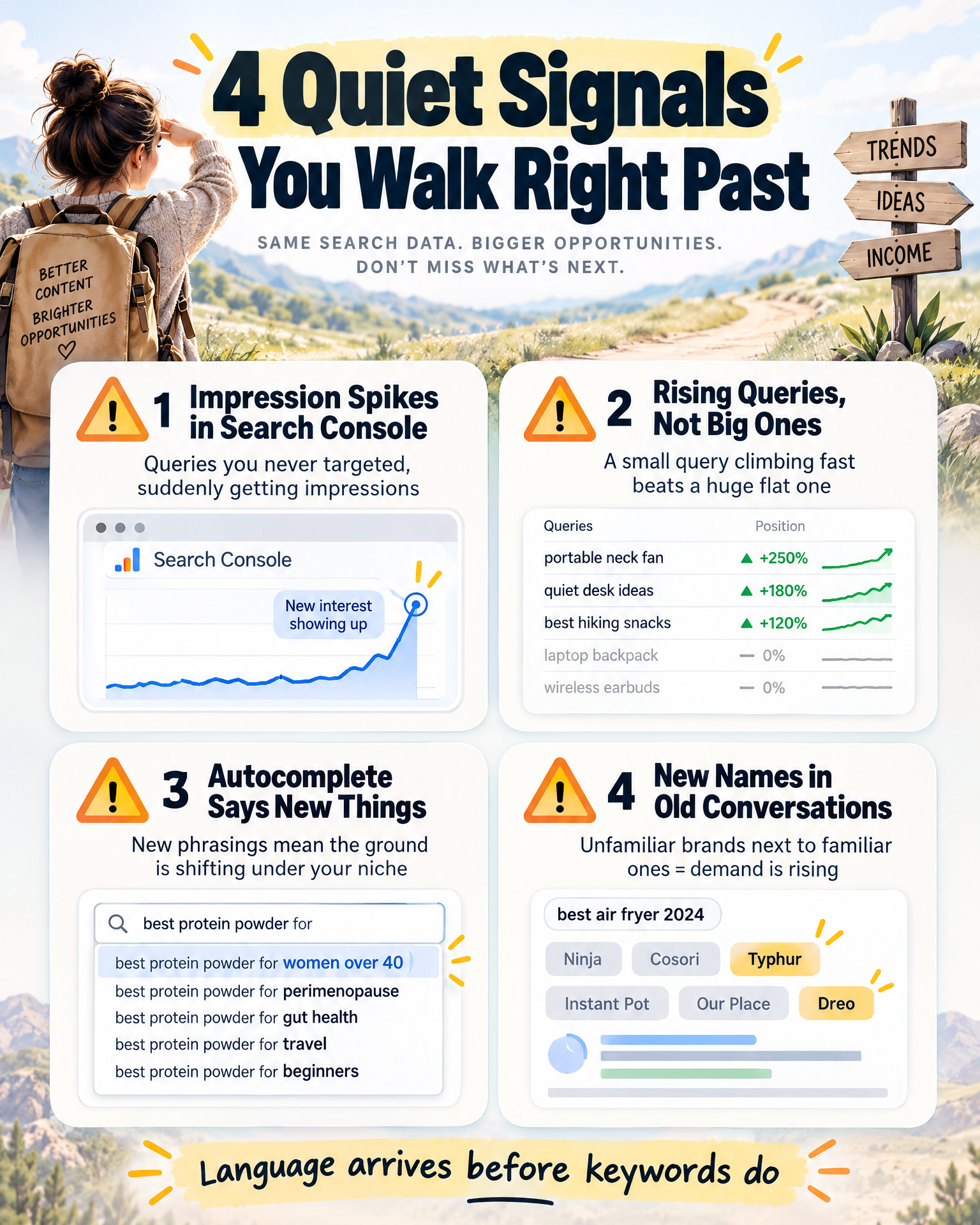
Before a topic becomes an obvious trend, it leaves tracks. Small ones. Faint ones. Most bloggers walk right past them because they’re not looking down. Learning to notice these footprints is, honestly, the single most valuable habit in this entire process.
That strange spike in your Search Console impressions
Search Console is sitting there, quietly tracking a relationship between your site and emerging demand, and most people never think to look. Keep an eye out for queries that suddenly generate impressions you never intentionally targeted. That’s often Google testing your existing content against a query that’s just starting to heat up.
Pay special attention when you see a cluster of impressions but almost no clicks. That gap is telling you something specific — Google sees the topical connection, but your page isn’t quite dialed in to satisfy that intent yet. For a deeper look at exactly what this pattern means and how to act on it, Why Search Console Shows Impressions but Your Traffic Barely Moves breaks it down before the rest of the internet catches on.
Rising queries, not big ones
Trend tools that flag “rising” or “breakout” searches exist specifically to catch early movement — use them for that, not for volume-chasing. Shape matters more than size here. A small query climbing sharply is worth more to you right now than a massive, flat, long-established one, because that flat one has already been colonized, fought over, and claimed.
When autocomplete starts saying things you haven’t heard before
Autocomplete and “People also ask” boxes shift in near real-time based on what real humans are actually typing. When new phrasings or unfamiliar adjacent questions start appearing around a topic you already write about, that’s the ground shifting beneath your niche — often well before any keyword tool notices.
New names showing up in old conversations
The Quiet Signals Nobody Else Is Watching
Watch for new brands, products, or terms starting to appear alongside the established players in your space. When something unfamiliar keeps popping up next to names everyone already knows, that’s frequently the first whisper of rising demand.
Keyword tools only measure demand after someone types a phrase into a search bar. But people talk about their frustrations, curiosities, and half-formed questions long before that happens. This — genuinely — is one of the most underused discovery methods available to you.
Reddit, in all its messy honesty
Reddit threads are full of raw, unpolished language — the kind people use before an SEO-friendly phrase even exists for what they’re trying to say. Search inside relevant subreddits for recurring questions or complaints, and you’ll often find demand months ahead of any keyword tool. When several people ask a similar question in slightly different words, that repetition is a signal all on its own.
Facebook groups, where decisions actually get made
Niche Facebook groups skew practical. People aren’t musing — they’re asking what to buy, what worked, what they’re stuck choosing between. These conversations tend to surface comparison-style topics long before they trend anywhere else.
YouTube comments, the graveyard of unanswered questions
Scroll the comments under a recent video in your niche and you’ll find a goldmine of unmet needs. Viewers ask follow-ups the video never covered. They request comparisons the creator skipped. Those gaps? Often exactly the kind of underserved, specific content that wins the first-mover advantage.
Forums and Discord servers, where the old-timers notice first
Community Listening — Hearing What People Want Before They Have Words for It
Long-established forums and active Discord communities tend to have members who’ve been around long enough to spot shifts early — new categories, new workarounds, new use cases — well before mainstream search behavior ever reflects it.
The thread connecting all of these: language always arrives before keywords do. People describe what they want in plain, human conversation long before that conversation crystallizes into a clean search phrase. Catch the language early, and you can often predict the keyword before it technically exists.
Seasonal Trends — The Ones You Could’ve Seen Coming
Not everything is unpredictable. A big chunk of the demand in almost any niche repeats — same time, every year, close enough to the day that you could set a calendar reminder.
The mistake most affiliate bloggers make with seasonal content is treating it like breaking news — writing about it once it’s already trending that season, instead of preparing early enough for it to be indexed and ready before demand peaks. Search engines need lead time to crawl and evaluate new content. Publish in the moment, and you’ve usually already missed that year’s window.
A smarter move is building a simple internal calendar of your niche’s recurring cycles — buying seasons, renewal periods, annual events, back-to-school rushes, gift-giving windows, budget-year shifts, whatever applies to you. Historical trend data going back a few years will usually show you these patterns clearly, since seasonal demand tends to repeat with only small variations.
This is also where refreshing an old post — rather than writing something new from scratch — stops being a shortcut and becomes an actual strategy. If you already have something relevant from last year, updating it ahead of the next cycle, with sharper structure and better alignment to current intent, often beats starting over. The logic behind that decision is laid out in When Should You Update an Old Blog Post Instead of Writing a New One? — worth a read before your next seasonal window opens.
News Spikes and Product Launches — When Speed Is the Only Strategy
Some demand doesn’t build gradually at all. It arrives in a single moment — a launch, a headline, a policy shift, a cultural spark — and suddenly a topic is urgent and searchable, seemingly overnight.
These spikes behave nothing like seasonal trends. They appear fast, peak fast, and fade fast. Speed matters more here than almost anywhere else in your strategy, because the window can close within days — sometimes hours.
A few things help keep this manageable instead of chaotic:
- Know your trigger dates ahead of time. Most niches have predictable moments — annual announcements, known release windows, recurring conferences, regulatory dates. You can build loose content frameworks for these before you even know the specifics. – Separate “fast” content from “deep” content. When a spike hits, get something accurate and useful up quickly. Depth can come later, once the urgency has cooled. – Notice where the spike is coming from. A spike sparked by one big publication or creator tends to fade faster than one driven by genuine, widespread public curiosity. That distinction tells you how much effort the moment actually deserves.
Before You Write a Word — How to Actually Validate a Trend
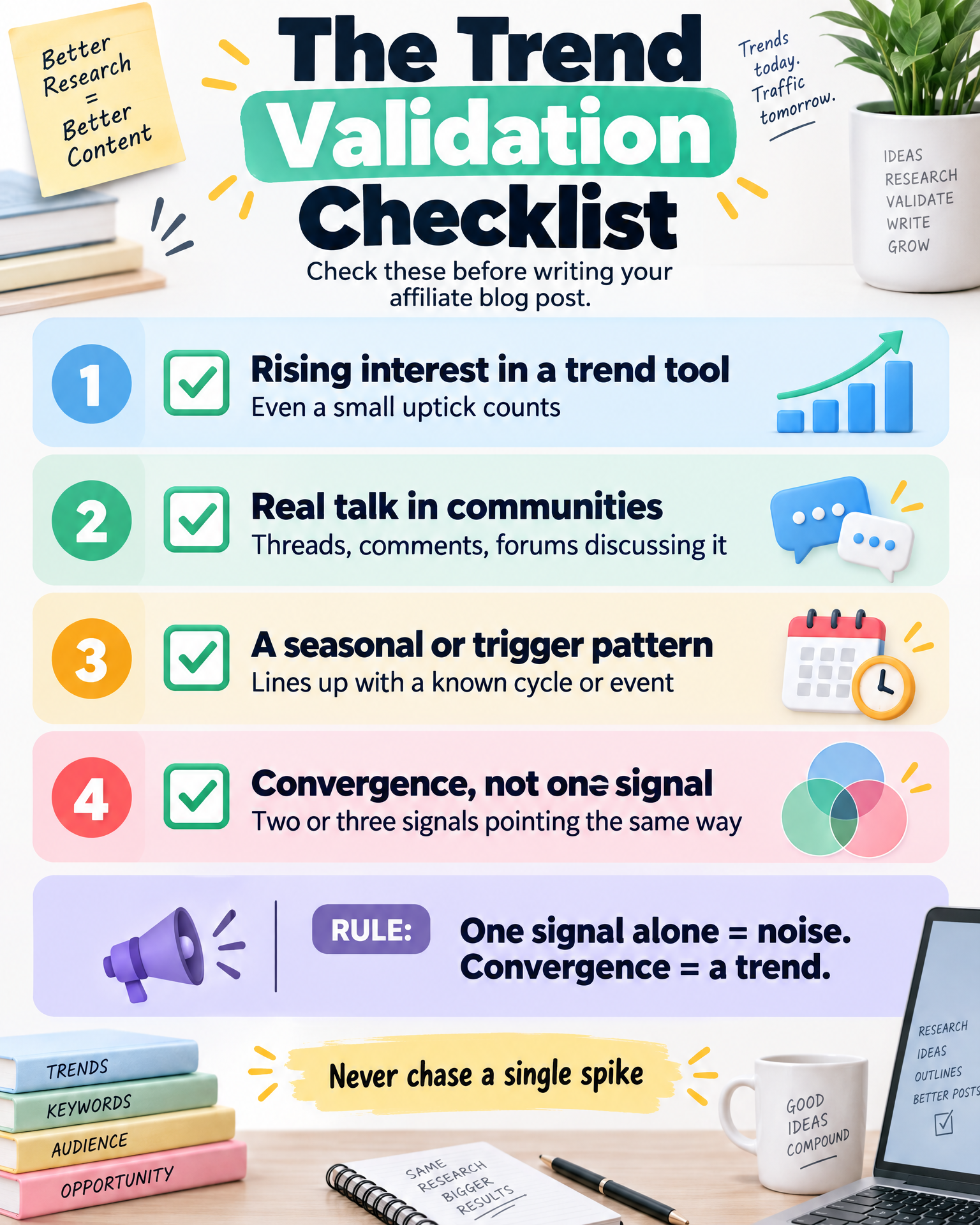
Not every flicker of a signal deserves a full article. Chase every micro-spike and you’ll burn hours on topics that never turn into real, sustained demand. Validation is the filter that keeps you from wasting your time on noise.
Before you commit to writing, look for agreement across at least two or three independent signals:
- Is there rising interest in a trend tool, even a small amount? – Are people actually talking about it — in threads, comment sections, forums? – Does it line up with a known seasonal pattern or a clear external trigger?
When a topic shows up in several unrelated places at once, that convergence tells you far more than any single data point ever could. A rising query with zero community chatter might just be noise. Heavy forum discussion with no search movement yet might simply mean you’re early — which, in this system, is actually the best problem you can have. It buys you time.
It’s also worth glancing at who’s currently ranking — not to talk yourself out of writing, but to understand the landscape. Thin, outdated, or narrowly-angled top results? That’s an opening. Comprehensive, well-established content already dominating the space? You might be better off finding a narrower slice of the topic than trying to out-muscle it head-on.
Publishing Fast Without Falling Apart — The First-Mover System
Once a signal checks out, speed becomes everything. This is exactly where most bloggers lose the edge they worked so hard to find — not from lack of insight, but because their process simply moves too slowly to catch the window.
A workable first-mover system tends to include:
A ready-made skeleton. Skip the blank page. Keep a flexible outline — problem framing, key considerations, comparison points, a clear answer to the core question — ready to populate the moment a topic checks out.
The answer up top. Structure the piece so the core answer lands early, not buried under three paragraphs of throat-clearing. Readers want it fast. So do the search engines and AI summaries pulling from your content.
Research that’s tight, not exhaustive. Early content doesn’t need to be the internet’s most comprehensive resource on day one. It needs to be accurate, genuinely helpful, and fast to produce. Depth can come later, once you know the topic has legs.
Internal links, immediately. Connect the new piece to related content on your site right away. It helps search engines understand context faster and gives readers somewhere to go next. And not just randomly — How to Plan Internal Links That Move Readers Toward Buying Content shows how to plan those links so they steer readers toward the content that actually earns.
A request for indexing, not a wait-and-see approach. After publishing, actively request indexing instead of hoping it gets crawled eventually. Emerging topics benefit disproportionately from being seen quickly.
A note to come back later. Mark the piece for expansion once you see how the trend actually develops. Lean now, deeper later — once you know it’s worth the investment.
So You’re Already Late — Now What?
Sometimes, no matter how sharp your process is, you’ll still show up after everyone else. It happens to every affiliate blogger alive. It doesn’t mean the system failed — it just means you’re operating in a competitive information space. What actually matters is what you do next.
Look honestly at what’s already ranking. Is it genuinely thorough, or does it just have a head start? Thin or outdated top results still leave room for something stronger, even if you’re late to the party.
Find the angle they missed, instead of repeating what they said. If the top content covers the broad version of a topic, look for the narrower slice it skipped — a specific use case, a particular audience, a follow-up question left dangling.
Consider updating instead of starting over. If you already have older related content, strengthening and repositioning it can sometimes beat publishing something new into an already crowded field.
Win on depth when you can’t win on timing. Clarity, structure, and how thoroughly you actually satisfy the reader’s real question — these still carry serious weight, both for traditional rankings and for how AI summaries choose what to surface.
Check whether the real problem is visibility, not timing. Sometimes the issue isn’t that you’re late — it’s that your site isn’t generating enough baseline visibility for any content to gain traction, old or new. If that rings a bell, Why Your New Affiliate Blog Gets Almost No Google Impressions is worth your time. Discovery timing only matters once your crawl and indexing health is solid enough to work with.
Questions You’re Probably Asking Yourself Right Now
Why does everyone else always seem to find this stuff before I do? Because the tools most people rely on — keyword platforms, trend dashboards, content calendars — surface topics at the exact same point in the trend lifecycle, for everyone, at once. If your entire discovery process lives inside those tools, you’ll keep discovering things at the same moment as every other person staring at the same dashboard.
Can I actually catch trends early, or is that just a nice idea? You genuinely can — though “reliably” here means consistent habit, not perfect timing every single time. Watching Search Console patterns, listening in communities, tracking seasonal cycles — all of these surface signals earlier than mainstream keyword tools, simply because those tools measure language that hasn’t yet been formalized into a common search phrase.
How do I know if something’s actually worth writing about, or just noise? Look for convergence. Rising interest, active conversation somewhere, and alignment with a known seasonal or trigger pattern. One signal alone is weak evidence. Two or three pointing the same direction? That’s worth your time.
Should I rush to publish first no matter what? Not always. Speed matters most for genuine news or launch spikes, where the window is brutally short. For slower seasonal trends, being early and thorough beats being fast and thin.
What if I’ve already missed it — is the topic just dead to me now? Not at all. Find a narrower angle, update something you already have, or lean into depth and usability instead of trying to outrun content that already has a head start. Timing is one factor among several — not the only one that decides who wins.
Products / Tools / Resources
None of this hinges on one magic tool. It hinges on habits — the watching, the listening, the timing. Still, a few categories of tools make each stage genuinely easier to run consistently:
- Search performance monitoring, like Google Search Console, for catching impression patterns and rising queries your own content is already being tested against. – Trend-tracking platforms, like Google Trends, for visualizing early movement and comparing seasonal patterns year over year. – Community monitoring tools for keeping an ear on Reddit, forums, and social platforms — useful for catching recurring questions before they ever become formal keywords. – Content calendar or planning software for mapping out your niche’s known seasonal windows in advance, so you’re preparing rather than scrambling. – Indexing and crawl-request tools built directly into search consoles, for nudging faster discovery of new or freshly updated content.
Each of these plays a specific role in the discovery cycle laid out above — but none of them replace the actual habit underneath all of it: watching early, validating carefully, and publishing on purpose instead of reacting to whatever a dashboard happens to light up that week.