

You’ve seen the name by now. Adam Enfroy — the guy who turned a personal blog into what’s reported as a multi-million dollar operation, then packaged the whole climb into a course called Blog Growth Engine. Reviewers now call the current version “Blog Growth Engine 4.0,” which tells you something on its own: this thing has been rebuilt enough times to earn a version number.
But here’s what actually matters, and it’s not “is Adam Enfroy the real deal.” That question gets asked constantly and answered even more constantly, usually by people trying to sell you something. The sharper question — the one nobody seems to sit with long enough — is this: if you’re running an affiliate-focused blog, not a personal brand empire, not a SaaS-adjacent authority play, does this course solve the problems you actually have?
That’s the whole review. No affiliate link, no invented guarantee — just what’s inside, what it costs, who it’s built for, and where it stops being useful if your model is affiliate commissions.
Table of Contents
What Blog Growth Engine Actually Is (and What It's Not)
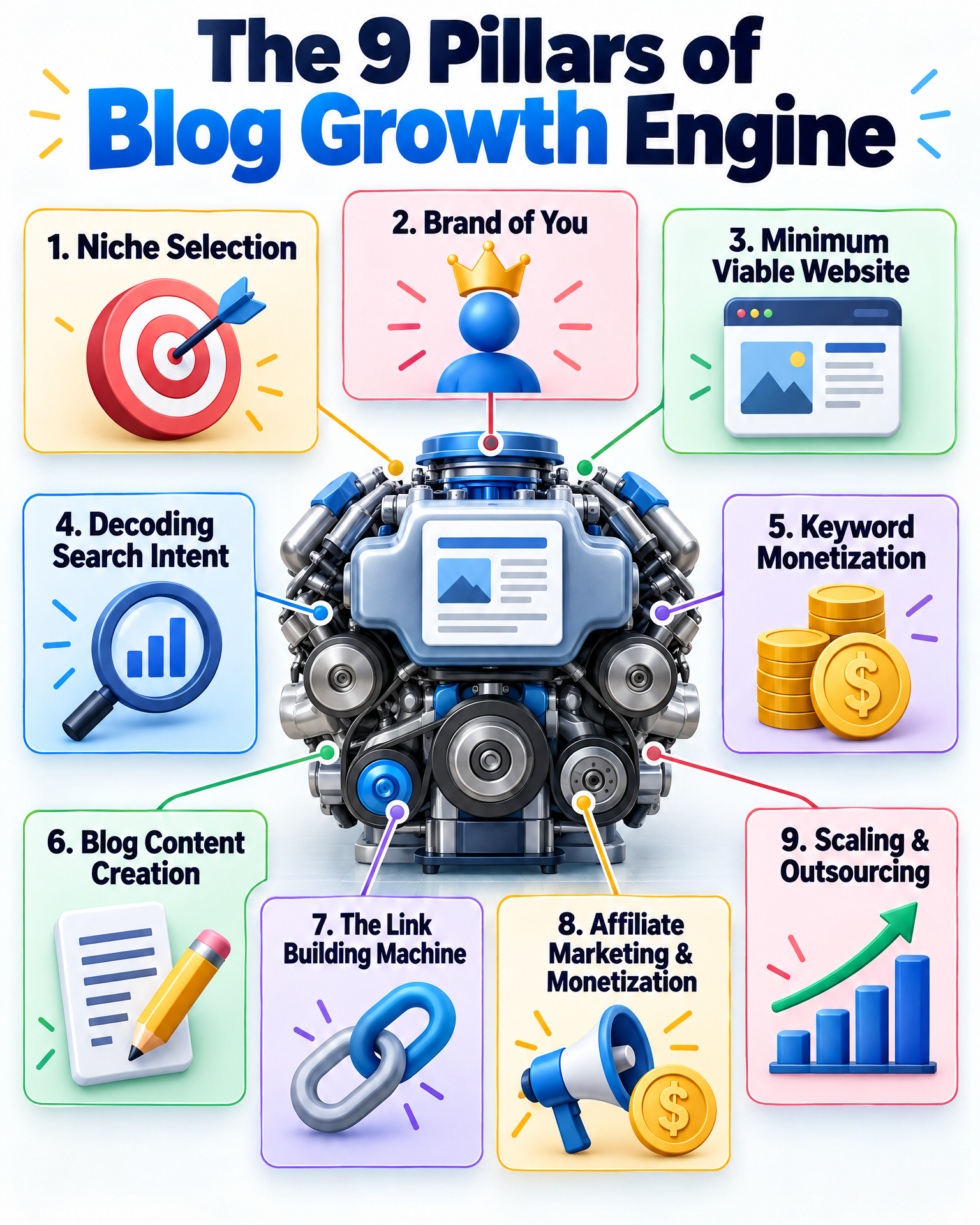
Let’s clear the fog. Blog Growth Engine is not a “how to write a blog post” tutorial — don’t expect it to be. It’s not a niche-specific affiliate playbook either. What it is positioned as is bigger: a full-stack system. Niche selection. Building a personal brand around yourself as founder. Launching what the course calls a “minimum viable website.” Understanding search intent well enough to monetize it. Producing content at a pace most solo bloggers never reach. Building links. Monetizing through affiliate marketing and other revenue streams stacked on top of each other. And eventually — this is the part people skim past — outsourcing enough of it that the business doesn’t collapse the moment you take a week off.
That last piece is the soul of the course. Enfroy isn’t teaching “start a blog as a side hustle” — he’s teaching “build a media business with your name stitched into it, then hire people to handle the parts you’d rather not do.” That framing surfaces in nearly every module, and it’s the detail most likely to determine whether this fits your life or just sounds impressive on a sales page.
If your actual plan is a lean, quiet, maybe even anonymous affiliate site — tight niche, organic traffic, no face attached to it — you’ll still walk away with real value here. But make no mistake: the course is built for a wider ambition than that. Personal brand. Multiple income streams. Eventually, a small team behind you. Knowing that distinction going in will save you from a very specific kind of buyer’s remorse — the kind where the product is excellent, just not for you.
Inside the Curriculum: What You're Actually Paying For
Review sources describe 77+ modules, structured to mirror how Enfroy says he built his own blog. Here’s the shape of it.
Niche selection and positioning. Not just “pick something you like” — the course walks through monetization potential, competitive landscape, and whether a niche can even support a personal brand layered on top of it.
Brand of you. This is where Blog Growth Engine splits from most competitors. Instead of treating the blogger as invisible scaffolding, it treats you — your face, your story, your voice — as an actual business asset. Some readers feel relief; others, who’d rather stay behind the curtain, feel dread. Worth knowing which camp you’re in before you commit.
Minimum viable website. Getting a stripped-down site live fast — technical setup and essential pages, without over-engineering before you have traffic.
Decoding search intent. Matching content to what searchers actually want — informational, commercial, transactional. Intent mismatch is one of the quiet killers of affiliate content: you can rank and still earn nothing. This module exists to keep that from happening to you.
Keyword monetization. Most courses treat keyword research and monetization as two separate skills you bolt together later. This one fuses them from the start — a keyword isn’t just volume, it’s revenue potential, judged as one thing.
Blog content creation. Templates and SOPs built for volume — useful if you’re chasing topical authority across dozens or hundreds of pages, less useful if you’re planning to publish twelve posts and call it done.
The link building machine. A named framework for earning backlinks — still one of the most expensive, most time-consuming parts of ranking a newer affiliate site.
Affiliate marketing and blog monetization. The section that matters most for this review’s reader — affiliate programs, monetization strategy, and stacking income streams instead of betting everything on one.
Scaling and outsourcing. How to hand pieces of the work — writing, editing, link building — off to other people, so the blog stops depending entirely on your own two hands.
Underneath the core curriculum sit templates and SOPs, lifetime access with updates, a private community, weekly live Q&As, and unlimited 1-on-1 coaching calls — an unusual amount of direct access at this price point.
Who This Course Actually Fits — and Who's Wasting Their Money
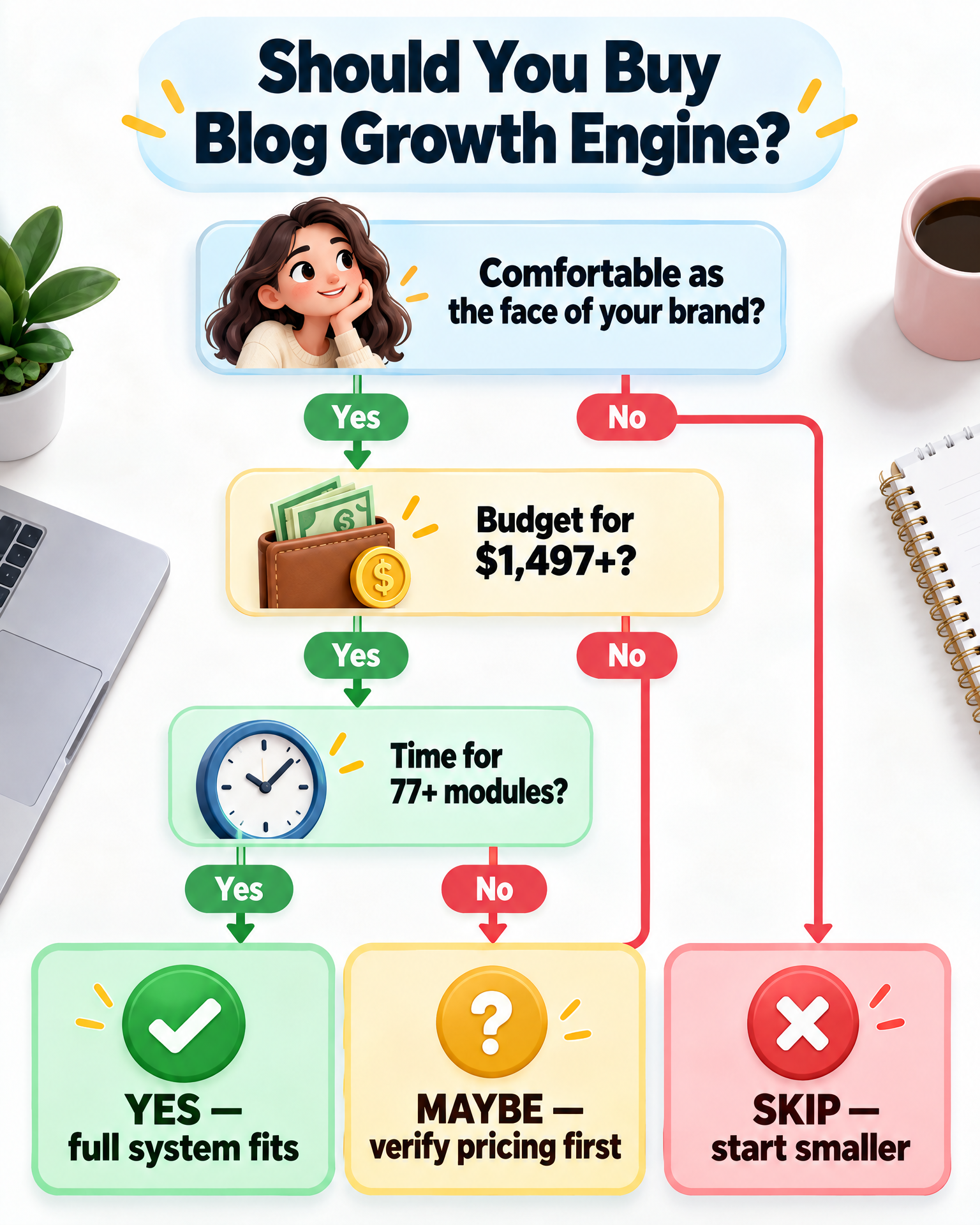
Picture the person this was built for: someone who wants one complete system covering both the SEO mechanics and the money side, who’s either comfortable putting their face behind their content or ready to get comfortable with it, and who has the budget and the patience to work through a genuinely dense curriculum instead of needing a fast, narrow win by next week.
Now picture who it doesn’t fit. If you’re a beginner on a tight budget, spending four figures before you’ve proven you can publish consistently is a real risk. If you already know your niche and just need a content-and-monetization framework, you may pay for a mountain of material you’ll never touch. And if appearing on camera or building a public-facing brand makes your stomach turn — if your plan is a topic-first site where you never show up — a meaningful chunk of this curriculum won’t apply to you.
Let’s be honest about something the sales pages tend to gloss over: affiliate blogging doesn’t require a personal brand. Never has. Some of the most profitable affiliate sites out there are built entirely around the topic, with the founder nowhere in sight. If that’s your intent, it’s worth asking yourself whether you’re paying for training you’ll actually use, or training built around a different business model that happens to overlap with yours at the edges. Our breakdown of Best Affiliate Blogging Courses for Beginners covers alternatives built more narrowly around affiliate mechanics, without the personal-brand scaffolding — probably a better starting comparison if brand-building was never part of your plan.
Let's Talk Price (and Why You Shouldn't Trust Any Number Here)
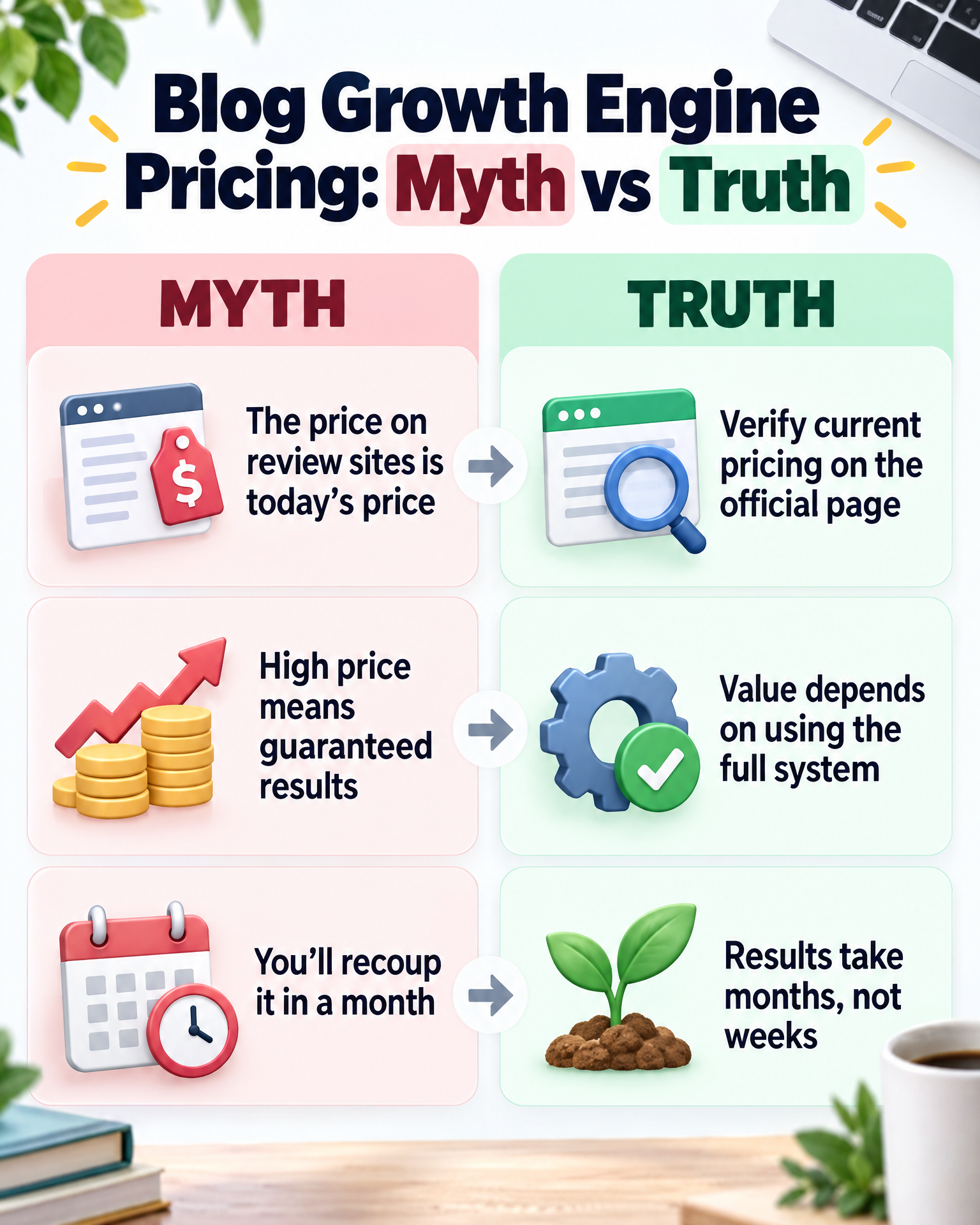
This is the section where you need to slow all the way down. Review sources report the core program landing around $1,497, with higher tiers or coaching bundles reported anywhere from $1,497 up to $3,997, depending on whatever promotion happens to be running. Some past promotional windows have priced it lower than that.
Here’s the caveat that actually matters more than any figure above: none of these numbers should be treated as current. High-ticket digital products shift constantly — promotions rotate, tiers get restructured, bonuses get bundled and unbundled. Reviewers have also noted the program appears to have been relaunched or remarketed under different names over time, including “Launch to 10K” and “AI Income Blueprint.” Treat that as an observation from reviewers, not a confirmed fact — but it’s a reasonable enough signal that the offer structure, and the pricing attached to it, has moved more than once.
Before you decide anything, verify current pricing directly on the official Blog Growth Engine page. Not this review. Not a YouTube video from eight months ago. Not a forum thread that’s aged out of relevance. Check today’s number, today’s guarantee language, today’s bonuses — because all three of those things move.
And one more detail worth checking rather than assuming: some reviews mention a 14-day action-based money-back guarantee. That detail isn’t consistently confirmed across sources, so treat it as unverified until you’ve read the exact terms — including what “action-based” actually requires of you — on the official sales page.
Where the Course Genuinely Earns Its Keep
Even with every caveat on the table, there’s real substance here if you engage with the whole system rather than cherry-picking modules.
The search intent and keyword monetization sections go straight at one of the most common ways affiliate blogs quietly fail: ranking for the wrong kind of keyword. You get traffic. You get zero commissions. If that’s ever happened to you, this is precisely the gap this part of the curriculum is built to close — and it pairs well with our piece on Why Your Affiliate Blog Gets Traffic but No Sales, which walks the same problem from a diagnostic angle instead of a curriculum angle.
The link building module carries more weight than it might seem to on paper. Affiliate sites, more than almost any other content category, live and die on domain authority. You’re not just competing with other bloggers — you’re competing with retailers, brand websites, and publishers with decades of link equity behind them. Link building isn’t a nice-to-have here. It’s frequently the entire difference between page one and page three.
The 1-on-1 coaching access is a genuine differentiator. Most courses at this price stop at a community forum and recorded Q&As. Live coaching calls — even accounting for variance in coach quality — give you a real feedback loop that self-paced material can’t replicate.
And the scaling module addresses a stage most courses ignore: when you can’t write, edit, and build links fast enough to keep growing. Most courses stop at “how to start.” This one at least gestures toward “how to stop being the bottleneck.”
Where It Falls Short — and the Red Flags Worth Naming
The price is the obvious wall. At roughly $1,497 and climbing depending on tier, this isn’t an impulse buy, and it’s a genuine risk if you haven’t yet proven — to yourself, not to anyone else — that you’ll actually stick with blogging past the first restless month. Weigh that entry cost honestly against your own realistic runway to profitability before you commit to anything.
The time cost is just as real. With 77+ modules, this isn’t a weekend project — it’s closer to a part-time course load stretched across weeks or months, on top of the actual work of building your site.
Some of the tactical detail may also be aging by 2026. SEO courses recorded even two or three years back can lag behind how Google actually surfaces content today, how AI overviews are reshaping click-through behavior, and how brutally competitive certain niches have become since the material was filmed. The foundational strategy tends to hold up fine. The specific tactical advice — the stuff tied to algorithm behavior — ages faster than anyone selling a course wants to admit.
And then there’s the criticism that’s hardest to argue with: a lot of the core strategy — niche selection logic, search intent basics, monetization philosophy — is also on Adam Enfroy’s free YouTube channel. That doesn’t make the paid course worthless; it adds structure, templates, community, and coaching. But you can sample the philosophy for free before deciding whether it’s worth four figures to go deeper.
Blog Growth Engine vs. the Alternatives Everyone Compares It To
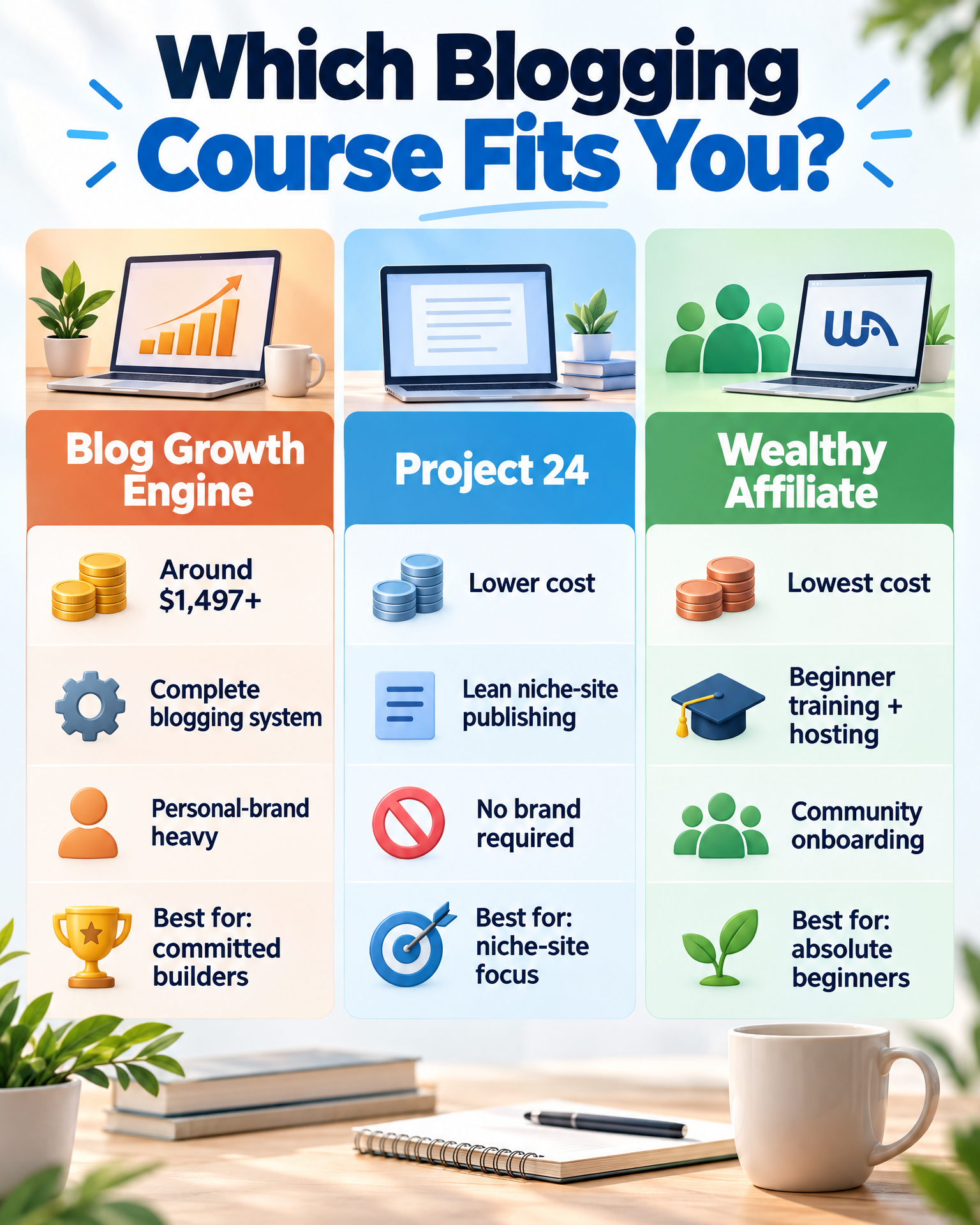
No course exists in a vacuum, and for affiliate bloggers specifically, the comparison that actually matters is against Project 24 and Wealthy Affiliate — two of the most commonly recommended alternatives, sitting at very different price points with very different philosophies underneath them.
Project 24, from Income School, runs on a simpler premise: publish consistently, target long-tail keywords, monetize through ads and affiliate links, and skip the personal-brand and outsourcing infrastructure. It’s generally cheaper and narrower — less “build a media company,” more “build this kind of content site.” If personal branding was never your plan, it may map onto your goals more directly. We’ve compared the two philosophies in more depth in Snowball Affiliate vs Project 24, and broken Project 24 down on its own terms in our full Project 24 Review.
Wealthy Affiliate sits in an entirely different tier — a much lower-cost, subscription-based training and hosting platform built for beginners, leaning on community and step-by-step onboarding. It’s less sophisticated on link building and personal-brand strategy, but it’s a far lower-risk entry point if four figures before your first ten posts feels premature. Our Wealthy Affiliate Review for Niche Bloggers covers where it earns its keep and where it runs out of road for more advanced site-building goals.
The honest framing: Blog Growth Engine is the most comprehensive and most expensive, with the heaviest lean toward personal brand and scaling. Project 24 is leaner and cheaper, built for niche-site publishing without the brand layer. Wealthy Affiliate is the lowest-cost entry point, best for beginners who need structure first. Your budget and your appetite for being the face of your site should decide this — not the module count. For the direct head-to-head against our own approach, read Snowball Affiliate vs Blog Growth Engine.
So — Should an Affiliate Blogger Actually Buy It?
If you’ve already proven to yourself that you enjoy this work, you’re genuinely willing to be the face of your site, and you’ve got both the budget and the hours to move through a dense curriculum without resentment building up along the way — Blog Growth Engine offers a legitimately complete system. It’s arguably one of the more thorough paid options out there for stitching SEO mechanics together with monetization strategy and eventual scaling.
But if you’re earlier than that — still deciding whether affiliate blogging is even right for you, working with a budget that can’t absorb a four-figure bet, or planning a topic-first site where you intend to stay out of the spotlight entirely — the cost-to-fit math gets a lot harder to defend. In that case, start smaller. Figure out what your first few pieces of content should even be — our guide on What Should You Write First on a New Affiliate Blog? is a practical place to start that conversation with yourself. Prove you’ll follow through before you spend anything. Then decide whether a four-figure course makes sense once you actually understand your own model.
This isn’t something you buy on impulse, and it isn’t a scam dressed up in a sales funnel either. It’s a legitimate, genuinely expensive system, built around one specific philosophy of blogging — and whether that philosophy matches yours is really the only question worth answering.
The Questions People Actually Ask Before Buying
Is Blog Growth Engine worth the price?
Honestly? It comes down to whether you’ll use the whole system — personal brand, scaling, coaching calls — or just cherry-pick the affiliate sections. Use most of it and the price makes more sense; need only narrow affiliate mechanics and cheaper alternatives will likely serve you. Either way, verify current pricing on the official page before deciding.
How much time am I actually looking at here?
With 77+ modules plus templates and SOPs layered on top, this isn’t something you knock out in a weekend. Think multi-week, possibly multi-month — and that’s separate from the actual work of building and running the blog itself.
Is this something a total beginner can jump into?
It’s accessible in the sense that it starts from niche selection and builds from there. But the pace, the price tag, and the sheer scope assume a level of commitment that someone still unsure if blogging is even for them may not be ready to make yet.
How does it stack up against Project 24 or Wealthy Affiliate?
Blog Growth Engine is the broadest and the most expensive, with a heavy lean toward personal brand and scaling. Project 24 is leaner and cheaper, built around straightforward niche-site publishing. Wealthy Affiliate is the lowest-cost, most beginner-friendly of the three. The comparison section above walks through the specifics.
Is this whole thing a scam?
No. Based on the reviewer evidence available, it’s a legitimate paid course with real curriculum, real community access, and real coaching behind it. Whether it’s a good purchase for you is a question of fit, not legitimacy.
Is there actually a money-back guarantee?
Some reviews mention a 14-day action-based guarantee, but it isn’t consistently confirmed across sources. Check the exact terms — all of them — on the official Blog Growth Engine page before you hand over any money.
Products / Tools / Resources
- Blog Growth Engine (Adam Enfroy) — official page (verify current pricing and guarantee terms directly before purchasing)
- Best Affiliate Blogging Courses for Beginners
- Project 24 Review
- Snowball Affiliate vs Project 24
- Wealthy Affiliate Review for Niche Bloggers
- Why Your Affiliate Blog Gets Traffic but No Sales
- What Should You Write First on a New Affiliate Blog?