

Here’s the thing nobody tells you when you finally start seeing real numbers in your analytics dashboard.
Traffic doesn’t pay your bills. Conversions do.
You’ve done the hard part — actual humans are landing on actual posts, month after month, in numbers that used to feel impossible. And yet you refresh your affiliate dashboard and see… crumbs. A few dollars here. A stray commission there. Nothing that matches what your pageviews should be putting in your pocket. The “how to start a blog” content you used to devour doesn’t apply anymore — you’re past that. What you’re missing isn’t visibility. It’s a system. A repeatable way to turn the eyeballs you’ve already earned into actual income.
That gap — the one between “people are reading” and “people are buying” — is exactly what Michelle Schroeder-Gardner built “Making Sense of Affiliate Marketing” to close. If her name sounds familiar, it’s probably because you’ve stumbled across Making Sense of Cents at some point, the personal finance blog she grew into a seven-figure business. For years, she published monthly income reports in plain view — numbers, screenshots, the whole thing — showing affiliate earnings that eventually crossed $2,000,000 before she quietly stopped publishing the figures in 2019.
So does the course live up to the track record behind it? Let’s actually get into it — what’s inside, who it’s genuinely built for, who’s going to feel like they wasted their money, and how it holds up against the other options crowding this space.
Table of Contents
The Quick Verdict, Before You Scroll Further
Making Sense of Affiliate Marketing is a text-based, self-paced course, and it’s laser-focused on one thing only: monetization. Choosing the right affiliate programs. Staying on the right side of FTC rules. Writing content that actually nudges someone toward clicking. Promoting links without turning your blog into something that feels like a used-car lot.
What it doesn’t do — and it’s upfront about this — is teach you SEO. It won’t help you build traffic. It won’t walk you through launching a blog from zero.
Bottom line: if you already have a blog with real, if modest, traffic, and your affiliate income just isn’t matching what your visitor count suggests it should be, this course is aimed directly at that exact frustration. If you’re pre-traffic, or you’re someone who learns best watching a screen rather than reading one, this probably isn’t your moment for it. Maybe later. Not now.
On pricing — and this matters — most reports place it around $197 as a one-time payment, with a two-payment plan also commonly listed. A few 2026 reviews cite a slightly higher number. Prices on courses like this shift more than people expect, so don’t take any single article’s word for it, including this one. Verify current pricing on the official Making Sense of Affiliate Marketing course page before you pull out your card.
Who This Course Was Actually Built For (and Who’s Wasting Their Time)
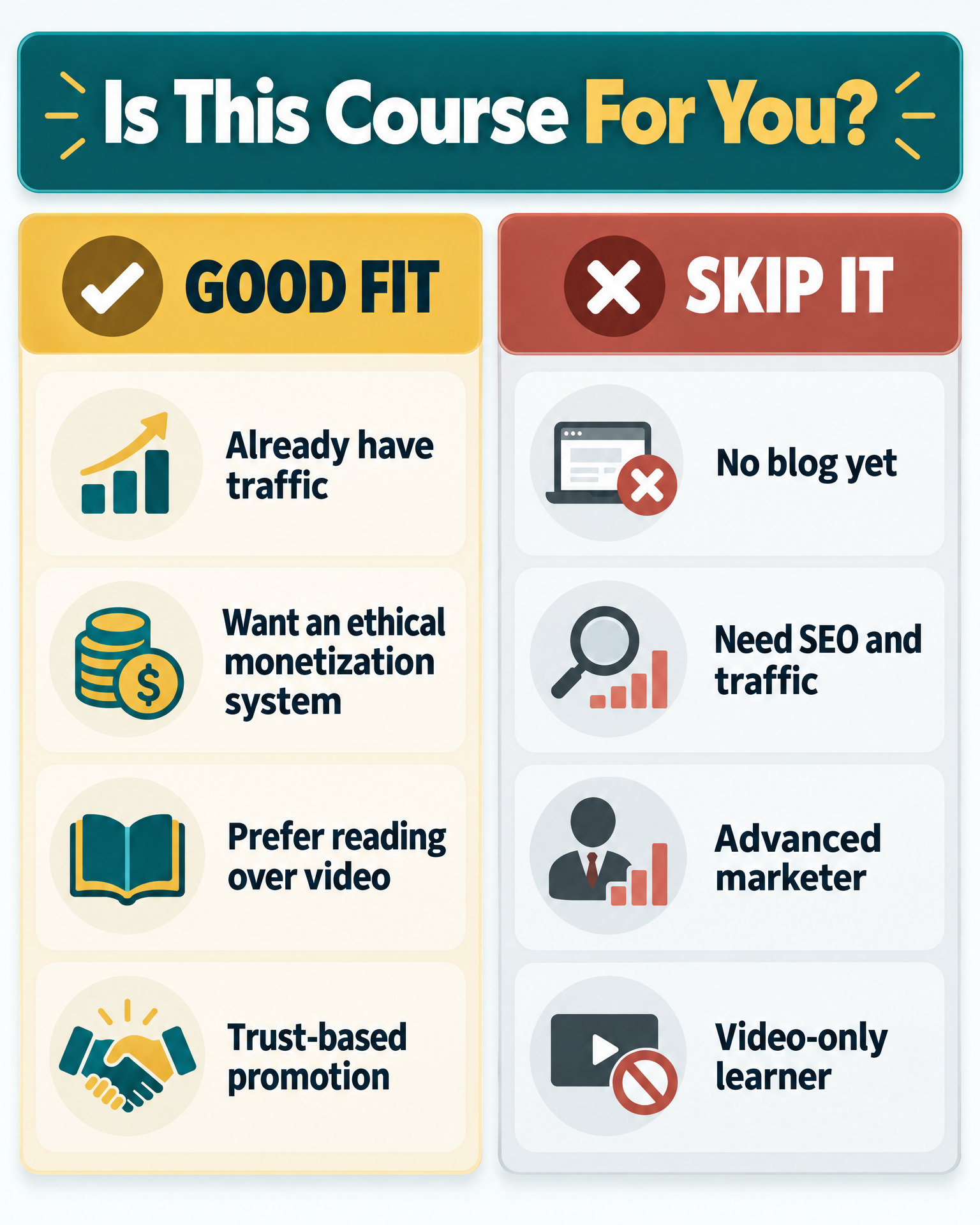
You’re probably going to get real value from this if:
You’re already publishing content on a regular basis and pulling in visitors — even if “consistent visitors” means a few hundred a month rather than tens of thousands. Your problem isn’t obscurity. People are reading your stuff. They’re just… not clicking. Not buying. Something in the handoff between “interested reader” and “paying customer” is broken, and you can feel it every time you check your numbers.
Maybe you want something straightforward — no fluff, no filler — for finding legitimate affiliate programs, disclosing them the right way, and writing content that actually converts instead of just sitting there. Maybe you’re someone who’d rather sit with a worksheet and a cup of coffee than click through forty minutes of video to extract fifteen minutes of useful information. And maybe, honestly, you just want to learn from someone who’s shown her work — publicly, for years — rather than a marketer selling a course built on theory and screenshots of somebody else’s success.
This isn’t your course if:
You don’t have a blog yet. Or you have one, technically, but the traffic is close enough to zero that it doesn’t matter. Learning conversion tactics with no audience to apply them to is like memorizing sales scripts with no customers walking through the door.
Same goes if your actual bottleneck is traffic, not conversion. No amount of clever link placement fixes a blog that nobody’s visiting. That’s a different disease with a different medicine.
If you’re the kind of learner who needs to watch someone do the thing on screen — see the cursor move, hear the explanation in real time — long blocks of text might just bounce off you no matter how good the underlying content is. And if you’re already deep into affiliate marketing, running real numbers, hunting for advanced scaling strategies or paid traffic plays, this course is going to feel like it’s several steps behind where you already are.
Not totally sure which camp you’re in? It’s worth reading through Why Your Affiliate Blog Gets Traffic but No Sales first — it’s built specifically to separate a traffic problem from a conversion problem, which matters more than people realize before they spend money on either kind of fix.
Inside the Course: What You’re Actually Paying For
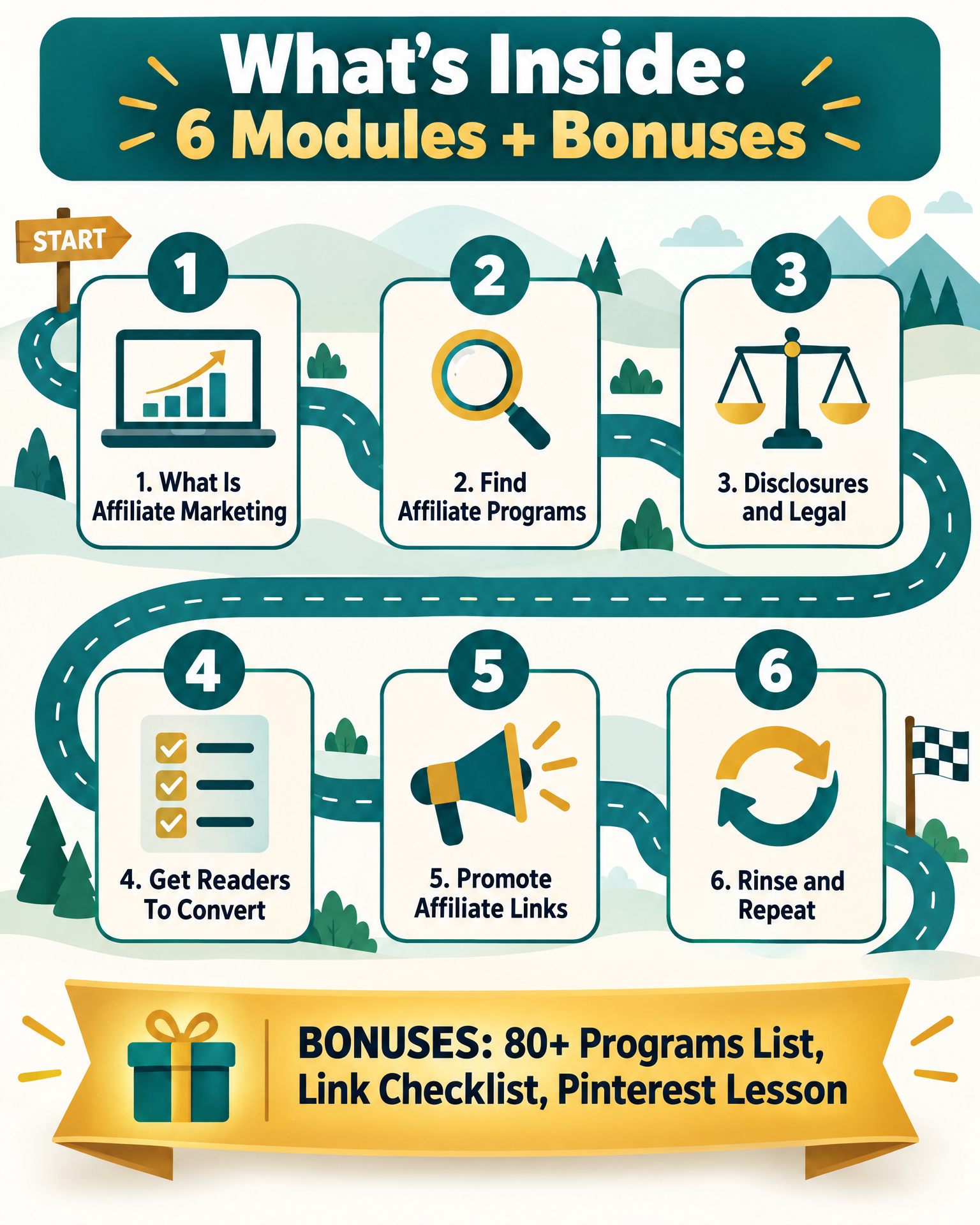
The course lives on Teachable, and structurally it’s not complicated: a Welcome module, six core modules, more than thirty individual lessons, printable worksheets you’ll actually reach for again, a handful of bonuses, and access to a private Facebook group for people who’ve bought in.
Welcome Module
Nothing flashy here — just orientation. Sets expectations, shows you the map before you start walking.
Module 1 — What Is Affiliate Marketing
The fundamentals. How it actually works under the hood, the terminology that gets thrown around, how affiliate income fits into a blog’s broader financial picture. Even if you’ve already got affiliate links scattered through old posts, this module is worth sitting through — you might realize you never fully understood the mechanics you’ve been half-relying on.
Module 2 — How to Find and Choose Affiliate Programs
This is where it gets tactical. Finding programs that actually fit your niche, sure — but also the part people underestimate: how to get *accepted* into selective programs. How to present yourself so an application doesn’t get rejected. This module pairs directly with one of the course bonuses — a curated list of 80+ affiliate programs across different niches — which quietly saves you hours of research you’d otherwise burn digging through Google.
Module 3 — Affiliate Marketing Requirements and Disclosures
The legal side. FTC disclosure rules, and — more usefully — how to phrase disclosures so you’re actually covered without sounding like a lawyer wrote your blog post. This module carries more weight than it looks like on paper. Disclosure mistakes are everywhere in this industry, and they carry real liability, not just an awkward feeling.
Module 4 — How to Get Your Readers to Convert
This is the heart of the whole course, arguably the reason people buy it. Click-through techniques, how to structure your content and your calls-to-action so a reader doesn’t just nod along and keep scrolling past your recommendation like it’s wallpaper.
Module 5 — Strategies and Ways to Promote Affiliate Links
Zooms out from individual posts to broader promotion — including a bonus Pinterest lesson from Rosemarie Groner of The Busy Budgeter, which gives you a platform-specific angle that lives outside your blog entirely.
Module 6 — Rinse and Repeat
Less a module, more a framework — a way to take everything you just learned and turn it into something you do automatically with every new post, rather than a one-off exercise you forget about by next Tuesday.
The Bonuses, Worth Naming Individually
- The list of 80+ affiliate programs across niches
- “The Perfect Affiliate Link Checklist” — a genuinely useful worksheet for auditing how and where you’re placing links
- A “what NOT to do” breakdown — writing only glowing reviews, promising income results you can’t guarantee, cramming five calls-to-action into a single post until it feels like a used-car lot
- The Pinterest strategy lesson from Rosemarie Groner
- Lifetime access, including future updates — the version reviewed here reflects a December 2025 refresh, according to a 2026 review
What Actually Works Here
There’s something different about learning from someone who’s shown her receipts for years, not months. Michelle Schroeder-Gardner published monthly income reports for a long stretch of time, eventually reporting more than $2,000,000 earned through affiliate marketing before she stopped sharing the numbers publicly in 2019. Most course creators in this space ask you to trust their credibility. She spent years documenting hers in public, in real time, before she ever sold a course about it.
The course also doesn’t assume you’re already fluent in this world. Module 1 starts from zero — actual basics — while the later modules go deep enough to still be useful if you’ve been doing this for a while and just never had it explained properly.
The legal compliance piece deserves its own mention. Module 3 isn’t a throwaway checkbox lesson. FTC disclosure requirements trip up a shocking number of bloggers, either through ignorance or willful avoidance, and having a dedicated, practical module on it is a real strength — not a footnote.
There’s also a certain philosophy running underneath the whole thing. The “what NOT to do” bonus — flagging things like exclusively positive reviews and unrealistic income promises — signals that this isn’t a course built around squeezing clicks at any cost. It’s built around trust surviving the transaction, which, if you’ve been blogging a while, you know is rarer than it should be.
And the tools aren’t decorative. The affiliate link checklist and the 80+ program list are the kind of things you actually pull back up six months later, not documents you skim once and forget in a folder. Add in lifetime access with real updates — reportedly refreshed as recently as December 2025 — and you’re not locked into a product that ages the moment you buy it.
Where It Falls Short
No video. None. This is the single most repeated complaint across reviewers, and it’s a real one — the entire course is text and worksheets, read at your own pace. If you’re someone who needs to watch a process happen on screen to actually retain it, this format is going to feel like a wall no matter how solid the content underneath it is.
There’s also zero traffic or SEO instruction, and the course doesn’t pretend otherwise. It’s monetization, full stop. If your blog gets a trickle of visitors a month, none of the conversion techniques in Modules 4 and 5 have anything to work with. You need the traffic first. This course starts after that problem is already solved.
The refund policy has a catch worth knowing about upfront. Yes, there’s a 30-day money-back guarantee. But reviewers consistently note it’s not automatic — you’re expected to show you actually went through the material and tried applying it. If your plan was to buy it, skim it, and request a refund without doing any of the work, that path isn’t as smooth as the phrase “money-back guarantee” implies.
It’s also just not built for someone already running a mature affiliate operation. If you’re past the fundamentals and hunting for scaling strategies, paid acquisition tactics, or advanced optimization, this course’s foundational focus is going to feel like it’s talking to someone a few steps behind you.
And pricing consistency across reviews is genuinely inconsistent — commonly reported around $197 one-time or two payments near $105, though at least one 2026 review cited a noticeably higher figure closer to $236.40 (or two payments around $126). That gap alone makes it worth confirming the number yourself directly on the official course page rather than trusting any single review’s stated price — this one included.
Buy It or Skip It — The Honest Breakdown

Buy it if you’ve got an existing blog pulling in steady, even modest, traffic. If your real frustration is affiliate income that doesn’t match your visitor numbers. If you’re fine learning from text and worksheets rather than needing video. If you want an ethically framed, legally sound approach rather than aggressive sales tactics. If learning from someone with a long, public earnings track record actually matters to you.
Skip it if you don’t have a blog yet, or your traffic is close to nonexistent — fix that first. If you’re a video-first learner who genuinely struggles with long-form text courses. If SEO or traffic-building is your primary, most urgent need. If you’re already an experienced affiliate marketer chasing growth tactics beyond the fundamentals.
If traffic is your real bottleneck rather than conversion, it’s worth looking into resources built around growth and content systems instead — the Blog Growth Engine Review is a good place to start before assuming a monetization-only course is your next move.
How It Stacks Up Against the Alternatives
No course covers everything. Traffic, content systems, monetization — these are genuinely different skill sets, and most course creators, this one included, are honest about which lane they’re actually in. Here’s how it compares.
Against a full blogging system course
A full system course usually bundles content strategy, SEO basics, and monetization into one package, trying to walk someone from an empty blog to an actual business. Making Sense of Affiliate Marketing doesn’t try that. It assumes the blog and the traffic already exist, and it stays narrowly focused on the monetization layer sitting on top. If you want something broader that pairs growth with monetization, the Blog Growth Engine Review is worth reading, and a direct side-by-side comparison lives in Snowball Affiliate vs Blog Growth Engine.
Against a traffic or SEO-focused course
If the real issue is that not enough people are finding your content in the first place, no monetization course — regardless of quality — is going to fix that. Traffic and SEO courses tackle discoverability: rankings, keyword targeting, structuring content for search visibility. This course assumes that battle’s already won. If you’re not sure which problem actually describes you, Why Your Affiliate Blog Gets Traffic but No Sales untangles “nobody’s finding my content” from “people find it but don’t buy” — two completely different fixes that require two completely different solutions.
Against a beginner-focused course roundup
Still deciding whether your blog is even far enough along to benefit from a monetization-specific course? Don’t assume this is your only option. The roundup at Best Affiliate Blogging Courses for Beginners lays out several entry points depending on where you actually are, and it’s a smarter first stop if you’re not fully convinced this course matches your current stage.
Against a comparable monetization competitor
If you’re weighing this against other monetization-specific programs, the Snowball Affiliate Review covers a comparable option worth reading before you commit — the two courses aren’t identical in structure, depth, or format, even though they’re chasing a similar audience. And if you’re torn between the two monetization courses directly, the head-to-head breakdown lives in Snowball Affiliate vs Making Sense of Affiliate Marketing.
The Questions You’re Probably Actually Asking
Is this worth buying if my traffic is still pretty low?
Honestly — probably not yet. This course is built for people who already have some traffic, not none. If your visitor count is thin, the conversion strategies in Modules 4 and 5 won’t have much to actually work with. Traffic generation just isn’t part of what this course sets out to do.
Does it have video lessons anywhere?
No, and this comes up in nearly every review. It’s entirely text — lessons you read at your own speed, backed by worksheets, with no video component at all.
What does it actually cost?
Most reports land around $197 as a one-time payment, or roughly $105 twice as a payment plan. At least one 2026 review cited a higher figure — close to $236.40, or two payments around $126. Given how much the reported numbers vary between reviews, check the official course page directly before buying. Don’t trust a fixed number from any single article, including this one.
Can I actually get a refund if it’s not for me?
There’s a 30-day money-back guarantee, yes. But it’s not a no-questions-asked situation — reviewers note you’re expected to show you actually went through the material and made an honest attempt to apply it, not just request a refund after a five-minute skim.
What am I actually getting for the price, beyond the six modules?
A Welcome module, over thirty lessons spread across six core modules, printable worksheets, the 80+ affiliate programs list, “The Perfect Affiliate Link Checklist,” a “what NOT to do” mistakes breakdown, a bonus Pinterest lesson from Rosemarie Groner of The Busy Budgeter, and entry into a private Facebook community for buyers.
Who’s actually behind this course, and does that matter?
Michelle Schroeder-Gardner, who runs the personal finance blog Making Sense of Cents. She grew it into a seven-figure operation and publicly documented earning more than $2,000,000 from affiliate marketing through monthly income reports she published for years, before stopping in 2019. That kind of long-running public transparency is genuinely rare among people selling courses in this space.
Will this teach me SEO or how to grow my traffic?
No. It stays scoped to program selection, legal disclosures, conversion tactics, and link promotion — not search optimization or traffic growth.
Is this more suited to beginners or to someone already experienced?
It’s beginner-friendly specifically on the monetization side — Module 1 assumes almost no prior knowledge. But it won’t hand an experienced marketer the advanced scaling tactics they’re likely already hunting for.
Is there something free I can try before spending money?
Yes — there’s a free 36-page ebook, “26 Affiliate Marketing Tips,” offered as a lead magnet. It’s a low-commitment way to get a feel for her teaching style before deciding whether the paid course is worth it for you.
Products / Tools / Resources
- Making Sense of Affiliate Marketing — the course this whole review is built around, created by Michelle Schroeder-Gardner and hosted on Teachable. Check the official course page directly for current pricing and enrollment details before buying anything.
- “26 Affiliate Marketing Tips” (free 36-page ebook) — a free lead magnet from the same author, and a genuinely useful low-risk way to sample her teaching style before spending money.
- Making Sense of Cents — the author’s own personal finance blog, home to the original income reports and the public track record this whole course is built on.
- Snowball Affiliate Review — a comparable monetization-focused course worth reading alongside this one before you decide.
- Blog Growth Engine Review — a good next stop if your actual gap is growth, not just monetization.
- Best Affiliate Blogging Courses for Beginners — a roundup for anyone still figuring out which stage-appropriate course actually fits where they are right now.
- Why Your Affiliate Blog Gets Traffic but No Sales — a diagnostic piece for figuring out whether you have a traffic problem or a conversion problem before you spend a dime on either fix.
- Snowball Affiliate vs Blog Growth Engine — a direct, side-by-side comparison for anyone torn between a monetization-only course and a full-system alternative.